

This page is the authoritative record of what the catalogue publishes for this model, and it is deliberately narrow. It carries the five published specification rows, an explanation of what each of them does and does not license a buyer to claim, and an equally explicit list of the fields the record leaves out. A buyer who wants to know what is true about this product on a Tuesday afternoon can read one page and know exactly where the boundary of the published record falls.
Two conventions run through it, and both matter more than they might appear. The first is that an absent field and a field with a value of none are different things: the catalogue publishes a line for a field on some models and not on others, and where there is no line, nothing is being asserted in either direction. The second is that a published figure and a measured figure are different things, and a rated figure and a guarantee are different things again. Several fields below fall into the second category, and the notes attached to them are not padding; they are the part of the record that stops a published number being turned into a promise it cannot support.
The other pages in this set take the record further in specific directions: the operational side of the charging rows is on the charging analysis, the boundaries of what can be claimed are on the limits analysis, and the horizontal position of the model against the entries around it is on the sibling comparison. This page is the reference they all start from.
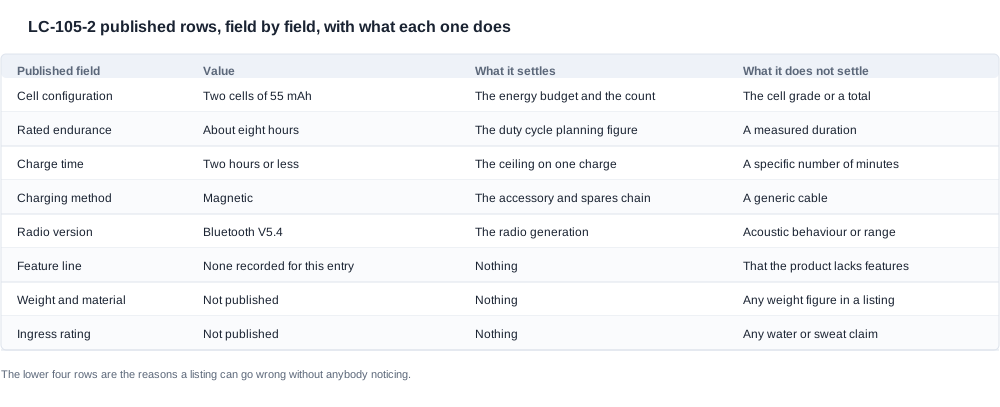
LC-105-2 specifications and features: everything the catalogue publishes
The LC-105-2 publishes Bluetooth V5.4, paired 55 mAh cells, a rated endurance of about eight hours, a charge time of two hours or less, and magnetic charging. That is the complete published specification. There is no second row of features, no supplementary table, and no entry elsewhere in the catalogue that adds a specification to it.
Read the sentence carefully, because the order of the fields is not a ranking and none of them is more important than another for a given deployment. The cell configuration comes first because it sets the energy budget; the rated endurance comes second because it is the number a duty cycle is planned against; the charge ceiling comes third because it sets the interruption; the charging method comes fourth because it decides the accessory chain; and the radio version comes last because it settles the least commercially significant question in the table.
The word "published" is doing real work in that sentence. Published means the catalogue carries a line for it. It does not mean the figure is a measurement taken under a stated condition, because for the endurance field there is no stated condition. It does not mean the figure is a guarantee, because a rating is not a guarantee. It does not mean the field is the only property of the product with that name, because a cell capacity says nothing about the cell's supplier, grade or protection circuitry. And it does not mean nothing else about the product is known, because a good deal more is known and simply not published.
The practical rule that follows is the one this whole set of pages is built on, and it is the criterion a buyer should apply to every line that goes into a specification, a channel document or a tender response. Anything a buyer states about this product in a listing, a specification, a distributor agreement or a tender response has to come from one of three places: this published row, a dated supplier document, or a decision the buyer has taken and can defend. A fourth source — a plausible assumption — is the one that causes the problems, and the limits analysis sets out what each of those assumptions ends up costing.
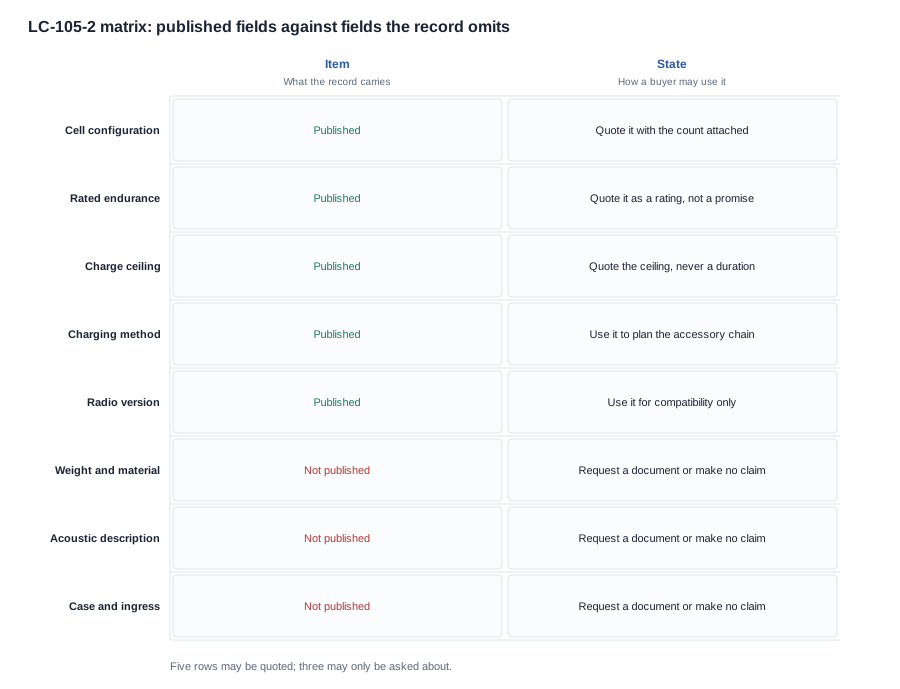

The five published rows, field by field
Each row below carries the value, what it settles, what it does not settle, and the question it raises. The questions are not padding either; they are the whole of the diligence this row supports, and they are what the rest of this set of pages expands.
The cell configuration: two cells of 55 mAh. The catalogue publishes the value and the count, and it does not publish a total. A buyer who adds the two values has derived a figure rather than read one, and a derived total should be labelled as such wherever it appears, because publishing a total as though it were a catalogue value is a claim the catalogue does not support. The row also says nothing about the cell supplier, the cell grade, the protection circuitry or how the two cells are arranged, and a product whose two halves can report different states is a product whose service procedure has to be written from a supplier's description of that arrangement.
The rated endurance: about eight hours. This is a rating, published without a stated test condition, which makes it a planning figure for a duty cycle rather than a duration to be promised. It can be quoted as a rating; it cannot be written as a guaranteed number of hours for a specific customer, and it cannot be set against another model's rating as though the two were measured on the same basis. The question it raises is the reference condition, and that is the single most useful follow-up on this model.
The charge time: two hours or less. An upper bound. The distinction between a ceiling and a duration is not pedantic here: a schedule built on a two-hour ceiling is defensible, and the same schedule rebuilt around a specific number of minutes asserts something the record does not contain. The wording has to survive translation into the carton artwork and the retail listing, which is where ceilings most often get quietly tightened.
The charging method: magnetic. A documented field with the largest operational footprint in the row, because it decides the spare-parts policy, the accessory transport file and the retail fixture question. It also means the product is not chargeable with a generic cable, which is a service argument the buyer has to make in the instruction insert rather than leave to the user.
The radio version: Bluetooth V5.4. It identifies the radio generation and removes a class of compatibility question. It says nothing about the acoustic behaviour, the range or the power consumption, and it is not evidence of a protocol qualification, which is a separate matter held in the industry's own listings and checked by the buyer rather than handed over by the supplier.
Two of the rows are worth combining in a buyer-facing sentence, because the combination is more informative than either alone. A cell configuration of two 55 mAh cells together with a rated endurance of about eight hours describes a product designed around a day's use rather than a long one, and a two-hour charge ceiling against a magnetic method describes a product whose charging is an event in the day rather than an occasional top-up. That is a coherent design, and it is the design a buyer should test against the duty cycle they actually have.


What the catalogue publishes no feature line for
Across the range, some entries carry a feature line in addition to their specification rows, describing an acoustic characteristic, a structural characteristic or a control. This model does not carry one. That is worth understanding properly, because it is easy to read the absence as a statement about the product, and it is not one.
The catalogue's feature lines are descriptive shorthand, and they are used inconsistently even within a single class of product. Two models in the same category can carry near-identical specification rows and quite different feature lines, and other models carry none at all without any implication that the product is less capable. What the absence means is narrow and technical: the catalogue does not record a distinguishing characteristic for this entry. It does not mean the product has no acoustic characteristic, no microphone arrangement and no structural features, and it certainly does not mean the product is worse than an entry that happens to have one.
The commercial consequence is specific rather than general. A buyer who wants to say something about how this product sounds, or how it is built, has nothing to cite and has to request a supplier document. A buyer who is content to describe it by its specification rows has everything it needs. And a buyer who reads another model's feature line as a benchmark for this one is comparing a recorded description with an unrecorded product, which is not a comparison at all.
There is a second absence in the same family that matters more. No model in the range carries a per-model conformity row, so there is no published certification status for this entry to quote, and the document that would carry it has to be requested from the supplier. The certification material published in the catalogue is images rather than readable text, and the ten certificates it shows are eight appearance-design patents and two utility-model patents. A patent protects an invention and does not evidence conformity, so nothing on that page substitutes for a per-model file. Buyers in this category ask for both, and the answer to the second question is always the same: the file has to be requested.
The rest of the omitted fields follow the same logic. No weight. No frame or temple material. No ingress rating. No charging-case arrangement. No microphone or noise-reduction specification. No battery transport document. None of these is published, and none of them is thereby absent from the product.
Checking a physical unit against the record
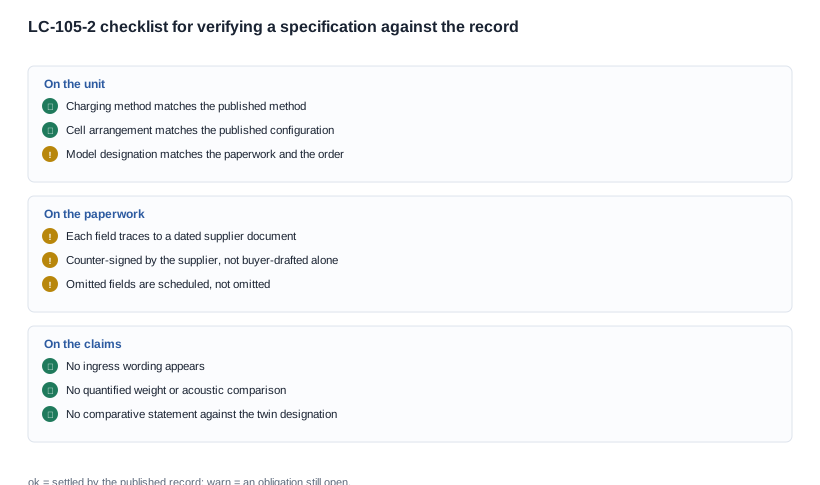
A record page is only useful if a buyer can check a product against it, and for this model the check is unusually quick because the published record is short. A unit that arrives with a different charging method, a different cell arrangement, a different radio generation or a different model designation is not a unit that matches the record, and the difference is visible without instruments in a way that most specification checks are not. The reverse case is the one that takes longer: a unit that matches the record on all five published fields may still differ on every field the record omits, which is precisely why the omitted fields have to be closed by documents rather than by inspection.
There are two practical consequences for a buyer's quality plan. First, the five published fields make a cheap, fast receiving check, and a buyer who does not run that check is paying for the inspection later in a return instead. Second, because the record is so narrow, the inspection plan has to be built on the supplier's documents rather than on the catalogue, and the documents have to be named in the purchase specification before the first delivery rather than requested once a unit has already been rejected. A buyer who has a written specification that says which document supports which field can send a claim; a buyer with a catalogue page and a rejected unit has an argument.
A third check is worth adding, and it is the one that catches the most: compare the model designation on the unit with the model designation on the paperwork, and compare the model designation on the paperwork with the model designation on the purchase order. Three strings that should be identical frequently are not, and the mismatch is invisible in every other check because the five published fields are identical across the designations involved. A buyer that verifies the fields and not the designation has verified the product and not the paperwork.
That check is also the one that connects this page to the question of whether one conformity file can cover both designations in the range. Until that question is answered, the designation on the unit is the only thing that ties a physical product to a document, and it is the thing that has to be right.

How to use this page in a purchase specification
The published row is a specification block waiting to be written, and writing it correctly is a small job with a disproportionate effect on the rest of the file. The block should carry the five values, and it should carry the caveats with them, because a caveat that is not in the specification is a caveat that nobody downstream will apply. The checklist below is the short version of that block, and it is the form a buyer can hand to a supplier and ask them to countersign without any further discussion about what the fields mean. It is a shortlist of what to ask before you order, and a red-flag list for what to refuse: an unsigned block, a caveat that has been dropped between the quotation and the specification, or a claim in a channel document that no document in the file supports are all reasons to stop and resolve the point before the tooling is committed.
- State the cell configuration as published, including the count, and label any total as a derived figure wherever it is used.
- State the endurance as a rating, and record the reference condition as an item to be supplied rather than omitting the point.
- State the charge time as a ceiling, and require that the same wording is used in the carton, the listing and the instruction insert.
- State the charging method, and attach the accessory and spare-parts consequences to it in the same clause.
- State the radio version, and note separately that protocol qualification is checked against the industry's own listings.
- List the omitted fields explicitly in a schedule attached to the specification, each with a named owner and a stage, so that the gaps travel with the document rather than living in somebody's notes.
- List the claims that are not made, so that a distributor agreement, a channel document and a tender response all work from the same restricted set.
- Carry the model designation on every document, and note that the range contains a second designation published on an identical row, which is a clarification to obtain rather than a difference to state.
There is one further point about the block itself, and it concerns who signs it. A specification that has been assembled by the buyer alone describes a product the buyer hopes to receive; a specification that the supplier has reviewed and countersigned describes a product both parties have agreed to talk about. Where the two positions differ, the difference is the commercial negotiation, and it is much easier to have that negotiation on a page before the tooling is committed than after. The review is also what turns the caveats into something operational, because a caveat the supplier has not seen is a caveat that may contradict the supplier's own view of the product.
The eighth line is a reminder that the specification block for this model is not only a list of values. It is a list of values plus the set of statements that are not permitted, and the second half is what keeps a buyer out of trouble. A specification that says only what the product is will be read by every downstream reader as permission to say everything the product is; a specification that also says what may not be claimed is a control that travels.
Where the other pages take the record further
The record on this page is the starting point, and five other pages in this set work on it in a specific way. The buyer question set sorts the questions a procurement team actually asks into the ones the record can answer and the ones it cannot, and shows how to send the second group in a form that produces documents rather than paragraphs. The charging analysis takes the charging method and the charge ceiling and works out what they mean operationally, including the case, the contact durability and the questions that settle the accessory decision. The limits analysis prices each unpublished field by the way it fails, which is the difference between a per-unit cost, a per-shipment cost and a per-market cost. The value assessment deals with the question a published specification cannot answer on its own, which is whether the product is worth what it will cost once the price, the terms and the documentation scope have been established. And the sibling comparison explains why the published rows place this model in a cluster where the specification alone does not separate the options.
The model-by-model comparison pages exist for the same reason, and each isolates a single variable: the capacity and charging-method difference against the D11 on price positioning, the deployment match against the D12 on use case fit, the form and the one published runtime difference against the G07 on form factor, and the cell class and the radio generation against the K01 on specification.
Our own position is that the published row is the whole of what we can assert from the catalogue, and we will not extend it with figures from elsewhere in the industry. Where a value is missing, we will say it is missing, name the party that has to supply it, and say what form the answer has to take to be worth keeping. That discipline is worth more to a procurement team than a longer specification would be, because a longer specification that nobody can check is not a specification at all.
There is one more thing this page can be used for, and it is the reason the record is worth keeping in a form that can be quoted. A published row is a stable reference point. A supplier's answer to a question is a snapshot of one date and one configuration, and a product can change without the question being asked again. Keeping the catalogue record and the supplier's answers in the same file, with both dated, gives a buyer the ability to say what was true about the product on a given day, which is the only version of the truth that is useful when a customer, a distributor or an inspector asks. The record does not change unless the catalogue changes, which is exactly the property that makes it worth holding on to.
If you want this published row formatted as a specification block for a particular procurement process, with the omitted fields already scheduled and the restricted claims already drafted, tell us the process, the destination market and the configuration you are ordering, and we will return it in the form your document expects.


