

Most comparisons in this range are conducted on the specification table, because the specification table is the only thing a buyer can read. A use-case comparison asks a different question and gets a different answer: not which product has the better numbers, but which product's operating profile matches the way the device will actually be used. On this particular pair the answer is not obvious from the specification at all, and the reason is a structural difference in how the two products are charged.
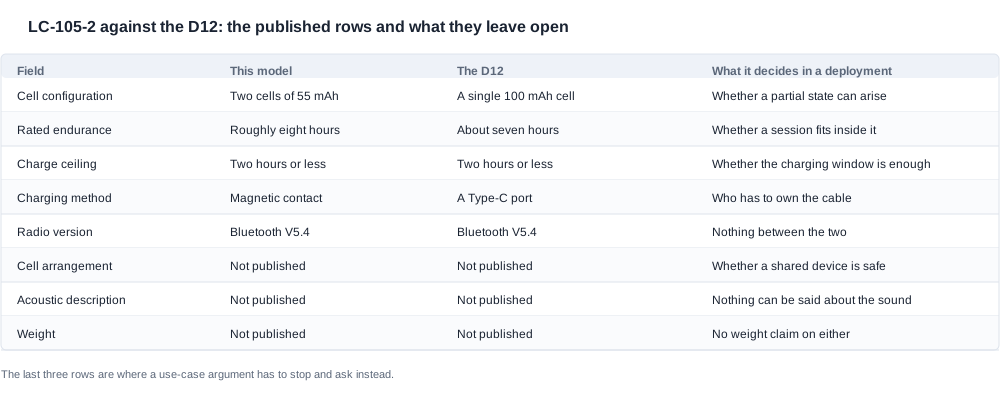
The published rows for the LC-105-2 — a pair of 55 mAh cells, a rating of about eight hours, a two-hour limit on one charge, magnetic charging, and a radio at version 5.4 — describe a device built for a working day with a proprietary charging method. The D12 is published with a 100 mAh cell, a rating of about seven hours, a two-hour charge ceiling, a Type-C port, and version 5.4 on the radio. On the paper those are close. In a deployment they are not, because one of them asks the user to own a charging lead and the other does not.
This page sets out the deployment profiles that actually occur, what each one demands of a device, and how to run the comparison so that it ends in a test rather than in an opinion. The variable it isolates is the deployment; the capacity and charging-method comparison is handled separately, and the form question is covered on the G07 page.
LC-105-2 against the D12: matching a device to the way it will be used
A use-case match is decided by the deployment, not by the product, and that statement sounds obvious until a buyer tries to apply it. The published rows are properties of the device. A deployment is a set of facts about people, places and habits: how long a shift is, where the charging happens, how often the device changes hands, whether the person using it owns their own accessories, and what happens to the device between uses. The rows and the facts have to be matched, and the matching is not arithmetic.
Three facts about this pair make the comparison more than a formality.
The charging methods are different in kind. A Type-C port takes a cable that the great majority of users and almost every technician already has, and which any retail counter, any warehouse and any service bench can supply without a supplier's part number. A magnetic contact takes a lead that has to be sourced, stocked, counted and replaced, and that has to be in the box if the customer is to use the product on the day it arrives. Whatever else the comparison concludes, this difference is real and it is a difference in what the deployment has to supply rather than in what the device can do.
The cell configurations are different in consequence. A single 100 mAh cell is one component with one state to reason about. A pair of smaller cells raises a question that the catalogue does not answer: what does the product report when the two halves are at different charge levels, and how does it behave when one of them is exhausted? The arrangement is not published, so the consequence is not published either, and a deployment that depends on a device never being in a half-charged state cannot be assessed from the record.
The ratings are close, and the gap between them is smaller than the gap between the charging habits. About eight hours of rated use against about seven is an hour on a planning figure, published without a stated condition in either case. An hour matters at the end of a long shift; it does not matter at the end of a day with a proper charging routine. Which is exactly why the deployment has to be established before the rating is weighed.
There is one further fact about the range that a buyer comparing these two products should know, and it is awkward rather than useful. The D12's published row is identical to the D11's, field for field. A buyer who treats the D12 and the D11 as one product with two labels will find that the record gives them no way to tell them apart, and will need the same written clarification from the supplier that the twin designations in the range require. It is not a defect in either product; it is a gap in the documentation that has to be closed before either can be specified.

Four deployment profiles and what each one demands
The deployments that actually occur in this product class are few enough to name, and naming them is the fastest route to a decision because each one has a characteristic charging habit attached.
The continuous-shift profile. The device is worn or carried for most of a long shift, charged once or not at all, and returned at the end of it. This is the profile where the rating is decisive and the charging method is decisive too: a two-hour charge ceiling at the end of a twelve-hour shift is a problem if the only charger is a proprietary lead, because the lead has to be left somewhere overnight. A device with a standard port can be charged from any socket or a power bank that is already present. On this profile the D12's configuration is the easier one to deploy, and the hour of rating is a second-order consideration.
The full-day profile. The device is used for a working day with one interruption, and it is charged at a desk or in a vehicle during the day and again in the evening. Here the charging habit is the ordinary one, the user owns their own equipment, and the published rating carries most of the weight. A two-cell device with a slightly higher published rating and a magnetic lead can work well here, provided the instruction insert is clear and the user is prepared to own the lead.
The shared-device profile. The device changes hands during the day, or between shifts, or between people in a household. This is the profile where the cell arrangement question becomes a service question rather than a curiosity, because a device that can be in a partially charged state is a device whose state the next user cannot read. It is also the profile where the charging accessory becomes a hygiene problem rather than a convenience: a proprietary lead that passes between users is a lead that has to be managed.
The low-duty profile. The device is used in bursts, perhaps a couple of hours a day, perhaps a few times a week, and it spends most of its life in a drawer or a case. Here the rating is not the constraint at all, and the constraints are the standby behaviour, the state after long storage, and the recovery time. The catalogue publishes none of these, and a buyer with a lot of low-duty devices should ask about them before anything else.
The match in each of these four cases is answerable, but it is answered differently in each. That is the point of doing a use-case comparison rather than a specification comparison: the same two products can be the right and the wrong answer depending on which profile the business actually has, and a comparison that does not name the profile is not a comparison at all.


What a deployment decision can and cannot be made from
There is a boundary here, and it is worth being precise about where it sits, because the temptation in a use-case article is to recommend, and the evidence in this range does not support a recommendation.
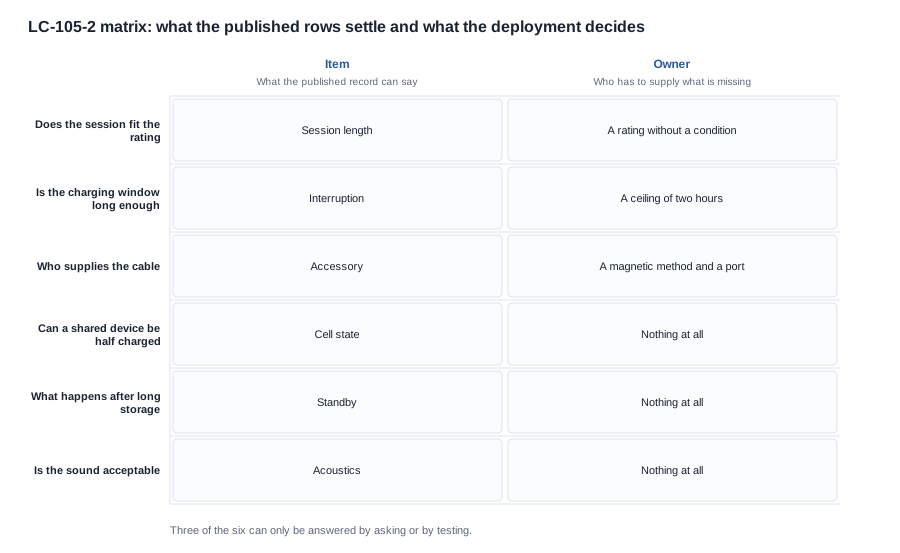
A use-case comparison can settle the following. Whether a device's charging habit is compatible with the deployment's charging habit, and therefore whether the accessory chain and the carton need to be modelled as recurring costs or ignored. Whether a published rating is sufficient for the profile, or whether the profile needs a device that has not been asked about yet. Whether a service process has to cope with a partially charged state, a lost lead or a shared accessory. And whether the deployment is one the product is designed for at all, in which case the answer is to change the deployment or change the product rather than to negotiate the price.
A use-case comparison cannot settle the following, and any article that appears to settle them is overreaching. Which product is better, in the absence of a named deployment. Whether one of them lasts longer in practice, when both ratings are published without a condition. Whether either is quieter, clearer or more usable, since no acoustic or physical description is published for either. What either weighs, since the weight is not published for either and there is no figure to compare. Whether either can be used in a wet environment, since no ingress rating is published for either.
That last group is the one that matters commercially. A buyer who has correctly identified that a deployment needs a device that is lighter, or that is rated for a wet environment, or that has a documented acoustic characteristic, has not found a flaw in either product. They have found a requirement that the published record cannot satisfy for either of them, and the next step is to ask the supplier whether such a configuration exists, not to choose between the two on the basis of it.
There is one more boundary that is specific to a comparison, and it is the one that is most often ignored. Two products that are published on identical rows are not interchangeable in a channel, because a customer cannot be given a reason to choose between them. If a business ends up holding both, the reason has to be the deployment itself: this one is the standard-connector option for environments where the user brings their own cable, and this one is the magnetic option for environments where the lead can be fixed in place and counted. If the business cannot articulate that difference in one sentence, it should hold one of them rather than two.

A decision path that ends in a test rather than an opinion
The path below is designed to be run in a single sitting, and it ends with a physical test rather than with a preference.
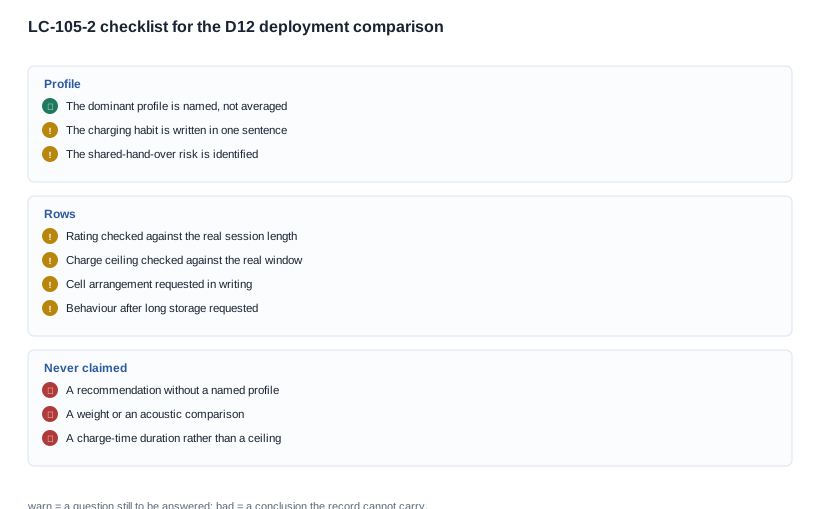
- Name the deployment profile from the four above, and state which one dominates the volume. Do not average them.
- Write the charging habit of that profile in one sentence, including where the charging happens and who owns the equipment used.
- Check the published rows against the profile and mark each of the following as satisfied, marginal or unknown: the rating against the session length, the charge ceiling against the available window, the charging method against the charging habit, and the cell arrangement against the shared-use risk.
- List the unknowns that remain, and put each one to the supplier as a written question rather than settling it by assumption. The arrangement of the cells, the state after long storage, the recovery behaviour and the measured charge time are the four that matter most.
- Obtain a sample of each candidate and run it through the profile in practice: charge it where the profile charges it, use it for a session, and check what the user would have to do to make it work at the end of the day.
- Compare the total cost for that profile, with the accessory and packaging lines included for the product whose charging method the profile actually triggers.
- Decide, and write down the profile and the reasoning alongside the decision, so that a later change in the deployment is visibly a change of profile rather than a change of mind.
The questions that go to the supplier in step four are worth writing down in advance, because the temptation in a use-case comparison is to ask only for the easy ones.
- How are the two cells arranged, and what state does the product report when they are at different charge levels.
- What is the state of the product after it has been stored unused for a period, and does it recover to a usable state on its own.
- What is the measured charge time from a stated starting state, and what is the reference condition behind the published rating.
- What does the product do when the charging lead is removed mid-charge, and does it resume from where it stopped.
- Whether the charging lead is supplied in the retail carton, and in what quantity.
- What the state indication is, and whether a user can tell at a glance whether the device is ready to use.
The first two are the ones that decide the shared-device and low-duty profiles, and they are the two that most often turn out to have an answer the buyer did not expect. The fourth is the one that affects the continuous-shift profile, where an interruption is likely to happen at exactly the wrong moment.
The reason for ending at a test rather than at a comparison of the rows is simple. Almost everything a buyer wants to know about this pair is unpublished, and an unpublished property cannot be settled by reading two specification lines. It can only be settled by asking, by sampling, or by deploying. Steps four to seven are the three ways of doing that, in increasing order of cost, and the mistake most buyers make is stopping at step three and treating the outcome as a decision.
There is a commercial argument for doing this work properly, and it is worth putting to a finance colleague rather than keeping it technical. A device that is mismatched to its deployment produces costs that are invisible in the unit price and visible in three places: the return rate, the support handling time, and the write-off of units that are discarded rather than fixed. None of those three appears on a purchase order, which is why a mismatch so often survives until the second quarter of a programme. Working the deployment match before the order is a cheap way of moving a cost that will appear either way from the after-sales budget into the procurement decision, where it can still be influenced.
The same piece of work has a second use, which is that it produces a written statement of what the business actually needs. That statement is the thing to take to a supplier when the documentation arrives, because it turns a request for information into a request for a product that fits. A buyer who arrives with a named profile, a stated charging habit and a list of four open questions is negotiating; a buyer who arrives with a request for the file is collecting. The cost of the difference is the difference between a supplier who has been told what to build and one who has been told to send whatever is available, and in a range where two designations share a published row and a third product is documented identically to a fourth, the ability to state a requirement precisely is worth more than any single published figure.
One last point belongs in the sequence, and it is the one that separates a procurement decision from a shopping decision. The comparison is complete when the profile has been named, the open items have been closed and the cost lines for that profile have been priced, and at that point the decision may still be either product. That is a legitimate outcome, and the buyer should be prepared for it. What is not legitimate is choosing a product because it was the one in front of them at the time the request went out. A use-case comparison that cannot produce a verdict for a given profile is not a use-case comparison; it is a list of published rows with a question attached.
The practical test of whether the exercise was done properly is simple. Six months later, when the deployment has changed and somebody asks why the device in the field does not match the one in the original specification, the answer should be a document that names the profile, lists the questions that were asked, records the answers and shows which of them changed the decision. If that document exists, the comparison holds and the change is visible. If it does not, the product was chosen by a sequence of circumstances that nobody recorded, and the next change will be handled the same way. Writing the profile down is inexpensive, and it is the single thing that separates a decision that can be reviewed from one that can only be re-argued.
Our own position on this is that we publish the rows for both products and we will not manufacture a use-case recommendation out of them, because the recommendation depends on facts that belong to the buyer rather than to us, and a recommendation we cannot source is worthless to the person who has to defend it. We will say what the published rows settle, what they leave open, and which open item is the one that decides the answer in each profile. That is more useful than a verdict, and it is the only version of a verdict that survives a change in the deployment.
If you tell us the profile that dominates your volume, the charging habit that goes with it, and whether the device passes between people, we will return the comparison for that profile only: the rows that are satisfied, the rows that are marginal, the questions that have to go to the supplier, and the cost lines that the profile actually triggers.


