

MT5 smart glasses vs L1 Pro battery and charging is a comparison of two camera models that share a charge ceiling and almost nothing else about power. The MT5 is published with a 220 mAh cell, magnetic charging, a six-to-eight-hour runtime band and a case whose capacity is not stated. The L1 Pro is published with a 290 mAh cell, no charging-method row at all, an about-seven-hour runtime point and a 1400 mAh case. The two models also sit in different resolution classes — eight megapixels against thirteen — and that fact governs the power question more than the cell figures do.
The honest summary is that the two models are not comparable on battery life from the published rows, and that the charging comparison is decided by documentation rather than by hardware. Both of those statements are useful to a buyer, because each one tells you what to ask.
MT5 smart glasses vs L1 Pro battery and charging: the rows that differ
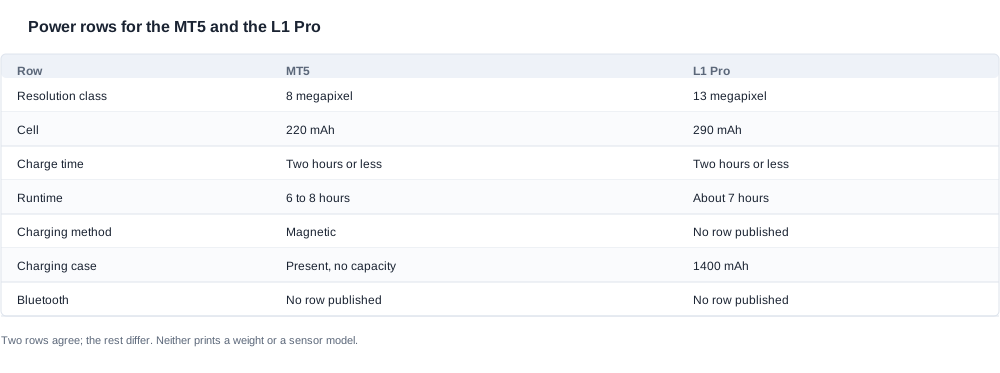
Here is the complete set of power-related rows for the two models, including the ones where they agree.
Agree on the charge ceiling. Both publish a charge time of two hours or less. This is a ceiling rather than a measurement: no starting state of charge and no completion criterion accompany it. Write it as "two hours or less" or "at or under two hours"; "under two hours" is a different and stronger assertion that neither model supports. Twenty-six of the twenty-eight models in this catalogue are published on the same ceiling, and only the D17 and the ZH12 are published at about one hour.
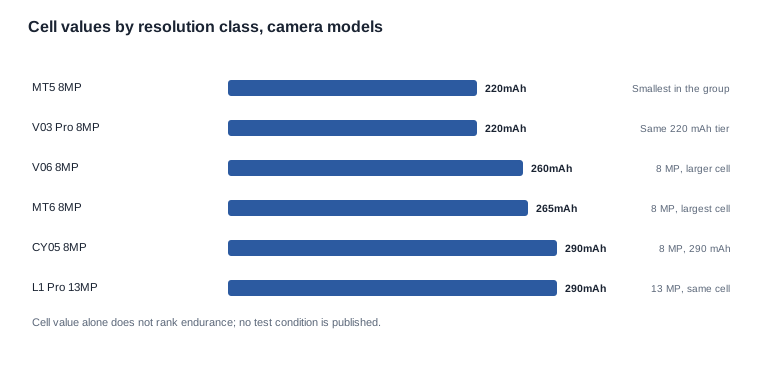
Differ on the cell. 220 mAh against 290 mAh, a difference of seventy milliamp hours. The 220 mAh value is shared with the V03 and the V03 Pro and is the smallest in the camera group. The 290 mAh value is shared with the L2 Utral and the CY05, and the CY03.
Differ on the runtime shape. Six to eight hours against about seven hours. Neither carries a test condition. This is the single most consequential difference on the page, because it is the difference between a disclosure about several conditions and a single measurement, and it cannot be converted into a ranking.
Differ on the charging method. The MT5 publishes magnetic charging. The L1 Pro publishes no charging-method row at all.
Differ on the case. The MT5 is documented with a case and no stated capacity. The L1 Pro publishes a 1400 mAh case, the largest case capacity in the camera group, shared with the CY03 and the CY05.
Agree on the absence of everything else. Neither model publishes a Bluetooth version, a sensor model, a field of view, a frame rate, a video format, a weight, a colourway or any descriptive feature line. Neither publishes a per-model certification row.

Resolution class governs the load, and neither publishes it
The cell comparison is the one buyers reach for first, and it is the least informative of the three differences, because the cell does not determine endurance on its own. On a camera product the imaging subsystem is the dominant load, and the two models sit in different resolution classes: eight megapixels for the MT5, thirteen for the L1 Pro.
That difference is real and it points in a predictable direction — a higher resolution class generally draws more when the camera is active — but it cannot be quantified from this documentation, for a specific reason. Neither model publishes a sensor model, a field of view, a frame rate, a video format or a low-light behaviour. Without a sensor model and a frame rate, the power draw of the imaging subsystem cannot be estimated, let alone compared, and the seventy milliamp hours of extra cell on the L1 Pro cannot be netted against whatever the higher resolution costs at run time.
This is the same gap that keeps the eight-megapixel figure from being an imaging claim, and it is worth stating in both contexts: the catalogue publishes a resolution class and nothing behind it. For a buyer, the consequence is procedural rather than analytical. You cannot rank these two models on endurance, so the question has to be converted into a protocol request and answered by measurement rather than by inference.
The class structure is itself worth holding on to. Eight camera models are published in the eight-megapixel class — the KY06 and the CY05, the CY03 and the V06, and the MT6 and the V03, and the MT5 and the V03 Pro — and three in the thirteen-megapixel class: the L2 Utral and the L1 Pro, and the S7. Any endurance comparison inside a class is closer to meaningful than any comparison across classes, and any comparison across classes needs a protocol that holds the camera state constant.
Two different charging architectures, one of them undescribed
The charging comparison is where the two models genuinely separate, and the separation is as much about documentation as about hardware.
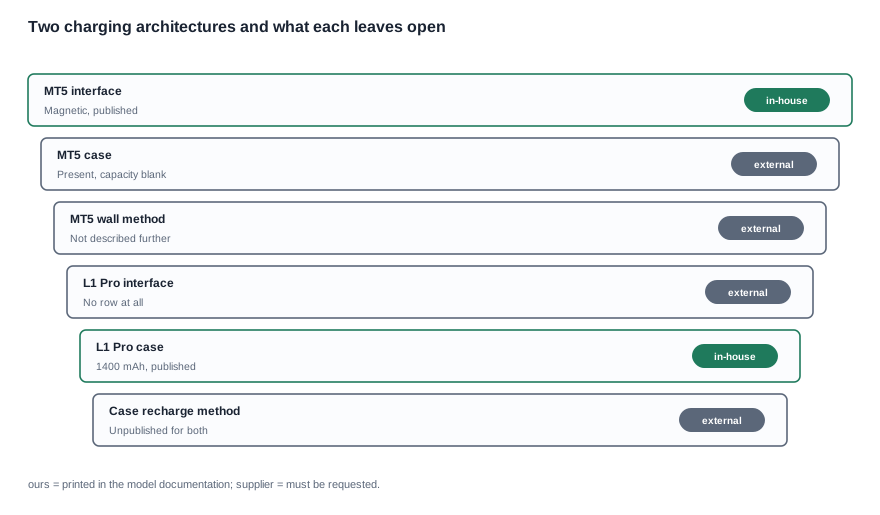
The MT5 architecture is documented and incomplete. Magnetic charging is a published row, which means an accessory or a dock is expected in the box, because a magnetically charging frame cannot be topped up from a wall socket alone. The case is documented as present. What is not documented is the case's capacity, its charge time, its weight, its dimensions, and whether it recharges the frame or only holds a spare cell.
The L1 Pro architecture is documented through its absence. No charging-method row appears on the page. The model does publish a 1400 mAh case. Across the eleven camera models, four publish no charging-method row at all — the CY05 and the L1 Pro, and the CY03 and the MT6 — and every one of those four publishes a case capacity. That pattern is consistent with the case being the charging route and the interface simply being left undescribed, and it is worth asking about directly rather than inferring.
The distinction matters because "no charging-method row" and "magnetic charging" lead to different cartons. The first may be a case-only product with no wall interface in the box; the second is a magnetic product whose case or pad must be present. Neither publishes the answer, so both are open items, and the MT5's is open on a different axis from the L1 Pro's.
The case taxonomy across the camera group is worth keeping whole, because it is where most purchasing errors originate. Five models publish a case capacity: the L1 Pro and the CY03, and the CY05 — each at 1400 mAh, the L2 Utral at 900 and 1400 mAh in a single row, and the MT6 at 1200 mAh in a folding case. Two models — the MT5 and the KY06 — are documented with a case and no capacity. Four models, the S7 and the V03, and the V03 Pro and the V06, carry no charging-case row at all. That is three distinct states, and the silent one is routinely collapsed into the other two in buying conversations, because a missing row reads like a negative answer to anyone who has not been told otherwise.

What this comparison can and cannot settle
It settles the accessory question, partly. The L1 Pro's case is sourceable against a capacity. The MT5's is not. If your operation sources accessories, cartons or retail packaging centrally, that asymmetry alone is worth weighting.
It settles the carton question, not quite. A folding case, a 1400 mAh case and an unsized case are three different parcels, and none of the three has a published weight or a published dimension. The carton can be planned once those are measured; it cannot be planned from the documentation.
It does not settle endurance. The runtime figures are not comparable because no protocol accompanies either, and because the two models sit in different resolution classes. The correct move is to stop trying to rank them and to ask one question of both suppliers instead.
It does not settle a wall-interface question. Magnetic charging on one model and no method row on the other is a documentation difference, and until it is resolved the two products cannot be assumed to have the same in-box experience.
It settles nothing at all about price. No unit price, minimum order quantity, lead time or landed cost is published for either model. There is no price tier in this catalogue and no basis for one. Any comparison of value between these two has to be built from a quotation, and the criteria for building it are the same as the criteria above: the case figures, the weighed unit, the protocol answer and the commercial terms.
What follows from that is a practical rule for how to choose between them without the documentation providing the answer. Rank them on the things the documentation does settle, treat everything else as a scheduled request, and record explicitly which unanswered item would reverse the decision. Buyers who apply that rule end up with a shortlist they can defend; buyers who skip it end up with a preference they cannot.
Building the request list from this comparison
The comparison generates its own questions, and they are ordered by how much each answer changes the commercial outcome.
- What is the MT5's case capacity, stated in the same format as the L1 Pro's 1400 mAh? One sentence closes the largest planning gap on the model that appears cheaper.
- What is the packed unit weight of each model with its case in the carton, on a calibrated scale? Applies to both, because neither publishes a frame weight and the only published weight anywhere in this catalogue belongs to a different model entirely.
- How does each case work — does it recharge the frame or hold a spare cell? This determines whether a case-based endurance claim is available on either product.
- What charging interface does each model use, and what is in the box? Asked of the L1 Pro, this closes its absent method row; asked of the MT5, it confirms what the magnetic row implies.
- What is the runtime test condition for each model? Four sub-questions each: was the camera recording and at what resolution and frame rate, what were the audio and radio states, what were the starting and ending battery states, and how many samples were taken.
- What is the case charge time for each model, and is it a ceiling or a measurement? Nobody publishes it for any case in this catalogue.
- What are the minimum order quantity, lead time, sample policy and warranty terms for each? None of it is published, and all of it belongs in the same document as the specification so the two do not drift apart.
- What compliance documentation exists per model? One page in our catalogue covers export certification at company level, and it holds ten patent certificates — eight covering appearance designs, two covering utility models — and no per-model certification row anywhere. For European Union buyers, the relevant buyer-side instrument for radio equipment is the Radio Equipment Directive (EU) 2014/53/EU; the electromagnetic compatibility directive, (EU) 2014/32/EU, is a separate requirement and is routinely confused with it. Ask for the scope that applies to the model in your purchase order, and check that the model designation on any document matches the order.
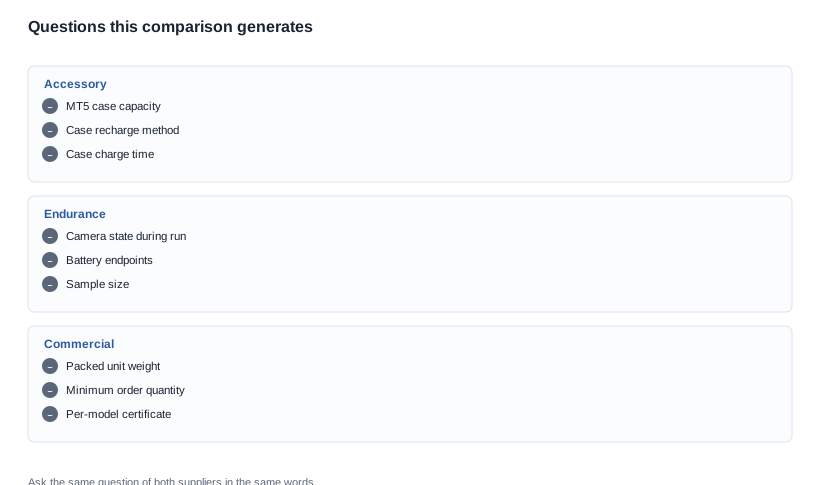
Ask questions one to four of both suppliers in the same message and in the same words. A comparative request produces a comparative answer; two separate conversations produce two sets of figures that cannot be compared, and the buyer is left doing the work the supplier should have done.
How to evaluate a supplier's answers to this list
The request list is straightforward. Judging what comes back is where the commercial outcome is decided, and the criteria are the same for a two-model power comparison as for any other specification conversation.
A closed answer carries a number, a unit, a test condition and a document reference. A partial answer carries a number and a unit without a condition, which can still go into a specification if the assumption is written on the face of it. A referred answer points at a distributor listing, a web page or a previous model, which resolves nothing because it cannot be traced back to the model in your purchase order. A restated answer repeats the question back, and the correct response to that one is to ask again, more narrowly.
Four answers on this particular list deserve disproportionate attention, because each of them tends to arrive in the weak form. The case capacity tends to arrive as an approximation rather than a figure. The case recharge method tends to arrive as a description of the accessory rather than an answer about the frame. The runtime protocol tends to omit the camera state, which makes it a description of a different product. And the packed unit weight tends to arrive as a computed estimate rather than a weighed measurement. Each of these is easy to fix before you order and expensive to discover afterwards, so each should be treated as an open item until the strong form arrives.
The commercial answers follow the same discipline. A supplier that quotes a minimum order quantity, a lead time and a sample policy in the same document as the specification has told you something about how that organisation works; a supplier that quotes them separately from the technical reply has told you something else. Where a factory is involved in the supply chain rather than a trading company, asking which operations are in-house and which are subcontracted is a due diligence question that costs nothing and answers a great deal, because it determines who signs a warranty commitment and who absorbs a defect claim six months later.
Where the risk sits, and how to price it
The risk in this comparison is not that either model is worse than the other. It is that the documentation invites a conclusion that the hardware cannot support.
The specific trap is the runtime comparison. A six-to-eight-hour band and an about-seven-hour point invite a reader to conclude that one model runs longer, and the conclusion feels obvious enough that nobody checks it. But a band and a point measured under two protocols are two disclosures of different shapes, and neither model publishes the camera state that dominates the load. If your channel publishes an endurance comparison, that comparison will be challenged by exactly the buyer who asks for the protocol — and the challenge will be correct.
The second trap is the resolution class. A reader seeing thirteen megapixels against eight will assume better images, and on most consumer categories that assumption would be broadly correct. Here it cannot be verified, because neither model publishes a sensor model, a field of view, a frame rate or a video format. The number is a resolution class. It is defensible as a row and indefensible as a claim, and the difference between those two uses is the difference between a specification sheet and a liability.
The third trap is the case. Reading "ships with a charging case" as though the MT5's case were equivalent to the L1 Pro's 1400 mAh case is the single most expensive inference available on this page, because everything downstream — the carton, the freight class, the in-box copy, the returns exposure — is built on it. The one number that prevents it is the one number that is missing.
How to price that risk is straightforward. Treat every unanswerable item as an assumption with an owner and a date, and require the supplier to replace it with a figure in the contract rather than in an email. Put the specification annex and the commercial terms in one document so that a change in either is visible in the other. Negotiate the tolerance bands rather than the single figures, because a band is usable in a freight model and a single number is not. And if any of these figures is still open when the first shipment is due, decide deliberately whether to ship with the assumption disclosed or to hold the shipment — that decision should be made by whoever owns the purchase order, on the record, rather than discovered later through a returns pattern.
One further precaution is worth taking if these two models will sit in the same range. Record the runtime condition attached to each figure in the same place the figure is used, so that a copywriter picking up the product page six weeks later inherits the condition along with the number. The failure this prevents is not hypothetical and it is not always caused by carelessness — it is what happens when a specifier writes a caveat, a designer carries only the figure into a layout, and the caveat never reaches the page. Where a figure cannot carry a caveat on its face, the honest alternative is to publish the range with its condition attached and accept that it reads less cleanly than a single point.
Where the boundary sits
The published position on these two models is clear and narrow. Both charge in two hours or less. One is published with a 220 mAh cell and a six-to-eight-hour band and magnetic charging with an unsized case; the other with a 290 mAh cell, an about-seven-hour point, no charging-method row and a 1400 mAh case. The first is in the eight-megapixel class and the second in the thirteen-megapixel class, and neither publishes the detail behind its resolution figure.
What we will publish is every one of those rows exactly as it appears. What we will not publish is a runtime ranking between the two models, a claim that one outlasts the other, or any weight, sensor model, case dimension or certificate number that the documentation does not contain. The comparison is genuinely useful to a buyer — it isolates an accessory difference, a documentation difference and a class difference that would otherwise blur together — and it is useful precisely because it stops where the evidence stops.


