
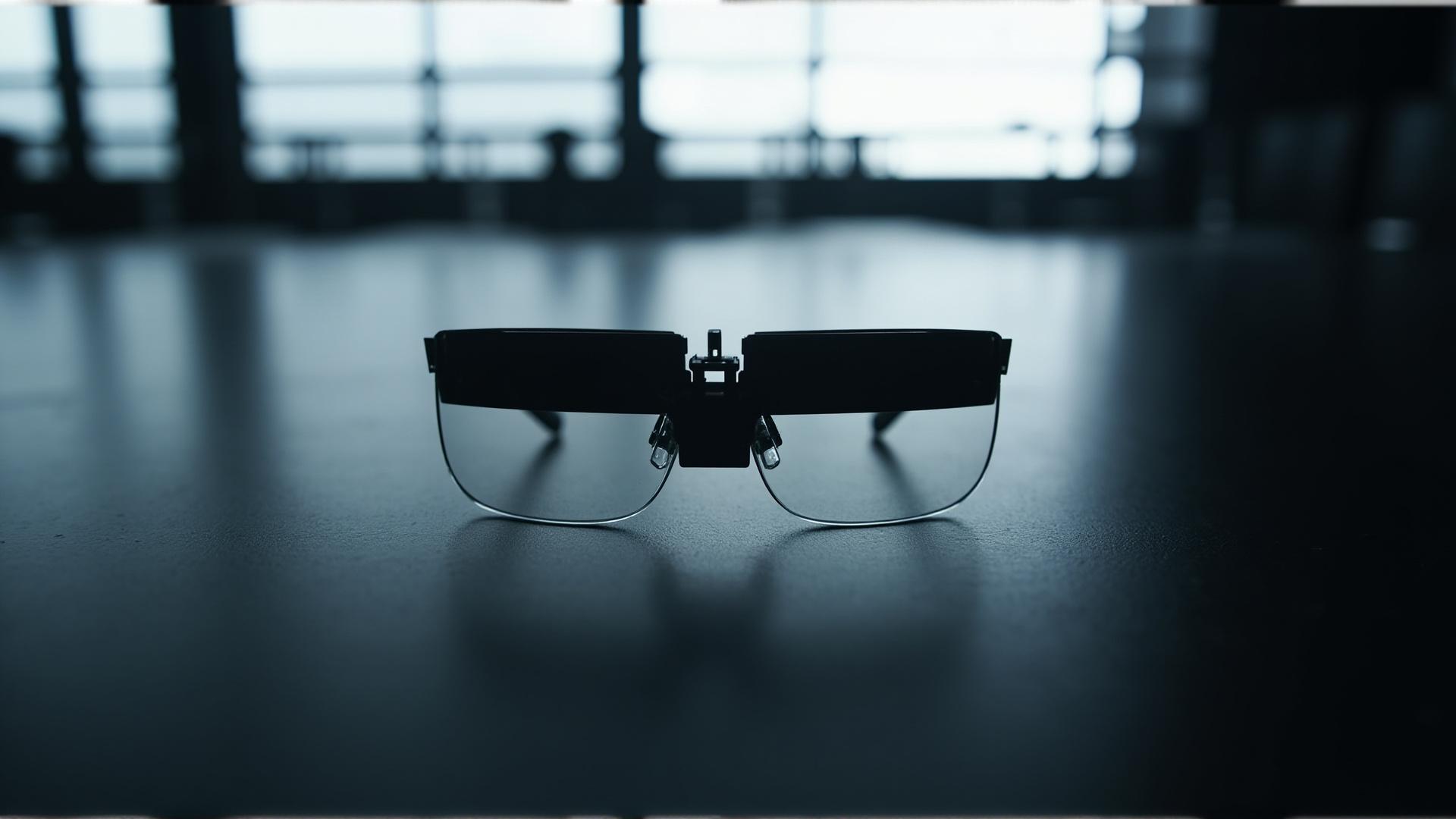
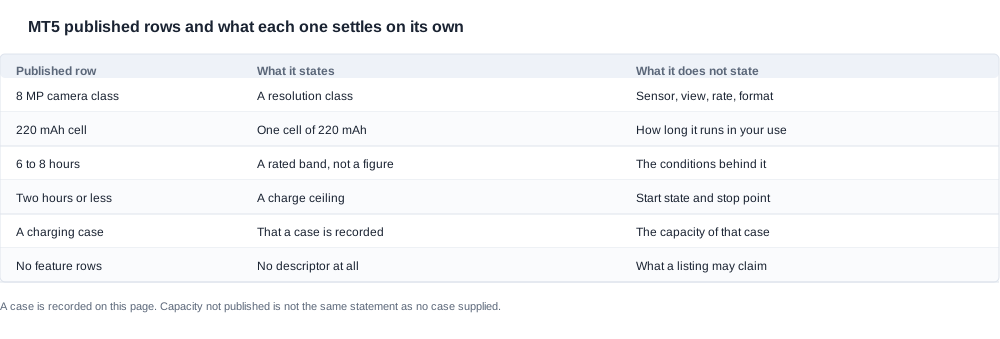
The MT5's catalogue page is short, and the way it is short matters more than the length. It gives an eight megapixel camera class, a 220 milliampere-hour cell, a rated use published as a band of six to eight hours, a charge time of two hours or less, and a charging case whose capacity is not published. Then it stops. There is no feature row on the page at all, no radio version, no weight, no ingress marking, and nothing about the camera beyond the resolution class.
None of that is an error, and none of it is a reason not to order the model. It is the reason this page exists. A page with a feature row hands a channel something to write; a page without one hands a channel a list of questions, and the quality of the order depends on how well those questions are asked. This is a checklist for the buyer: what the MT5 page does publish, what it leaves open, how each open item becomes a written request rather than an assumption, and the order to send those requests in so that one exchange answers most of them.
What to check before ordering to know about MT5 smart glasses: the published row and the blank one
Four published items carry the whole of the MT5 specification, and it is worth stating exactly what each one does and does not do, because a buyer who reads a catalogue row as a set of product claims will over-read every one of them.
The eight megapixel camera class tells you the resolution class of the camera and nothing else. Across the camera models in this range there are two published classes, eight megapixel and thirteen megapixel, and the class is a number of pixels. It does not describe the sensor, the lens in front of it, the field of view that reaches it, the rate at which frames are written, the container the footage is stored in, or how the camera behaves in a dim room. A buyer who treats the class as a quality grade is making a claim the number cannot support, and the claim will be checked by whoever reads the listing first.
The 220 milliampere-hour cell is a single cell, and this model is one of the three camera models that publish a 220 milliampere-hour cell, with the V03 and the V03 Pro. It is a real specification and a real constraint, and it is also the field that most often gets compared against a rating without the rating being checked. The endurance published for this model is not a number but a band of six to eight hours, and the two ends of that band come from the same row on the page. Other camera models publish five to eight hours, and others publish about seven hours flat. A band is not a specification a buyer can plan a shift around, because the band does not say which end applies to a given use.
The charge time of two hours or less is a ceiling, and the catalogue publishes neither the state the cell is in when the clock starts nor the point at which the charge counts as finished. That second omission is the one that bites operationally, because a warehouse, a distributor and a customer all have to agree on what "charged" means, and nothing on this page tells them.
The charging case is the fourth item and the blank one. The page records that a case is part of this model's arrangement and does not publish the case's capacity. That is a different statement from the one made for the camera models whose pages carry no case row at all, and a different statement again from the one model in this family whose page says in words that no case is supplied. This model sits in the first of those three positions: a case is recorded, and its capacity is open.
That distinction is the one a buyer most often gets wrong in a hurry, and it is worth being blunt about why. "No case" is a simple sentence that fits on a packing list, and it is the sentence a hurried buyer reaches for when the page does not give them a capacity. But a capacity that is not published is not the same thing as a case that does not exist, and a buyer who writes "no case" on the basis of a blank capacity will be wrong about the box contents, about the accessory line, about the spares stock, and about the returns process, in that order. The correct reading of this page is: a case is recorded, and the question about it is a question, not a conclusion.
The absence of feature rows is the second thing to be clear about, and it is the absence that shapes the whole buying task. A model whose page carries a descriptor hands the channel a sentence it can use. This model's page carries none, which means every sentence on the product page has to be built from the four numbers above, and each of them needs its condition attached. "About seven hours" is not a description; "up to six to eight hours of rated use, under conditions the catalogue does not publish" is. A channel that writes the first version of either is going to have to correct it later, and corrections to published endurance claims are expensive in a way that corrections to most other copy are not.
The practical consequence for a buyer is that this model rewards preparation rather than persuasion. There is no attractive row to lean on, and there is no confusing row to reconcile — the page is simply short, and the work is in turning each omission into a question that a supplier can answer in writing. What follows is that conversion, one blank at a time.
The 220 milliampere-hour cell, and the case whose capacity the catalogue leaves open
The two fields that decide the operating side of this model are the cell and the case, and they are worth taking together because the case is what makes the cell's behaviour visible. A 220 milliampere-hour cell with a band of six to eight hours of rated use is a configuration that a buyer should expect to spend a working day thinking about, and the case is the accessory that either extends that day or does not.
Because the case's capacity is not published, three questions follow immediately and none of them can be answered from the page. What capacity does the case hold? Does the case charge the frames, or does it only hold a charge that was put in by another means? And what do the frames themselves charge from, given that the page's charging column records the case rather than naming an interface? Those three answers decide the accessory line, the spare stock, the customer's charging habit, the return that arrives with a dead unit, and the packing instruction. They are also the three answers a factory can give in three lines.
There is a second layer underneath those, and it is the one that decides whether a channel can run this model at all. Is the case supplied with every unit, or is it allocated by batch? Is the case itself a stocked item with a part number, or is it an untracked accessory? And what happens to the accessory when a customer returns the unit — is the case expected back, is it replaceable, and at what lead time? A channel that cannot answer those has a returns process with a hole in it, and the hole appears in the second month rather than the first.

On the cell itself, the thing to settle is the band. The catalogue publishes six to eight hours of rated use for this model, and the same cell figure appears on other camera models in the range that publish a different band, which tells you the rating is a property of a measurement rather than of the cell. A buyer therefore has two questions and not one: what were the conditions behind the published band, and what is the expected figure under the conditions this channel actually operates in. The second question is the one that goes into the packaging, and it can only be answered by running the product, which is a reason to order the sample early rather than late.
The weight of the product is also not published, and no weight appears on this page or anywhere else for this model. For a product worn on the face for a working session, that is a question a customer asks on the first day and a distributor asks before agreeing a return rate, and it is a one-line answer from the factory. It is worth adding to the same request rather than making a second one, because a second request costs a second round trip.
There is also nothing on this page about resistance to water or sweat, and nothing about a protective rating of any kind for this model. The two camera models in this range that carry such a marking are not this one, so no statement of that kind may be written onto a listing, a leaflet or a channel script for the MT5. If the requirement involves conditions, the answer has to come as a written statement from the factory about what the product is specified for, and it has to be written in a way a customer can rely on.

Turning every blank row into a question the supplier has to answer in writing
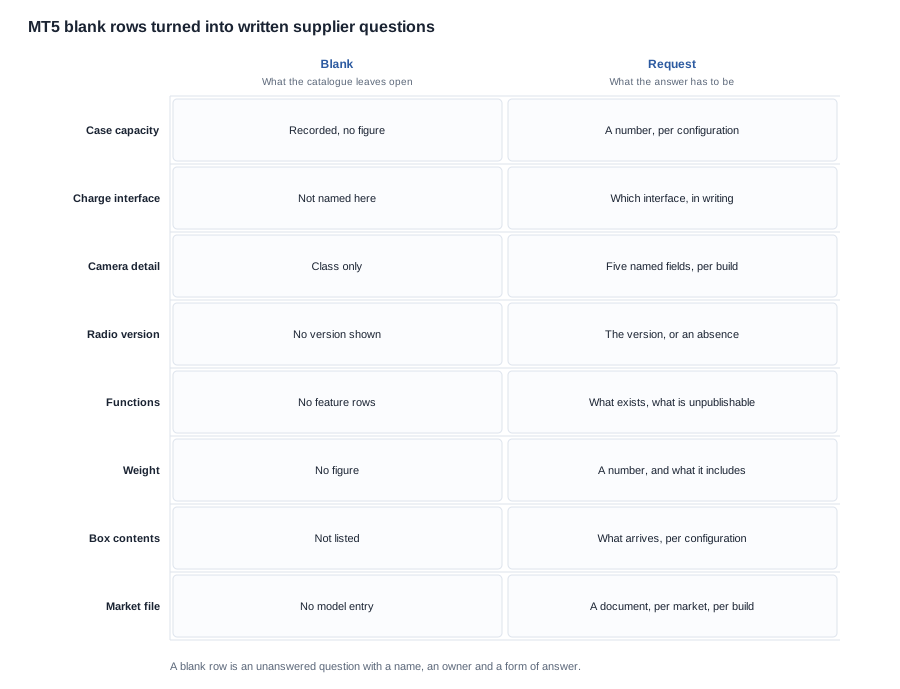
The method is simple enough to state in one line and laborious enough to do properly. A blank row is not missing information; it is an unanswered question with a name, an owner and a form of answer. The list below is the blanks on this model's page, each written the way it should be sent.
- The case. What capacity does the charging case for this model hold, and is the case supplied with every unit or allocated by batch? Is the case a stocked item with a part number?
- The interface. Which interface do the frames charge from, and does the case charge the frames or only hold a charge placed into it separately?
- The camera. Beyond the published eight megapixel class, what are the sensor, the field of view, the recording rate, the file format and the storage capacity for this model, and where does recorded footage go?
- The radio. Which Bluetooth version does this model carry, if any? The camera models in this range do not publish a radio version, and the absence is a question rather than an answer.
- The functions. This model's page carries no feature rows at all. Which functions are present in the product but not published as rows — is there a remote shutter, an AI function, a removable component — and which of them would appear on a product page if they were documented?
- The weight. What does the unit weigh, and does the published figure include the case?
- The conditions. What were the conditions behind the published six to eight hour band, and what is the expected figure at a given volume, in a given environment, over a given session?
- The charge. What is the state the cell is in when the charge starts, and what is the point at which the charge is treated as complete?
- The box. What is in the box for this model, and does the box content differ between configurations?
- The market file. The paperwork held against this model and this build, the destination markets it was issued for, and the body that issued each item; no per-model certification entry appears in the catalogue, so the file has to be requested in full and named by market.
The way each question is worded is doing most of the work, and it is worth being explicit about the difference between a good request and a bad one. "Can you tell me about the case?" is a conversation opener, and it will produce a paragraph that has to be interpreted. "Publish the case capacity for the MT5, state whether the case is supplied with every unit, and give the part number for the accessory" is a request, and it produces three answers that can be written into an acceptance record and compared against the next order. The second form is also harder for a supplier to decline, because declining it requires saying which of the three items does not exist.
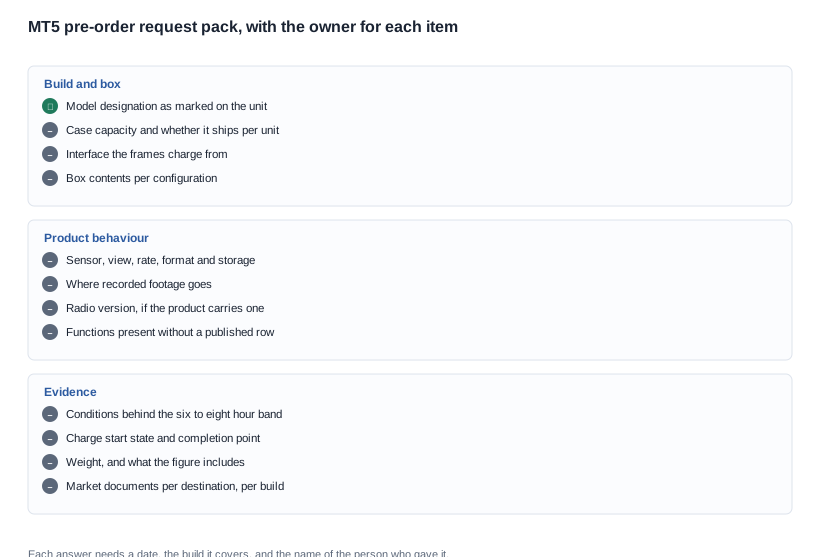
Two of the ten questions need particular care because the answer is not a specification. The fifth one, about functions that exist but are not published as rows, is a question about what a listing is allowed to say, and a supplier who answers it in the negative has told the channel that the product page will be built from numbers alone. That is a perfectly workable position and it is a completely different product page from the one a descriptor produces, and it should be known before the copy is written rather than after. The tenth one, about the market file, is a question about evidence rather than about the product, and the correct state to record is which of the three states applies — a claim with a number still to be confirmed, a claim with a marking but no report behind it, or nothing provided for this model at all.
A third question deserves its own note: the seventh one, about the conditions behind the endurance band. A rated figure is a measurement, and a measurement without its conditions is a number a buyer cannot use. It is also the number most likely to appear on the packaging, which means the answer to it is the answer that decides whether the packaging can be written. If the factory will not state the conditions, the safest line for a listing is the band as published, and that is a weaker product page than any of the models in this range that publish a single figure with a named condition.
Every answer should be recorded with three things attached: the date it was given, the build it covers, and who gave it. An answer without a build reference will be reused against a different unit later, and an answer without a date will be treated as current when it is not.
There is a criteria question behind the list as well, and it is worth settling before the list is sent rather than after the first answer arrives. A buyer who has decided what a closed file looks like — a written answer per item, a document per market, a record that reproduces the build — will know when the file is done and can order against it. A buyer who has not decided will discover the standard when the supplier asks which items are still outstanding, and will be tempted to close the remaining ones with a verbal answer because the order is due. The checklist for this model is only useful if it is treated as the definition of done rather than as a list of things to raise.
The red flags in a returned request are worth naming, because each of them looks like progress. An answer that says the information is available on request. An answer that covers the model rather than the build. An answer that promises a document "shortly" with no date attached. And an answer that answers a different question than the one asked — the case capacity answered with a case description, the camera class answered with a camera description. Each of them is easy to spot if the request is numbered, which is why the numbering is not a formatting preference.
And the trade-off to keep in view is that a longer request costs more of the supplier's time than a short one, and the time comes back as delay. The reason to send all ten anyway is that the alternative is ten separate exchanges spread across a production schedule, each one arriving too late to affect the decision it was supposed to inform.

The order to send the requests in, and what closes the file
The sequence below is the one that answers the most in the fewest exchanges, and the reasoning is simple: identity first, then power and accessory, then the camera, then the radio and the functions, then the market file. Each step depends on the one before it.
- Identity and build. Confirm the model designation as it appears on the unit and on the packaging, what the unit is, and which build the answers will cover. Nothing else in the request can be attached to a build until this is settled, and a request that arrives without it produces answers that cannot be filed.
- Power and accessory. The case capacity, the interface, the box contents, the completion criterion for the charge, and the weight. These are the questions the first order will be judged on, because they decide what arrives and what the unit does with it.
- The camera. The five published-row gaps behind the eight megapixel class — sensor, view, rate, format, storage — plus where the footage goes. This is the group that decides whether the product can be described accurately in a listing.
- Radio and functions. The radio version, and the list of functions that exist without a published row. This is the group that decides what the product page can say.
- The market file. The documents, per market, per build. This is the group that cannot be closed in advance, because the file set is assembled per market and per build rather than held ready, which is why it goes in the same request rather than in a later one.
The order matters less than the bundling, and the bundling is the point: all five groups go out in one request, attached to the sample order, so the answers and the unit arrive together. A buyer who sends group one, waits, then sends group two, and then group three, has paid three round trips and will still be waiting on the group that decides the packaging when the packaging is due. One request with ten numbered items, sent with the sample, costs one exchange and produces a file that is complete enough to judge the unit against.
What closes the file is specific, and it is not a promise. It is: a written answer to each of the ten items, each answer naming the build it covers; the market file for the destinations the order will ship to; and a configuration record that lets the second order reproduce the first. Two things do not close it, and both are common. A verbal answer does not, because the person who gave it will not be the person who answers next time. An answer given for "the model" rather than for a build does not, because the next production run may differ from the one the answer described.
The acceptance record that comes out of a closed file is short, and it is the thing the first batch is judged against: the unit that arrived is the unit that was described, the case that arrived is the case that was described, the capture behaves as observed, and the paperwork covers the build and the market it is for. A file that produces that record is worth more than a quotation, because the quotation is about one order and the record is about every order after it.
What this page will not do is tell a buyer which programmes the MT5 fits, or rank it against other camera models, or say which requirement it is best for. The catalogue does not publish price, lead time, minimum order quantity, capacity beyond the eight megapixel class, or any outcome data, and a conclusion of that kind would be a judgement presented as a fact. What the catalogue does publish is a short row and a set of blanks, and the checklists above are how a buyer turns the second into the first.
Tell us which blank row is blocking your order, and we will write the request for that row in the form our own documentation team would use.


