

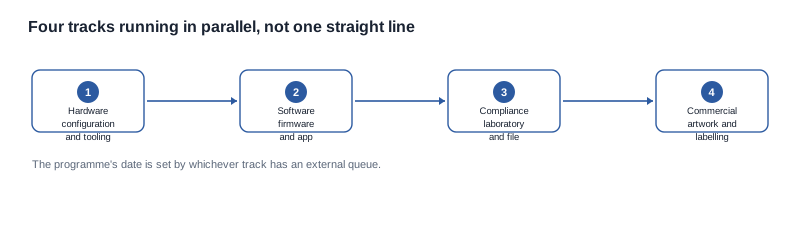
How an ODM programme actually works is a question that usually gets answered with a process diagram, and the diagram is typically a straight line with five boxes. The real process is not a straight line: it is four tracks running in parallel, each with its own owner, its own external cycles and its own failure mode, and each capable of reopening another track's work without warning.
Understanding the shape matters commercially, because the straight-line version tells a buyer the programme takes a fixed amount of time regardless of what happens, and the real version tells them which decisions move the date. A number without a constraint attached is not a plan; it is a hope with units.
So odm development how it works is a description of the programme as it actually runs, including the four loops that put the schedule back and the two external queues that dominate most of them.

odm development how it works: the four tracks and what each one owns
Track one: the hardware. Configuration selection, industrial design, electronics integration, tooling, first article and the production run. This is the track a buyer thinks of when they think of the programme, and it is the track that is most visible and most under the buyer's own control.
Track two: the software. Firmware, the companion application, feature decisions, the release policy and the software side of the compliance position. This track often starts later than the hardware and frequently becomes the constraint, because hardware can be built in parallel with the application but the application cannot be finished before the firmware is. It is also the track with the longest tail, because it keeps producing work long after the shipment.
Track three: the compliance. The test plan, the laboratory, the sample batches, the technical file, the Declaration of Conformity and the market mapping. This track is usually the longest and is rarely the buyer's own function, which is exactly why it surprises people. In the European Union the frameworks include the Radio Equipment Directive (EU) 2014/53/EU with the EN 18031 harmonised standards cited into it, and the General Product Safety Regulation (EU) 2023/988 applicable from 13 December 2024, plus UKCA for the United Kingdom and FCC equipment authorisation for the United States, with separate frameworks applying to anything sold to children.
Track four: the commercial. Packaging artwork, labelling per market, the manual and its translations, the retail and channel material, and the certification documents the importer needs to hold. This track has external cycles — print, artwork approval, laboratory queues — that are the slowest parts of the programme and the least visible on a factory schedule.
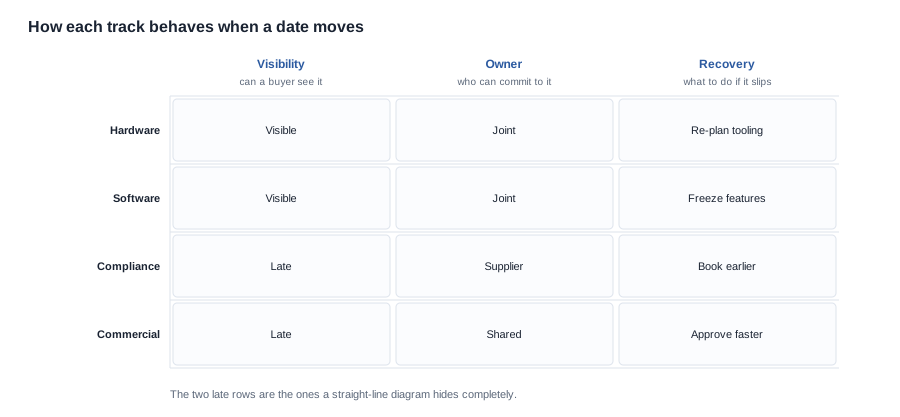
The reason the tracks matter is that they fail differently. A slip in the hardware track is usually visible immediately and can be re-planned. A slip in the compliance or commercial track is invisible until it has already happened, because the work is happening in queues the buyer cannot see and the supplier does not control.
The ownership split is worth stating explicitly, because it explains why two parties to the same programme can hold genuinely different beliefs about what is happening. The factory owns the hardware track in practice, and the buyer's team owns the commercial track by default, because nobody else is going to do the artwork. The software track has shared ownership and is therefore the one most likely to stall quietly, because a shared decision with no named decision-maker does not get made. The compliance track is usually owned by the supplier's function with the buyer's legal function as a distant observer, and it is the track where that arrangement causes the most trouble.
The four consequences follow from that ownership map. Nobody should ask the factory to commit to the compliance date without asking who in their own organisation is making the decisions that feed it. Nobody should treat the commercial track as supplier scope when it is buyer scope. Nobody should expect a shared software track to self-resolve. And nobody should be surprised when the compliance track finishes last, because it has the longest external queues and the fewest people whose job it is to shorten them.
None of these four is a criticism of anybody. They are consequences of the shape of the work, and a programme that names the shape in week one can staff it properly. A programme that discovers the shape in week nine has already lost the option of assigning the missing owners, which is why this particular paragraph matters more than its length suggests.

The four loops that put the schedule back
1. The first article changes the design. Most commonly the finish, occasionally the configuration. This is why cosmetic approval has to happen against a physical sample before the first article ships rather than after it arrives.
2. The compliance track changes the design. A certification requirement can force a component change, and a component change reopens the technical file. This is the loop that surprises people most, because it arrives from a laboratory rather than from an engineering team, and it arrives as a finding rather than as a request.
3. The software track changes the hardware. A feature decision — an offline model running locally, a different sensor behaviour, a change in how Bluetooth naming works — can change the bill of materials. Programmes that freeze hardware before the feature list is frozen are structurally exposed to this loop, and usually discover it after the tool has been cut.
4. The commercial track changes the configuration. A channel requirement for a different case capacity or a different colour can change what is produced, and it frequently arrives after the hardware is frozen. The commercial track is the one most likely to originate outside both parties, because it comes from a distributor.
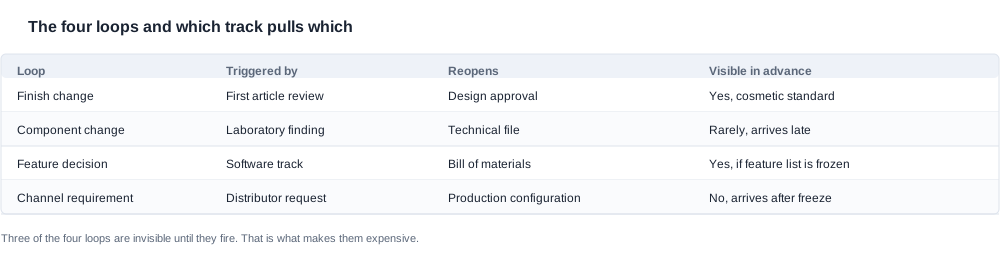
Three of these four loops share a property that makes them expensive: they are invisible until they fire. A finish change is visible because someone is holding the unit. A feature decision is visible if the feature list was frozen. A channel requirement is not visible at all until a distributor asks, which is typically after the hardware freeze, because that is when a distributor starts having an opinion.
There is a fifth loop that is not on most lists and that buyers should watch for: the importer loop. The importer's legal function will have requirements about labelling, documentation retention and market claims that nobody in the programme has seen. Those requirements are usually reasonable, occasionally incompatible with what the product is, and always arrive at the worst moment because importers are consulted late. Bringing the importer into the programme during the requirements phase costs one meeting.
Loops are worth classifying, because the classification determines what a buyer can do about them. Some loops are visible in advance: a finish change is visible if a cosmetic standard exists, and a feature-driven component change is visible if the feature list is frozen. Those are managed by writing the relevant decision down at the right point. Some loops are only partly visible: a component availability change is visible if the bill of materials has been reviewed for single-sourcing, and those are managed by knowing which components have an alternative. And some loops are invisible — a laboratory finding, a distributor's colour preference, an importer's documentation requirement. The management action for those is different in kind, because you cannot prevent them and you can only shorten the recovery, which is why the fallback question matters more for those than for anything else.
The commercial loop deserves particular attention because it is the one most often dismissed as trivial. A colour or a case capacity change requested by a distributor is small as a manufacturing question and large as a commercial one, because it arrives after the freeze, it affects artwork and labelling, and in some categories it affects the model list on the technical file. The correct response is not to refuse it but to have a priced path for it, agreed before anyone needs it — which is a change-process question rather than a design question, and belongs at stage eight rather than in the middle of production.
Which track is the constraint, and how to find out in week one
The constraint is knowable at the start, and identifying it is the single most useful thing a buyer can do before committing to a date.
Is a laboratory queue involved? A new assessment, a new model list or a new market means a slot that has to be booked, and the booking is the constraint rather than the testing. If the programme needs any test that has not been booked, that booking is the first item on the schedule, before anything else, including tooling.
Is new tooling being cut? Then the tooling lead time is a floor under the whole programme. It is not compressible by adding people and it is not compressible by paying more in the ordinary sense, because the queue is the shop's.
Is artwork yet to be approved? Then the commercial track has a cycle of its own that starts the moment artwork goes to a printer and does not stop when the factory does.
Is the firmware feature list frozen? If not, the software track can still change the hardware, which makes the hardware date provisional.
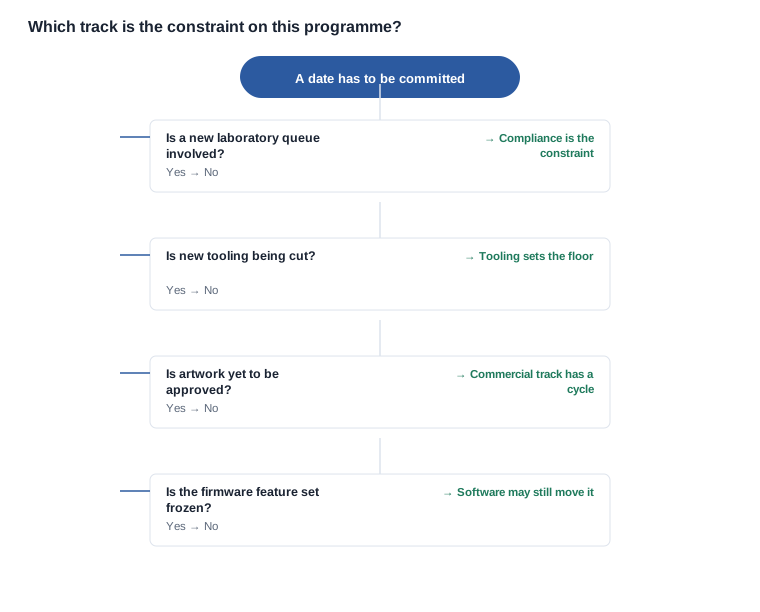
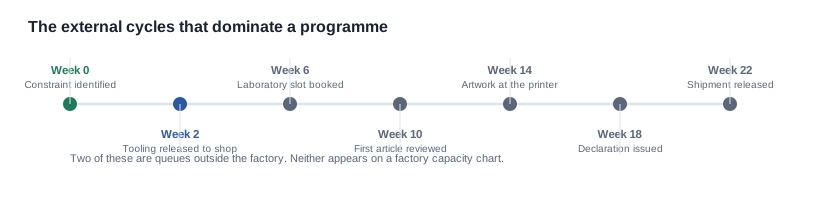
The practical consequence is that the constraint is usually external rather than internal. In our experience the two that dominate are a laboratory queue and a tooling lead time, and neither of them appears on a factory capacity chart — which is why a supplier quoting a duration without naming one is quoting something the buyer cannot verify or plan against.

The four questions that turn a diagram into a plan
- Which of the four tracks is the constraint on this programme, and why? If the answer names a track and a reason, the date can be worked back from. If the answer is a single number with no track attached, ask again.
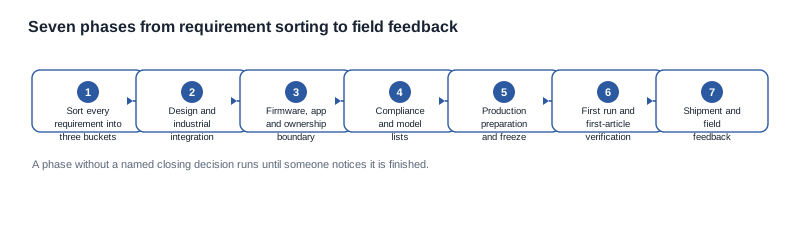
- What is the decision that closes each phase, and who signs it? Not the activity that finishes the phase but the decision that closes it, because the date is only as firm as the last open decision. A decision left open until the first article is a decision that can still move the date.
- What are the external cycles, and what are their lead times? The laboratory, the artwork, the printer, the tool maker. Ask for them separately rather than as a combined figure, because they behave differently and one of them is usually the answer.
- What is the fallback if the constraint phase slips? A programme with a stated fallback recovers. A programme without one re-plans from scratch, and the re-plan is always more expensive than the fallback would have been.
Two further questions are worth adding because they cost nothing and change what a buyer can do with the answer. Is the sample the production configuration — because any sample whose cell, colour or firmware build differs from what the factory will build invalidates every evaluation done on it, and the divergence is usually invisible. And what is the earliest date at which a change can still be absorbed without cost, which is the real deadline behind every other date on the programme.

Planning a programme whose date you cannot control
Almost nobody sets a launch date in an ODM programme. Most work backwards from one that somebody else set — a trade show, a retail listing date, a channel commitment, a marketing plan — and then discovers how much of the programme sits outside their control. Planning for that is not pessimism; it is the difference between a schedule that holds and a schedule that is revised in month four.
The method is short. Identify every element of the programme with an external queue attached, and put the longest of them on the critical path rather than the longest element inside the factory. Then, for each item on that path, establish three things: the earliest it can start, the longest it can plausibly take, and what happens to the rest of the programme if it takes the longest. The third question is the one buyers skip, and it is the one that determines whether a slip is an inconvenience or a re-plan.
Once that is done, the plan has a shape that can be communicated honestly: a date the factory controls, a date the external queues control, and a set of decision points between them. The buyer's own team can only influence the second and the third, and knowing which is which is worth more than any acceleration the factory could offer.
What to ask, specifically, when a supplier offers a single duration: which element of that duration is the longest single item, and what is its lead time. If the answer is a phase structure with a named constraint inside it, the number is usable. If the answer is a repeat of the same number, the supplier has not identified the constraint and the number should not be used for planning.
Four red flags are worth watching for in any programme schedule. A duration given without a constraint named. A laboratory booking that has not been made while the programme claims compliance is complete. A tooling release that depends on a design approval nobody has scheduled. And a firmware feature list that is still open while the hardware is described as frozen. All four are common, all four are visible in week one if anyone looks, and all four are discovered in week twelve if nobody does.
The criteria for deciding whether a programme is well run are equally short, and they can be applied from outside. Every phase has a named decision that closes it and a person who signs it. Every external cycle has a stated lead time rather than an estimate. The sample is the production configuration and that is written down. And there is a fallback for the constraint track. Where all four hold, the programme can be planned. Where one is missing, the missing item is where the schedule risk sits, and a buyer who wants to negotiate anything in this programme should negotiate that item first.
Before you commit to a supplier on schedule grounds, the due diligence question is not about their average duration. It is about the last programme that slipped: which track caused it, how long it took to recover, and whether the recovery was planned or improvised. The answer tells you more about the next programme than any reference on a completed shipment will.
What our published range lets a programme select
For reference, the published configuration options a programme would be selected from: camera models at 8 MP and 13 MP with cells from 220 mAh to 290 mAh, charge times under two hours, runtimes of roughly five to eight hours, magnetic or Type-C charging, and case options at 900, 1200 and 1400 mAh. Audio models with dual cells at 55, 70 or 90 mAh per side or single 100 mAh and 115 mAh cells. Sport models with IP54 catalogue markings and four published colours on the V06. Children's models with 40 mAh and 70 mAh cells, roughly twenty hours of runtime, and posture and distance detection. A light-responsive entry with Bluetooth 5.4, a 100 mAh cell and electrochromic lenses. A bone conduction entry with a 35 dB gain, a 200 mAh cell and Type-C charging.
The frame weight appears for one model only in the whole catalogue, 158 g for the MT6, and Not published for the rest. Unit prices are Not published, and so are minimum order quantities and production lead times; both are confirmed per enquiry, which is the correct treatment for figures that depend on a configuration and a volume rather than on a model name.
It is worth saying what that list is for, because it is easy to read it as a shopping list rather than as a scheduling input. The published rows tell a buyer which configurations exist, which is what lets a programme select a platform in week one instead of designing one in week ten. They do not tell a buyer how long anything takes, and anyone who reads a catalogue row as a schedule will be disappointed. The two questions are separate and only one of them is answered by data.
The rows that matter most for track selection are the ones that identify which model class a requirement belongs to — a camera model, an audio model, a sport model, a children's model or a light-responsive model. Each class carries a different compliance profile, a different runtime profile and a different set of market claims, which is what makes platform selection a scheduling decision rather than a shopping decision.
The reverse is also worth knowing. What the published rows cannot tell you is whether a given model has an existing technical file, whether its model list covers the markets you intend to sell, or whether it has been in production before. Those three questions determine whether a programme is a configuration and a compliance exercise or a new development, and none of them is answered by the catalogue. They are answered by asking, and they are the first thing to ask.
How to shortlist on this basis rather than on price: pick three configurations that satisfy the requirement set, then for each of them establish the track profile — which tracks are active, what the external queues are, and what would have to change to make it a different programme. Suppliers who can fill that table from existing information are telling you they have done this before, and the buyer who compares three suppliers on it learns more in an afternoon than in three weeks of specification meetings.
Before you commit to a platform on schedule grounds, the criteria are these three: the external cycles are named, the model list covers the intended markets, and the first decision on each track has an owner and a date. If all three hold, the programme can be planned honestly. If one does not, that is the item to resolve before signing rather than after.
We will tell you which track is the constraint on your programme, and we will name the external cycles rather than presenting a single duration. If you send the configuration, the quantity, the markets and the date you are working back from, we will tell you which track is the constraint, where the queues are, and what the decision points are. The timeline overview sets out the same sequence by phase, and the design phase covers the decisions that have to close before the hardware track can start.
Related reading
- ODM development
- ODM timeline overview by phase
- ODM design phase and its decisions
- Mass production stage
Send the configuration, the quantity, the markets and the date, and we will tell you which track is the constraint.


