

An ODM timeline looks predictable on a chart and turns out to be a sequence of decisions with dependencies running between them, which is why a buyer who asks for a schedule gets a number and a buyer who asks for a timeline gets something they can actually plan against. The distinction is worth making explicitly at the start, because the two words get used interchangeably and they support very different conversations.
A schedule is a set of dates. A timeline is a set of decisions, what each one depends on, and what happens to the downstream phases if it goes the wrong way. In a category where production lead times, minimum order quantities and capacity figures are all Not published and confirmed per enquiry, the timeline is the only one of the two that can be given honestly. So this odm development timeline overview is a description of the phases, the decisions inside each phase, and the gates where a programme can slip.
There is a practical reason to hold this distinction in a category where nothing is published as a fixed number. When lead times and capacity are confirmed per enquiry, the only thing a buyer can carry across conversations is the structure — the phases, the gates and the dependencies — because the structure survives being wrong about the numbers while a number does not. A buyer who has internalised the phase structure can absorb a changing lead time; a buyer holding a single date has no way to respond to one at all.
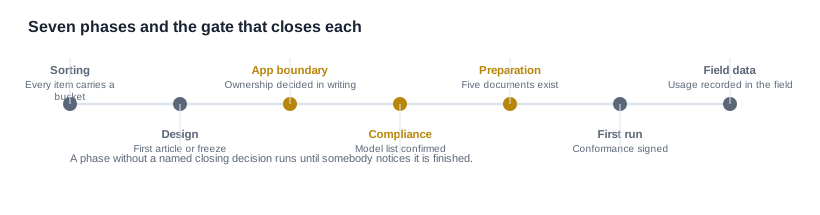
ODM development timeline overview: seven phases and the decision that closes each
Phase 1: Requirement sorting. Not requirement gathering — sorting. Every requirement goes into one of three buckets: fixed by the platform, configurable within the platform, or genuinely custom. In our range the configurable space is concrete. Cell configurations run at 55 mAh × 2, 70 mAh × 2, 90 mAh × 2, single 100 mAh and 115 mAh, with camera cells from 220 mAh to 290 mAh. Charging is magnetic or Type-C. Case options are 900, 1200 and 1400 mAh. Camera resolution is 8 MP and 13 MP, and colour options are published for two models. Everything outside that space is a development, and calling it configuration because it sounds small is the most expensive misclassification available at this stage. The gate is a requirement list where every item carries its bucket; without it, phase 2 becomes a negotiation rather than a design.
Phase 2: Design and industrial. Frame, temple, electronics placement, the charging interface, the controls. The published constraint here is that the frame weight is Not published for every model in the range except one, and the battery decision determines the temple cross-section, which means this phase and the next one are really the same phase. The gate is a first article, or a design freeze with a documented tolerance for what is still open — and the second of those is not a softer version of the first, it is a different decision with a different consequence.
Phase 3: Firmware, app and the interface boundary. Who owns the app, what the version policy is, and what happens to the platform at the end of the engagement. This is the phase most often deferred and the one with the longest tail, because an app is a permanent obligation rather than a deliverable. The gate is a written decision on software ownership, and the decision that matters is not who wrote the code but who carries it when the supplier relationship changes.
Phase 4: Compliance. Which documents, which laboratory, which markets. No per-model certification row appears anywhere in the catalogue, so the compliance phase of a programme has to be scoped from written material the factory provides for the specific model and market rather than from a published table. Where the certification work is the constraint rather than production, the programme's date is simply the certification date, and treating that as a production problem produces a plan that cannot work. The gate is the model list on each document confirmed against what will actually ship.
Phase 5: Production preparation. The frozen bill of materials, the variant matrix, the first-article inspection plan, the change control procedure, and the packing and traceability record. The traceability record is the one most often deferred and most badly missed, because it is what makes a warranty claim work two years later. The gate is that all five documents exist, in a state where somebody else could act on them.
Phase 6: First production run and first-article verification. The point at which the process is tested on real units rather than on a bench. The gate is first-article conformance signed, against a stated sample size and a stated set of criteria.
Phase 7: Shipment and field feedback. Field data is the only stage that produces information about real usage, and it is the stage most programmes skip, which is one reason the published runtime figures stay untested against reality.
The phases are listed in the order they usually occur rather than the order they must be resourced. In practice two of them run in parallel from the start — the requirement sorting and the initial compliance route check — because both are cheap, both change the specification, and both become expensive the moment a design is frozen against them. The sequencing that catches people out is phase 3, because software ownership is discussed late, when the cost of changing the answer has already risen to the point where nobody wants to hear it.
It is also worth being clear about which phases produce a visible artefact, because programmes manage attention rather than time. Phases 1, 4 and 7 produce documents and data. Phases 2 and 6 produce physical units. Phase 5 produces documents that nobody will read again unless something goes wrong. The phase that produces nothing visible is the one that slips, because there is no artefact whose absence anybody notices until the phase after it cannot start — which is the argument for treating an ungated documentation phase as the most dangerous item on any plan.
One further structural point about the gates themselves. A gate is only real if it can stop the programme, and most gates in practice are advisory: the phase finishes, the artefact appears, and nobody checks it against anything. Making a gate real requires three things, and all three are cheap. There has to be a named signatory rather than a team. There has to be a defined test rather than a judgement that things look right. And there has to be a consequence, so that arriving at the gate without the answer produces a delay that somebody feels. Programmes that add those three elements to their existing gates usually report the same result: fewer surprises in the second half of the programme, and a schedule that moves less often but moves for stated reasons.
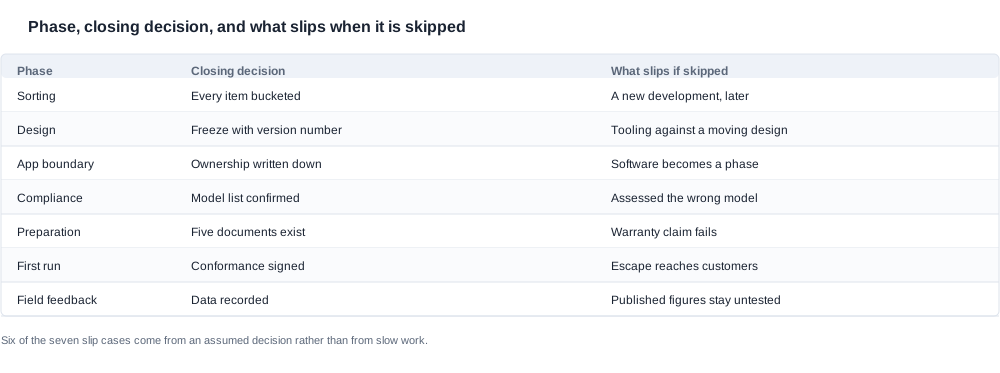

What actually causes a programme to slip
Slips in an ODM programme are rarely caused by work taking longer than expected. They are caused by a decision that everybody assumed had already been made. Six account for the large majority, and all six share the same shape: an assumption rather than a failure.
The requirement that was never sorted, which turns out to need a new development three phases later. The sorting phase costs a day; finding out in phase 5 costs a schedule.
The cosmetic approval during the first article rather than before it. Colour and finish are the most frequent first-article rejection, and the approval has to happen against a physical sample under a defined viewing condition — not against a photograph on a screen, and not against a verbal nod in an earlier meeting.
The app ownership left open, and then discovered to be a development in phase 3 instead of a decision.
The certification model list, where the document covers a family and the specific model that will ship is not named on it. This one is discovered by a customer rather than by the factory, which makes it considerably more expensive.
The cell substitution, which changes the transport documentation and the product's conformity position, and which nobody flagged because nobody knew the cell part number was in the file at all. A change that looks like an internal supply decision and behaves like a compliance event is the definition of a risk that needs an owner rather than an alert.
The traceability record, deferred until the first warranty claim needs it, at which point the information no longer exists and cannot be reconstructed from the unit in front of you.
The reason these six recur so reliably is that each of them sits at a boundary between two parties who both believe the other has it. The remedy is not vigilance; it is a gate with a named signatory, because a gate converts an assumption into an answer and an answer can be recorded.
There is a second reason these slip cases cluster at phase boundaries rather than inside phases. Work inside a phase has a natural owner and a natural finish, so it is self-completing. A boundary is where ownership transfers, and transfers are where assumptions live. The practical consequence is that the questions worth asking are not about progress within a phase but about what one party is about to assume about the other — and the answers to those questions are cheap to obtain at the boundary and almost impossible to obtain afterwards, because by then both parties have adapted to the assumption.
It is also worth noting which of the six are recoverable and which are not. A cosmetic approval can be re-run against a sample in days. A certification model list can usually be corrected by having the right model assessed, at the cost of time on the critical path. A cell substitution that has already shipped cannot be corrected at all; it can only be contained, which is why the substitution rule is worth more than the substitution notice. A traceability record that was never created cannot be created retrospectively for units that have left. Knowing which category a problem falls into before it happens is most of the value of reviewing this list at the start rather than learning it later.
Sorting the six that way also tells you where contingency is worth spending. Effort spent on the recoverable items is largely wasted, because they recover anyway; effort spent on the unrecoverable ones is what changes the outcome. In practice that means the budget for contingency belongs on traceability, on the substitution rule and on the certification model list, and not on the approval loops that everybody instinctively watches. That is an unusual allocation to propose, and it is the reason this list is worth reading twice before a programme starts rather than after it has slipped.
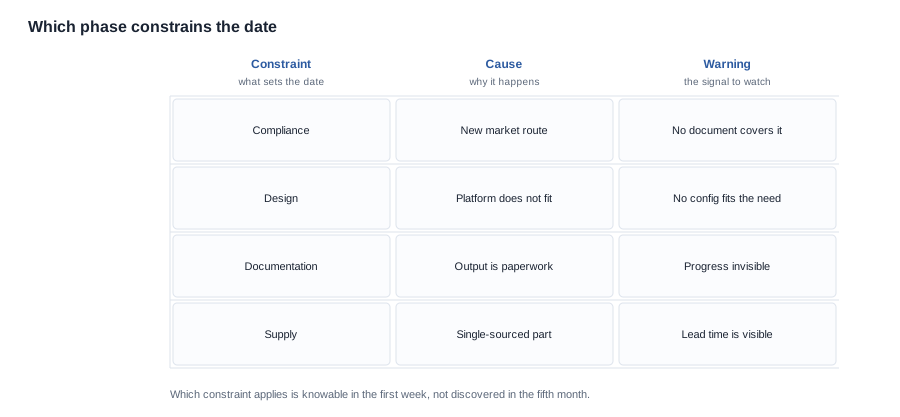

Which phase is the constraint on your programme
Most programmes have exactly one phase that determines the date, and it is normally identifiable at the start rather than discovered at the end. Knowing which one it is changes the plan completely, because a programme constrained by compliance is managed by starting compliance early, while a programme constrained by production preparation is managed by removing documents from the critical path.
Compliance-constrained programmes are common where the destination market requires a route the factory does not already hold. The early warning is a market requirement that no existing document covers. The management response is to establish the route and the laboratory before the design is frozen, because a design decision that invalidates an assessed configuration is the most expensive kind of late change.
Design-constrained programmes are those where the platform genuinely does not fit and something structural has to change. The early warning is a requirement that cannot be satisfied by configuration. The response is to sequence the decision before tooling, because this is the one constraint where an early decision is worth more than an early action.
Documentation-constrained programmes look like nothing is happening and are the most frustrating to manage, because the work is real and the progress is invisible. The early warning is a phase whose output is a set of documents rather than a set of units. The response is to schedule the documents explicitly and give them a signatory.
Supply-constrained programmes are visible earlier than the others, because a constrained component usually has a lead time that everybody can see. The response is to identify which components are single-sourced before the design depends on them, rather than after.
Which one applies is knowable in the first week. Which one is discovered in the fifth month is a question of attention rather than of information.
Knowing the constraint is worth more than it first appears, because it changes who should be asked for the date. A programme constrained by compliance should take its date from the assessment route and treat production as something to be arranged around it. A programme constrained by design should take its date from the structural decision and treat compliance as a check. A programme constrained by documentation should take its date from the signatory's availability, which is the one most often ignored and the easiest to fix by simply naming the person early rather than by adding resource. The failure mode in all three is the same: a single date is quoted that represents the sum of every phase, when the buyer needed the float on the phase that is actually variable.
There is a fourth constraint that is easy to miss because it belongs to the buyer rather than to the factory, which is the marketing date. A programme can be technically unconstrained and still miss, because the commitment was made to a channel rather than to a programme, and the channel date cannot move. When that is the real constraint, the useful response is not to accelerate the build but to change what ships in the first wave — a narrower configuration, a later market, a staged launch — because the alternative is spending the float of every phase to protect a date that was chosen arbitrarily at the outset. Asking which of these four is the binding constraint is one of the cheapest questions in the entire engagement, and it frequently changes the answer. The criteria for deciding are simple enough to apply without any domain knowledge: if the phase has an external dependency nobody in the room controls, it is the constraint; if everything in it is internally decided, it is not.


Four questions that turn a timeline into a plan
-
What is the gate for each phase, and who signs it? A phase without a named closing decision is a phase that runs until somebody notices it is finished, and in a busy programme nobody notices.
-
Which phase is the constraint on this programme? Usually compliance, documentation or design, and it is knowable at the start rather than at the gate.
-
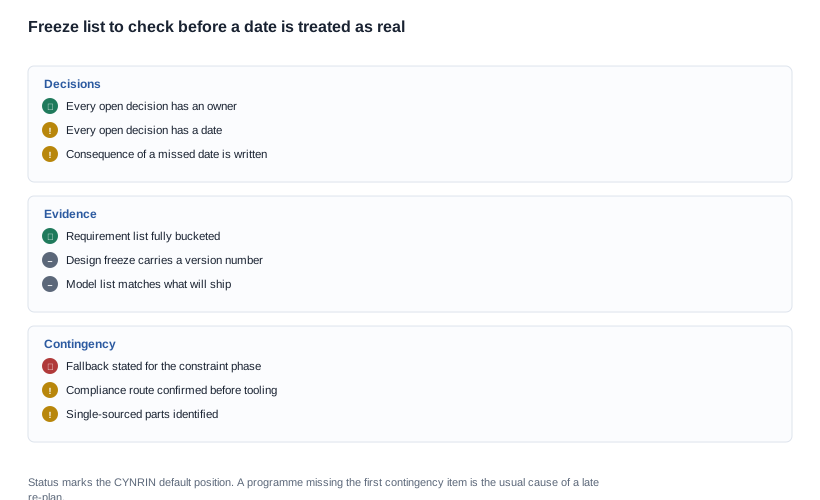
What has to be frozen before the date holds? The date is only as firm as the last unfrozen decision, so the useful question is not how confident anybody is but which specific items are still open.
-
What is the plan if the constraint phase slips? A programme with a stated fallback for its critical phase is a programme that recovers in days; one without it re-plans from scratch and loses weeks.
A fifth question is worth adding for anyone working back from a fixed commercial date: what would have to be true for that date to be honest? The answer is usually a list of frozen decisions and a completed compliance route, and it is frequently shorter than the programme plan assumes. If the list cannot be produced, the date is a hope rather than a plan, and saying so early is the cheapest service anybody in the programme can do.
The same question works in reverse and is often more useful, and it is the one that makes this a checklist rather than a status report. If a buyer asks what could be removed to make the date comfortable, the answer is almost always a decision rather than a task — one requirement that has not been decided, one approval that has not been named, one document that has no owner. That is a better trade than compressing the build, because compressing the build moves quality risk into a place where it cannot be seen, whereas removing a decision moves it into a place where it can still be discussed.
What we publish about schedule, and what we will not
We do not publish an ODM timeline, a lead time or a capacity figure on this site. All of them depend on a configuration, a quantity, a certification position and a current schedule, and a number published out of that context is a number nobody can plan against — worse than no number, because it gets put in a business case and defended.
What we will give you is the phase structure and the gates, because that part is genuinely reusable and does not depend on the specifics of your programme. It is also the part that tells you which questions to ask, and the questions are what actually determine the date.
The distinction we are drawing is not between being helpful and being cautious. It is between a number that survives contact with a specific programme and one that does not. A published lead time is true of no programme in particular; a quoted lead time against a named configuration, quantity, certification position and current schedule is true of that programme on the day it was given, which is the only kind of number a purchase order can rest on. We would rather answer the same question twice for two real configurations than answer it once for a hypothetical one.
If you tell us the configuration, the quantity, the markets and the date you are working back from, we will tell you which phase is the constraint on your programme and what has to be frozen before that date becomes real.
Related reading
- ODM development
- The design phase and its decisions
- Mass production stage
- Development process checklist
Send the configuration, the quantity, the markets and the date, and we will tell you which phase is the constraint.


