

The design phase of an ODM programme is where the buyer's product meets the manufacturer's platform, and the meeting is usually less comfortable than it needs to be. The buyer arrives with a brand, a customer and a commercial requirement. The manufacturer arrives with a platform that already exists, a bill of materials behind it, and a set of things that are not negotiable because they are load-bearing.
Both positions are reasonable. The failure is that the design phase is usually run as a negotiation over specifications, when what is actually happening is a negotiation over which requirements are genuinely fixed and which are negotiable. Buyers who cannot tell those apart spend the phase fighting for things that were never available and conceding things that were, and both halves of that trade produce a worse programme than either side intended.
So odm development design phase is best understood as the set of decisions that determine whether the remaining phases are smooth or painful — and every one of them is cheaper to take now than later, by a margin that is easy to demonstrate and easy to underestimate.
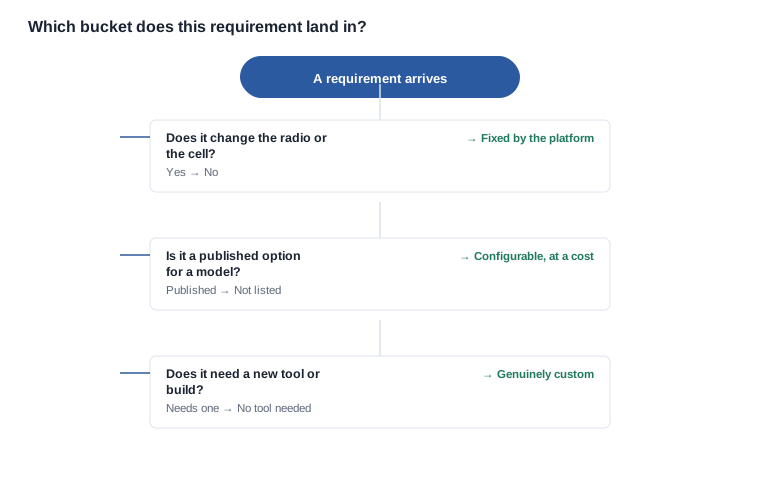
odm development design phase: the three buckets every requirement lands in
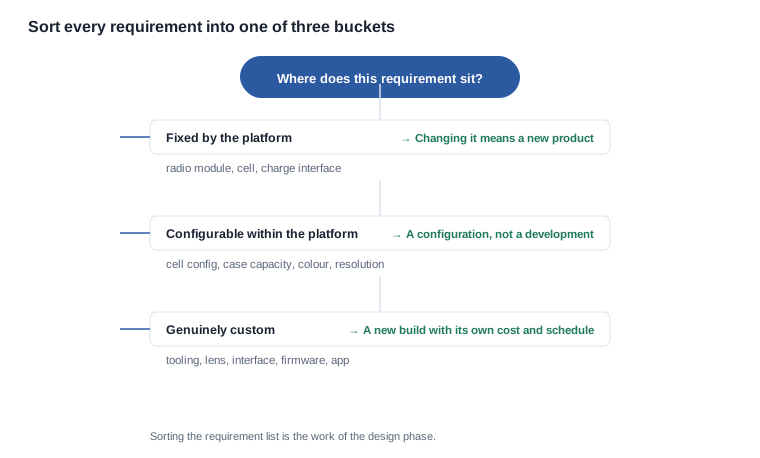
Fixed by the platform. The parts of the design that cannot change without a new development. In a range like ours this typically means the radio module and its certification, the battery cell and its cell-level test coverage, the charging interface, and the platform's approach to firmware and the application. A buyer asking for a Bluetooth version change on a platform built on a different radio is asking for a new product rather than a new configuration. Our published range carries Bluetooth 5.3 on two models and 5.4 across the rest, which is a good illustration: the difference is real, it is published, and it is not a configuration option — it is a different model's property.
Configurable within the platform. Where the published options are genuine. Our catalogue shows this clearly: cell configurations at 55 mAh × 2, 70 mAh × 2, 90 mAh × 2 and single 100 mAh and 115 mAh cells; charging by magnetic or Type-C; case options at 900 mAh and 1400 mAh; camera resolution at 8 MP and 13 MP; and colour options published for two models — the V03 Pro in orange, off-white and black, and the V06 in orange, white ice blue, black and black ice blue.
Genuinely custom. New tooling, a custom lens, a custom interface, a custom firmware build, a custom application. All available, each carrying a cost, a schedule and a compliance consequence. The category exists and it is not a failure state; it is simply a different programme with a different economics, and the design phase is where you find out which one you are in.
The actual work of the design phase is to sort a requirement list into these three buckets, with a named owner against each line, and to do it before the specification meeting rather than during it. A requirement that has not been sorted is a requirement that will be answered by whoever is most confident in the room, which is not the same as the person who is most correct.
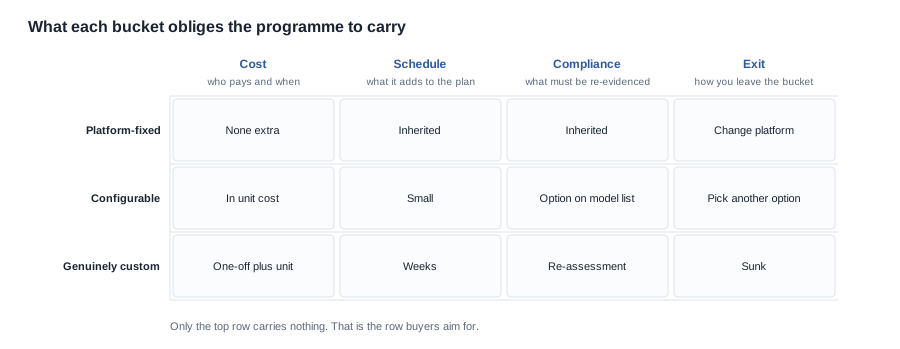
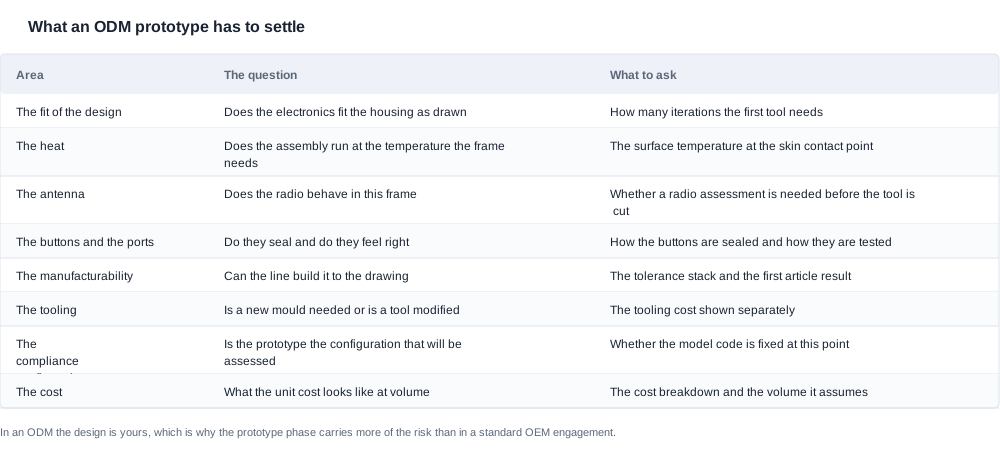
That matrix is worth reading slowly, because the top row is the only one that carries nothing. A platform-fixed requirement costs nothing extra and adds nothing to the schedule, because the work was done before the programme started. A configurable requirement costs in the unit price and adds weeks at most. A genuinely custom requirement costs a one-off plus a unit cost, adds weeks, forces re-evidencing, and — critically — is sunk the moment you commit.
The six decisions that are cheap here and expensive later
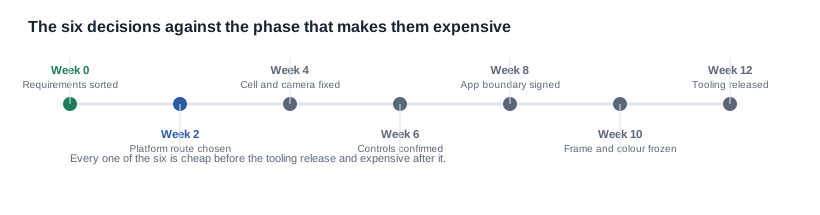
- The model, from the published range or a new build. This determines everything downstream. A platform model with your branding is a configuration exercise; a new build is a development programme with a different cost and a different schedule. This is the only decision on the list that cannot be revisited cheaply later.
- The battery and charging configuration. Fixed by platform, configurable within it, or new. The cell determines the runtime, constrains which case option is available, determines the charging interface, and drives the transport documentation. It is the decision with the widest reach per unit of effort.
- The camera, or the absence of one. The published tiers are 8 MP and 13 MP, and nothing is published about the sensor itself, the field of view or the video specification. So the decision in the design phase is which tier you take, not which sensor — and if the sensor matters to your claims, the answer is that it has to be established separately before you commit.
- The interface and controls. Capacitive touch on the audio models, physical buttons and indicators on the AR entry, remote shutter control on the D17 and ZH12. This decision has a durability and a sealing consequence and is rarely treated as a design decision at all, which is why it gets made by whoever is holding the sample.
- The firmware and application boundary. Whether the application is yours, the platform's, or a hybrid, and who maintains it. This is the decision with the longest tail, because an application is a permanent obligation and a firmware version difference between your evaluation sample and your first shipment is a claim waiting to happen.
- The industrial design and colour. Whether the frame is one of the published options or a custom mould, and whether the logo sits on the temple, the case, the box, or all three. Every one of these choices is free before the freeze and expensive after it.
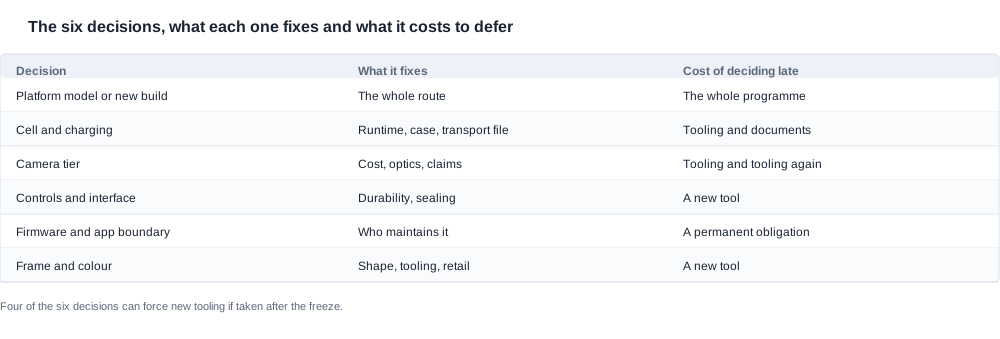
Four of the six can force new tooling if they are taken after the freeze. That is the single most useful thing to know about the design phase: it is not primarily a creative phase, it is the last point at which four expensive decisions are still cheap.
Each of the six also has a second question attached to it, and the second question is where programmes diverge. The model question has a range-life question: is this model expected to stay in the catalogue for four years, and if so, is it the first of a family rather than a standalone. The battery question has a transport question: what does the cell choice do to the transport documentation and the packaging, because both change with it. The camera question has a claims question: if the specification is Not published, what may the listing say, and who owns that wording.
The controls question has a usability question that belongs to the buyer rather than to the manufacturer: is capacitive control correct for a product that will be operated with gloves, in rain, or by someone who is not looking at it. The firmware question has a lifecycle question: who updates the branch in year two, and what happens to a unit whose branch is no longer supported. The frame question has a scale question: does the logo treatment survive the move from one factory quantity to another, because logo methods differ between small and large runs and a logo that has to be re-tooled at scale is a schedule event.
None of these second questions requires a supplier to answer, and all of them are cheap now. That is the pattern behind the table: the design phase is not where creativity happens, it is where the irreversible decisions are taken while they are still reversible.
What a design phase looks like when it is run badly
The bad version is highly predictable, and recognising it early is worth a great deal.
It starts with a specification meeting where the buyer presents a requirements document and the supplier responds line by line. The supplier says yes to the things that are easy, no to the things that are impossible, and something ambiguous to the things that are expensive. Nobody writes down the ambiguous lines because they were answered verbally, and the meeting ends with a shared sense of progress that is not supported by any document.
Three weeks later, a pre-production sample arrives and two requirements are unfulfilled. One was genuinely impossible and nobody believed the supplier's answer; the other was possible at a cost nobody mentioned, because the cost conversation happened verbally too. The buyer's position is that both were agreed. The supplier's position is that neither was specified. Both positions are defensible, and the programme now has a dispute that will take longer to resolve than the original requirement would have taken to clarify.
The expensive version of this failure is not the dispute. It is the concession made in order to end it. Buyers frequently drop a requirement to recover the schedule, and the dropped requirement is sometimes the one that was the reason for the programme. What survives that is a product nobody argued for.
The way to avoid it is procedural rather than cultural. Every line gets a written answer, every ambiguous answer gets converted into either a costed option or a stated refusal, and every concession gets recorded as a decision with a name against it. The requirements phase covers the sorting work that has to happen before any of this.
There is a diagnostic worth knowing, because it tells you within a few minutes whether a design phase is on track. Ask for the requirement list as it currently stands, together with the answer given against each line and the date that answer was given. Any programme that is healthy will return a document with named owners and dates. Any programme that is not will return a description of a meeting. The distinction matters more than it sounds, because a programme without that record cannot be negotiated at all — there is no baseline to concede from, so every subsequent conversation reopens everything that came before it.
Three red flags are worth naming specifically. The first is a supplier who answers a requirement without saying which bucket it falls into, because that answer will be quoted later as though it were the same commitment in both cases. The second is a buyer who arrives with a competitor's specification rather than with a use case, which produces a design that matches a competitor's decisions without matching the buyer's customers. The third is a programme with more than two requirements marked as the top priority, because a priority list of that kind is not a priority list.
How to evaluate a design phase as a supplier interaction, rather than as an event, comes down to three observations. Watch what happens to a requirement the supplier cannot meet: a good outcome is a stated refusal with the nearest alternative. Watch what happens to a requirement the supplier can meet at a cost: a good outcome is a costed option, not a promise and not a refusal. Watch what happens to a requirement neither of them is sure about: a good outcome is a written note that it is unresolved, with an owner and a date. Programmes that behave consistently across all three are the programmes worth shortlisting, and programmes that behave differently across all three are not.
Before you commit to a design direction, the criteria are short: every requirement has a written answer, every answer names its bucket, every custom item has a cost and a lead time attached, and every unresolved item has an owner and a date. If those four hold, the design phase has done its job regardless of how creative it felt.


The four questions that settle the phase in one meeting
What is the make-or-buy boundary on this programme? The line between what the manufacturer has already built and what you are commissioning determines both the schedule and where the risk sits. A buyer who never asks this spends the programme unsure which costs are one-off and which are structural, which is the subject of the cost breakdown in detail.
Which of my requirements are commercial and which are technical? A requirement that exists because a competitor has it is a commercial requirement, and treating it as a technical one produces a design nobody can build to the standard you had in mind while appearing to agree with it. This question takes ten minutes and routinely removes a third of the requirement list.
What does the programme inherit from the platform's certification? If the radio module and the cell are fixed, part of the conformity position is inherited and does not need redoing. That is a schedule benefit worth knowing at the start, and it is the benefit most often left on the table because nobody asked which parts are inherited rather than new.
What is the version control policy? How firmware versions are released, how the sample version is reconciled with the shipped version, and who decides when they differ. This is the question that prevents the most common late-stage surprise in an ODM programme, and it is worth having answered in writing before the first sample rather than after it.
A fifth question is worth adding even though it is not about design at all, because it determines whether the design decisions will still be the right ones in eighteen months: what is the expected life of this model in the range. A product intended to stay in the range for four years should be designed for the accessory, the packaging change and the firmware update that will arrive in year three, and a product intended for a single season can be designed to launch and stop. Both are legitimate; designing for one and planning for the other is what produces the expensive surprise.
A sixth question gets asked last and should be asked first: is there a configuration in the published range that already satisfies most of this requirement set. In a category with dozens of models and a genuinely wide configuration space, this is not a remote possibility. It is common, and finding the near-match before the design phase begins routinely removes a tool, a firmware branch and an application build from a programme that was going to be quoted as a new development. The near-match is not always right — there is usually one requirement it does not meet — but knowing which requirement that is, and what it would cost to close, is a much better starting position than a blank sheet.
There is a seventh question that is almost never asked and should be: what does the competition in this category have that this programme cannot have. Not as a feature list, but as a boundary-setting exercise. A buyer who has established in advance that a particular capability is out of scope has saved themselves from discovering it in a design review with someone senior attached, and has also saved the supplier from quoting for it.

The make-or-buy boundary, which is really a risk decision
The question that produces the most change in a programme is not about specifications. It is about where the boundary between what already exists and what has to be built actually sits, because that single line determines the cost, the schedule and — less obviously — which risks the programme carries.
A buyer who asks the manufacturer to build a modified platform has chosen to carry the engineering risk: the schedule depends on design work, the cost depends on whether that work goes right the first time, and the compliance position has to be re-established because the bill of materials has changed. A buyer who configures an existing platform has chosen to carry a different risk: the specification is constrained, the differentiation is narrower, and the commercial outcome depends on positioning rather than on engineering.
Neither route is better. What is wrong is choosing without knowing, which is what happens when a requirement list arrives without a view on the boundary and the manufacturer assumes the buyer means the cheapest route to a demonstration unit rather than a production programme. Suppliers are not being obstructive when they ask the question; the answer genuinely determines what they quote, because the two answers describe different products.
There are four signals that the boundary is being decided by default rather than by decision. The first is a requirement list that describes features rather than outcomes, so nobody can tell which are essential. The second is a schedule with a single date and no phases, so nobody can see which part was assumed to be quick. The third is a budget expressed as a total with no tolerance for a second tool, which is a strong indication that only one tool is expected and nobody has checked. The fourth is an application requirement written as a feature rather than as an ownership arrangement, which almost always means the ownership question has been deferred and will surface at the worst possible time.
The way to settle it is to write the boundary down as a single sentence, put it in the agreement, and then test every subsequent requirement against it. Requirements that fit inside the sentence are inside the existing programme. Requirements that do not are either a new development, a scope change, or a requirement that should be dropped — and all three are better outcomes than a requirement that quietly becomes somebody's problem in month four.
Once the boundary is written, the three buckets stop being an opinion and become a test. A requirement is platform-fixed if the platform already does it, configurable if the catalogue already offers it, and custom if neither is true. That test is boring, repeatable and quick, which is exactly why it works, and it can be applied to a new requirement in month seven with the same confidence as to the first requirement in week zero.
What to ask when the boundary is contested is straightforward: what would have to be true for this to be a configuration rather than a development, and how long would that take to establish. The answer is usually a specific number of weeks and a specific piece of engineering, which is enough information to make a decision. What is almost never useful is a yes or a no.
What our published options let you decide now
We will tell you honestly which of your requirements sit in each of the three buckets, including where a requirement cannot be met on the platform and what the nearest available configuration is. We would rather have that conversation in the design phase, when it costs a conversation, than in pre-production, when it costs a tool.
We will also say plainly that the published options are the options. Our catalogue lists charge times, rated runtimes, cell configurations, charging methods, camera resolutions, case capacities and the colour options for two models. Beyond that it is custom development with a cost and a schedule attached, and we will quote it as such rather than as a variation on the catalogue.
That distinction is the reason to run the design phase against a written requirement list rather than a verbal brief. If you send us the requirement set, we will sort it into platform-fixed, configurable and genuinely custom, mark each line with the nearest available configuration where one exists, and identify which of your requirements are commercial rather than technical — before anyone opens a CAD file, and before the cost of the programme is a number you have already committed to.
Related reading
- ODM development
- Development process how it works
- Customisation depth for eyewear brands
- Engineering customisation: what can be changed
Send the requirement set and we will sort it into platform-fixed, configurable and genuinely custom before anyone opens a CAD file.


