
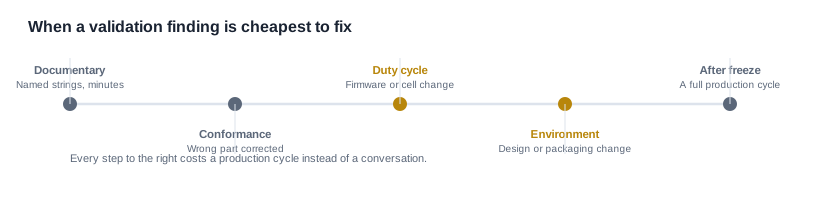
Validation is the phase where a project either becomes a production order or becomes an expensive lesson. It is also the phase most often compressed, because the pressure to ship is highest immediately before the order and the tests themselves start to feel like a formality once a sample appears to work. Done properly, an odm development validation phase is not a formality at all. It is the last point at which anything can still be changed cheaply, because after validation every finding costs a production cycle rather than a conversation.
The principle underneath all of it is short enough to write on a wall: validate against your own specification, not against the factory's assessment of it. The distinction sounds pedantic and is worth a great deal of money, because a factory that has tested a unit against its own criteria has established that the unit meets the criteria the factory chose, which is a different proposition from the one the buyer is about to sign a purchase order against.
ODM development validation phase: the principle and the sequence
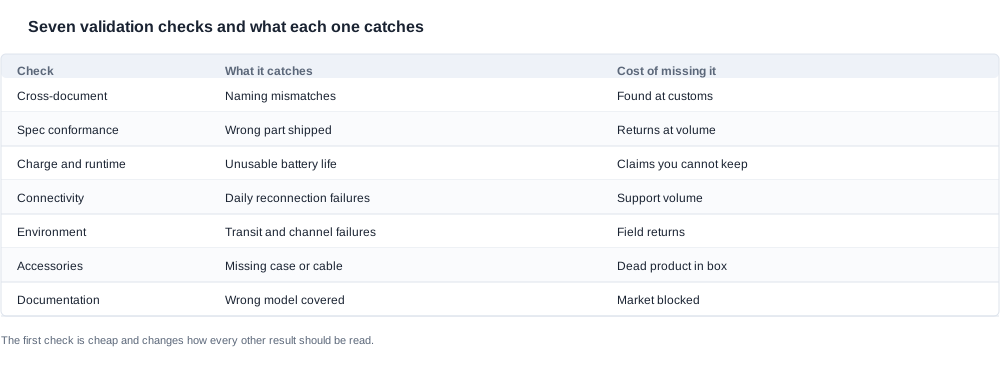
Validation is worth doing in a fixed order, because the order determines how much each finding costs. Cheap, documentary checks go first, because their results change the interpretation of everything that follows. Physical measurements go next, on units drawn from more than one position in the build. Behavioural and environmental checks go last, because they are the slowest and because they are the ones most likely to need a re-run once something earlier has been corrected.
The sequence below is the one we would propose for a first programme, and it is deliberately unglamorous:
- Cross-document consistency, because a mismatch here changes the meaning of every other result.
- Specification conformance, row by row, against written criteria.
- Charge, runtime and thermal behaviour, measured in the configuration being bought.
- Connectivity behaviour, including the failure paths rather than only the successful one.
- Environmental and transit exposure, in the conditions the product will actually meet.
- Accessories, packaging and labelling, verified against what will physically ship.
- Regulatory documentation, checked against the market and the exact model.
The reason the order is documentary-first is worth stating, because it is counter-intuitive to anybody who assumes validation means testing. A naming mismatch discovered on the last day does not just fail the check; it silently invalidates the interpretation of everything else, because a report about the wrong model is a report about a product that does not exist. Fixing that first costs an afternoon and makes the remaining results meaningful. Discovering it afterwards means re-running the programme, not merely re-reading it.
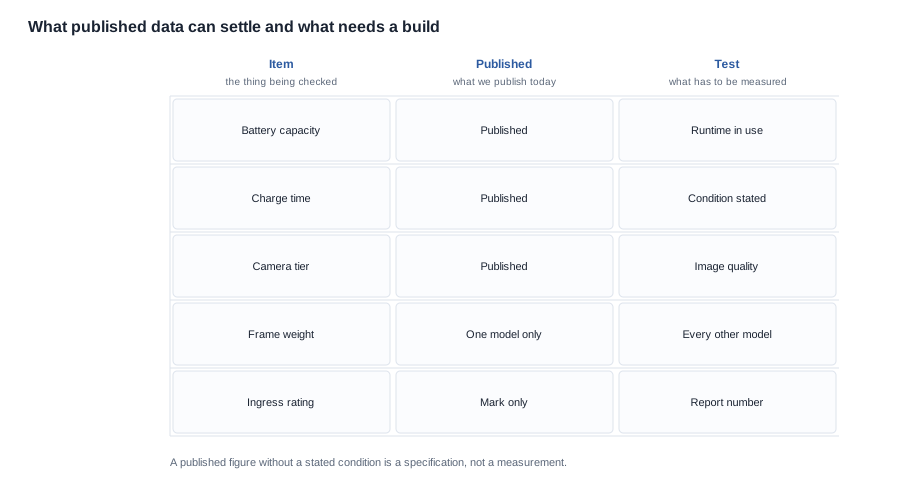
There is also a sampling question that determines whether any of this is worth doing at all. A single unit establishes that the product can work. A spread across units establishes what can be claimed. Where a figure will appear in a product listing, a datasheet or a tender response, the number has to survive contact with a customer who measures it themselves, and the only way to know that in advance is to measure a sample and look at the distribution rather than the average. In our own catalogue this matters more than average because several headline figures carry no stated test condition — the published charge times are under two hours across the range, with about one hour on the D17 and the ZH12, and no condition attached to either — so a buyer has no published baseline to compare a measurement against and has to generate their own.
Each of these produces a result that either passes, fails or cannot be determined. The third category is the one programmes handle worst, and it deserves a rule of its own: a row that cannot be determined is not a pass. Recording it as unknown, with the reason, is the difference between a validation report that can be relied on later and one that quietly becomes a series of assumptions.


Conformance and cross-document consistency
Specification conformance starts with the rows, not the features. Take the written specification and check every row: battery capacity, charge time, Bluetooth version, rated runtime, charging interface, camera resolution, plus every customised item — logo position, colour against the approved sample, packaging artwork, firmware version, Bluetooth device name. The pass criterion should be written as it is meant to be applied: total conformance, with no exceptions and no averaging. A partial conformance rate sounds reasonable and produces a product that is not the product that was approved.
There is a distinction inside this that catches buyers regularly: a row can be checked against a criterion, or it can be checked against an expectation. Battery capacity, charge time and camera resolution have published figures behind them in our catalogue, so they can be measured and compared. Frame weight, frame material, acoustic performance and lens performance are Not published for this range beyond the single published frame figure of 158 g for the MT6, so for those rows there is nothing to compare against — the buyer's own criterion becomes the reference point rather than a cross-check on one. Both are legitimate; what is not legitimate is treating an unevidenced row as a pass because the factory said nothing was raised, which is how a specification gap survives all the way to the customer.
The second distinction is between a value that is right and a value that is in the right place. A logo in the correct artwork at the correct size in the wrong position on the housing is a failure against the specification even though every measured value passes, which is why the customised items in the list above are all checked as position and appearance rather than as presence.
The cross-document check matters more here than anywhere else. The Bluetooth device name, the model designation on the packaging, the model designation in the Declaration of Conformity and the model designation the factory builds against must all be the same string. These mismatches are trivially avoidable at validation and disproportionately expensive to discover later, because each of them surfaces in a different place — one at a customs inspection, one in a returns investigation, one in a compliance question from a market regulator — and none of them surfaces in the same conversation.
Three cross-document items are worth checking every time because they change independently of each other: the model designation, the firmware version, and the regional configuration. A firmware version that changes after validation does not necessarily invalidate a measurement, but it does change which software the measurement describes, and a regional configuration difference can change both the radio behaviour and the labelling in ways no amount of measurement elsewhere would reveal.
There is a fourth item that is easy to forget because it lives outside the product: the version of the specification itself. A validation report that does not state which revision of the specification it was measured against cannot be used later, because the natural assumption will be that it refers to the current revision. Attaching a revision number to the report costs nothing and is the difference between a document that settles a question and a document that starts one.
Two further checks belong in the same category because they are documentary and therefore nearly free. Whether the sample units were built from production tooling or from a separate sample tool changes how much weight the results can carry, and it is a question that has to be asked before the results arrive because afterwards it becomes an assumption. And whether the acceptance criteria were written before the samples existed or after they arrived in good condition, which is a question about the integrity of the exercise rather than about the product, and which determines how the buyer should read a clean pass.

Endurance, connectivity, charge and runtime
Duty-cycle endurance is not a bench test. Run the product through the duty cycle the customer will actually use — for a camera product, recording; for an audio product, calls mixed with playback — for the duration the claim will cover. The published figures in our catalogue carry no stated test condition, which means the only meaningful endurance figure available to a buyer is one they measured themselves. Record when it stopped, whether the stop was abrupt or gradual, and repeat on more than one unit. A spread between units from the same lot is normal and worth knowing, because it determines what can be claimed in marketing and what has to be hedged.
Thermal behaviour belongs in this group as well. Surface temperature at the skin contact point under a full workload is the measurement that tells you whether a design decision was realistic, and a measurement taken at rest tells you almost nothing. It is also one of the figures most often absent from published material, which makes it one of the more valuable rows for a buyer to generate themselves. Where the result is uncomfortable, the useful response is a design conversation while the tooling is still modifiable rather than a market claim later.
Connectivity should be validated through the whole cycle, not just the successful path. First-time connection, connection to a second device, range-out, reconnection time, behaviour after a reset, and whether a custom device name survives a reset. The reconnection test is the one that predicts day-to-day satisfaction better than any other single measurement in the list, because it is the behaviour encountered most often by the person carrying the product. A unit that takes half a minute to reconnect after the phone is put down produces a steady stream of support contacts that no amount of spec compliance offsets.
Charge and runtime should be measured in the configuration being bought. Published charge times across our range are under two hours, with about one hour on the D17 and the ZH12, and no stated condition for either figure. Measure from the state that matters, in the configuration on the purchase order, on more than one unit, and write down the ambient condition. For case-equipped models, verify the case separately — whether it restores a full session, and, for the foldable case on the MT6, whether it holds its charge through storage rather than only immediately after charging.
There is a further point about measurement conditions that costs almost nothing to fix and is worth stating explicitly, because it is where two honest measurements of the same unit disagree. Charge time depends on the starting state, the ambient temperature and whether the case is attached. Runtime depends on the workload, the radio state and whether the unit is warm. A figure measured on a warm unit after a morning of testing is not wrong; it is simply not comparable with a figure measured on a cold unit, and a report that does not state which condition applied cannot be compared with anything. Writing the condition into the report is the whole remedy.
Where a claim is going to be made publicly, the measured condition and the measured spread should be the basis of the claim rather than the best single reading. A buyer who reports the best unit from a sample of ten has created a number that will fail in front of the first customer who compares notes, and the cost of that correction is considerably higher than the cost of reporting the spread honestly at the start.

Environmental, accessory and documentation checks
Sample provenance should be settled before anything else is measured. Where each unit came from, in which position of the build, and in which configuration. A result without provenance cannot be extrapolated, so it can only be repeated, and repetition is the expensive way to buy confidence. Provenance is free, and a report that carries it can normally be re-used for a second review without anybody rebuilding the evidence.
Environmental exposure should be tested in the destination environment rather than the factory's. Temperature extremes if the product ships to markets that have them. Drop handling, because it is the most common transit failure and because the packaging is part of the result. Dust and moisture exposure relevant to the channel — with the point worth stating plainly that the V06 and the S7 carry an IP54 marking with no third-party report number behind it, so the marking is a published specification rather than an evidenced test result, and a buyer with a real exposure requirement needs evidence of their own.
Accessories and packaging should be verified against what physically ships. Accessory count, artwork, the printed count inside the carton, and the master carton labelling. This is the stage at which a missing case is caught rather than discovered in returns, and a case-equipped product without its case is not an incomplete order but a non-functional one.
Packaging deserves more attention than it usually gets, because it is the one component that is validated last, is hardest to change once printed, and affects every unit rather than one. Three specific checks earn their place. Whether the master carton labelling matches what the documentation and the purchase order describe, since a mismatch here is discovered by a freight forwarder rather than by anybody in the programme. Whether the printed accessory list inside the carton matches the physical contents, since a printed count that is correct on paper and wrong in the box produces a customer who believes something is missing. And whether the packaging has been tested with the actual unit rather than a dimensional mock-up, because a carton that fits a drawing does not necessarily fit a unit with its accessories in place.
Whether the documentation was produced for this programme or inherited from a previous one is a separate question from whether it is valid. A document that covers the product because the product is unchanged is fine and is the efficient outcome. A document that covers the product because somebody assumed the earlier assessment still applied is not fine, and the distinction is visible only if somebody asks which assessment the document comes from, for which model, and on what date. The catalogue carries a company-level export page and nothing at model level, so that question has to be asked rather than inferred, because the answer determines whether the buyer needs a laboratory at all or only a written confirmation from the factory.
Regulatory documentation should be checked against the market and the exact model. Report number, laboratory, date, model list on the header. Declaration of Conformity for the EU. Radio approval per region. Battery transport summary. Nothing in the catalogue attaches a document to a model, and the compliance picture for a specific market therefore has to be established in writing rather than inferred from a general statement about the company — so a buyer who needs a specific document for a specific market should establish the route rather than infer it from a general claim.
What the validation output has to contain
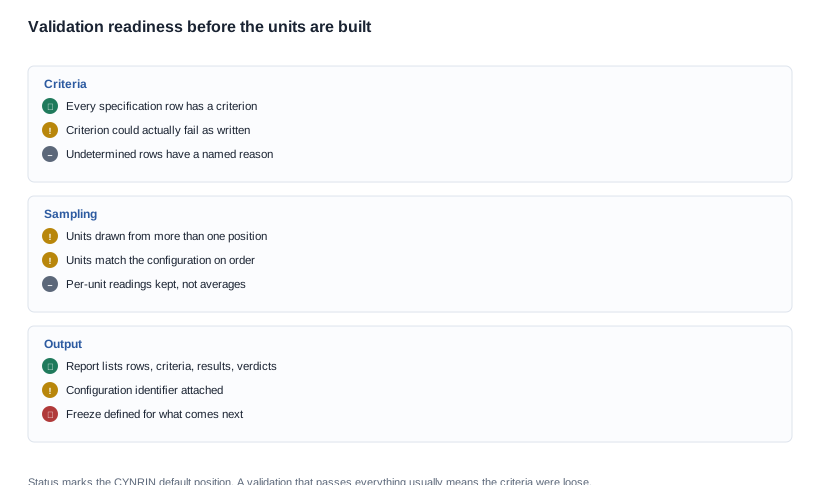
The output of the odm development validation phase is a signed report, and its structure matters more than its length. Five parts, in this order:
- Every row of the specification, as written, with nothing merged or summarised away.
- The criterion for each row, stated so that somebody else could apply it.
- The measured result, with per-unit readings rather than a single average wherever a spread matters.
- A pass, fail or undetermined verdict, with the reason recorded against every undetermined.
- The configuration identifier the results describe, so that the report remains attached to a specific product.
There is one more question worth answering in the report itself, and it is the question that determines whether anybody reads it again: what was not checked? A validation that states its own limits is usable by a procurement team six months later, when a component has been substituted and somebody needs to know which results still describe the product. A validation that claims complete coverage is not, because the first substituted component will make it wrong and the reader will have no way to tell which parts were affected. Recording the limits costs a paragraph and preserves the value of everything in the report.
Failures are at least as valuable as passes. A validation that found nothing usually means the criteria were too loose rather than that the product is excellent, and the two are distinguishable only by asking whether each criterion could ever have failed.
The same applies to the samples themselves. Record where each unit came from, in which position of the build, and in which configuration, because a result without that provenance cannot be extrapolated and can only be repeated. Repetition is the expensive way to gain confidence; provenance is free, and a report that carries it can usually be re-used for a second buyer's due diligence without anyone rebuilding the evidence. Freeze the configuration when validation passes, and treat every subsequent change as reopening the part it touches — because a report that describes a product nobody is buying is evidence about a product, and nothing more.
There is a commercial point underneath the whole phase that is worth making once. A validation finding costs a week when it arrives early and a production cycle when it arrives late, but the same finding usually costs more than either, because it is discovered by the customer rather than by the programme. The programme that treats validation as a formality is not saving time; it is moving the work to a point where it costs several times as much and where the reputational damage sits with the brand rather than with the factory.
A validation that fails with a specific, fixable finding is worth more than one that passes with vague criteria, because the first is roughly a week of work and the second is a year of returns. If you send us your specification and acceptance criteria, we will tell you which rows we can validate against your standard and which depend on information we have not published — frame material, weight beyond the single published figure, acoustic performance, lens performance and certificate numbers being the main ones.
Related reading
- ODM development and validation
- Development process documentation
- What to check when samples arrive
- Pilot runs and how to specify one
Send your specification and acceptance criteria and we will say which rows we can validate.


