
Verification of a photochromic lens supplier is harder than verification of almost any other component in this category, and the reason is a vocabulary problem before it is a technical one. The trade uses the word photochromic to describe at least two completely different technologies: lenses that darken in response to ultraviolet light, and lenses that darken in response to an applied voltage. One of them needs no power at all. The other needs a battery, a driver circuit and firmware. They behave differently, they cost differently, they fail differently, and a supplier who has not noticed which one you are talking about will happily quote you the wrong one.
This guide is written as a supplier audit, not as a specification guide. The distinction matters. A specification guide asks what you want written on a datasheet. A supplier audit asks a harder question: whether the organisation in front of you is capable of holding to that datasheet at the volume you are going to order, and whether anything in its supply chain can change underneath you without you noticing.
Photochromic: how a lens supplier verification runs
A lens is an optical component with a chemical or electrochemical behaviour, and it is usually the one part of a smart glasses product that the assembler does not make. That single fact sets the shape of the audit. Everything else — the frame, the electronics, the cell, the firmware — sits inside an organisation you can inspect. The lens sits one or two steps upstream, and the supplier's answer to your questions is filtered through whatever relationship they have with the person who actually presses and coats it.
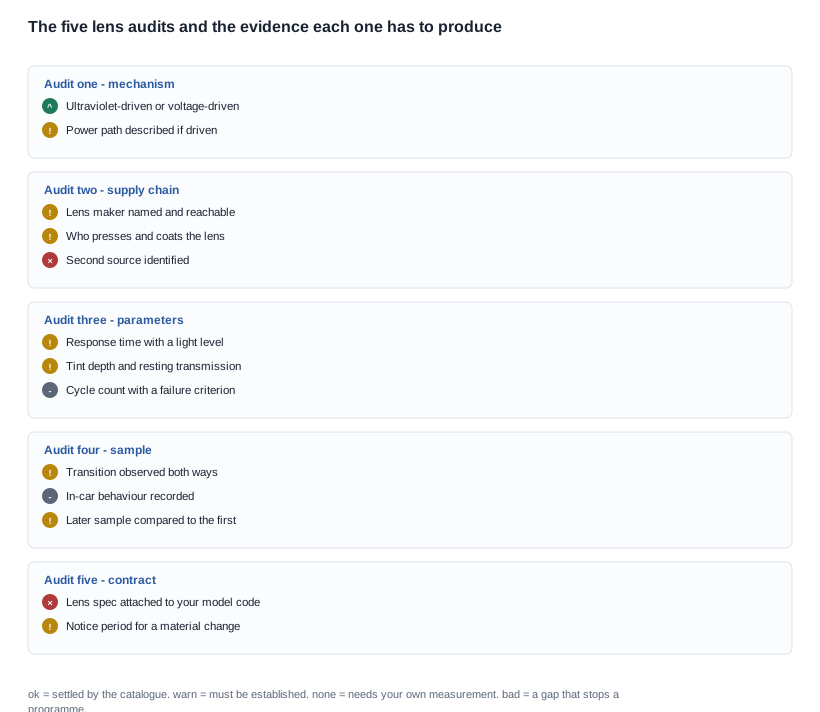
So the audit has five parts, and the order is not arbitrary. It runs from the cheapest question to the most expensive one, and each part assumes the previous one passed:
- Establish the mechanism. One binary question. It decides the behaviour, the power budget, the compliance questions and roughly half the price.
- Establish where the lens comes from. Whether the supplier presses and coats it, or buys it and fits it. This is the question that tells you whether their answers are first-hand or second-hand.
- Establish the parameters, and whether they arrived with a method. A lens specification without a measurement behind it is a brochure.
- Test a sample yourself. A lens can be evaluated without a laboratory, and doing it before you sign saves a great deal of argument later.
- Fix the arrangement in the contract. Who owns the specification, what happens if the lens maker changes the material, and who supplies a second source.
The right-hand column of the chart above shows the evidence each audit has to produce, and the markers show where that evidence normally has to be created rather than collected. In our experience of this category, audits one and two are usually answerable in an email, audit three is where a supplier's capability becomes visible, and audits four and five are the two that a buyer most often skips.
Three kinds of evidence, and only one of them is worth much
An audit produces evidence of three different qualities, and they are not interchangeable.
A claim is a statement about a product: "the lens darkens in under thirty seconds". It is free to make, it is usually true in some conditions, and it cannot be checked by anyone who does not already own the measurement method.
A record is a statement with an identifier attached: a certificate reference with an issuing body and a validity date, a test report with a date and a sample identifier, a batch record with a quantity. A record can be checked by a third party, months later, by someone who has never spoken to the supplier. It is the only kind of evidence that survives a customs inspection, a marketplace review or a warranty dispute.
A measurement is a number produced on a unit that resembles yours, under stated conditions, recorded by someone with a reason to record it accurately. It is the only kind of evidence that settles a disagreement between two suppliers.
In this category the ordering is unusual, and it is worth noticing why. For most electronic components you can buy the supplier's record and be done. For a lens, the record exists at the lens maker, the supplier's claim is a summary of it, and the measurement is usually yours — because there is no standard method published for anyone else to use. That is why the audit sequence above moves from the mechanism, through the chain of custody, into the parameters, and ends on your own sample. Each step is producing a different quality of evidence, and the final one is the only one specific to your product.
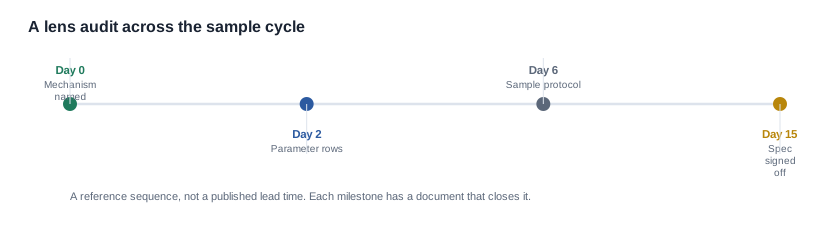
The practical consequence for a buyer with a deadline is that the measurement steps cannot be compressed. You can obtain a certificate reference in an afternoon. You cannot obtain a temperature-correlated switching curve in an afternoon, and no supplier will do it for you on a rush basis without a charge that reflects the cost of doing it twice.


Audit one and two: the mechanism, and who presses the lens
Audit one is binary, and it is asked first
An ultraviolet-driven lens is a passive material. It darkens in sunlight, clears in shade, needs no power, and it does nothing behind a car windscreen because the glass has filtered out most of the ultraviolet that drives the reaction. It also changes slowly, which is a design constraint rather than a defect.
An electrically driven lens is an active component. It darkens when it is told to, clears when it is told to, responds quickly, can be programmed, and needs a cell, a driver circuit and a control path. It introduces a state question — what the lens does when the cell is empty — that the passive route never has to answer.
Our own range shows why the question has to be asked even of a supplier you have already shortlisted. The dedicated colour-change model we publish is electrically driven, with Bluetooth V5.4, a charge time of two hours or less, magnetic charging, a 100 mAh cell and a rated runtime of about seven hours. The V03 Pro lists a colour-change lens as a feature alongside its camera specification, and we treat that as a configuration option rather than as a separate product line. Two mechanisms, one catalogue, one word.
Write the mechanism into the specification, not just the word. A supplier who answers "photochromic" to a question that asked for "ultraviolet-driven or voltage-driven" has told you they have not read their own configuration file, and that is useful information.
Audit two separates two different businesses
A lens manufacturer and a company that buys lenses and assembles them into frames are different businesses, and the difference shows up in three places.
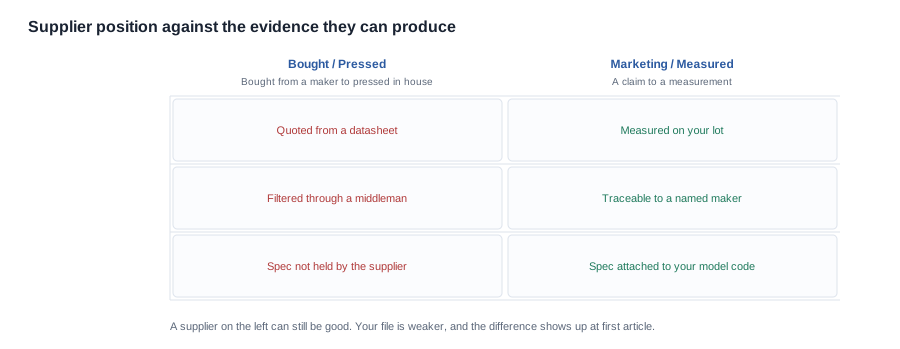
A manufacturer can explain why a lens behaves as it does, and can tell you which of its own parameters is adjustable and which are fixed by the chemistry. A buyer of lenses can only quote what their own supplier told them, which is a filtered version of the same information — and filtered twice in the case of a trading company with no pressing line at all.
Only a manufacturer can tell you whether your order is being placed against a production batch or a hand-selected sample, and only a manufacturer can tell you what the lead time actually consists of.
The question is simple to ask and revealing to hear answered: do you press and coat the lens yourselves, and if not, who do you buy it from, and can I deal with them directly? A supplier that will name the lens maker is a step further along than one that will not. A supplier that is the lens maker is a different conversation altogether — about minimum volumes, change control and custom tint.
The reason this matters commercially is that it determines who bears the risk of a lens change. If the assembler buys from a maker, the maker's material revision reaches your product through two organisations, neither of which may consider it a change at all. If the assembler presses and coats the lens itself, the specification sits inside the organisation you have audited.
Audit three: the parameters that need a method attached
A lens specification is meaningless without the measurement behind it. These are the rows to insist on, and for each one the question is the same: what condition was it measured under?
Response time, with the light level and the instrument used. A transition quoted without an illumination level and a measurement method cannot be compared with any other number, because response depends on how hard the light is driving it and on the temperature of the lens. Ask for both directions. A supplier who has measured one direction and quoted it as a single number has given you half a figure and made it look complete.
Tint depth and resting transmission. Both values, on an actual sample. A supplier who quotes only the darkest value is quoting the number that flatters the product and omitting the one that describes it.
Operating temperature range. This is a commercial row as much as a technical one. A lens rated for a narrow band is a lens that cannot be sold into a market with winter conditions, and discovering that after your artwork is signed is expensive and slow.
Cycle life, expressed as a number of light-dark transitions tested. This is what separates a lens that will last two summers from one that will not. Ask what happens at the end of that count, and whether the count is a laboratory figure or a field figure.
Ultraviolet blocking and visible light transmission. These are the optical rows that determine whether a wearer accepts the product. A lens that darkens correctly but transmits too little visible light gets taken off within an hour, and a return for that reason carries no signal about the lens at all.
And then the row that applies to all of them: which of these were measured on your production lot, and which were copied from the lens maker's datasheet? That single question separates a supplier who has a process from a supplier who has a purchasing relationship.
The documentary row sits alongside the parameter rows, and it is where the audit most often uncovers a scope problem. Ask which model designations the documents name, and ask whether the configuration you are ordering appears on that list. In a family where several models share their electrical rows, this is the check that catches a substitution, and a mismatch here is a stop condition rather than a query — a document covering a platform does not cover a branded configuration of that platform. The same logic applies to the lens maker's own material documentation: it covers the material, not the assembly, and the assembly is where the lens actually sits in the frame. Our own procurement reference for the document set is under certification checklist, and the specific point to test on a lens programme is whether the lens module appears in the material file or whether it has been treated as part of the frame.

Audit four: what a lens sample can prove without a laboratory
A lens sample can be evaluated in a way that does not require a laboratory, and doing it before you sign saves a great deal of argument later. Four observations do most of the work.
Put the lens under a strong ultraviolet source and watch the transition happen. Note how long it takes to darken and how long it takes to clear, and note the ambient temperature. Write both readings on the same sheet. A supplier who has quoted a switching figure will recognise the measurement; a supplier who has not will find the observation confusing, and that confusion is itself a signal.
Put it behind a window and note what happens. If nothing changes, the mechanism is ultraviolet-driven. If the lens changes in response to a button rather than to light, it is electrically driven. This is the cheapest mechanism test available, and it takes seconds.
Measure or photograph the darkest and lightest states against a reference card, and keep the card. A photograph is the only form of this evidence your channel team can reproduce when a customer disputes the effect, so take the photograph rather than relying on a description.
Compare a second sample from a later date against the first. This is the observation that tells you whether you are buying a lens or a batch, and it is the one that most often changes a supplier's answer to the tolerance question. Suppliers with a controlled process find this comfortable; suppliers without one tend to treat it as a trick question.
If you run these and the results differ from the specification you were given, you now have a factual basis for the conversation. That is a much better position than a general sense that something is off, and it is a much better position than an argument about whose reading is correct.
Audit five: the clauses that keep a lens specification from drifting
The last audit is the one buyers skip and later regret, because nothing goes wrong on the day it is signed. Four questions carry most of the value.
Who owns the lens specification? Meaning: if the lens maker changes the material or the coating, does your product change without your agreement? The test is whether the specification is attached to your model code in a document both sides have signed. If it is not attached, it does not exist yet, however good the sample looked.
What happens to your compliance file if the lens changes? A change in lens material can affect the substance declaration and, depending on the configuration, the optical description of the product. The clause you want is a notice obligation with enough lead time to act on it, not a courtesy notification.
What is the notice period? A clause with no interval in it is a clause with no protection in it. Three months is a common figure for a material change; the number matters less than the fact that it is written down and that it starts from a defined event.
Who supplies the second source if the lens maker stops? A single-source lens in a frame is a single point of failure that nobody notices until the shipment is late. This is a question about continuity, and a supplier who cannot answer it has not thought past the first order.
On the commercial side, the specification you audit is the one that governs the quotation. The lines worth negotiating are the number of configurations and their individual minimums, the artwork round count, the packaging and insert design including the market labels and the language of the documentation pack, the delivery split against a sample-approval milestone, and the payment sequence — an opening deposit, a balance on the inspection result, and a retention tied to the file. What is not a lever is the certification cost or the certification elapsed time, which are fixed per product family and set by the test laboratory's queue; and the tooling, which is a one-off cost normally amortised across the first order, where the useful questions are over what volume it is amortised and what happens to it if the programme is discontinued.
What we can verify about our own lens entries, and what we cannot
The boundary we hold: we publish the rows we have and mark the rest as not published, which in this category means quite a lot of marking.
We publish the electrically driven colour-change model as Bluetooth V5.4, a 100 mAh cell, a charge time of two hours or less, roughly seven hours of rated runtime and magnetic charging. We do not publish a tint depth, a response time, a transmission figure, a temperature range or a cycle life for it, and we will not estimate them from the general behaviour of electrochromic lenses. We do not publish a model designation for it either, which is a row that has caused practical difficulty for buyers comparing it line by line with a competitor.
We publish the V03 Pro photochromic configuration through the platform rows — 8 MP, 220 mAh, Type-C charging, flexible temples, three colour options — and we publish no lens performance figure for that configuration either.
We publish one weight in the entire catalogue: 158 g for the MT6 camera platform, excluding its foldable charging case. No model in the range publishes a weight with a light-responsive lens fitted.
That means we cannot complete audits one to five for you on our own lens, and we would rather say that plainly than present a completed audit card for a product we hold no data on. What we can do is walk through the same five audits with you, tell you which of the eight rows we can answer today, and tell you which ones need the lens maker's own file before anyone signs anything.
We also make no claim of eye-protection, vision or health benefits for any product in any market. A lens that changes the light transmission of a product is a visible feature, and a visible feature is one your customer will describe back to you in their own words — which is exactly why the mechanism has to be named on the page.
Related reading
- The two lens technologies and how they differ — photochromic and electrochromic lenses
- Where the lens sits in the selection of a platform — photochromic smart glasses
- The cost side of the same decision — cost against performance
- The evidence a supplier should be able to produce — certification checklist
Send us the lens specification you have been given and we will tell you which rows are missing, which are ambiguous, and what to ask for before you sign.


