

Photochromic: questions answered at the specification stage
A light-responsive lens is the one feature in this catalogue that buyers most often specify before they have decided what they are buying, and most often get wrong in the same way. The wrong way is to treat "photochromic" as a single product, when the word covers two mechanisms that behave nothing alike: a passive lens driven by ultraviolet light in the environment, and an active lens driven by power in the product. The first costs almost nothing to add and does nothing without sunlight. The second costs a cell, a driver, a control path, a firmware function and a charging routine, and gives the wearer a tint they can command. A buyer who has not decided which of these two products they are buying cannot set a specification, and every downstream step — the quotation, the claim wording, the sample approval, the return rate — inherits the ambiguity.
The second thing the question set usually gets wrong is the order of the questions. Buyers ask first about the mechanism, then about the appearance, then about the price. The commercial order is the reverse. The decisive questions are: how deep does the tint go, how fast, in which direction, at which temperature, and how many cycles before it fails. If the answers to those five are not in the supplier's file, then the price, the mechanism and the appearance are all negotiating over something that has not been defined.
Our catalogue publishes two lens routes, and they are separate products rather than two configurations of one product. The first is the V03 Pro, an 8 MP camera platform with a 220 mAh cell, a rated runtime of five to eight hours, charging in two hours or less over Type-C, flexible temples and three published colour options, where a light-responsive lens appears as a listed configuration. The second is a dedicated electrochromic entry with no model designation at all, a 100 mAh cell, magnetic charging, a rated runtime of roughly seven hours and Bluetooth V5.4. The absence of a model designation on the second entry is not a formatting detail; it is the single fact that decides the schedule, and it is treated in the section on the certification trap below. The mechanism behind both routes is covered in more depth on the photochromic lens technology page.
What we do not publish, for either route, is the performance of the lens itself: no switching time, no transmission range in either state, no tint depth, no uniformity tolerance, no temperature range, no cycle life. Those are not oversights. They are the numbers a lens supplier holds and a lens buyer must obtain, and the useful output of a catalogue without them is a precise list of what to ask and what to hold the answer to.
The four questions buyers ask in this order
- Is it photochromic or electrochromic? The mechanism decides the cost, the power budget, the flat-battery behaviour and the claim wording. Until it is answered, the quotation is not comparable with anything.
- How dark does it get, and how fast? Depth and switching speed in both directions decide whether the product works in the customer's day or only in a demonstration.
- Does it need power to change? A powered lens needs a charging routine, a driver and a firmware function, and it has a state to specify for when the cell runs down.
- What is the model designation? A product that cannot be named on a certificate, on a package or at customs cannot be documented, and an undocumented product cannot be insured or warranted.
The reason this ordering matters commercially is that the first question is answerable from any supplier's data sheet, while the second and third are the questions that actually separate two quotations that look similar on unit price. A buyer who asks the four in the wrong order spends a sample round discovering the difference. A buyer who asks them in this order can often eliminate one route before any sample is produced.
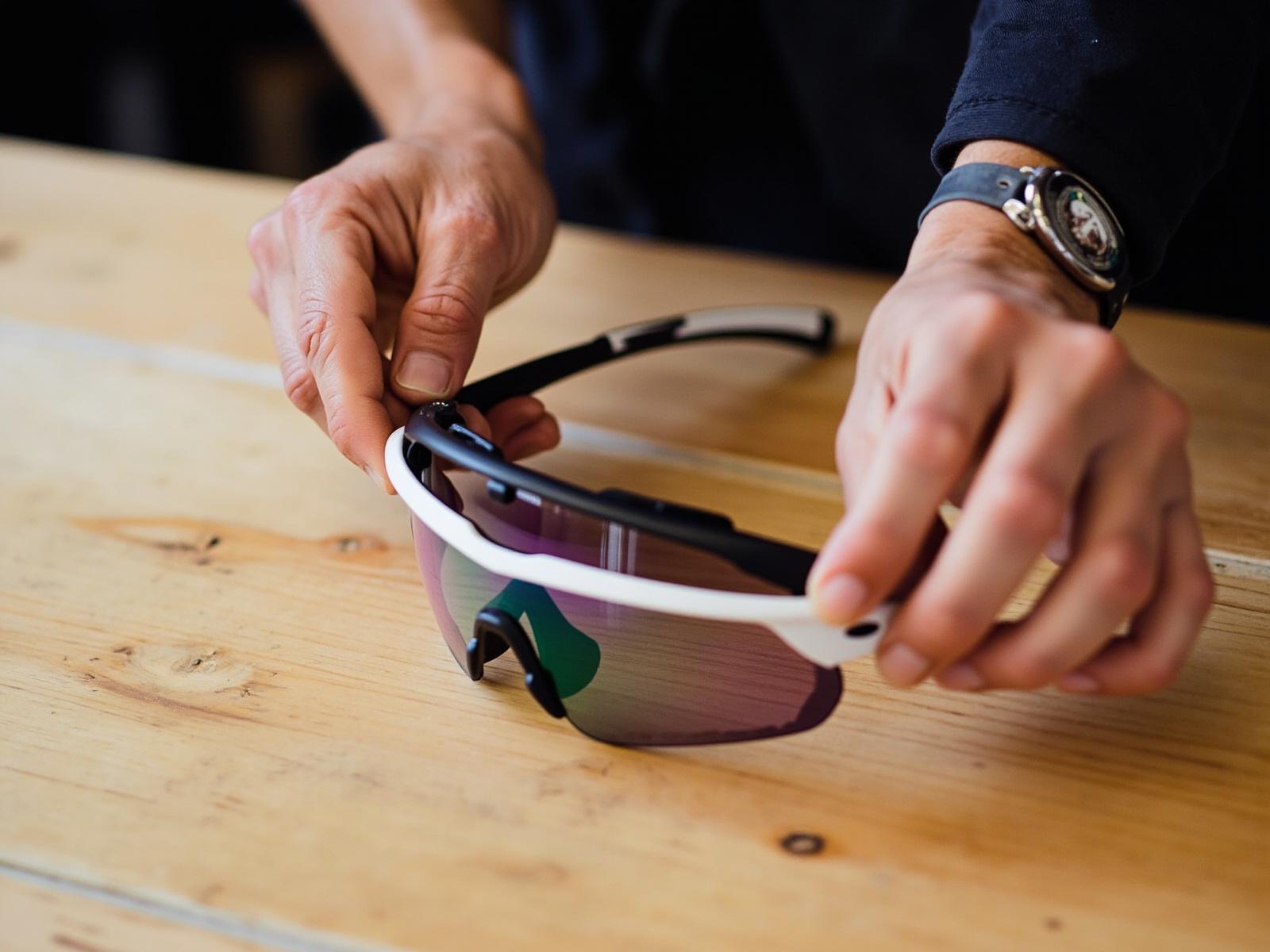
Passive and active are two products, not two settings
The distinction is worth stating in commercial terms rather than technical ones, because it is the distinction that decides the cost structure of the programme. A passive ultraviolet-driven lens is a component with a manufacturing specification attached to it. It scales with unit volume, it adds nothing to the electrical design, and it imposes no obligation on the user beyond putting the glasses on. An active lens is a sub-system: it brings a cell or a share of one, a driver circuit, a control path from the product's own electronics, a firmware function, and a charging interface that has to be specified. It also brings a question that a passive lens never raises, which is what the product does when the cell is flat.
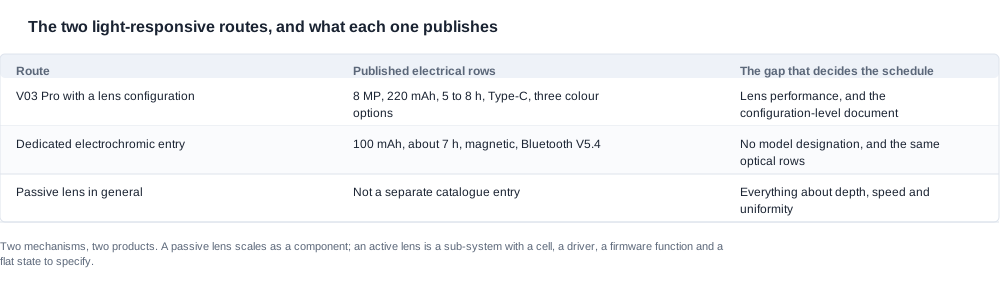
The table above is the whole published lens position in our catalogue, with the gap that each row leaves attached to it. Two consequences follow directly from it. The first is that the V03 Pro route is the cheaper programme: the lens enters as a configuration on a camera platform that already exists, so the setup, the artwork and the platform documentation are already in place and the marginal cost is the lens itself plus the new combination in the schedule. The second is that the dedicated electrochromic entry is a separate product with its own bill of materials, its own technical file, its own artwork and its own conformity position — and, because it carries no model designation, none of that can be attached to a document until the designation is issued.
The most common commercial error in this category is comparing the two routes on unit price alone. A passive lens in a volume order is a small number that the supplier knows is a small number, and the setup and re-validation costs attached to the active route are where the programme is actually decided. Two quotations that look like a fifteen per cent gap on unit price can be a two-fold gap on the whole programme once the platform change, the documentation re-issue and the artwork round are counted. The buyer's negotiating capital belongs on the setup lines, the per-configuration minimums and the market list, not on the lens unit price.
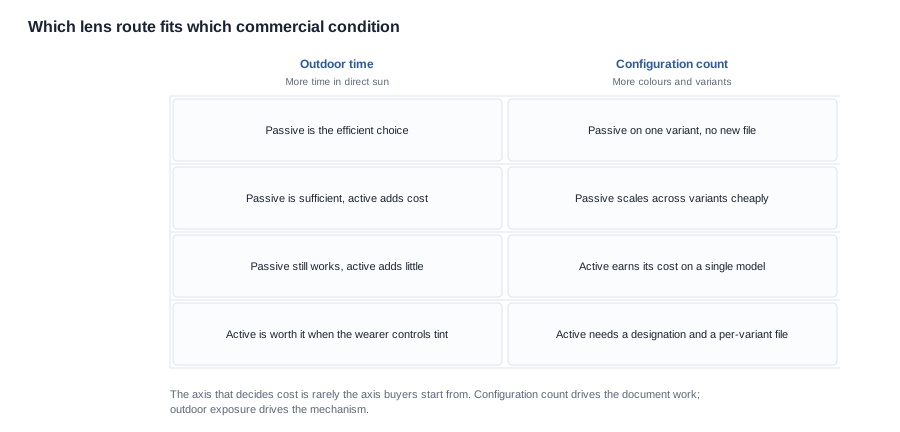
The tint depth that never appears in a listing
Depth is the number that decides whether a light-responsive lens is a feature or a decoration, and it is almost never quoted. A lens that moves from a high clear transmission to a moderate dark state and one that moves from the same clear state to a low dark transmission are different products with the same retail name, and a listing cannot tell them apart. The threshold to hold is a transmission range with the units and the method stated, and it must include the clear state. A supplier quoting only the darkened figure has quoted the part that looks good on a beach and has said nothing about the indoor experience, which is the part a customer spends most of the day in.
The measurement method matters as much as the number, because transmission is a spectral quantity and the figures most often seen in retail material are a single wavelength or a heavily weighted average. A buyer who wants a comparison needs to know whether the figure is a weighted average across the visible band, what the instrument was, and what the sample condition was. Two suppliers can each be correct and still be describing different quantities. The warning is worth stating plainly: transmission figures from different suppliers are not directly comparable, and the reason is usually the measurement rather than the lens.
There is a second depth question that matters commercially and is almost never asked: the uniformity of the tint across the lens. A centre reading is easy and nearly useless, because a customer notices edge-to-centre variation before noticing an average. The threshold to hold is a maximum difference between zones on a stated grid, agreed before the first article rather than discovered at it. A tolerance set after the first article is a tolerance that has already been missed, and in a lens programme that typically means a re-tool, a re-run and a date that moves.
Temperature, the number nobody quotes
Every lens supplier quotes a temperature range, and almost every quote is wider than it is useful, because the range is usually a laboratory survival range rather than a performance range. The commercially meaningful question is not whether the lens operates at the extremes; it is how slow it is at the cold end. A lens that takes ninety seconds to reach a moderate darkness under strong sun may take several minutes to reach full darkness under weak winter light, and the second scenario is the one a customer in a northern market is standing in during the selling season.
The threshold to hold is a pair of switching times — one per direction — each with an initiating light level, an ending light level and a temperature. The reason both directions are needed is that the two are not symmetric: the transition into darkness is driven by the light, and the transition back is driven by the temperature and the residual energy in the coating, so a lens that clears quickly in a warm room may linger in a cold one. A supplier who quotes one direction has quoted half the behaviour, and the half they quoted is the one that happens on a beach.
This is also where the claim in the listing is won or lost. A claim that says the lens adapts to light conditions is defensible with any mechanism. A claim that says the product is a pair of sunglasses is a claim about depth, and depth is a number the supplier has to hold. In a category with no published baseline, the difference between a narrow claim and a wide claim is worth more than the price difference between two quotes.

How to test a light-responsive lens before you sign
Verification here is documentary first and physical second, and the order matters because a physical test without a written threshold produces a number you cannot use. The sequence below has five steps, each of which assumes the previous one passed.
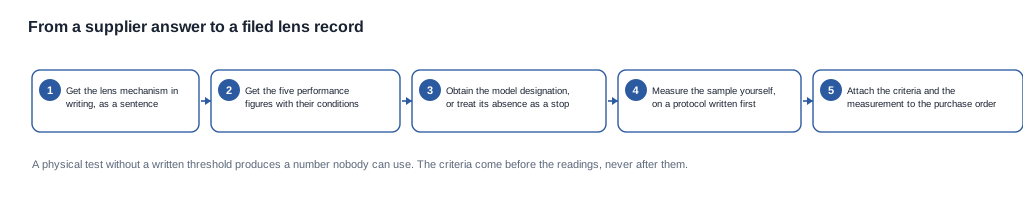
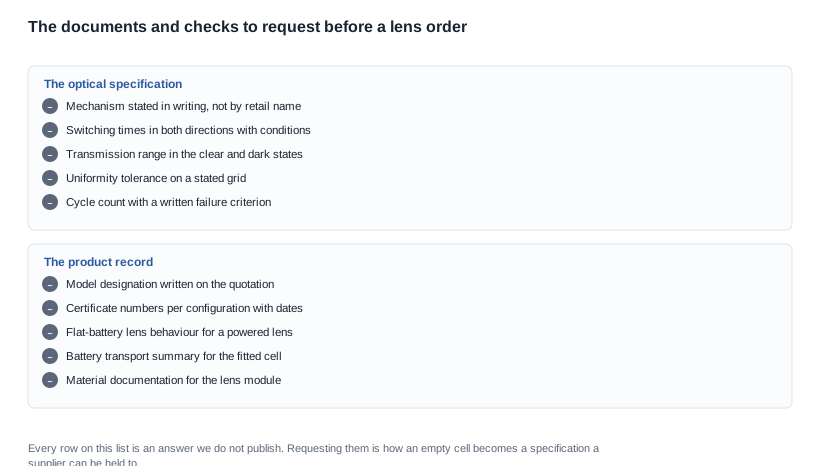
Step one: get the mechanism in writing, as a sentence. "Photochromic" and "electrochromic" are retail words; a supplier's written mechanism statement is a specification. Ask whether the lens is driven by ultraviolet light in the environment or by power in the product, and ask what happens to the lens when the product's cell is flat. A passive lens has no flat state, and a powered lens does, and the answer changes the user guide, the support script and the claim.
Step two: get the five numbers with their conditions. Switching time in each direction, the transmission range in the clear and dark states, a uniformity tolerance, the temperature range, and a cycle count with a failure criterion attached. Ask for the conditions with each one. A figure without conditions is not usable in a specification and should be removed from the comparison table rather than carried into it, because a number that looks better than a competitor's and means something different is worse than a blank.
Step three: get the model designation, and treat its absence as a stop condition. This is the step that is routinely skipped and routinely regretted. A product without a formal designation cannot be listed on a certificate, cannot be described correctly at customs, and cannot be the subject of a warranty claim that names a product. If the supplier says the designation will follow, the correct answer is that the designation is a precondition of the first order rather than an administrative item, and the date is derived from it.
Step four: run your own measurement on the sample, on a fixed protocol. The protocol that closes the rows is short: a comparison photograph against a lens you already own, in the same light, at the same moment; a stopwatch timing in one direction and then the other; a run in a cold environment; and a run with the cell state varied so the flat-battery behaviour is observed. Write the protocol down before the first reading, because a protocol designed afterwards is a description of what you saw.
Step five: put the criteria and the measurement into the purchase order. In a category with no published standard, the contract is the standard. Criteria held only in an email are not binding; criteria attached to the order are the acceptance standard, and a lot that fails them is a lot you can refuse.
The certification trap in a family document
The most expensive paperwork mistake in this category is treating a family-level document as coverage for a configured product. A family certificate may cover the platform; it very often does not cover a specific lens configuration, a specific colour combination, or a specific market. The symptom is not usually visible at the factory gate. It appears as a customs query, a marketplace rejection, a compliance review that asks for the document covering the variant, or a warranty claim that cannot be settled because the product in the box is not the product on the paperwork.
The prevention is mechanical and cheap. Put the exact model designation on the purchase order, with the configuration written the same way it will appear on the box. On receipt, check the string on the units against the string on the order. Add a clause requiring the documentation pack to be reissued for any configuration change. And in the European Union, check the conformity position against the Radio Equipment Directive (EU) 2014/53/EU — the radio equipment directive, not the EMC directive, which is a separate instrument — because a powered lens with a radio makes the product subject to the radio rules regardless of the lens itself.
The last point is worth a second sentence, because it is the point where a lens programme quietly becomes a radio programme. A passive lens on a product that already carries a radio changes the optics and the marketing; it does not change the conformity scope. An active lens adds a function to the product, and the question of whether that function alters the radio assessment, the safety assessment or the cybersecurity obligations has to be asked before the design is frozen, not after the first market is blocked.
The protocol you can run on one sample
The five steps above look heavier than they are, because most of them are a single sample unit and a single afternoon. A buyer who arranges one sample, keeps it for two days, and follows a written protocol will end up with better information than a buyer who collects six sample units and compares impressions. The reason is that the protocol forces the conditions to be stated, and the conditions are where the differences live.
The one discipline that cannot be skipped is the order of the readings. Start with the flat-battery state, because it is the state a customer will meet first and the one nobody tests. Then run the clear-to-dark transition, because it is the transition the listing photograph captures. Then the dark-to-clear transition, because it is the transition that decides whether a customer can see indoors. Then the cold run, because it is the transition that generates complaints in a northern market. Recording the readings in that order means the last reading is the one you will remember, and it is the one that decides the return rate.
The three programme failures that arrive after launch
Lens programmes rarely fail during the sample round. They fail in the weeks after the launch, and they fail in three recognisable ways, each of which has a symptom, a root cause and a prevention available at zero cost before the deposit.
The claim outruns the evidence and the return arrives with a photograph. The symptom is a customer reporting that the lens does nothing, usually with a picture taken in a condition the product was never specified for. The root cause is a copy line written from the retail word rather than from the mechanism. The prevention is to fix the claim wording before the product page is written, and to let the copy describe the mechanism instead of the outcome the customer hopes for.
The product performs correctly and is still returned, because the expectation was set by a different technology. The symptom is a cluster of returns from a single channel, with descriptions that do not match the product. The root cause is that a buyer who has handled mineral photochromic lenses carried that expectation into a listing for a powered lens. The prevention is to state the mechanism in the copy and to set the expectation consistently across the listing, the packaging and the support script.
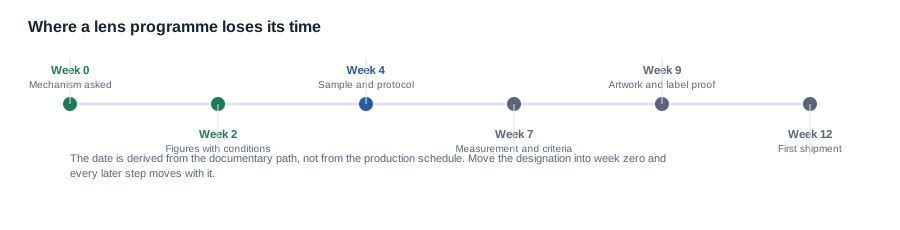
The programme is a month late and the cause is a document rather than a factory. The symptom is a launch date that slips while the factory reports that the units are ready. The root cause is that the designation, the artwork and the technical file all waited on one another, and the designation was requested last. The prevention is to request the identifier in the first exchange and to derive the date from the documentary path rather than from the production schedule.
The commercial terms, and the line that cannot move
Three groups of cost sit inside a lens programme, and they behave differently enough that a buyer who negotiates them as one category wastes effort. The variable group is the lens unit price, which falls with volume and which the supplier knows is a small number. The setup group is tooling, artwork, the platform change and the documentation re-issue, and it is where the negotiation actually changes the outcome: the per-configuration minimum moves when a buyer commits to a combination count rather than a unit count, the artwork round count is negotiable and each round costs a week, and the market list is a negotiation as much as a decision, because a channel served from markets where approvals already exist is worth a better price than one that requires new testing.
The third group is fixed in both cost and duration, and the useful thing a buyer can do is to say so early rather than to argue about it later. Certification cost and certification time are a property of the test laboratory and of the product family, and pressing on either produces a longer schedule rather than a shorter one. Tooling is a one-off cost which is usually amortised across the first order, so the questions worth asking are over what volume it is amortised and what happens to it if the programme is discontinued. The re-validation cost of a configuration change is per configuration, and it is the line that compounds quietly across a range.
The documents to request before the deposit are: the certificate numbers with the issuing body and the validity dates, per model designation; the written mechanism statement; the switching times with their conditions; the transmission range in both states, or a written statement that it is not published; the flat-battery behaviour of a powered lens; the material documentation for the lens module, per material; the battery transport summary for the fitted cell; and the model designation written on the quotation itself.
What the photochromic contract has to say
A photochromic option decision, step by step
This is a hypothetical scenario, written to show the decision sequence rather than to report a client result. Assume a European outdoor brand with four colourways and an existing camera platform, currently shipping into three markets, considering a light-responsive lens option for a spring line. The constraint that matters is not the lens. It is that the brand's own listing reviewer rejected a claim in the previous cycle because the supplier's data sheet had no measurement behind it, and the brand does not want to repeat that.
Step one: the mechanism. The channel is cyclists and trail runners who spend hours outdoors, and the complaints they send are about swapping glasses rather than about vision. The exposure is direct sun, so a passive ultraviolet-driven lens is mechanically sufficient, and it removes a cell, a driver, a firmware function and a charging routine from the design. The brand's engineering lead notes that the passive route also removes the flat-battery question entirely, which removes one of the acceptance criteria they would otherwise have to write.
Step two: the demonstration. Rather than accepting the supplier's figure, the brand buys one unit, places it beside a mineral lens the team already owns, and photographs both in the same light at the same moment. The result is a tint visible in a photograph, which is the test that matters, because the brand's product photography will show the lens. The brand records the protocol and the observation on a single page, and that page becomes the source of the copy.
Step three: the paperwork. The brand asks for the certificate numbers per configuration and finds that the family-level document names the platform rather than the lens configuration. That is a real gap, and it converts the model designation from an administrative detail into a precondition. The brand makes it a condition of the first order and puts a re-issue obligation into the contract.
Step four: the commercial structure. Four colours with a lens option is four new combinations, and the brand negotiates the per-configuration minimum on the basis of a committed combination count rather than a unit count. It moves the artwork approval earlier than it normally would, because the lens configuration has to appear on the box, and it adds one artwork round for the feature demonstration to the schedule.
Step five: the claim. The brand's copy says the lens adapts to light conditions and makes no claim about sunglass depth, because no transmission range was available. The listing reviewer accepts it, because the claim is now narrower than the evidence rather than wider.
The result is a cheaper programme, a narrower claim, and a schedule with one identified precondition rather than four unowned risks. The decisive point of the walk-through is that none of the decisive decisions were made at the sample stage, and the lens specification was never the thing that decided the outcome.
What we publish about lenses, and what we do not
We publish the electrical rows for every model we list, including the rows for the two lens routes: the V03 Pro as an 8 MP camera platform with a 220 mAh cell, a five-to-eight-hour rating, Type-C charging and a photochromic lens listed as a configuration; and the dedicated electrochromic entry as a 100 mAh, roughly seven-hour, magnetic-charging product with Bluetooth V5.4 and no model designation. We do not publish switching times, transmission ranges, tint depth, uniformity tolerances, temperature ranges or cycle lives, because we do not hold verified figures for them, and a number we cannot support is a liability in a technical file rather than an asset in a sales conversation.
We also do not publish a frame weight for the lens routes, and we would rather tell a buyer that than quote a typical figure from another model. The one weight our catalogue states belongs to a different product in a different family, and borrowing it into a lens discussion would be a factual error dressed as a specification.
What we will do is walk a buyer through the published rows, confirm which configurations exist and which do not, and state plainly where a specification in the brief is one we do not hold. If a requirement is optical rather than electrical, the productive next step is to write it as a threshold with a method and put it in front of a supplier willing to be measured against it. That is the whole basis on which a lens programme is bought, and the photochromic lens technology page is where the mechanism behind both routes is set out in more detail.


