

Photochromic lenses: the mechanism question behind a colour-change programme
The colour-change mechanism decides the product, not the depth of the tint. A lens driven by ultraviolet light in the environment and a lens driven by an electrical signal from the product are different products, with different bills of materials, different service requirements, different failure modes and different documentation. The trade uses one word for both, and a buyer who accepts the word is accepting a quotation for a product that has not been chosen yet.
That is why the first question in this category is not about performance. It is: which mechanism, in the document that carries the price. Everything else in this article hangs off the answer, because a lens driven by ambient ultraviolet light behaves in one way, a lens driven by electricity behaves in another, and a quotation for one cannot be compared with a quotation for the other on price or on lead time.
The second question follows immediately, and it is about where the product will be used. A lens driven by ultraviolet light needs ultraviolet in the environment to work, which means it does not change much behind a vehicle windscreen, and it does not change at night, and it changes slowly in low winter light. A lens driven by electricity changes wherever the product has power, which is a different proposition entirely and brings a cell, a driver circuit, a control path, a firmware function and a flat-battery state into the specification. A programme that needs the lens to change indoors, at night or in a car can only be served by the second, and a programme that is outdoor and daytime only may not need to pay for the first.
The third question is administrative but decisive: is this a lens configuration on an existing platform, or a dedicated product? The two are different programmes. A configuration change alters the optical description and, on a camera platform, the imaging description as well, and it brings new artwork, new packaging and new documentation scope. A dedicated product has its own bill of materials and its own conformity file. The quotation for a configuration may quote the platform's price with a lens surcharge, which is not the same commercial object as a quotation for a new product.
Our own catalogue holds both kinds of entry, and reading them together is instructive. The V03 Pro lists a colour-change lens as a configuration option alongside its camera specification: an 8 MP platform with a 220 mAh cell, a rated runtime of five to eight hours, a charge time of two hours or less, Type-C charging, flexible temples and three published colour options. The dedicated light-responsive entry is published as electrically driven, with Bluetooth V5.4, a 100 mAh cell, a charge time of two hours or less, a rated runtime of roughly seven hours and magnetic charging — and, notably, with no model designation at all.
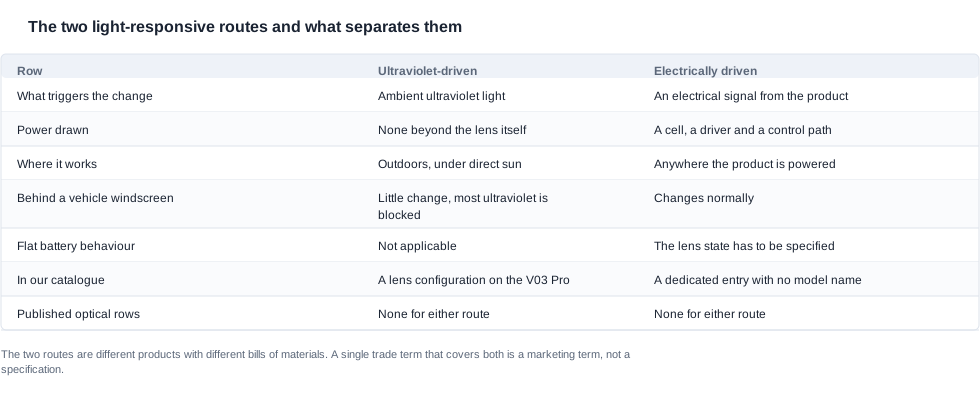
The five rows that decide the purchase
The mechanism, named. Passive ultraviolet-driven, active electrically driven, or a hybrid. The answer has to be a mechanism, not a trade term, and it has to appear in the document that carries the price.
Both transmission figures, and the state each is measured in. The clear-state figure describes the indoor experience and the dark-state figure describes the outdoor one, and the pair together describe the range the lens actually works across. A supplier who quotes one flattering figure has quoted half the specification. A lens that moves from ninety per cent transmission to twenty per cent and one that moves from ninety per cent to forty-five per cent are different products with the same story.
Both durations, and the light level that drives them. Switching in one direction and clearing in the other are separate behaviours with separate figures. The direction of travel, the initiating light level, the ending light level and the temperature all belong with the number, because a figure without them is positioning language rather than data.
The uniformity tolerance, on a stated grid. A centre reading is easy and nearly useless, because variation is noticed before an average is. Agree the tolerance before the first article, not at it, because a tolerance set afterwards is a tolerance that has already been missed.
The stock or made-to-order status, with the part number and the lead time. A stocked lens carries the lens maker's minimum and lead time, which the factory controls. A made-to-order lens carries a minimum and a lead time that the factory does not control and cannot compress, and that number is frequently the largest in the whole programme.
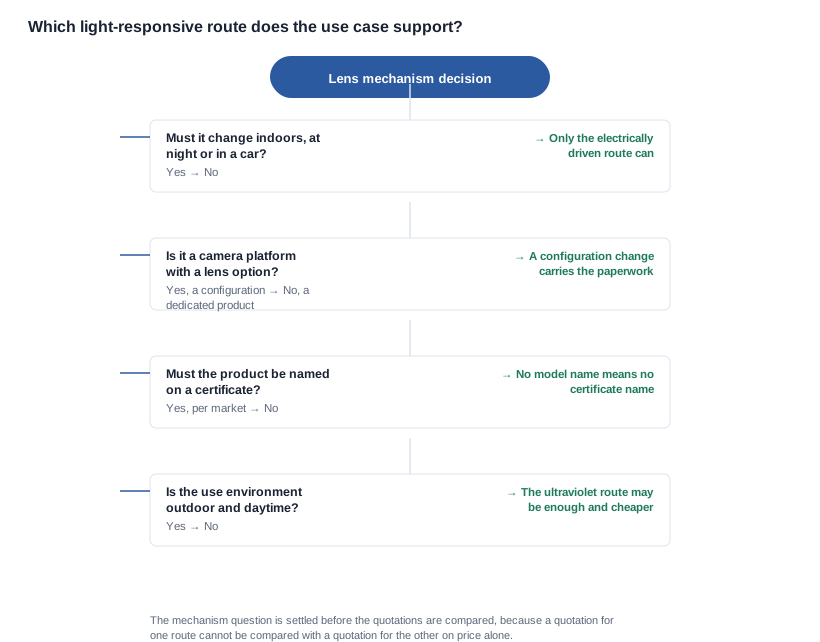
Who signs for a lens configuration, and what they are approving
The reader here is a brand-side product owner working with a procurement manager, or a channel buyer building a private-label range, or a merchandiser who wants a light-responsive option on an existing platform. The situation is one of three: comparing quotations that describe the lens differently, adding a lens option to a platform that is already in production, or opening a dedicated light-responsive product line.
What the buyer is approving is a change to the optical description of the product, and that is more consequential than it first appears. A configuration change is a product change. Whether it is welcome or not, the lens alters what the product is, and where the product also has a camera it alters what the product's imagery is. A change to the bill of materials, a change to the frame material and a change to the charging interface all carry the same consequence: the material documentation and the conformity position have to be reviewed rather than assumed to carry over.
Two people sign this, and they sign different things. The product reviewer approves the claim, and the claim is what the lens makes possible. The compliance or technical reviewer approves the documentation, and the documentation is what the lens makes necessary. When the lens is a configuration on a camera platform, both of those approvals need re-opening, because the approved sample on file describes a product without the lens. This is where programmes get stuck: the artwork is approved, the certification is filed, the launch date is set, and then someone realises the lens configuration has never been through a conformity review.
There is a third party that has an interest and rarely gets a seat: the customer who will buy the product in a vehicle. The most common commercial discovery in this category is that a light-responsive lens sold for driving does not change behind a windscreen, because the glass blocks most of the ultraviolet the mechanism depends on. That discovery arrives as a returns problem, and it arrives after the listing is written. The fix is not technical; it is to establish the environment before the mechanism is chosen, and to write the environment into the claim.
Where the cost of a lens mechanism sits in the quotation
Lens programmes are mispriced more often than any other configuration in this category, and the reason is that most of the cost is not in the unit price of the lens. It is in the setup, the specification commitment and the lead time, and the first two are fixed while the third sits outside the factory's control.
The visible cost is the lens itself. Its price depends on the technology, the size, the coating, the tint depth and the volume, and it scales with units, so it falls as volume rises. At a pilot quantity it is often the smallest line in the programme.
The less visible cost is everything the lens drags into the product. An active lens brings a cell, a driver circuit, a control path and a firmware function, and it may bring a case, which changes packaging, shipping weight and the battery transport paperwork that travels with the goods. A passive lens brings none of those, which is the single largest reason it costs less. A buyer comparing two quotations that describe the lens in the same words is comparing two different bills of materials.
The third cost is the specification commitment, and it is the one most often missing entirely. If the lens is a named feature rather than a commodity, the lens maker has to commit to a specification, and that commitment carries a minimum volume attached to it. At pilot quantities the specification commitment and the setup, not the unit price, dominate the difference between two quotations. Two quotes that look like a fifteen per cent gap on unit price can be a twofold gap on the whole programme once the setup and the re-validation are counted.
The fourth cost is the lens lead time, and it should be carried in the schedule as an external dependency with a date attached, in the same way a custom cell or a radio approval is. A made-to-order lens is frequently the longest single wait in the programme, and a buyer who has built the launch date around the factory's production schedule has built it on the wrong number.
The fifth cost never appears on a quotation: the substitution risk. The lens is the part of the product most likely to be quietly substituted and the hardest thing to check in a warehouse, because a substituted lens looks exactly like the one it replaced and the difference shows up only in a photograph. The defence is a clause tying the lens specification in the order to the specification on the approved sample.
So the buyer's negotiating space sits in the setup lines, the per-configuration minimums, the artwork rounds and the market list. It is not in the unit price of a lens in a volume order, which is a small number and which the supplier knows is small.

Turning a lens answer into a specification row
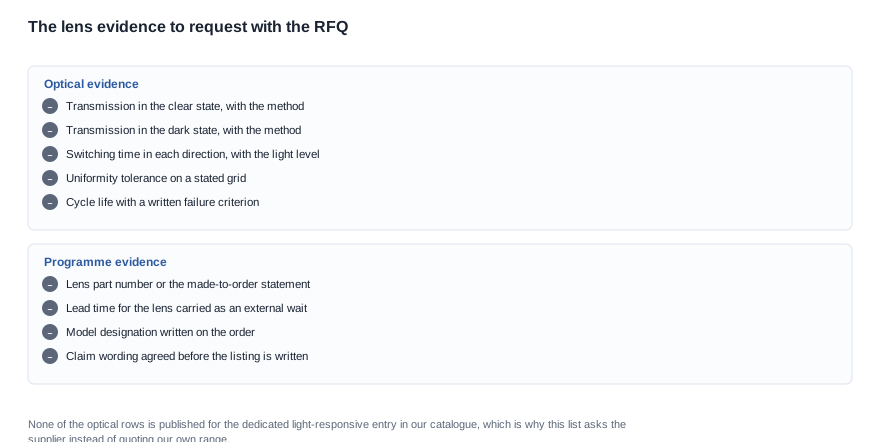
Verification in this category is mostly documentary, and it is quick once you know which five artefacts to request. The order below assumes each step passed the one before it.
Step one: ask for the mechanism in the document that carries the price. Not in a conversation and not in a product page. The word used on the listing and the word used on the purchase order should be the same word, and if they differ, the purchase order wins. A supplier who cannot state the mechanism in the quotation has not selected the lens yet.
Step two: ask for both transmission figures with the state each is measured in. The clear state and the dark state, each with its method. If the supplier will only give one figure, that figure is the one that flatters the product, and the specification is incomplete.
Step three: ask for both durations with their conditions. The direction of travel, the light level and the temperature. A supplier who cannot name the conditions has not measured the lens the way you need it measured, and the difference between two quoted fading times can be larger than the difference between two products.
Step four: ask for the uniformity tolerance and the cycle life with a failure criterion. The tolerance needs a grid and a measurement method. The cycle count needs a transmission level at which the lens is considered failed, written by you and applied by both parties. A cycle count without a criterion is a quantity rather than a service life, and it makes year-three behaviour unknowable.
Step five: ask whether the lens is a stocked part or a made-to-order part, and get the part number and the lead time. This is the question that decides the schedule. A custom lens carries a wait the factory does not control, and it is frequently the largest number in the programme.
Step six: test the use case against the mechanism rather than against the feature. Put the sample in the environment it is sold for and photograph it there, next to a lens the team already knows, in the same light at the same moment. That photograph is the test that matters, because the brand's own product photography will show the lens.
Step seven: tie the lens specification in the order to the specification on the approved sample. This is the clause that catches a substitution, and it is the clause that turns the lens from a hopeful description into a contractual attribute.

How lens programmes fail
The mechanism mismatch in a car. An ultraviolet-driven lens was sold for driving and does not change behind a windscreen. The root cause is that the environment was never written into the requirement. The control is to fix the environment before the mechanism is chosen and to never accept a trade term as a specification.
The fading time that decided the product. A lens that takes too long to clear indoors was evaluated without a fading figure. The root cause is that no fading figure was requested. The control is to require both durations with their light levels and to include them in the sample evaluation sheet.
The custom lens on a short schedule. A made-to-order lens was assumed to be in stock, and the schedule was built on that assumption. The root cause is that the stock status was never asked about. The control is to request the part number and the lead time and to carry it in the schedule as an external wait.
The tint figure without a state. A transmission figure was quoted at rest and read as the figure in use. The root cause is that one figure was accepted where two were required. The control is to require both states explicitly and to treat a single figure as an incomplete specification.
The substituted lens. The units in the channel look right and behave differently, and the difference is only visible in a photograph. The root cause is that the lens specification was never tied to the approved sample. The control is a substitution clause and a retained photographic reference from the first article.
They are everyday gaps rather than exotic ones, and none of them is grounds for changing supplier. They are reasons to put a line in the order.
The commercial terms a lens programme can move, and the ones it cannot
The commercial treatment of a lens is the item buyers most often underestimate, because the item that matters is not the one in the quotation.
The setup lines and the per-configuration minimums are the live numbers. The setup cost is the factory's fixed cost rather than a market rate, and it is the line where a per-configuration minimum actually moves. Where a lens option multiplies across colourways, committing to a combination count rather than a unit count is what moves the per-configuration minimum. Note the arithmetic: a four-colour range with a lens option is four new configurations, not one.
The artwork round count is negotiable and each round is a week. The lens usually needs to appear on the box and in the product photography, so an extra round is often needed. Agreeing the number of rounds in advance is worth more than negotiating the unit price afterwards.
The market list is a negotiation as much as a decision. A channel served from markets where approvals already exist is worth a better price than one that requires new testing, and the number of markets in the programme is a negotiated number.
Sample cost, evaluation unit quantities and first-article inspection allowances are negotiable and frequently given away. Under pressure on a first order these are easy to obtain and cost the supplier very little.
The lens specification itself is negotiable as a document. Agreeing the transmission range, the durations and the tolerance before the quotation is worth more than negotiating the unit price afterwards, because an agreed specification is what the sample can be tested against.
Certification cost and certification time are fixed. They are a per-family cost and a queue at the test laboratory. Pressing on either produces a longer schedule rather than a shorter one. Tooling is not usually involved in a lens change, but the artwork and the packaging are, and a configuration change that alters the optical description requires the conformity position to be reviewed rather than inherited. A re-test caused by a configuration change is charged per configuration, which makes it the line that compounds across a range.
The lens maker's minimum and lead time are not negotiable. A custom lens carries a commitment the factory has already made to somebody else, and no amount of negotiation at the factory level compresses it. The buyer's only lever is to ask for a stocked part, to accept a specification that a stocked lens can meet, or to move the wait to the front of the schedule where it can be managed.
The clauses worth having in the agreement are these. The lens mechanism and the exact lens part number, attached to the order. Both transmission figures with their states and methods. Both durations with their light levels and temperatures. The uniformity tolerance and the cycle life with its failure criterion. The flat-battery lens state, for a powered lens. The specification of the approved sample, tied to the order. And a clause requiring notice before any change of lens, coating, tint range or frame material, because each of those invalidates the configuration.
A worked example: an outdoor brand evaluating a colour-change option
A note on what follows: the case is constructed, it is not a client project, and it is written to show the sequence of choices rather than an outcome.
Assume a European outdoor brand with four published colour options and an existing camera platform, shipping into three markets, considering a colour-change lens option for a spring line. The constraint that matters is not the lens. It is that the brand's own listing reviewer rejected a claim in the previous cycle because the supplier's datasheet had no measurement behind it, and the brand does not want to repeat that.
The first decision is the mechanism, and it is decided by the environment rather than by preference. The brand's channel is cyclists and trail runners who spend hours outdoors, with direct sun exposure for most of the day. That is the case where a passive ultraviolet-driven lens is mechanically sufficient, and it removes a cell, a driver, a firmware function and a charging routine from the design. It also removes the flat-battery question entirely, which removes one acceptance criterion the brand would otherwise have to write. The brand's engineering lead notices this immediately, because the cost of an acceptance criterion is always higher than it looks.
The second decision is the demonstration, and it is deliberately cheap. Rather than accepting the supplier's figure, the brand buys one unit, places it next to a mineral lens the team already owns, and photographs both in the same light at the same moment. The result shows that the tint is visible in a photograph, which is the test that matters, because the brand's product photography will show the lens. The protocol is recorded on one page, and that page becomes the source for the copy.
The third decision is the paperwork, and it is where the programme nearly stalls. The brand asks for the certificate numbers per configuration and finds that the family-level document names the platform rather than the lens configuration. That is a real gap, and it converts the model designation into a precondition rather than an administrative detail. The brand makes the designation a condition of the first order and puts a re-issue obligation into the contract.
The fourth decision is commercial. Four colour options with a lens option is four new configurations, and the brand negotiates the per-configuration minimum on the basis of a committed combination count rather than a unit count. It moves the artwork approval earlier than it normally would, because the lens configuration has to appear on the box, and it adds one artwork round for the feature demonstration to the schedule.
The fifth decision is the claim. The brand's copy says the lens adapts to light conditions and does not claim a sunglass depth, because no transmission range was available to support one. The listing reviewer accepts it, because the claim is now narrower than the evidence rather than wider.
The outcome is a cheaper programme, a narrower claim and a schedule carrying one identified precondition instead of four unowned risks. Everything that actually decided it was settled before the sample order, and the price of the lens was not among those things.
What our catalogue says about light-responsive lenses, and what it leaves open
The published material on light-responsive lenses is the part of the specification we can stand behind, and everything else is a question for the supplier's own file. We publish the rows our catalogue states, we mark the open rows as open, and we will not quote a lens specification that nobody measured.
These are the rows we do not publish:
- The switching time in each direction, the light level and the temperature behind it, are not published.
- The transmission range in the clear state and in the dark state, and the method used, are not published.
- The uniformity tolerance and the grid it is measured on are not published.
- The cycle life and the failure criterion are not published.
- The lens part number, and whether the lens is a stocked part or a made-to-order one, are not published.
- The model designation for the dedicated light-responsive entry is not published, and neither is the flat-battery behaviour of its lens.
These are the rows our published data does settle:
- The dedicated light-responsive entry is published as electrically driven, with Bluetooth V5.4, a 100 mAh cell, a charge time of two hours or less, a rated runtime of roughly seven hours and magnetic charging.
- The V03 Pro lists a colour-change lens as a configuration option alongside an 8 MP camera specification, a 220 mAh cell, a rated runtime of five to eight hours, a charge time of two hours or less, Type-C charging, flexible temples and three published colour options.
- Across the wider range, the published Bluetooth rows run from V5.3 on the K01 and the K02 to V5.4 on the audio tier, and the charge time is published on every entry, at two hours or less on all but the D17 and the ZH12, which publish about one hour.
We will not infer a switching time, a transmission range or a cycle life from a mechanism name, and we will not present the electrically driven route as a more capable product than the ultraviolet-driven one without a measurement behind the comparison. What we will do is take a use case, a configuration and a target market, and tell you which parts are settled, which are open, and which have to come from a sub-supplier.
The photochromic lens pillar carries the full treatment, including the mechanism comparison, the glossary of the terms that turn up in supplier answers and the use-case breakdown.
The environment list that decides the mechanism
Write the environment into the requirement before anything else. Direct sun for a full working day, a vehicle cab, an indoor evening, a night shift — the list decides the mechanism, and the mechanism decides the bill of materials.
Then put five rows in the request for quotation: the mechanism named, both transmission figures with their states, both durations with their light levels and temperatures, the uniformity tolerance with its grid, and the stock or made-to-order status with the part number and the lead time. Ask for the model designation in the same round, because a lens programme that waits for it waits for the artwork, the file and the customs description at the same time.
Finally, photograph the sample against a lens you already know, in the same light, and keep the photograph. That single record becomes the acceptance reference, and it is what you would otherwise have to reconstruct from a customer complaint. Send us the configuration, the quantity and the target market and we will tell you which of the published rows apply and which questions are the ones we would put to the factory ourselves.
Related reading
- The mechanisms and what separates them — photochromic and electrochromic lenses
- The terms that come up in the answers — the colour-change glossary
- The scenario that decides the mechanism — colour-change lenses by use case
- The cost side of the same decision — cost against performance
Send the configuration, the quantity and the environment, and we will say which parts of the lens specification are settled and which are yours.


