

A sample request in this category looks like a small order and behaves like a miniature export. There is a lithium cell in the box, the paperwork is the same paperwork the commercial order will need, and the duration is set by the slowest element of a chain that most buyers never think of as a chain at all. A request goes out on a Monday and a buyer discovers the following week that the unit is waiting on a document that nobody asked for, or that the configuration was not the one they wanted, or that the shipment is sitting in a queue somewhere with no way to see it.
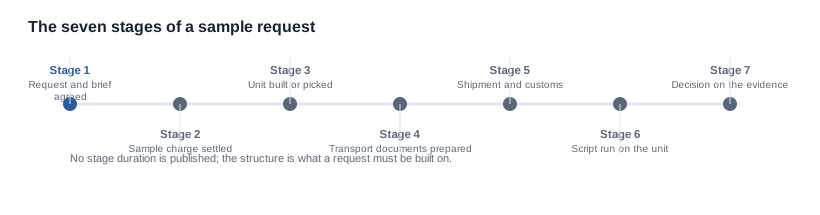
We do not publish a sample lead time, and that is a deliberate position rather than an omission. A published duration would be wrong for most requests, because the length of a sample timeline depends on the configuration, on whether the unit is drawn from stock or built, on the destination, on the customs treatment, and on how much of the chain the buyer has already prepared before asking. What we publish is the structure of the chain and what moves each part of it, so that you can build your own schedule and ask for the numbers that apply to your request.
There is a second reason the structure matters more than a number, and it is the more valuable one. A sample is the only rehearsal most programmes get of the commercial chain. A sample that moves cleanly proves something about the documentation, the route, the declarations and the paperwork that a specification sheet cannot. A sample that arrives after three emails and a customs hold has proven exactly the same thing, only at a far smaller cost than the first production shipment.
There is a third reason, and it is the one that keeps the subject interesting for buyers who have already been through it once. The same structure recurs in the production order, stage for stage, with the same handovers and the same failure modes — the only difference is the volume and the invoice. A buyer who has seen the chain work once, on one unit, has a map for the order that follows. A buyer who skips the sample has the map and the shipment at the same time, which is the worst possible way to acquire either.
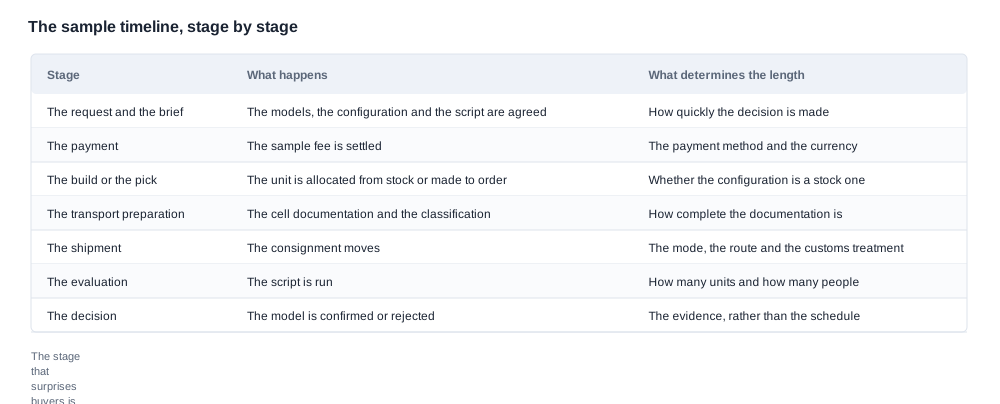
Requesting smart glasses samples: the seven stages of a sample
Stage 1 — the request and the brief. The models, the configuration, the destination and the criteria are agreed. This stage is determined by the speed of your decision rather than by the factory, and it is the stage you control completely. A request that names one model, one configuration, one destination and the questions it needs to answer can be answered quickly. A request that says "something for our first launch" cannot be answered at all, and the round trip it generates delays every stage behind it.
Stage 2 — the payment. The sample charge is settled. A cross-border transfer on a small amount carries charges at both ends, and on a modest fee those charges can exceed the fee itself. That is worth raising before the invoice is issued rather than after, and the payment method and the account details are the kind of thing that takes a day to get right and a week to get wrong.
Stage 3 — the build or the pick. The unit is either allocated from existing stock, which is the quick path, or made to order, which is not. The dividing line is the configuration: a stock configuration in a stock colour can often be picked, while a customised sample — with a logo, a colour and a packaging set — inherits the lead time of the components it depends on. The customisation points published across the range are logo, colour, packaging, temple shape, system and user interface, Bluetooth naming and firmware customisation, and each one adds to this stage differently.
This is where the shortlist decision bites hardest. If the buyer has narrowed twenty-eight catalogue entries to two candidates on the published rows, stage three may involve building two units rather than one, which lengthens it slightly but answers the question that matters. If the buyer has narrowed to one candidate but left the colour, the case and the packaging open, stage three becomes a build rather than a pick, and the timeline reverts to whatever the tooling and the artwork cycles require. Which model you request and how completely you specify it are the same decision, taken in different rooms.
Stage 4 — the transport preparation. The cell documentation, the classification and the commercial declaration are prepared. This is the stage that surprises buyers, and it surprises them because the documentation usually already exists and nobody expects to wait for it. It is also the stage where a mismatch between the document and the goods gets found, which is the cheapest possible moment to find it.
The reason this stage exists at all for a single unit is the cell. A smart glasses product is a lithium battery product, and the rules that govern a lithium consignment do not scale down for a sample. The same classification, the same declaration and the same handling apply whether the consignment is one unit or a full shipment, which is why the transport preparation for a sample is a genuine stage rather than a formality and why it can be requested in advance rather than waited for.
Stage 5 — the shipment. The consignment moves. The mode, the route and the customs treatment set the length, and for a single unit the forwarder's handling and documentation queue are frequently longer than the transit itself. The rules that apply to a lithium product apply to a one-unit consignment in the same way they apply to a full shipment, which is why a sample is not simply a small parcel and why the transport route is a real stage rather than a formality.
Stage 6 — the evaluation. The script is run on the unit. This stage is entirely yours, and its length depends on how many units you received and how many people are involved. It is also the stage most often underestimated: a proper evaluation involves multiple wearers, a fixed scene for the camera, a fixed workload for the battery, recorded results and a written conclusion.
Stage 7 — the decision. The platform is confirmed, or it is rejected. The evidence decides this, not the calendar. A programme that reaches this stage on a deadline rather than on evidence has usually decided before the unit arrived, and the sample then becomes a formality rather than an instrument.
Mixed evidence deserves a defined route of its own, because it is the normal outcome rather than the exception. A unit that passes on fit and runtime but is inconclusive on the camera is not a failed sample; it is a sample that has answered two of three criteria. The honest response is to record which criteria passed, which did not, and what the next instrument should be — a second configuration, a second unit, a different test method — rather than to summarise the unit as acceptable or unacceptable. A buyer with three written criteria has a result even when one of them is unresolved, and a buyer without them has only an impression.
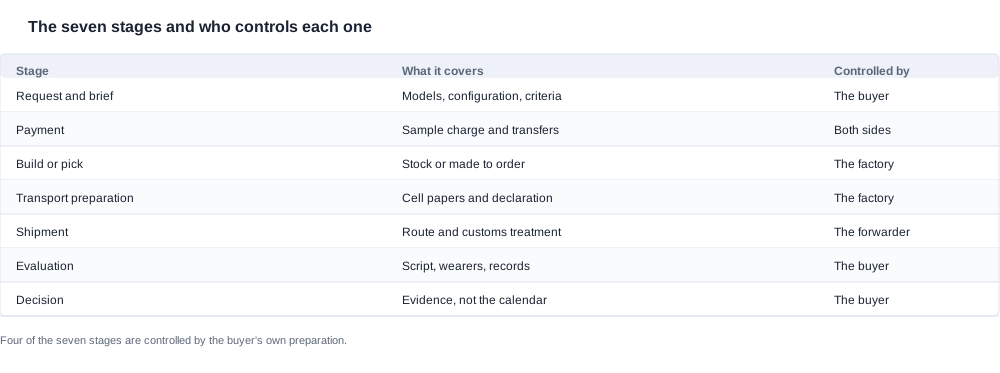

Requesting smart glasses samples: the stages a buyer can shorten
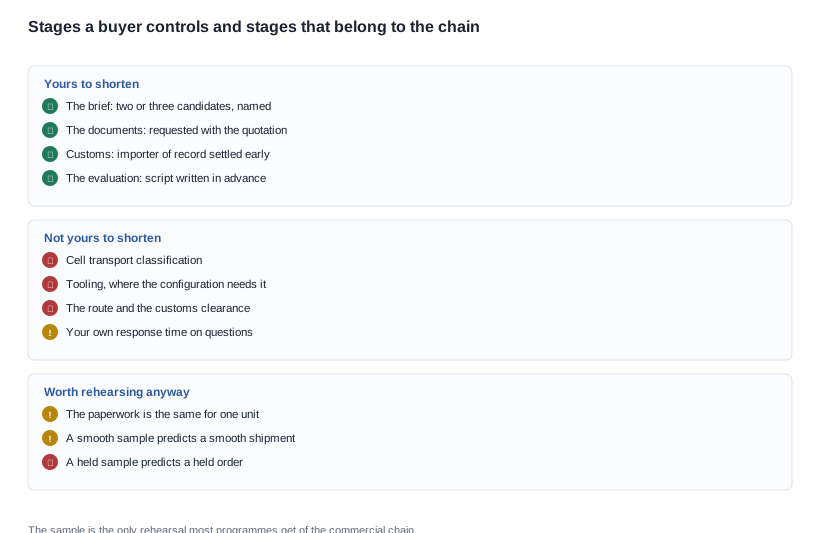
Four of the seven stages respond to preparation, and all four of them are prepared by the buyer rather than by the factory.
The brief. Deciding the model, the configuration and the questions before the request is the single largest saving available, because it removes the round trips from stage one and pulls everything behind it forward. The catalogue supports this directly: the published rows let you narrow a range of twenty-eight entries down to two or three before anything is shipped, because the charging methods, the case capacities, the resolution tiers and the cell capacities and the colours are all published and all comparable. A buyer who arrives with two candidates and a written criterion has removed most of stage one before it starts.
The documentation. Ask for the transport documents and the test summary at the same time as the quotation rather than after the unit has been built. This removes a wait from stage four that the buyer would otherwise have created, and it does something else as well: it surfaces the question of what the file actually contains. The published position on this site is that the export certification page is a picture page carrying ten patent certificates — eight design patents and two utility models — with no per-model certification row and no published UN38.3 test summary. Asking for the documents attached to your configuration is how that gap gets closed, and asking early means the answer arrives with the quotation.
The customs treatment. Establishing who the importer of record is for the sample, and whether it is the same entity as for the commercial order, removes a question that otherwise appears at the border, where it is expensive. Settle the same question for the production order while you are settling it for the sample, because the answer for the first unit is the answer for the first thousand.
The evaluation. Writing the test script before the sample arrives turns stage six from a day of improvisation into a day of measurement, and it shortens stage seven, because the evidence is already assembled and the decision is a comparison rather than a debate.
The criteria are what make the shortening work. A script with three written criteria produces a result in one sitting; a script with ten produces a negotiation, because every result is weighed against a different expectation depending on who is holding the unit. If the shortlist has more than one candidate, the same three criteria have to be applied to each, which is what makes the comparison a comparison rather than a set of anecdotes. Fixing the criteria before the request is what allows one shipment to answer the whole question.


Requesting smart glasses samples: the stages nobody can shorten
Three stages are outside the buyer's control and are the same constraints the commercial order will meet.
The cell and the transport classification. The documents that govern a lithium product depend on the cell, not on the sample. Nothing a buyer can do will compress that, and it is worth saying so plainly rather than discovering it at stage four.
The tooling, where the configuration needs it. A customisation that requires a new mould cannot be sampled from stock. This is the stage where the sample inherits the schedule of the production run, and the honest consequence is that the sample can then confirm the tooling rather than influence it — a materially different sample, and one worth knowing you have bought.
The shipment itself. The route, the carrier's handling and the customs clearance are what they are. The practical implication is that a sample's schedule should not be treated as a reliable predictor of the production shipment's schedule; the volumes differ, the paperwork differs and the priority differs. What a sample does predict is the paperwork, and that is the part worth rehearsing.
This is the part of a sampling programme that is frequently misunderstood. The purpose of a sample is not only to see the product. It is to test the whole chain: the documentation, the route, the customs treatment and the paperwork. A sample that arrives smoothly has demonstrated that the commercial shipment will arrive smoothly. A sample that arrives after three emails and a hold has demonstrated that the first commercial shipment will as well, at a far greater cost and with a far larger consignment in the queue.
There is also a stage that is invisible and worth counting: the buyer's own response time. The time between asking a question and answering it, on either side, is part of the schedule and it is rarely the supplier's fault. Agreeing a single point of contact on each side, and a rule that questions are answered in a batch rather than one at a time, does more to compress a sample timeline than any amount of urgency.
Schedule is negotiable in a specific and useful way, and it is worth knowing how before you need it. A supplier can usually compress a sample by releasing something that sits on the factory side of the chain — a stock allocation instead of a build, an artwork proof instead of a print run, an earlier forecast, a faster preparation charge, a simpler configuration. What they cannot compress is the cell documentation, the route, or the clearance. So a negotiation about schedule is a negotiation about which factory-side input you are willing to give up earlier or simpler, and a buyer who frames the request that way gets a faster sample without asking for something impossible. The trade-off is that each of those concessions narrows what the sample proves, and the negotiation is only worth having if the buyer knows which question the sample still has to answer afterwards.
Requesting smart glasses samples: the commercial details to settle early
Two details are worth settling in the request itself, because both become awkward later and neither is difficult now.
The sample charge, and whether it is credited against the first order. A credited charge is a commercial concession and an uncredited one is a cost, and the difference between them is far larger than the fee itself when the programme continues. Establishing it at the request stage also establishes the commercial relationship early, which is a reasonable thing to want from a supplier before the first unit has left the building. The sample terms are set out on the sample policy and cost page.
The return arrangement. Whether a sample can be returned, on what terms, to whom and by when. A sample that cannot come back is a commitment rather than a trial, and for a customised unit that is a decision worth thinking about twice. It also affects what you record on arrival: a unit that will be returned is usually recorded differently from one that will be kept as the reference.
A third detail is worth adding to the list because it is requested late more often than not: the build number, the configuration and the box contents. We confirm the configuration, the box contents and the build number for each unit before it ships, and having that record at the receiving end is what lets a sample function as evidence later rather than as an object. The specification published per configuration, the case, cable and packaging contents, and the customisation points are all available as the reference against which a received unit is checked.
A fourth belongs here for anyone who has been through a programme before: the criteria for the return. It sounds bureaucratic, and it is the criterion that determines what happens when the sample arrives and fails the first check. A written answer covering whether a rejected unit is rebuilt, whether the preparation charge is repeated, how long the decision on the rejection takes and what the schedule impact is, turns a dispute into a process. A missing answer turns every rejection into a fresh negotiation, and rejections are more common than buyers expect in a category where the catalogue publishes so few of the physical rows that determine whether a unit passes.
The due diligence question is the same one that applies to every other stage: is the supplier describing a process or describing an intention. The stages that are ours are visible — the unit is built, the documents are prepared, the shipment is booked. The stages that are the forwarder's are visible to the buyer only as a tracking state. Everything else is a claim, and a claim about a stage is worth exactly as much as the paperwork that supports it.
The route for establishing the actual dates for your request is the quote request page, where the configuration and the destination are stated and the schedule for that specific request comes back with the commercial terms.
Requesting smart glasses samples: what our published documentation can and cannot say
It is worth being explicit about the boundary, because a buyer who assumes a published figure exists will plan around a number that does not.
What is published. The model code list, the specification for each configuration including resolution, cell capacity, charging method, charge time, rated runtime, case capacity and colour, the case, cable and packaging contents, the seven customisation points, and the platform assessment that sits behind the OEM ready range.
What is not published. The sample fee, the shipping cost, the payment method list, the sample lead time, the minimum order quantities, the production capacity, the lead times, the model-level certificate numbers, the test report numbers, the transport files and the cell test summaries. Each of those is a property of a specific order or a specific programme, and each is established in a quotation rather than on a page.
What that means practically. Two things. First, a sample timeline you build yourself from the structure above will be more accurate than a published duration would have been, because you will have filled in your own configuration and destination. Second, the parts of the chain that sit outside the factory — the route, the customs treatment, the buyer's own response time — are worth writing down in your own plan, because nobody else can plan them for you. The transport rules that govern a lithium product are described in battery transport compliance, and the way a sample is tracked in transit is covered in do you ship samples with tracking.
There is a version of this that is worth holding on to through a long negotiation. A sample timeline is not a promise about the product and not a promise about the factory. It is a map of who holds which part of the chain on the day the unit ships. When a stage runs long, the useful question is which party is holding it and what they are waiting for, and that question is answerable even when the duration is not published. Which model is at the end of the chain, and which question the sample was meant to settle, are the two things the map has to keep visible, because both are easy to lose in the middle of a documentary delay.
Related reading
- The request itself — request a quotation
- The protocol the sample is judged under — sample policy and cost
- The transport rules — battery transport compliance
- The range behind a sample — OEM ready products
Send the models, the configuration and the destination, and we will give you the full timeline with the stages we control and the ones we do not.


