

Yes, samples go by express courier with tracking. The interesting part of the answer is what the tracking does and does not tell you, and that is not the same as what a buyer usually wants from it.
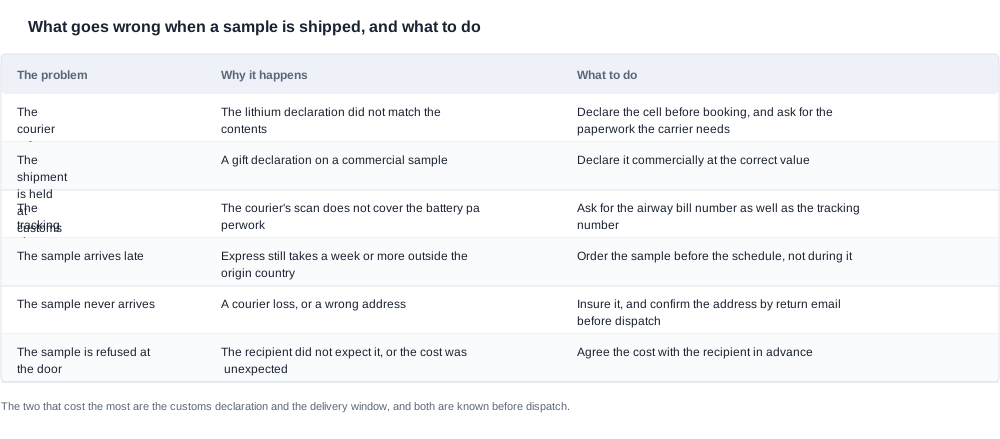
A sample in this category is a small package containing a lithium cell, sent as a regulated consignment. The tracking of such a consignment is less informative than the tracking of an ordinary parcel, because the scan history of a shipment that required a dangerous goods declaration is not always continuous, and because the paperwork travels separately from the box. The practical problems are concentrated in four places: the carrier's lithium acceptance, the customs treatment, the delivery window, and what happens if the sample is lost or refused. None of them is hard to avoid, and all four are cheaper to handle before dispatch than after.
Do you get one reference or two for a tracked sample?
You should get two, and the second one is the one people forget to ask for.
The courier tracking number follows the physical consignment. It is what the courier's website accepts, and it is what tells you whether a parcel is moving, sitting at a hub, or waiting on a signature.
The airway bill number identifies the document set. For a consignment that has been declared, it is what lets the sender, the recipient and the forwarder refer to the same shipment in the same way, and it is what a customs query is answered with.
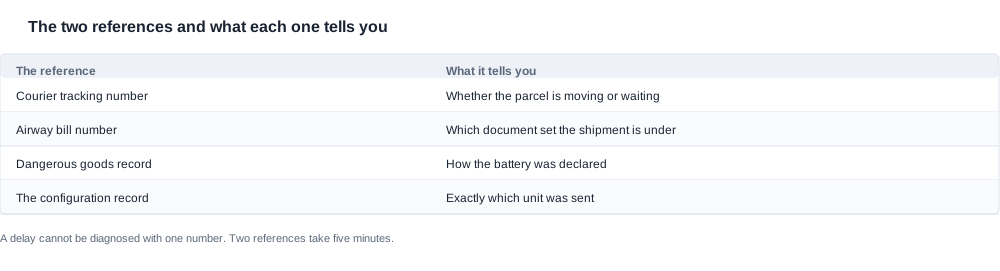
The two numbers are not always visible in the same place, and a delay frequently has to be diagnosed before anything can be done about it. If the courier's scan shows the parcel sitting at an export hub with no movement, that is a transport question. If the courier's scan shows it delivered but nobody has it, that is a delivery or a refusal question. If the airway bill shows a customs hold and the courier shows nothing at all, that is a documentation question, and it is the one that cannot be fixed by chasing the courier.
The practical instruction is to ask for both numbers, in the dispatch confirmation, and to keep the dangerous goods declaration with the consignment record rather than in an inbox. When a sample is delayed — and some will be — the difference between a five-minute diagnosis and a week of emails is almost entirely down to whether the paperwork was filed with the paperwork.
There is a third reference that is worth having, and it is not a tracking number: the configuration. The model code, the colour, the firmware or system version, the accessories in the box and the packaging as shipped. A sample that arrives without a record of exactly what it is cannot be evaluated against a specification, and it cannot be matched to a quotation if the conversation is about a variant.
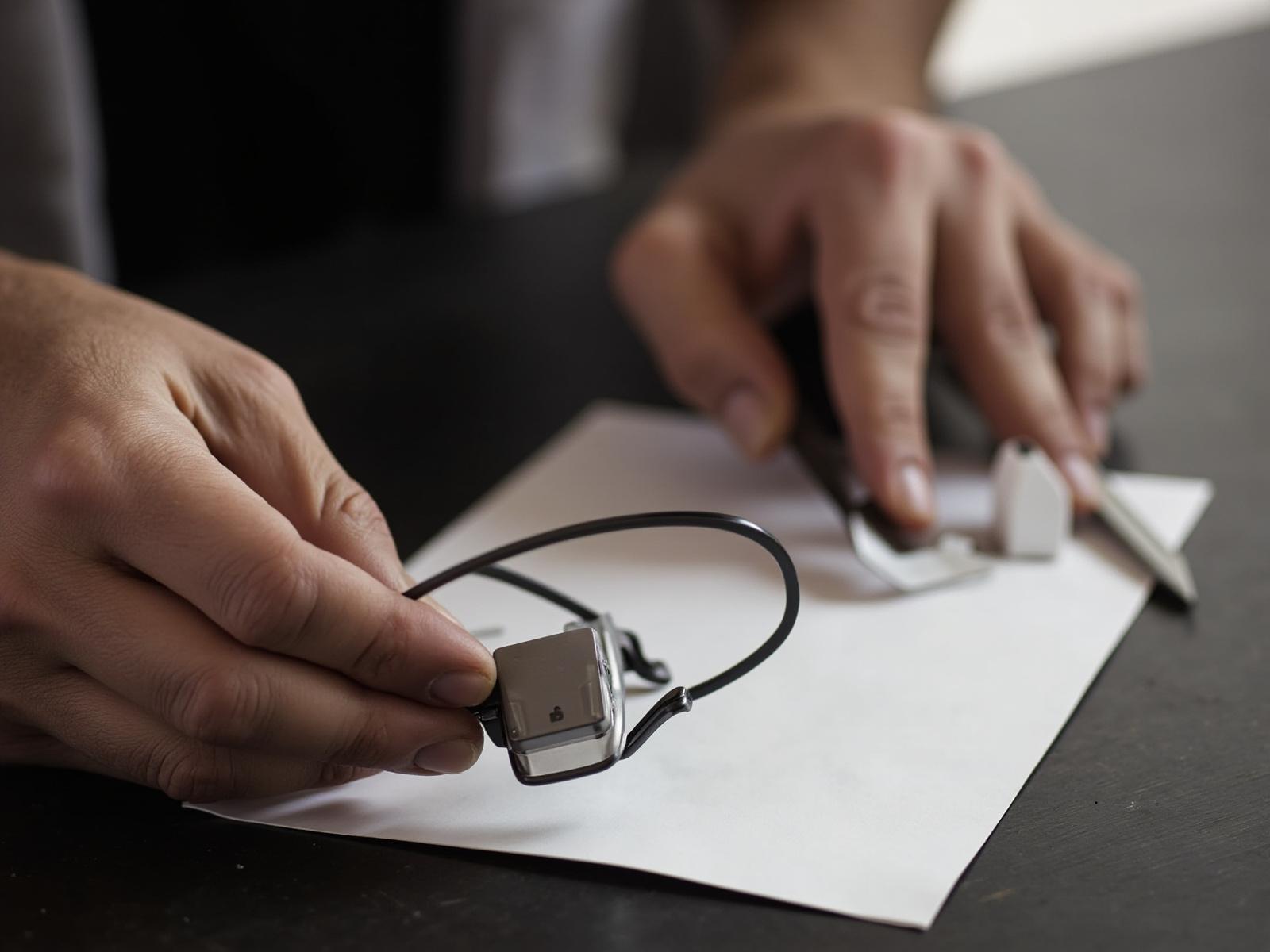
Do you know what the carrier needs for a lithium cell?
A lithium cell in a small package is a regulated consignment, and the carrier needs documentation that matches the actual contents. Where the declaration and the contents disagree — a battery in the box that is not on the paperwork, a declared quantity that does not match, a cell shipped in a configuration the packing instruction does not cover — the consignment is refused rather than delayed, which is a considerably worse outcome than a delay.

The sequence above is the part that has to be right before the carrier ever sees the box, and every step in it is cheap. The configuration is fixed and recorded. The actual contents of the box are compared against the declared contents — not the intended contents, the actual ones, including the cable and the packaging and the case if one is in the box. The declaration is issued to match. The method and the route are chosen against the carrier's acceptance for that battery configuration, at that state of charge. Only then is the consignment booked, and only then is the tracking number issued.
The point about the state of charge is worth dwelling on, because it is the detail that catches people. Rules about how much charge a lithium cell may carry when shipped by air are tied to the packing instruction applied and to the classification of the cell. A sample charged to full because somebody wanted to test it overnight is a sample that is harder to ship than one that is not, and in some cases cannot be shipped by the method you had in mind. Deciding on the charge state before the sample is packed is a two-minute decision that removes an entire category of delay.
The carrier's acceptance also varies by route and by destination, and it is not something to discover on the day. Some carriers will not accept certain battery configurations by air to certain destinations at all, some require the test summary that travels with the cell, and some require a written packing instruction on file. Whether that document is available for a specific model is something to confirm rather than assume — our catalogue does not publish a per-model test summary, and the transport rules are set out in our battery transport compliance material.
The question to put to whoever books the shipment is therefore not "can you send this" but "what does the carrier need for this specific configuration, and what do you need from us to have it". It is a better question than it looks, because it surfaces a requirement while there is still time to satisfy it, rather than at the counter.
There is a trade-off in the choice of method, and it is worth making it explicitly rather than accepting the default. The three axes are speed, cost and acceptance, and they do not all point the same way. The fastest option is the one with the widest acceptance, which makes it the safest to book, and it is also the most expensive per sample. A cheaper method — a slower service, or a consolidated shipment — reduces the cost per sample and narrows the routes the carrier will accept, which sometimes means a longer route or a different destination handling. For a first sample on a model you know little about, the expensive and widely accepted method is the right default, because a sample that cannot be shipped is a sample that never arrives and a programme that stalls for a reason that has nothing to do with the product. For a repeat sample of a configuration you have shipped before, the cheaper method becomes reasonable, because the acceptance question has already been answered.
That is a negotiation worth having with the forwarder rather than a decision worth making on your own, and the specific ask is the same: give us the options for this configuration, each with the acceptance position and the cost, and let us choose. A forwarder who answers with a single method without being asked why has not done the work.
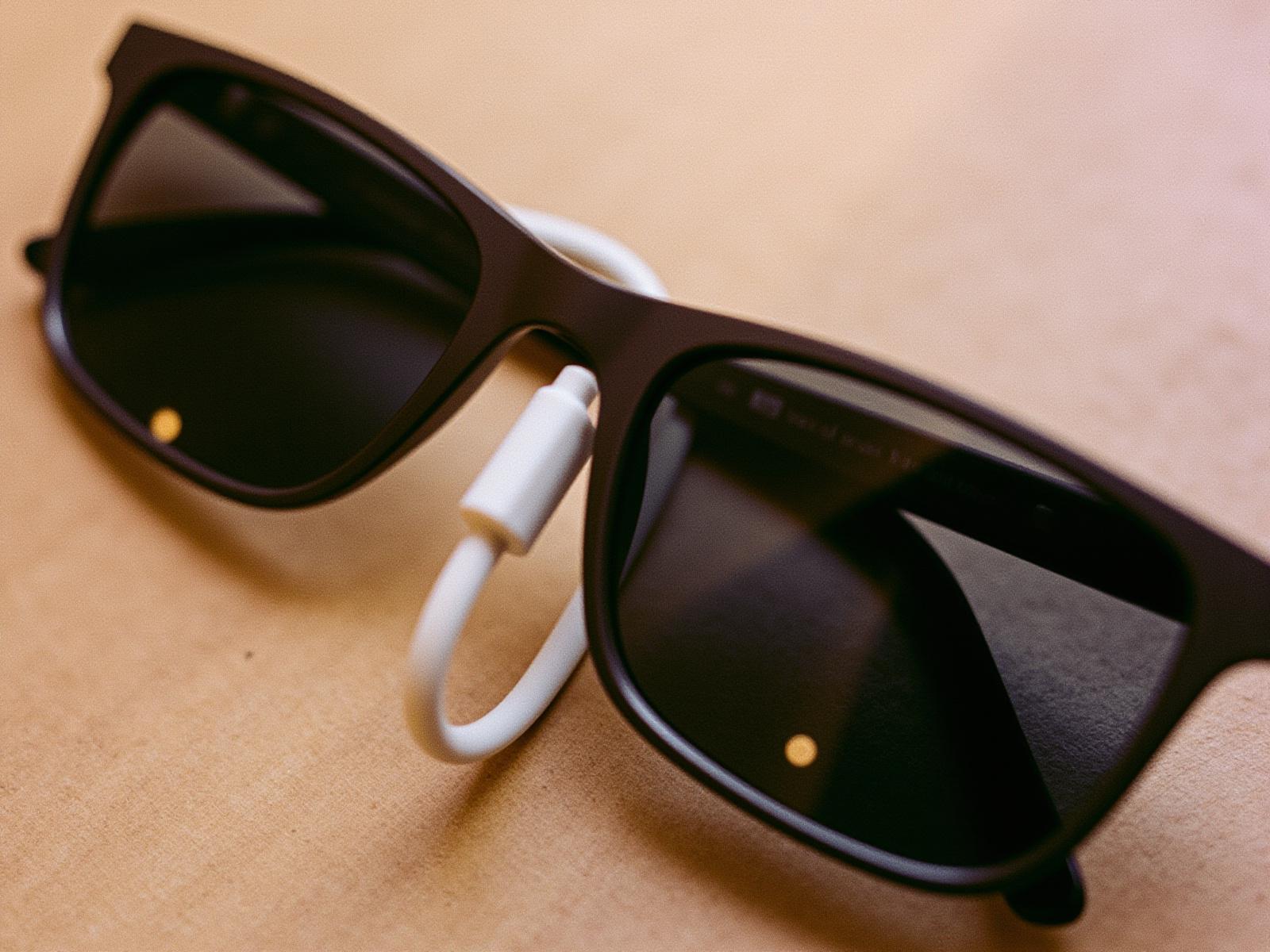
Do you want the invoice to match the box, or do you want a story?
A sample is a commercial good and should be declared as one, with a description that matches what is actually in the box and a value that reflects it.
Declaring a sample as a gift is a small fiction that creates a real problem in three separate places. It becomes a problem if the consignment is inspected, because the paperwork then contradicts the contents. It becomes a problem if the sample is re-exported, because a gift declaration does not travel back out. And it becomes a problem when the recipient's own customs or finance process requires a commercial invoice for the value, which is common in a business that has to book a cost somewhere.
A commercial invoice for a sample is a short document, and asking for it is the difference between a delivery that clears and one that stops. It should carry the model code and the description of the goods, the quantity, the value, the country of origin and the shipper and consignee details. The value is worth getting right rather than declaring a token figure, for a practical reason: a recipient's own tax or accounting process may treat a declared value as a real cost, and a token figure creates a mismatch with a real invoice when the sample is expensed on the other side. The description matters just as much, because it is what a customs officer compares against the contents.
The destination country's process is the part that is not in our control and is worth anticipating. A sample shipped into a country where the importer has to register the shipment, obtain a clearance reference or pay duty on receipt will meet a different process from one shipped into a country with a simplified low-value regime. The recipient's own responsibility here is the part that catches people: if the recipient is a business that imports regularly, they may have an account with the authority, a licence or a standing procedure, and they may not have told you about it. The best preparation is a short conversation with the recipient before dispatch, and the second best is a copy of the invoice going to them before the parcel does.
There is a third customs question that only applies to some buyers and is worth raising because it is easy to miss: whether the sample is intended to be used, tested or evaluated, and whether the destination treats a sample differently from a sale. A sample that is opened, powered on and worn is arguably being placed on the market, and a buyer who is going to do that should know what their own position is before they do it rather than afterwards.

Do you plan for the sample to arrive inside your decision window?
This is the question that decides whether a sample is worth anything, and it is the one that is most often handled badly.
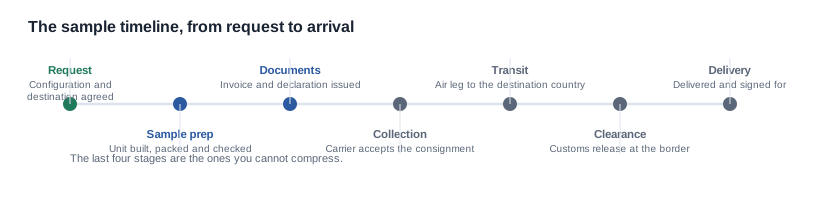
The timeline above is the planning shape of a sample shipment, and the point of it is the right-hand end. The transport and clearance stage is a significant fraction of the total, and it is the stage you cannot compress, no matter how the sample is prioritised on the factory side.
The practical consequence is worth stating plainly, because it is the most common reason a sample programme fails. A sample ordered during a programme review arrives after the decision has been made, and the answers arrive too late to be useful. The unit has been evaluated, the decision has been taken on a catalogue and a specification, and then the sample lands — and it either confirms what was already decided, in which case it was not needed, or it contradicts it, in which case it is too late to matter.
So the rule is to order samples at the point where the programme is waiting for them, not at the point where someone remembers that they are needed. In practice that means: the sample request should be triggered by a decision that is blocked on physical evidence, and the number of samples should match the number of people who will actually hold one. A common pattern is to order two or three of a model and have them sit in a drawer while six people each need one, which delays the evaluation and loses the samples in the meantime.
There is a second timing point that catches people, and it is about what the sample is for. A sample that is meant to answer a specification question has to arrive before the specification is finalised, because a sample that confirms a finished specification is a product, not a sample, and it is usually too late to be useful. A sample that is meant to answer a commercial question — is the build quality acceptable at this price, does the packaging work, does the unit survive a drop test — can arrive much later, because it is an input to a repeat order rather than a gate on a design.
Which model to sample, and how many, is worth a moment. Our range covers twenty-eight models across seven categories, and the published specification varies enough across the range that a sample of one model tells you very little about another. The audio class, the sport class, the camera class and the kids class differ in their published charging methods, their case configurations, their runtime figures and their ingress markings, and a camera model in particular cannot be evaluated for recording performance from anything except a camera model. Sampling the wrong model because it was the one that happened to be in stock is a common and entirely avoidable way to lose three weeks.
The criteria for choosing are worth applying in order, because they resolve most of the ambiguity. The first criterion is what the sample has to prove, because a sample that cannot answer the question it was ordered for is a sample that was ordered for habit. The second is whether the model in question is the one you would actually build the programme on, since a sample of a model you would never order is a demonstration rather than an evaluation. The third is whether the specification for that model is fixed enough for the sample to be meaningful — and here the published gaps are a useful filter, because a model whose charging method, case configuration or runtime is not published is a model where a sample is worth more, not less.
That is a genuinely useful way to use the samples you order. A buyer with a fixed, well-documented model and a clear question can often decide from the catalogue. A buyer with a model that has open rows and an unresolved question gets a lot more value from one well-chosen unit. Which one of those you are determines how many samples are worth ordering, and it is worth deciding before the order rather than after the first sample is evaluated and turns out to have answered a question you were not asking.
Do you know what happens if the parcel is refused or lost?
Two failure modes sit at the end of the timeline, and they are quite different from each other.
Refusal. A parcel that arrives when the recipient is not expecting it, or when the cost on the invoice is a surprise, or when the recipient is not authorised to sign for it, comes back to the sender. The cost of a refused parcel is the postage, and the cost of the delay is a programme. The prevention is almost entirely administrative and almost entirely free: confirm the delivery address by return email before dispatch, tell the recipient that a sample is arriving and what it costs, and check that the address is one where a signature can be taken by whoever is actually there. In a business that receives samples regularly this is already habit; in a first evaluation it is usually the thing that goes wrong.
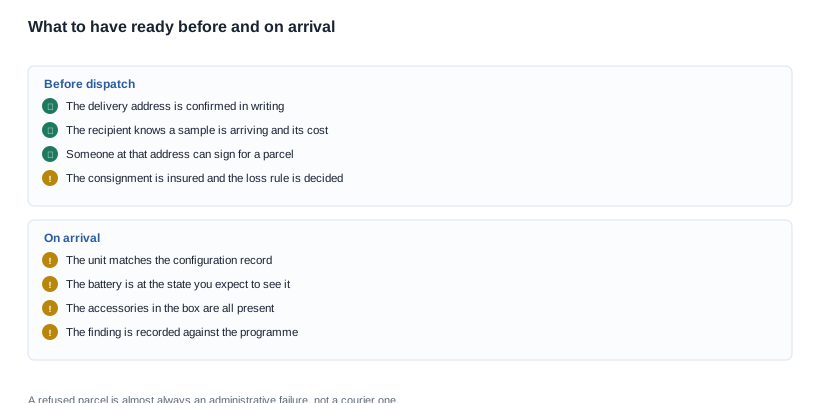
Loss. A courier loss is possible and it is a low-probability, high-frustration event, because the sample is usually a paid unit rather than a giveaway and replacing it means paying again. Insure the consignment, and decide in advance what happens if it is lost: whether a second sample is sent automatically, whether the fee is refunded, or whether the programme moves on. A decision made in advance turns an awkward email into a routine one.
There is a third kind of loss, and it is the one that actually matters. The sample arrives and is not what was expected — the wrong configuration, the wrong colour, a unit that does not match the approved specification. That is not a logistics problem and it is not fixed by shipping faster. It is fixed by sending the right thing, which means the configuration record matters as much as the tracking number.
It is worth being honest about the limits of a sample programme, because a sample is often treated as if it settles the question of whether to work with a supplier, and it does not. One unit tells you how a product feels in the hand, how the software behaves on the day you try it, and how the packaging presents. It does not tell you about consistency, because consistency is a property of a run and not of a unit. It does not tell you about the failure rate, because the sample that arrives is a unit that passed. And it does not tell you about the supplier's operational capability, which is what due diligence is actually for.
The way we would think about it is that a sample narrows the question rather than answering it. It removes the reasons not to proceed — the unit feels wrong, the software is confusing, the packaging is not sellable, the specification on the page does not match the product in the box. That is a lot of value, and it is worth doing properly. What remains after the sample is the set of questions that need a factory, a documentation pack and a conversation, and a shortlist should be built on the answers to those rather than on the sample.
On our own position: we ship samples by express courier with tracking, and we state the carrier, the method and the expected window in the dispatch confirmation rather than leaving them to be discovered. We do not describe a sample as shipped until the consignment has been accepted by the carrier, and we give the airway bill number alongside the tracking number. We do not publish a sample fee, a shipping cost or a fixed transit time, because all three depend on the configuration, the destination and the route, and a published figure would be a figure that is wrong for most of the destinations we ship to. What we can be specific about is the whole sequence: the configuration, the commercial invoice, the declared battery, the method and the window.
The sample policy is under sample policy and cost, the request form is at request a sample, the cost side is covered in requesting samples and what the cost covers, and the transport rules that govern the battery are in battery transport compliance.
Related reading
- The cost side of sampling — requesting samples and what the cost covers
- The policy — sample policy and cost
- The transport rules — battery transport compliance
Send us the delivery address and the destination market, and we will tell you the method, the documentation and the expected window before dispatch.


