

A sample request is the one document in a hardware programme where the buyer controls almost every variable, and it is the document where most buyers give away almost all of them. Left unstated, every field in a request resolves to whatever is easiest for the supplier to pull off a shelf: the entry-level model, the default finish, the default charging method, the default documentation scope, shipped to whoever the account is registered to. It arrives, it works, and it tells you nothing about whether the product you have scoped is the product you will receive.
The reason it happens is not carelessness. A request that arrives as two lines gets a fast response, which feels like progress. But the fast response is fast precisely because nothing was asked for, and the sample that follows is a general-purpose unit that would have been sent to anybody. The variables are knowable in advance, which means the outcome is controllable, and the whole value of a sample request lies in converting a generic unit into an answerable one.
There is a second reason to write the request carefully. In this category a large part of the specification is not published, so a sample request is also the instrument you use to find out what the supplier knows and what it does not. A well-written request gets you both the hardware and the boundaries around it.
It is worth being clear about what the request is not. It is not a purchase order and it does not commit you to anything, which is exactly why it is the cheapest place to be specific. Every variable you fix in the request is a variable you have moved out of the default column, and every variable you leave open is a variable the supplier will resolve for you in the way that is cheapest for them. The cost of a wrong guess at this stage is a wasted sample and a week of delay. The cost of a wrong guess at the order stage is a production schedule, a packaging artwork and a customer-facing product page.
Requesting smart glasses samples: what a request has to fix
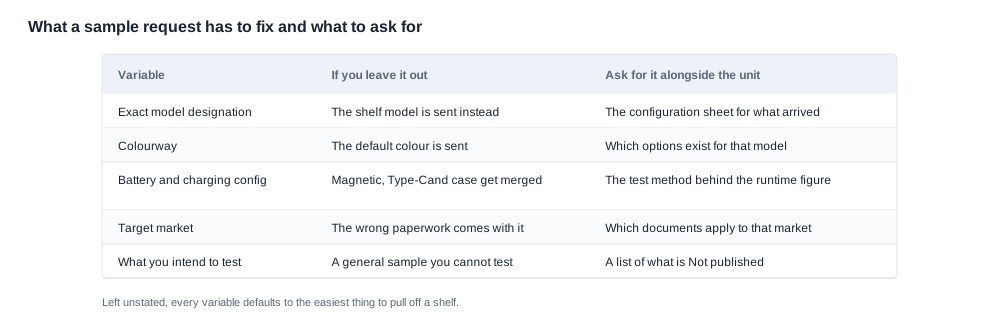
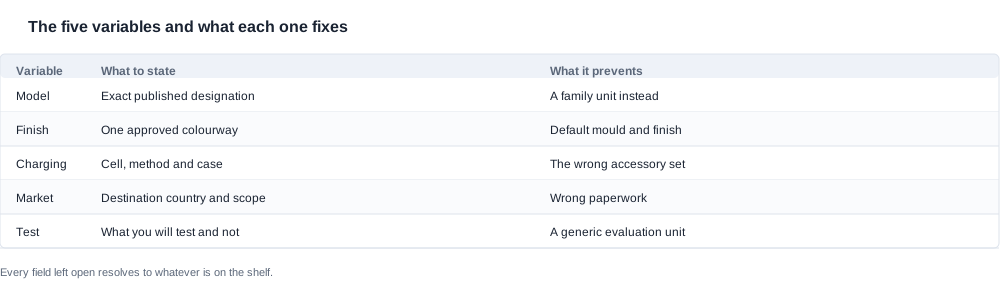
Five variables have to be fixed in every request, and each of them corresponds to a choice that is genuinely open rather than merely unstated. A request that fixes all five produces a unit that answers a specific question. A request that fixes four produces a unit that answers four questions and wastes the fifth.
The model, named exactly. Not a family, and not "something like the L1 Pro". The published camera tier contains V06 and CY05, KY06 and L2 Utral, V03 and MT6, V03 Pro and L1 Pro, S7 and CY03, and MT5, and one of those entries is published under the designation "L2 Utral" while also carrying a further variant designation whose meaning is not given. If your own literature is going to carry a model name — on packaging, on the product page, on a compliance file — you want the manufacturer's confirmation of the exact string in writing, before it reaches a printer. A designation you have paraphrased is a designation that cannot be matched against a model-specific document later.
The finish, or an explicit decision not to specify it. Two models in the range publish a colour list: the V03 Pro in three options and the V06 in four. For everything else the catalogue records no colour options at all. That means for most models the colour is not a finish decision but a new configuration, with its own commitment on the production schedule, and "whatever is available" is a decision you have made without knowing it. If colour is part of your proposition, name the one you want and get it confirmed against an approved physical reference.
The battery and charging configuration, stated as three separate decisions. The cell configuration, the charging method, and the case option are three options that buyers routinely bundle into one sentence. In the published range, charging method is split seventeen magnetic and seven Type-C, and is not published at all for MT6 and L1 Pro, and CY05 and the CY03. On the case, capacity is published for five models — the CY05 and the L1 Pro, and the CY03 — each at 1400 mAh, the L2 Utral at 900 or 1400 mAh, and the MT6 at 1200 mAh in a foldable case. A case is listed for the KY06 and the MT5 without any capacity figure attached. Nothing in the catalogue records a case for the V03, the V06 or the S7, and the V03 Pro is listed without one. Ask for a specific case or ask for no case, and write down which one you asked for.
The destination market, and therefore the documentation scope. A sample intended for evaluation in the European Union and one intended for the United States are the same hardware with different paperwork, and the paperwork is the part you want to see at sample stage rather than at first shipment. Naming the market in the request also tells the supplier which documentation to send, which is the most efficient way to discover what they hold.
What you intend to test, and what you are not. This is the variable suppliers respond to most usefully. A request that says "for general evaluation" gets a general sample. A request that says "to check call quality in a noisy outdoor environment, plus lens tint at a stated light level, plus a runtime check under continuous use" gets a sample you can actually test, because the supplier knows what to prepare, may supply supporting documents, and may tell you in advance that a particular test is not something they can support.
Requesting samples across a range: one request or several
Buyers with more than one model in mind face a choice that is rarely discussed explicitly: whether to send one request covering several configurations or one request per configuration. The two produce very different results, and the difference is not administrative.
A combined request is faster to write and faster to answer, and it is usually the wrong choice. The supplier reads it as a range request and answers it as a range request — one configuration, one colourway, the default on everything else — because that is the efficient way to respond to an ambiguous brief. You get three samples, and all three are the same configuration in different quantities. The requests then have to be redone one by one, and the samples you already paid for have told you nothing.
Separate requests cost more in supplier time and produce something entirely different: each unit is built to its own brief, each arrives with its own configuration sheet, and the comparison between them is real. The cost of the redundancy is duplicated paperwork. The saving is that you never hold three samples that are secretly the same sample.
That leads to a decision about how many samples to request, which is a question about evidence rather than about quantity. In a hardware programme the minimum useful set is three units: one to test, one to keep as the golden sample reference, and one to keep in reserve for the moment when the first is being used and the second is being shipped to somebody else. Beyond three, the additional units are worth requesting only when there is a specific question that a second unit of the same configuration could answer — a tolerance question, an environmental question, a question about which of two approved finishes matches a physical reference better.
The golden sample is the unit that quietly determines the rest of the programme, and it is worth spending a request on. It is the reference against which production units are compared during inspection, and if it was not built to a written brief it cannot do that job — because there is nothing written to compare against. So the request for the golden sample should carry the full brief, and the request should ask for it to be retained rather than returned. That single sentence, added to a request, is what turns a pile of evaluation units into an inspection standard.
There is one case where a wider request makes sense, and it is worth knowing because it is the exception rather than the rule: when the samples are for a customer presentation rather than for evaluation. A dealer or a retail partner who wants to handle the product needs a unit that looks like the product, and a unit that has been on a bench for two hours does not. In that case the request is short, the finish and the packaging are specified, and the test protocol is omitted — but the configuration is still named, because a presentation unit and an evaluation unit with the same name and a different configuration are a problem you will discover in front of a customer.

What to ask for alongside a requesting sample
The hardware is half the answer. The other half is what arrives with it, and this is where a request earns its keep, because these items cost the supplier nothing to send and a great deal for the buyer to obtain later.
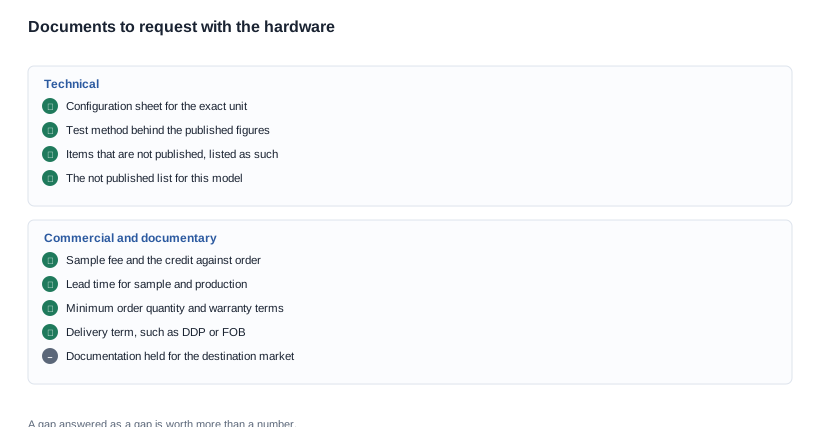
The configuration sheet for the exact sample. Not the catalogue page. A catalogue page describes a range; a sheet describes a unit, and the sheet is the document that names the cell configuration, the charging method, the case option, the firmware version and the accessories included. This is the document that becomes the golden sample description, and if it does not exist, the golden sample has no definition. The wider protocol the units are judged under, and the terms the sample itself is supplied on, are set out in sample policy and cost.
The test method behind the published figures. Which cells, which charge method, what the runtime figure was measured under, and for how many cycles. Every published runtime in this range carries an unstated test condition — the camera tier publishes runtimes of five to eight hours, on cells of 220 mAh to 290 mAh, and twenty-six models publish a charge time of two hours or less while only the D17 and ZH12 publish about one hour. Asking for the method costs nothing and changes what the figures mean.
The items that are not published, listed as not published. This sounds odd to request and it is the most useful line in the entire request. If a supplier answers "the frame weight is not published for that model" instead of producing a number, you have learned that the number does not exist in a form you can rely on — which is a materially different position from not having asked. In our own catalogue that list is long: one published frame weight across twenty-eight entries, the MT6 at 158 g for the glasses alone; no certification line broken down by model, and an export-certification page that is a picture page of ten patent certificates — eight designs among them and two utility models; no capacitive-touch row, and no translation row anywhere in it; and ingress markings on only two models, the V06 and the S7.
There is a practical technique for requesting a gap that avoids the awkwardness of asking for something that may not exist. Ask the question in the negative: "which of the parameters for this model are not published?" rather than "what is the weight of this model". A supplier can answer the first question without admitting a deficiency, because the answer is a list of omissions rather than a refusal. And once you have the list, you can decide which omissions matter to your product page — a gap in the weight is survivable for a product whose page does not quote a weight, while a gap in the charge time is not survivable for a product whose page promises a full day of use.
The commercial position on the sample itself. The sample fee and whether it is credited against the first order, the lead time for the sample and for the production quantity, the minimum order quantity that follows, the warranty terms, and the delivery term. Asking for these in the same email as the hardware is efficient, and it means the sample arrives with the commercial context attached rather than three weeks later.
The sample lead time, broken into its stages. This one is worth its own line in the request because a single number is worse than useless when the sample is on the critical path of a launch decision. The stages are the ones that actually vary: the time to confirm the configuration in writing, the time to prepare the unit to that configuration, the time to ship, and the time to clear the destination. A supplier who quotes three weeks without saying which part is three weeks has told you that the preparation is the longest part, which is usually true and usually the part that moves when the configuration is not fully specified. Asking for the stages also tells you where to push when the sample is late, which is a question with a useful answer and a useless one otherwise.
The documentation for the destination market. Whichever documents the supplier holds for the configuration, sent with the sample. Where we hold nothing per model, we say that, and the sample policy and documentation requirements set out how that conversation is usually handled.

Handling a requesting sample that arrives wrong
This happens more often than buyers expect, and the response matters more than the mistake. A sample that arrives mis-specified is free information, and it arrives before the commercial relationship is live, which makes it the cheapest information you will ever get about how a supplier handles a discrepancy.
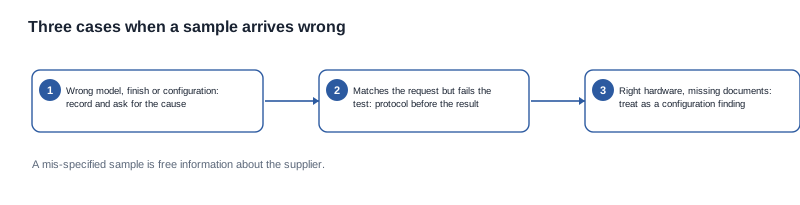
Three cases, and they need three different responses.
The sample is not what you requested — wrong model, wrong finish, wrong configuration. Document it precisely, photograph it, and put it in writing to the supplier before you return it. State what you requested, state what arrived, and state what you are doing about it. The purpose is not to establish blame. It is to observe whether the supplier investigates, corrects and explains, or simply replaces it without explanation. A supplier who explains the cause has told you something about their process. A supplier who replaces it silently has told you something too, and it is less useful.
The sample matches the request but fails your test. Here the evidence has to be stronger, because the supplier's natural response is to characterise the failure as a test artefact. Record the protocol before you start: what you measured, in what conditions, with what instrument, and against which criterion, with the tolerance agreed in advance. A result without a protocol cannot be discussed, and it will be attributed to whichever explanation suits the reader. A result with a protocol can be discussed, and often will be.
The sample arrives with the right hardware and no documentation, or the wrong documentation. This is the case buyers most often handle worst, because it feels like the supplier's fault and it usually is not. If the configuration does not have model-level documentation, then no sample will arrive with it, and the finding is about the configuration rather than about the shipment. Record it, ask what would be required to obtain it and on what lead time, and treat the answer as an input to the certification scope question rather than as a delivery failure.
Whatever the case, the discipline is the same and it is the part that gets skipped: everything goes in writing, on the day, with photographs, before the unit is returned or put into use. A verbal exchange with a courier or a colleague is not a record, and a sample that has been returned without a written record of why produces no information at all — not even for you, because by the time the question matters, nobody will remember what the fault was.
Building a requesting brief you can compare quotations against
There is a version of the sample request that is a shopping list, and there is a version that is a brief, and only the second one is worth building. The difference is that the brief is written so that two suppliers can answer it and you can compare the answers.
A comparable brief has four properties. It is written against a configuration rather than a preference, so the configuration can be quoted. It asks for the same nine things in the same order from every supplier, so the responses line up. It asks for the gaps as well as the content, so a supplier's answer to "what is not published for this model" is comparable with another's. And it specifies the test protocol, so two samples can be tested the same way and the results mean something.
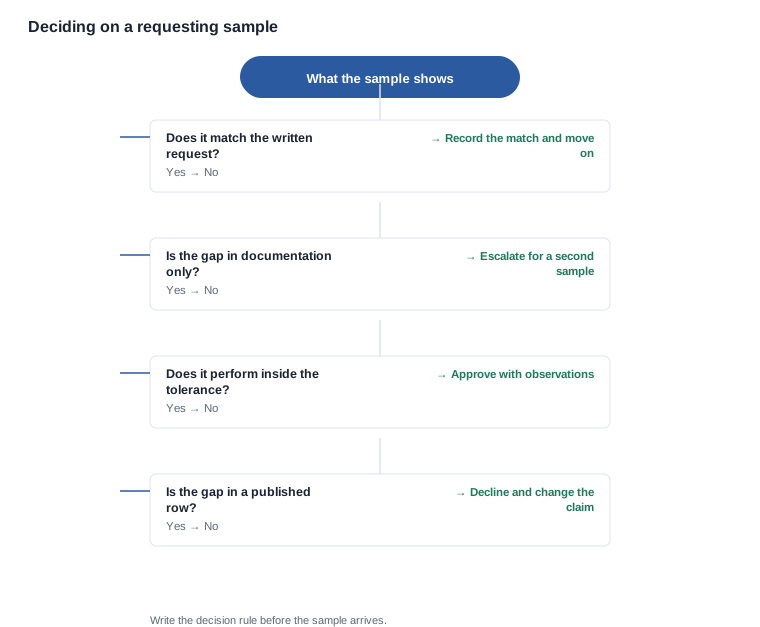
The brief also needs a decision rule attached to it, written before the samples arrive rather than after. Something like: approve if the configuration matches the request, the identified gaps are ones the brand can write around, and the unit performs inside the agreed tolerance; escalate to a second sample if the gap is fixable in documentation; decline if the configuration does not match or if the gap is in a performance row the product page depends on. Buyers who write the rule before the sample arrives make faster decisions and argue less about them afterwards.
The same brief does double duty as a shortlist document, and it should be written to allow that. If two suppliers receive the same brief and their answers differ, the difference is information about them — one has a configuration sheet and one does not, one states the gap and one glosses over it, one quotes a lead time broken into stages and one gives a single number. Those differences are visible without a call, without a visit and without a sample, which makes the brief one of the cheapest due diligence instruments available to a buyer. The criteria worth scoring are the same in both cases: does the configuration match, are the specification rows stated, are the gaps stated, are the commercial terms complete, and does the sample fee get credited.
The longer form of the same list — every field, with the reason it matters and the way to ask for it when the answer may not exist — is collected in what to include when requesting samples, and it is worth reading alongside this one before a brief is written. The two are complements rather than duplicates: this page is the argument for writing the request down, and the longer list is the instrument itself.
One last practical point on the brief, which is that it should be sent unchanged to every supplier. The value of the comparison comes from the invariance of the question. A brief that is rewritten to suit a particular supplier, with its gaps softened or its criteria adjusted, stops being a comparison and becomes a negotiation, and the negotiation happens on terms the buyer no longer remembers. The temptation is strong, because a supplier that asks a clarifying question can be accommodated with a small change to the wording — but the same accommodation has to be applied to every supplier, or the scoring at the end is meaningless.
The trade-off throughout is speed against specificity. A broad request comes back quickly and compares badly; a specific request takes longer to answer and compares well. The reason the second is worth the time is that the samples are the expensive part of the programme, and a sample that answers a generic question is a sample that has to be paid for twice.
Send the brief through the quote request route and we will come back with what is available in the configuration you have described, what is not, and what we can answer about the parts we cannot ship. The standard OEM sample process covers how a sample request is handled inside a standard programme, and verifying a sample against the policy covers the check once the unit is in front of you.
We would rather a sample request asked for the wrong thing than asked for nothing. A request with a specified configuration, a stated market and a named test gets you an answerable evaluation, and a vague one does not. We will also tell you plainly when a configuration you want is not available, and when the answer to one of your questions is that the figure is not published. We will not ship a sample in a configuration we cannot describe, and we will not fill a specification gap with a typical value to make a request look complete.
Related reading
- Requesting samples
- Sample policy and documentation
- How to verify a sample on arrival
- Standard OEM sample process
Send the model, the configuration, the market and the test you plan to run, and we will come back with what we can actually provide.


