

A sample is the cheapest point in a smart glasses programme at which a decision can still be changed, and it is routinely used for the most expensive one: confirming that the product is right. That inversion is the reason a standard oem sample process goes wrong so often. The unit arrives, everybody sees it, a photograph is taken, a favourable opinion is recorded, and the programme moves to a production order with the same unresolved questions it had before the unit was built.
The correction is not to test more on the sample. It is to decide what the sample is for before it is built, and to accept that a sample can settle some categories of question and cannot settle others. This page works through what a sample can and cannot do, the stages between a request and a signed reference unit, the tolerance and acceptance criteria that have to be agreed before the unit is made, and the questions a sample round should answer.
It contains no sample fee, no sample lead time, no sample policy and no approved-sample list, because none of those is published in our material and none of them can be stated without a configuration.
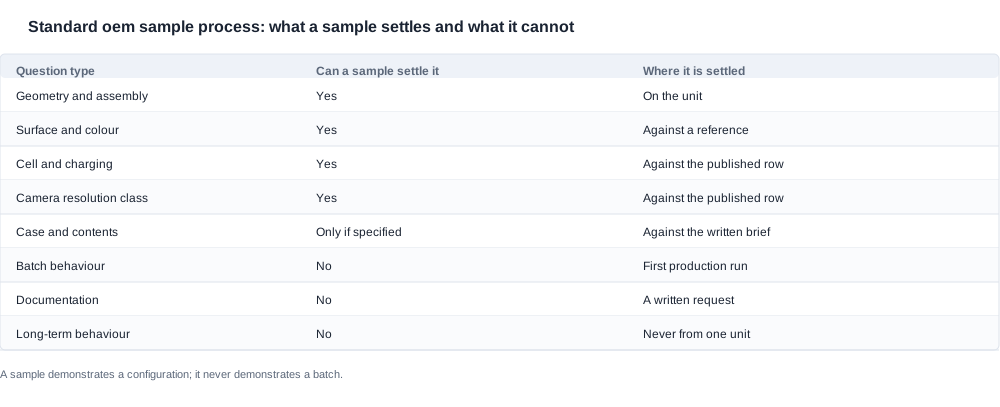
The table is the argument in one frame. A sample is a single physical unit, so it can demonstrate the existence and appearance of a configuration and it cannot demonstrate the behaviour of a batch. Almost every disappointment with a sample comes from asking it the second question.
What a sample is expected to settle, and what it cannot
A sample settles anything that can be observed on one unit: the geometry, the assembly, the surface finish, the appearance of the colour, the behaviour of the controls that the configuration carries, the completeness of the accessory set, and whether the unit matches the written requirement at all. These are real and useful answers, and they are the reason a sample round is worth running.
There is a practical consequence. A requirement that has been separated into its observable part and its batch-dependent part can be split in two: the observable part goes into the sample criteria, and the batch-dependent part goes into the inspection plan for the first production run. Programmes that do that separation before the sample arrives find the criteria list is short — four or five attributes rather than twenty — and they find that the remaining items now have somewhere to live. Programmes that do not find a twenty-item list, and a unit that passes or fails it as a single whole, which is a far less useful document to hold.
What a sample cannot settle is anything that depends on repetition. Runtime consistency across units, the behaviour of a production batch, the reliability of an assembly over a working life, the yield of a production route, and the behaviour of a material over time are all properties of a run rather than of a unit. A single unit that behaves correctly is evidence of possibility, not of reliability, and a requirement written as though a sample could satisfy it is a requirement that will be checked at the wrong point.
A sample also settles nothing about documentation. This point is worth making plainly because it is the one most often assumed. A unit bearing a mark or a label is not a conformity document, a unit packed in a carton with a printed panel is not a certification, and a unit that a supplier says is compliant is not a report. Our range carries no certification line for any model, the catalogue text names none of CE, FCC or RoHS, and the export certification page holds company-level artwork: ten patent certificates, none of which says anything about the unit in the box. A sample round that produces no document produces no document, whatever else it produces.
There is a third category, which is the most useful of all. A sample can settle the question of whether the requirement is worth pursuing, by making the consequences visible. A configuration that looks wrong on the sample is much cheaper to abandon than one that is discovered after a production run. That is a legitimate reason to run a sample before the requirement is final, and it is the reason a sample request often arrives with an open brief.
So the correct framing of a sample round is not "check the product". It is "convert an open requirement into a decided one, or abandon it cheaply". That framing decides what the sample is judged against, and it is why the acceptance criteria have to exist before the unit is built.
The stages between a request and a signed reference unit
Seven stages separate a request from the artefact a programme actually needs, which is a signed reference unit rather than a unit that was looked at.
The first stage is the request itself. A request that names the model, the configuration deltas, the destination and an indicative volume can be answered. A request that names a model and a wish cannot, and the supplier will answer it anyway, because a refusal is rarely the most useful reply. The value of writing these four things down is that the reply becomes checkable rather than impressive.
The second stage is the written restatement of the configuration by the supplier. This is the cheapest quality control in the entire programme, and it is routinely skipped. A supplier that restates the requirement in writing — the model, the cell, the charging method, the case position, the colour, the packaging, the destination — produces a document against which both sides can check what they actually agreed. Where the restatement differs from the request, the difference is the finding, and it costs nothing to discover at this stage.
The third stage is the build, against a stated bill of materials. The bill of materials is the list of what is different from the catalogue unit and what is identical to it. Without it, the sample is a unit of unknown provenance, and the buyer cannot tell whether a difference is a design decision, a component substitution or an error.
The fourth stage is delivery, with an item list. What is in the box matters here in a way it does not matter elsewhere, because the contents statement is also a printed claim on the carton. Across the eleven camera models the charging case is described three ways — five with a capacity, two with a case and no measurement, and four that print no case line whatever: the V06 and the V03, and the V03 Pro and the S7. For those four, the contents of the box are an open question, and a sample that arrives with a case has not answered it.
The fifth stage is the evaluation, against criteria agreed in advance rather than against an impression formed on arrival.
The sixth stage is the signature: the unit is signed as the reference, and the defects found during evaluation are recorded alongside the signature rather than discarded. A signed reference without a defect log is a lie of convenience, because the next unit will be compared against a unit that was never quite right.
The seventh stage is the release for production, with the signed reference attached to the purchase order and referred to by in the agreement. This is where the sample stops being an object and becomes a standard.

The chain of artefacts is the point of the diagram. A request produces a brief; the brief produces a restatement; the restatement produces a bill of materials; the build produces a unit; delivery produces an item list; evaluation produces a defect log; and the signature produces a reference unit. A programme that skips a stage does not save time, it loses the artefact that the next stage needed.

Agreeing tolerance and acceptance before the sample is made
This is the part of a sample round that is usually done in the wrong order, and doing it in the wrong order is what turns a sample into a negotiation.
A tolerance agreed after the sample has arrived is a tolerance negotiated about the sample. It has two features that make it useless. It is informed by evidence the supplier has not seen, which is why it drifts. And it is expressed in terms of the unit in front of the buyer rather than in terms of the requirement, which means the requirement itself never gets written down. The buyer ends up with a unit they have accepted, and no standard they can hold anyone to.
Agreed in advance, the same four items are straightforward, and they have to be in writing before the unit is built.
The first is the list of attributes being checked, tied to the published rows where they exist. Each of the twenty-eight entries publishes four standard rows — a cell, a runtime, a charge time and a charging method — and the eleven camera models publish a resolution class on top of them, so most of the checkable attributes for a camera programme are already anchored. It publishes colour names for two entries only, a removable part for three, an ingress marking for the V06 and the S7, and one weight in the range, the MT6 at 158 g for the glasses body and excluding the folding case. The attributes not on that list are exactly the ones a sample round has to define by agreement.
The second is the criterion for each attribute, expressed so that it can fail. A criterion that cannot fail is not a criterion, and a tolerance written as "acceptable quality" or "as per sample" transfers the argument to the receiving dock.
The third is the method. Who checks, with what equipment, against what reference, and how many units are examined if more than one is built. This is also where the limits of the published rows have to be recorded. A published charge time reads as two hours or less on twenty-six of the entries and about an hour on the D17 and the ZH12, and it carries no starting state and no end point. A published runtime carries a range and no method. A published resolution class carries a class and no frame rate. Each of those is checkable, but not by the criteria as published alone.
The fourth is what happens on a failure, decided in advance. Rework, replacement, a rebuilt sample, a requirement revision, or abandonment of the requirement. Deciding this while the sample is still hypothetical is easy; deciding it after the unit has arrived is a negotiation with the schedule already slipping.
A practical note on how many units to build. One unit answers the existence question and nothing about consistency. Two or three units, built in the same run and evaluated against the same criteria, begin to answer the consistency question for assembly and finish. Neither number answers the yield question, which belongs to production. The decision belongs to the buyer and it belongs before the round starts, because it determines both the cost of the round and the strength of what the round can conclude.
There is a fifth item that is not about the sample at all and belongs in the same document: the attributes the sample round explicitly does not check. Writing them down prevents the most damaging kind of silence, in which an unchecked attribute is assumed to have been verified because the round was described as verification.

The questions a sample round should answer
A sample round is worth running if it closes the questions that the sample can close, and is not worth the schedule risk if it is used to avoid closing the ones it cannot.
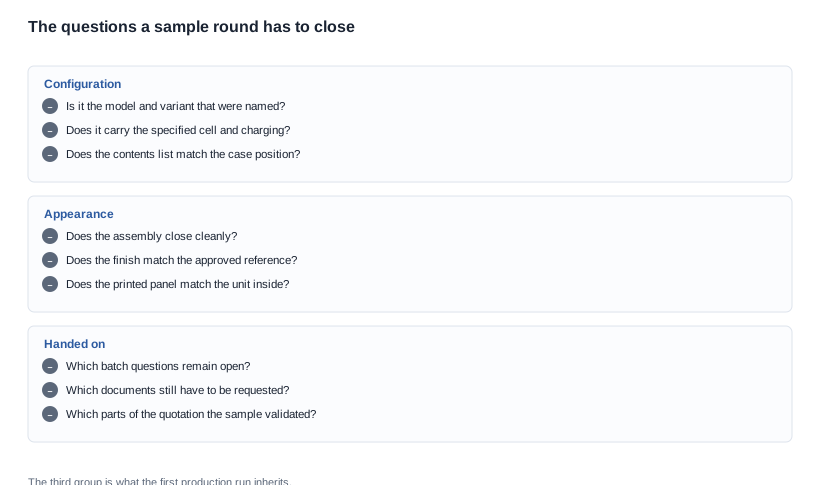
The configuration questions come first, and they are the easiest. Is the unit the model and the variant that were named. Does it carry the cell configuration that was specified. Does it charge by the method that was specified, or by a method nobody named. Does it include the case where a case is in scope, and does the packaging state what is in the box consistently with the case position. Is the colour one the model publishes, or one that was assumed. Does it include the removable part where that is part of the configuration, and does it assemble as a single unit if that part is supposed to be detachable.
The appearance questions come next, and they are the ones a sample is genuinely good at. Does the assembly close cleanly, with no visible gaps or misalignments. Is the surface consistent with the approved reference rather than with a general idea of the product. Is the finish the one that was agreed. Does the printed panel carry the model string and the colour designation that match the unit inside it.
The documentation questions have a short answer and it is important to keep it short: a sample produces no documents. What the sample can do is show which documents are needed, because the markings, labels and panels on the unit show what has to be documented. The conformity paperwork for the exact model designation has to be requested in writing, and it cannot be produced by a unit.
The batch questions cannot be answered by a sample and should be listed as open rather than left implicit: runtime consistency, assembly reliability over time, the behaviour of the production route, and the yield the production run is expected to achieve. Each of them belongs to the first production run, and each of them belongs in the inspection plan that the quality file carries.
The commercial questions are the ones that link a sample round to the quotation. What changed between the quoted configuration and the sampled one. Whether the sample configuration is the configuration the price assumed. Which parts of the quotation the sample has validated and which it has not. Whether the sample cost, whatever it was, appears as a line on the quotation or was absorbed. And whether the schedule the sample implies is compatible with the launch date.
There is a trade-off worth naming, because programmes confuse the two ends of it. A sample run early, against an open requirement, is inexpensive insurance: it can end the programme before a production run is committed, and it is the only way to see the consequences of a requirement nobody has yet written down. A sample run late, against a settled requirement, costs more and settles more, because the criteria already exist and the unit can be accepted or rejected without argument. The error is not choosing one end or the other. The error is running an early sample and then treating it as though it were the late one, which is how a programme ends up holding a unit nobody signed against a requirement nobody wrote.
The red flags are recognisable from the far side of a sample round. A sample requested without a written configuration. A sample evaluated against a verbal description rather than against written criteria. A sample presented as evidence of compliance. A sample that arrives with a configuration nobody asked for. A reference unit signed without a defect log. And a sample round with no statement of what it did not check, which is the one that produces the false confidence later.
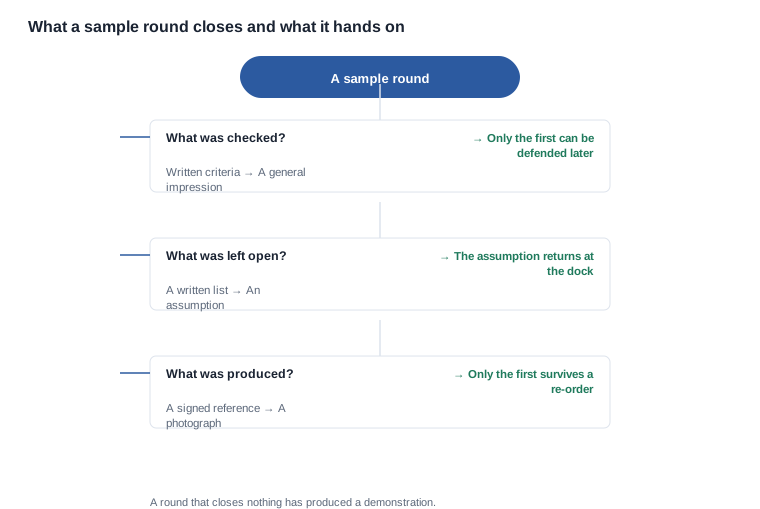
The decision diagram is the practical summary. A sample round either closes the questions it can close and hands the rest on in writing, or it is a demonstration, and a demonstration produces a photograph rather than a standard.
Where CYNRIN stands on standard oem sampling
A sample round is a specification exercise that happens to involve hardware, and the artefact worth having is a signed reference unit with a defect log attached. We will run a sample against a written configuration, we will restate that configuration in writing before the build, and we will state what the sample can and cannot settle rather than leaving it to be discovered at the receiving dock.
We will not produce documents through a sample. A conformity document for an exact model designation has to be requested and has to be requested for the destination it is intended for; the ingress marking on the V06 and the S7 carries an annotation on the catalogue page and no third-party report number published against it, so it cannot be restated away from the factory without a report behind it; and the 35 dB gain the bone-conduction entry publishes carries no acoustic evidence with it and supports no statement about hearing, medical use or about suitability for any population. Our catalogue also carries no certification line on any model, and nowhere in its text do CE, FCC or RoHS appear.
We publish no sample fee, no sample lead time, no sample policy and no list of pre-built sample units, and this article contains none of those figures. They belong to a quotation against a configuration, in the same way unit prices, minimum order quantities and warranty periods do.
What a buyer should take away is a method. Write the requirement, have it restated, agree the tolerance and the failure path before the unit is built, evaluate against written criteria, sign the reference and record the defects, attach it to the order, and hand on the questions the sample could not close. A programme that runs a sample this way usually discovers early that it no longer wants the product, and that discovery is the cheapest thing the round produced.
Related reading
- the tolerance and acceptance questions a sample round settles
- the acceptance criteria and the signature a batch needs
- the configuration a quotation has to be normalised against
- the quantity questions a first production run has to answer
- the geometry a signed reference unit has to match
A sample round earns its place when it produces a signed reference unit and a written list of what it could not check — everything else it produces is a photograph.


