
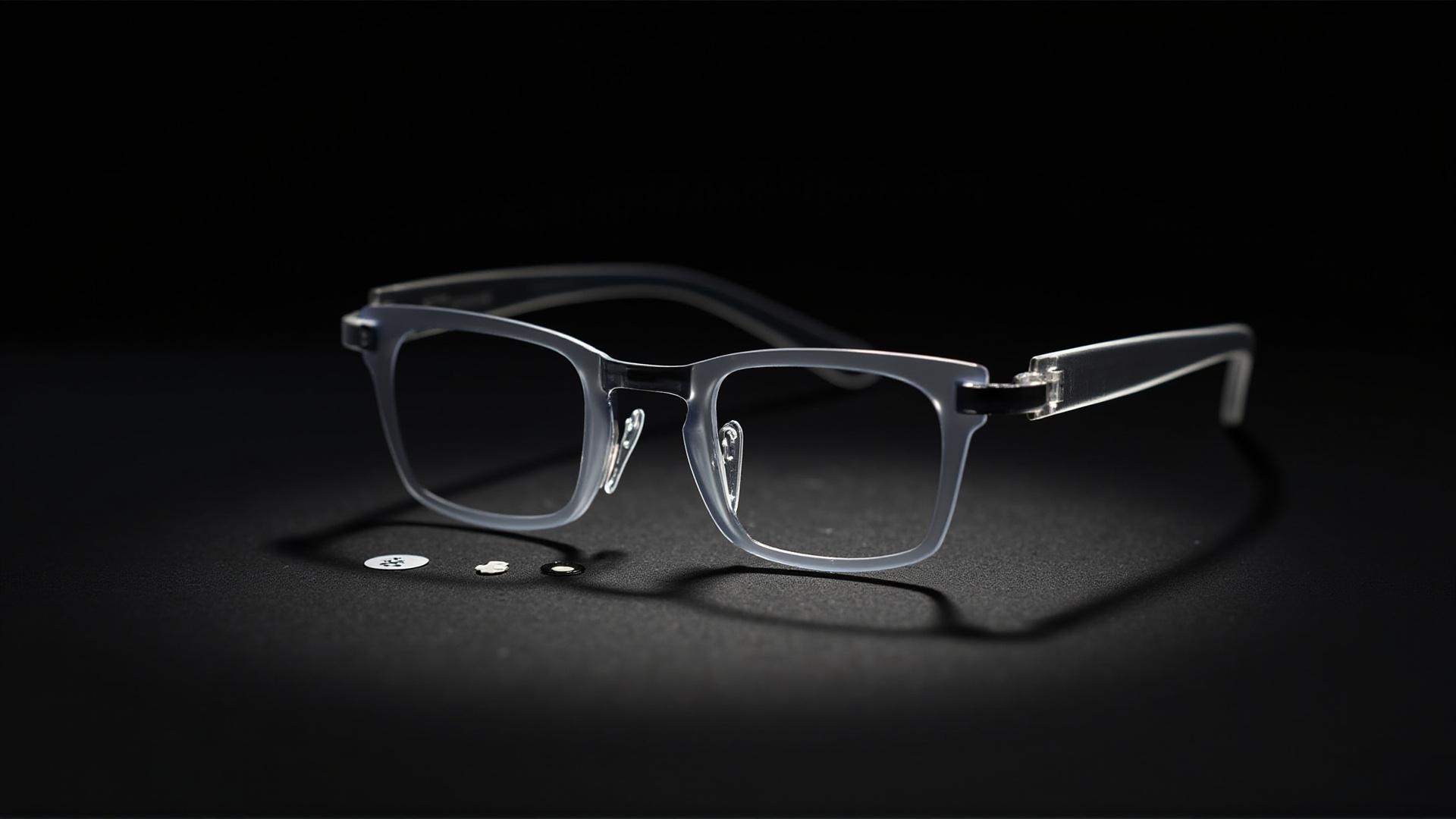
The S7's catalogue page is the most feature-rich in this range, and that is precisely why it needs the most careful pre-order list. Four descriptors are printed on the page — an ergonomic design row, a thirteen megapixel row, a removable inner frame row and an IP54 row — on top of the standard specification lines: a 260 milliampere-hour cell, an endurance published as a band of five to eight hours, a charge time of two hours or less and magnetic charging.
Three of those four descriptors raise a question of their own. A removable inner frame is a component that has to be ordered, counted and explained. An IP54 marking is a claim that needs a report behind it before it can appear on a box in a market. An ergonomic design row is a statement that needs a measurement or a procedure behind it before a customer can rely on it. The pixel row is the exception, because it restates something the specification already settled.
This page is a checklist for the buyer: what the page publishes, which of the published items a listing may state, which of them need a document first, and the order to ask for them in so that one exchange answers the lot.
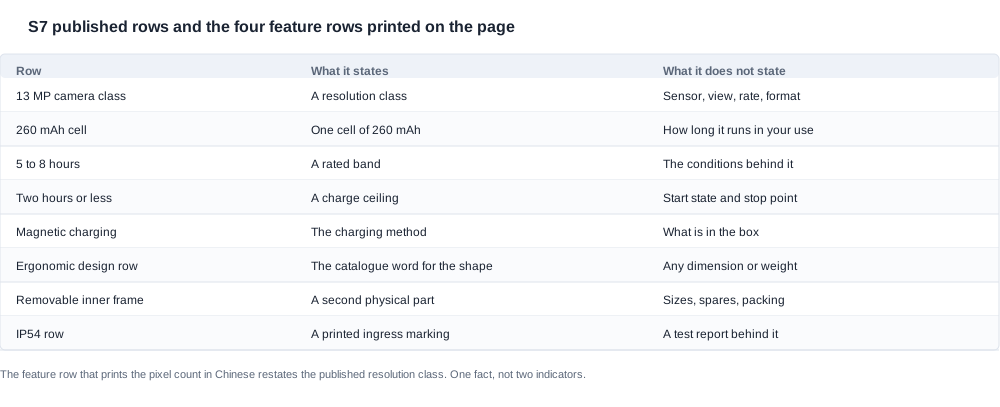
What to check before ordering to know about S7 smart glasses: three feature rows that raise their own questions
The standard rows first, because they are the ones a buyer uses to build a specification.
The camera is published as a thirteen megapixel class, and this model is one of the three camera models in the range that sit in that class, alongside the L1 Pro and the L2 Utral. The other eight camera models sit in the eight megapixel class. The class is a count of pixels, and it is the only published camera information for this model: no sensor, no field of view, no recording rate, no file format and no storage capacity are published for it.
The cell is 260 milliampere-hour, and this model is one of three camera models that publish that figure, the other two being the KY06 and the V06. The camera cells in this range fall into four groups — 220, 260, 265 and 290 milliampere-hour — and the 260 group is shared with the two models that also carry an ergonomic design row and, in one case, a removable inner frame. A buyer comparing this model against a sibling in the range will find the cell identical and the published endurance identical, and the differences in the feature rows.
The endurance is published as a band of five to eight hours rather than a single figure, which is the same band several camera models publish. A band cannot be quoted without its conditions, and the conditions behind it are not published: not the recording mode, not the volume, not whether the radio was connected, not how the case was used. The listing line has to carry the band and the qualification together, or it carries nothing.
The charge time is two hours or less, and that is a limit rather than a measurement: neither the charge's starting cell state nor the level at which the unit is called charged appears anywhere on the page. The charging method is magnetic, which is published, and which decides what goes in the box and what a customer replaces when it is lost.
Now the four descriptors, and the three questions they raise.
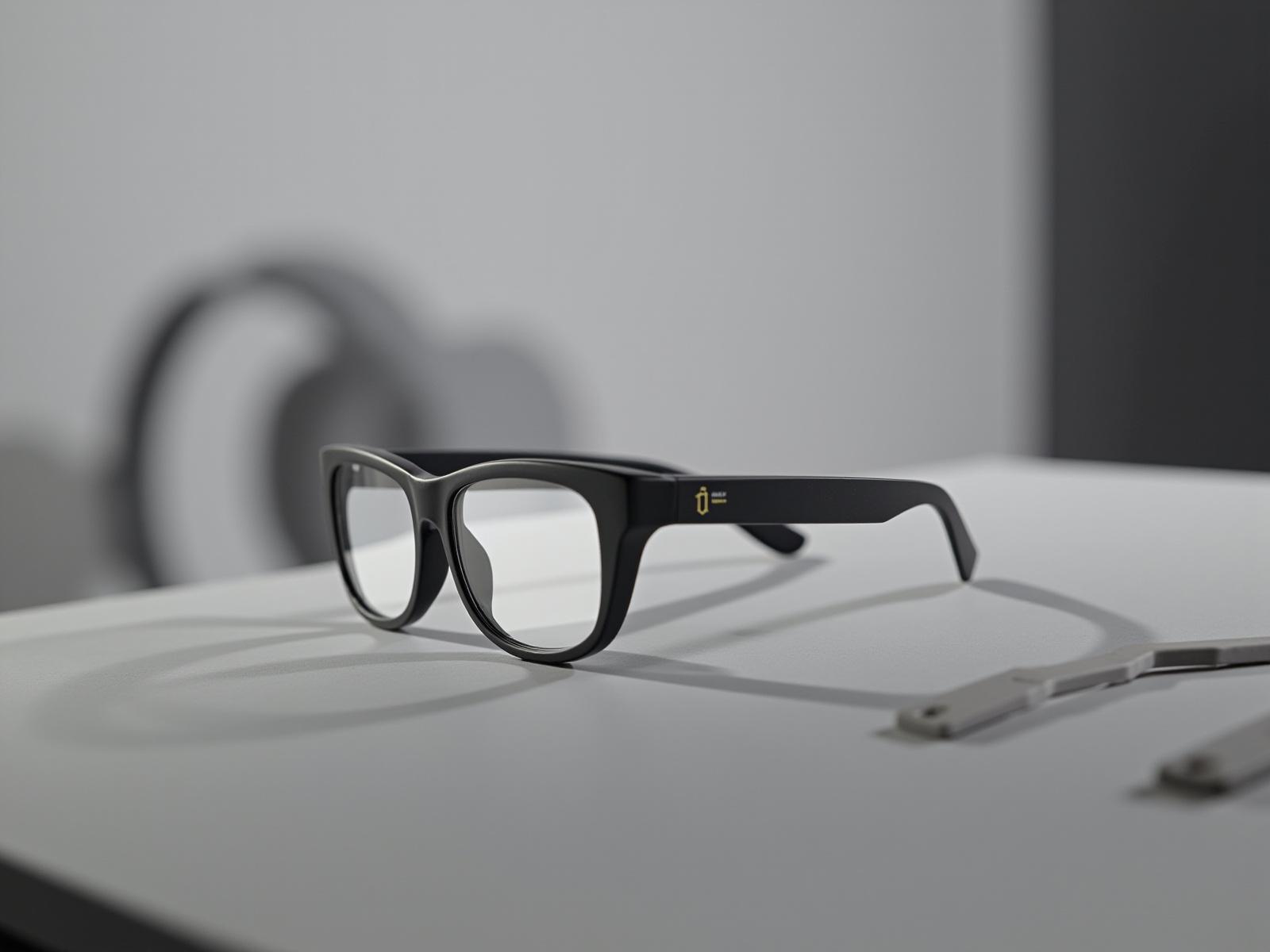
The ergonomic design row. It is a statement about shape and fit, and the catalogue publishes no dimensions, no adjustment range, no weight and no measurement that would let a buyer or a customer check it. A channel may quote the descriptor as the catalogue's word for the model. What it may not do is convert the descriptor into a comfort claim, a fit claim, or a statement about how the product behaves over a long session, because none of those is published for this model. The question to put is what the row is based on, and what a customer would be able to see.
The removable inner frame row. This one has a direct operational consequence, and it is dealt with in its own section below, because a removable component is not a feature — it is a second item in the box and a second line in the accessory order.
The IP54 row. The page prints it, and the catalogue publishes no test report behind it. That is the whole of the problem: an ingress marking is a measured claim, and a measured claim may only be made externally when the measurement is evidenced. The section below treats it separately for that reason.
The thirteen megapixel row. This is the exception, and it is worth being clear about why. The row restates the resolution class, which the specification already settles — 1300万高清像素 and thirteen megapixel are the same fact, not two indicators, and they must never be presented as though they were separate measures. A listing that quotes both is quoting one number twice, and a listing that treats the row as an additional quality step is claiming something the catalogue does not say.
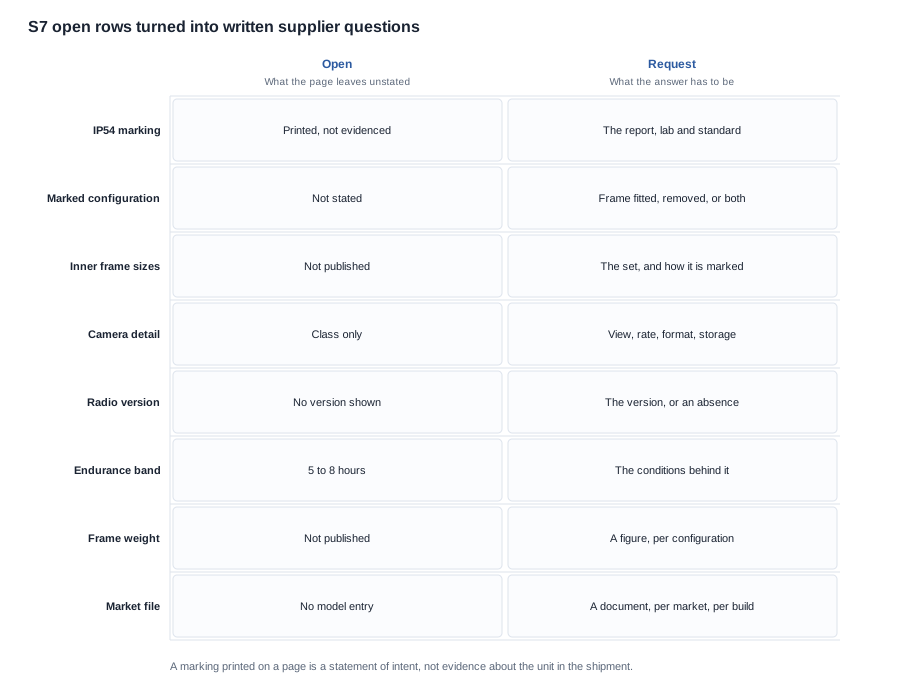
What the page as a whole leaves open, then, is substantial: the camera behind the class, the conditions behind the endurance band, the completion point of the charge, the radio version (the camera models in this range do not publish one), the physical dimensions and weight, the range of inner frame sizes and how they are supplied, the report behind the ingress marking, and the market documentation for the destinations the order will ship to. That is a normal amount of open ground for a camera model with feature rows, and it is exactly what the request list is for.
The 13-megapixel row and the IP54 claim that needs a report behind it
The resolution class is the easiest of the three to handle, because it is the only one of the three that the catalogue has already settled elsewhere. The camera is published as a thirteen megapixel class; the feature row prints the same fact in Chinese, and the two together are a single specification. A buyer can therefore write the camera line once, and the row on the page gives a channel a phrase in the same wording the factory uses — which is useful for a listing that has to quote the manufacturer, and useless as a second data point.
What the class does not do is anything that a customer can check. Thirteen megapixels is a count of pixels on a sensor whose size, lens and light-gathering are not published for this model. In practice that means three things a buyer has to request: the field of view, because it decides whether the product is usable for the use at all; the recording rate and format, because they decide whether the footage can be edited and shared; and the storage and transfer behaviour, because they decide whether the product works in a customer's workflow or creates a support queue. None of the three is published for any camera model in this range, so this is not a criticism of this model — it is the shape of the information the catalogue provides, and the buyer has to plan for it.
The IP54 row is a different kind of problem, and the kind worth spending the most attention on. The page prints an ingress marking. The catalogue publishes no test report for it, and it is the second of only two models in the range whose page carries such a marking. That combination — a printed marking, no published report, and only one other model in the range with the same — is precisely the situation that creates a dispute later, usually after a shipment is held at a border, a distributor asks for the evidence, or a customer asks what the marking means for the use they bought the product for.
The rule is straightforward and it is not negotiable: an ingress rating may be claimed in market material only when a test report supports it, and the report has to be tied to the build that is being shipped. That means the buyer needs to know which report it is, which laboratory produced it, which standard it was tested against, and whether it covers this model and this build. A marking printed on a catalogue page is a statement of the manufacturer's intent; it is not evidence that a particular unit in a particular shipment has been tested.

There is a second question attached to the marking, and it is the one that decides whether the product can be marketed for a condition at all. A test establishes that a product meets an ingress rating under defined conditions. It does not establish that the product suits a wet environment, that it can be worn in heavy rain, or that it will survive being washed. Those are different claims, and a channel that has the report in hand still cannot make them. The question to ask the factory is what the marking was established against, and the answer has to be recorded in the buyer's own words so that the copy can be written from it later.
A third question is practical: whether the report is available for every build of this model, or whether it was produced for a specific production run, and whether a change to the configuration would require it to be repeated. A camera model with a removable inner frame has more than one physical configuration, and a buyer should know whether the marking was established with the inner frame fitted, removed, or both.
The safest commercial position, and the one to write down before the first order, is that the marking is printed on the page and not yet evidenced, that no condition claim may appear in any material until the report exists and has been read, and that the question stays on the list until the report is in the file. A claim made on the strength of a catalogue page and withdrawn later costs more than the delay of waiting.

The removable inner frame, and what it changes for the accessory order
A removable inner frame is one of those features that sounds like a detail and behaves like a supply-chain decision. It is a second physical part, and a second part is a second line in the packing list, a second thing to count, a second thing to identify at returns, and a second thing for a customer to understand. This model is one of two models in the range whose page names a removable inner frame, the other being the V06, and that makes the accessory position for this model a decision to make rather than a detail to inherit.
The questions the row raises are practical ones. What inner frame sizes exist for this model, and are they supplied as a set, or chosen by the customer? How is a size identified — by marking, by packaging, by a printed label on the frame? Can a frame be ordered separately as a spare, and if so, against what reference? And what happens at returns: a unit returned without one of its two parts is a different problem from a unit returned with a damaged one, and the two are separated by paperwork the buyer has to design.
The packing list is where the cost of all this lands. A box that contains the frames, the inner frame, the case and the cable is a box with four components in it, and a warehouse that has been told to expect one item will find four. A channel that stocks spares has to decide whether the spare is the inner frame, the case, the cable or the whole assembly, and that decision is a commercial one that follows directly from the row rather than from a preference.
The one question that ties the inner frame to everything else on the page is about the evidence. If the inner frame can be removed and refitted, and the product carries an ingress marking, then the question of which configuration was tested becomes part of the evidence question rather than a curiosity. A report that covers the product with the inner frame fitted does not automatically cover the product with it removed, and a buyer who has not asked will not know which applies. That is why the frame questions and the marking questions belong in the same exchange, even though one of them is about hardware and the other about paperwork.
There is also a customer-facing version of the same point, and it is the version that decides what a listing can say. A removable inner frame is something a channel can describe in a sentence — the product comes with an interchangeable inner frame, in a set of sizes — and that is a legitimate claim on the strength of the published row. What it cannot do is describe the sizes, the fit, the materials or the effect on the marking without the answers above, and a listing that promises a fit the catalogue does not describe is a listing that generates returns in the first season.
The request sequence that answers all of it in one exchange
The eleven items below are the order this model should be checked in, and each is written as the request that closes it. They travel together, attached to the sample request, so that the answers and the unit arrive in the same round.
- Identity and build. The designation printed on the unit and on the packaging, and the build that every answer below is filed against.
- The ingress marking. Which test report supports the IP54 row, which laboratory produced it, against which standard, and whether it covers this build and this configuration.
- The configuration behind the marking. Whether the report was established with the inner frame fitted, removed, or both.
- The inner frame. Which inner frame sizes exist, how a size is identified at the bench, whether a frame is available on its own as a spare, and what the box holds.
- The camera. Behind the thirteen megapixel figure the catalogue prints nothing at all. The sensor is not named and the lens is not specified; the frame rate is absent, as is the angle the camera covers, and no container is given for the footage and no destination for a recording once it has been made.
- The radio. Whether this model carries a radio and which version — the camera models in this range publish none of their own.
- The endurance band. What was running during the published five to eight hours, and what the figure is under the conditions this channel actually operates in.
- The charge. What the two-hour ceiling applies to, and the state the cell is in when the charge starts and the point at which it is treated as complete.
- The ergonomic row. What the descriptor is based on, and what a customer would be able to see or measure.
- The physical details. The frame's measurements, whether anything on it adjusts, and what the unit weighs — no weight is published for this model.
- The market file. The conformity documents that exist for this model, the markets they are valid for, and the build they were drawn against; no per-model certification entry appears anywhere in the catalogue.
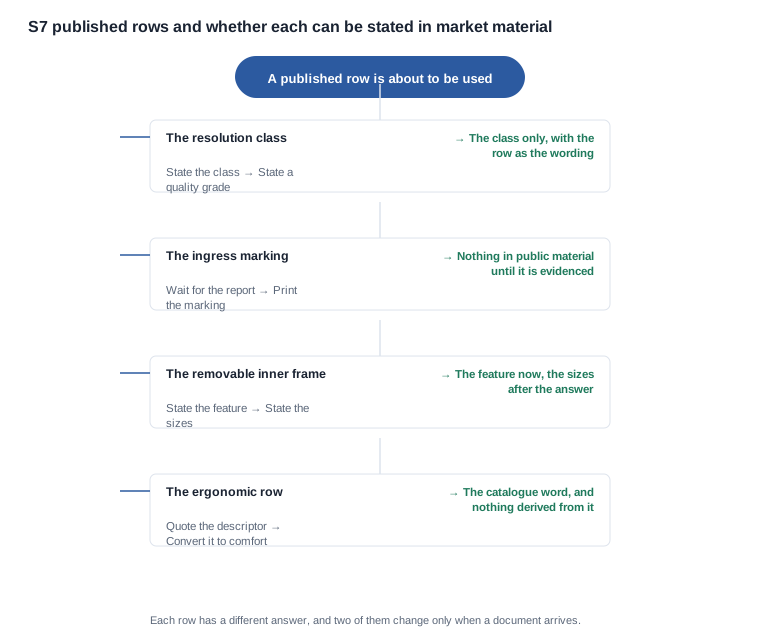
What closes the file is a written answer per item, each naming the build it covers; the report behind the ingress marking, if the marking is to be claimed; the documents for the destination markets this order will reach; and a configuration record from which the next build can be reproduced. A spoken answer closes nothing, and an answer offered for the model in general rather than for a build closes nothing either.
Two red flags are worth naming, because on a page with this many descriptors they are the likely ways a file stays open. The first is a marking confirmed by assertion — "the model is IP54" — with no report behind it and no build attached, which settles nothing and creates a claim the buyer has made on the manufacturer's behalf. The second is a frame supplied as a single size with no way for a customer to choose, which turns a published feature into an inconvenience in the unboxing and a return at the counter.
What a closed file leaves behind is a record short enough to read in a minute, and it is what the first consignment is judged against: the unit that arrived is the unit the page described, the removable component is accounted for in the box and in the packing list, the capture behaves as observed, the marking is either evidenced or absent from the material, and the paperwork covers the build and the market. That record is what the first batch is judged against, and it is the only thing that makes the four descriptors on the page usable in a market.
What this page will not do is rank the camera models or name a requirement this one is best suited to. The catalogue publishes no price, no lead time, no minimum order quantity, no sensor detail and no field of view, and any conclusion of that kind would be a judgement dressed as a published fact. What it does publish is a full set of descriptors and a short set of numbers, and the checks above are how a buyer decides which of them can be written on a box, which of them need a document first, and which of them are questions until somebody answers them in writing.
There is a shortlist discipline behind the order of these items, and it is worth saying why: the order is not arbitrary. The criteria that decide which rows can go into market material are simple: a row that is published and self-contained can be quoted as it stands; a row that is published but depends on something outside the page needs that something first; and a row that is published as a descriptor without a measurement behind it can be quoted as a descriptor and nothing more. Applied to this page, the resolution class is the first kind, the ingress marking and the removable frame are the second, and the ergonomic row is the third.
Applied to a buyer's own work, the same three kinds produce three different tasks, and mixing them up is what makes a pre-order list slow. The first kind needs nothing but a copywriter; the second needs a document request with a deadline; the third needs a conversation with the factory about what the descriptor is based on. The questions to ask, then, are not a single list but three lists, and the one that decides the schedule is the second — because a document request that arrives late holds a shipment, while a copywriter's task that arrives late holds a campaign.
Tell us which of these rows is the one your market will not accept without a document, and we will write the request for it in the form our documentation team would use.


