

Selecting smart glasses by market certification mapping is not a question about which framework applies. It is a question about which of your models each framework applies to, and that is a much harder question because it is per model rather than per range. A map drawn once for the catalogue and reused for every destination is the most common failure in this area, and it fails quietly: the paperwork looks complete, the launch goes ahead, and the problem surfaces at a customs inspection or at a distributor's own audit. This guide sets out how to build the map, which catalogue attributes actually feed it, what our own documentation can and cannot contribute to it, and how to check the result before it becomes a purchase condition. It is a method guide. It does not state which approvals any model holds, because our published records do not contain that information.
Selecting by market: what a certification map actually maps
A certification map has three layers, and most of the confusion in this area comes from mixing them.
The first layer is the framework set. For each destination you intend to ship into, there is a set of regulatory frameworks that could apply to a wearable electronic product: radio conformity, electromagnetic compatibility, chemical and material restrictions, battery and transport rules, general product safety, and the market-specific labelling and economic-operator requirements. The framework set depends on the destination, and it is largely outside our control — it is what the destination's rules require of a product of this type.
The second layer is the product attributes. For each of your twenty-eight catalogue entries, some set of attributes determines which frameworks are triggered: does it contain a radio, does it contain a rechargeable cell, is it supplied with a mains adapter, is it a children's product, does it claim a level of water resistance, does it make any claim about the wearer's health or body. These attributes are where the published catalogue rows earn their place, because the catalogue publishes them for you.
The third layer is the evidence. For each model and each framework, there is a document, and each document is in one of a small number of states: it exists, it is claimed but the reference is unresolved, it is marked without a supporting test report, or it is simply not held. This layer is where a sourcing programme actually lives or dies, and it is the layer that a certification map exists to make visible.
The relationship between the three layers is one-to-many and it is not symmetric. One radio framework applies to every model with a radio, but the evidence for it is per model. One battery framework applies to every model with a cell, and the evidence is again per model. One packaging rule applies to the whole shipment. So a map that records frameworks without recording model-level evidence is a framework list, not a map — it tells a procurement team nothing about whether the particular model they are about to order has a document behind it.
There is a practical consequence that is worth stating early. The map has to be built before the range is fixed, not after. If you select the models first and then draw the map, the map will describe whatever happens to be in the range, including the entries with no formal SKU and the entries whose classification our own two documents disagree about. If you draw the map first, the framework set and the evidence gaps will tell you which models can carry a destination at all — and that is a far more useful output, because it turns a compliance task into a shortlisting task.

Selecting the destination frameworks: three catalogue attributes decide the route
Three attributes in our published catalogue determine which frameworks a model can trigger. You cannot build a map without reading all three, because each one opens a different set of routes.
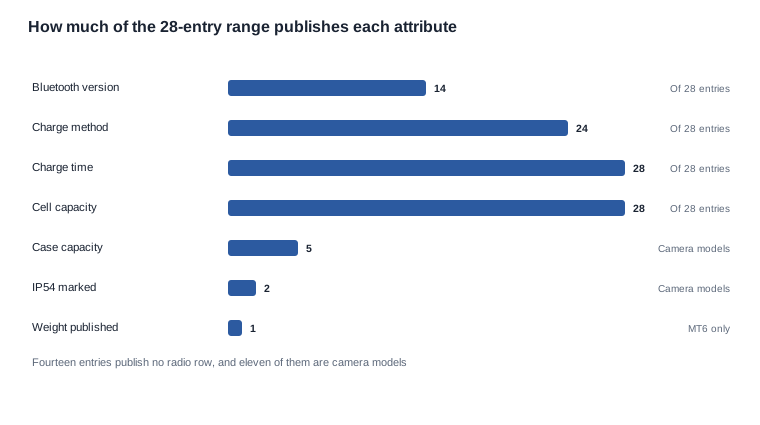
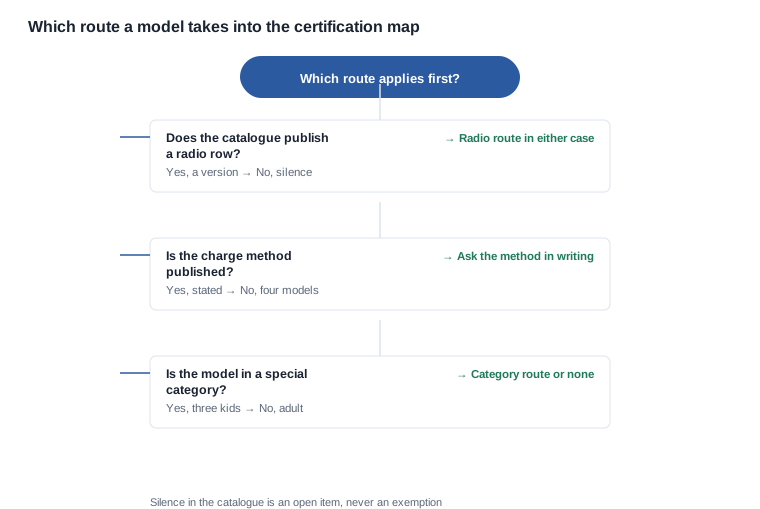
Attribute one: the radio. Fourteen of the twenty-eight entries publish a Bluetooth version. V5.3 is published on exactly two, the K02 and the K01. V5.4 is published on six of the eight audio models, on all three sport models, and on three further entries — the children's A07 and two of the rows that carry no formal SKU. Fourteen entries publish no Bluetooth version at all, and they are not a random fourteen: all eleven camera models sit in that group, together with the A05, the A06 and the bone-conduction entry. This is the single most important gap in the map, because the absence of a published radio row on a camera model is a silence in the documentation, not an absence of a radio. A camera product that records stills and video and has no published radio row almost certainly has one, and a buyer who maps the camera models as radio-exempt because the catalogue does not mention it will build a file that cannot be completed.
Attribute two: the power source. All twenty-eight entries publish a cell capacity, and all twenty-eight publish a charge time of two hours or less except the two sport models that publish about one hour. Charging method is published for twenty-four: magnetic on seventeen entries and Type-C on seven. Four entries publish no charging method at all — L1 Pro and CY05, and MT6 and the CY03 — each of which publishes a charging-case capacity but leaves the method unstated. Whether the cell sits in a charging case, whether that case ships with the product, and whether any mains adapter is involved are separate questions, and the catalogue answers none of them for the range as a whole. A mains adapter, if one exists, is the item that pulls a mains-supply framework into the map, so this is exactly the kind of question to put in writing early.
Attribute three: the product category. Three of the entries are children's models, the A05, the A06 and the A07, and category questions open frameworks that do not apply to adult products at all. The catalogue's pages for the A05 and the A06 list a fogging unit, correct and incorrect posture-and-distance prompts, and lens clarity and lens fogging; our product detail sheet records that the certification position for the children's category is not provided at all, and that safety and health claims in this category carry a high compliance risk. Category also covers water resistance: IP54 is marked on exactly two entries, the V06 and the S7, and our product detail sheet records that the marking carries no third-party test report number. A claim printed on a specification sheet is not the same as a claim backed by a report, and the map has to hold both facts without confusing them.
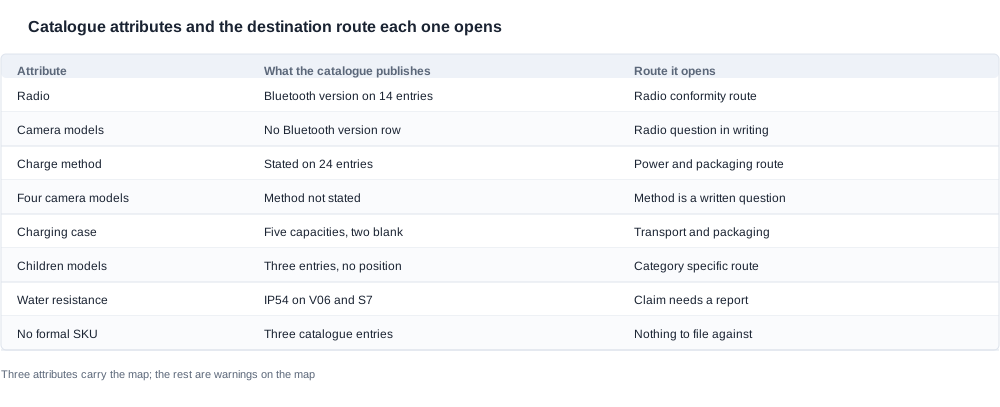
Two further points belong on the map as warnings rather than as attributes. The first is the catalogue's own inconsistency of classification. The catalogue PDF and our product detail sheet group the same twenty-eight entries into different categories — the sheet records nine camera, eight audio and five sport models, while the catalogue pages present eleven camera models and three sport models, and it flags the classification of the MT5 and the page annotations for the S7 and the V06, and the MT5 as items still to be confirmed. A map built on one document while a distributor's adviser works from the other will produce two different answers to the same question. Decide which document governs, record that decision, and say so in writing to whoever is auditing you.
The second is the three entries with no formal SKU: the augmented-reality entry, the electrochromic entry and the bone-conduction model. They carry published specification rows, but no SKU, so there is nothing for a document to be issued against until the internal data is resolved. The bone-conduction entry carries an amplification-gain row of 35 dB, and our product detail sheet records that its customisation capability is not disclosed and that its compliance risk is the highest of the range. Any map that includes these three entries has to carry an open item against each of them.
Selecting the evidence: the three states our own documents are in
What our own files contribute to the map has to be stated precisely, because the gap is where the procurement risk sits.
Two documents are relevant and they do not agree with each other. The catalogue PDF carries an export-certification page whose content is pictures rather than extractable text, and a search of the full text finds no occurrence of CE, FCC or RoHS — in fact no per-model certification row exists in it at all. The product detail sheet is the only one of the two that says anything about conformity, and it carries the CE, FCC and RoHS position as a company-level claim while leaving each model-level certificate number unresolved. The sheet adds that not a single entry in the range has arrived with a usable image, a clip or a test document.
That produces three evidence states, and the map should record which state each model sits in rather than collapsing them into a yes or no.
- Claimed at company level, reference unresolved. This is the state for the camera, audio and sport categories in the product detail sheet. The claim exists in the sheet; the identifier that ties a document to a specific model does not. The correct action is not to treat the model as compliant and not to treat it as non-compliant. It is to put the request on the list, with the model designation written out exactly as the catalogue writes it.
- Marked but unreported. This is the state for the IP54 marking on the V06 and the S7. The marking is published; our own records note that no third-party report number backs it. A buyer who prints IP54 on a listing needs to know whether a report exists, and ours does not say that one does.
- Not provided. This is the state for the children's category, where our records give no certification position at all, and for the bone-conduction entry. The appropriate map entry here is a question with a deadline attached, not an assumption.

The layers above are worth naming explicitly because they are frequently collapsed into one another. The first layer is what the catalogue prints. The second is what the supplier confirms in writing. The third is the third-party document itself. The fourth is the contractual reference that ties the document to the model and to the purchase order. A map that stops at layer two is a map of intentions; a map that reaches layer four is a map that survives an audit. For each model, record the layer you have reached, and treat any model still at layer one or two as not yet mappable.
There is also a dimension that no document resolves and that a buyer has to raise directly: the customisation axes recorded in the product detail sheet. The sheet records seven axes for the camera category, five for the audio category and five for the sport category, and the three sets are not subsets of one another — the audio set has no logo axis and no firmware axis and adds a lens-material-and-colour axis, while the sport set carries frame shape, lens configuration and a remote-control axis. That structure has a direct certification consequence which the sheet itself states: a parameter comparison against a competing product may only be claimed publicly after a physical comparison, acoustic performance has no third-party measurement behind it, and an IP rating may only be claimed with a test report behind it. In other words, the axes determine which configurations exist, and the configurations determine which documents are needed. You cannot finish the map without asking which configurations are actually available for the model you have chosen.

Selecting a model into the map: the checks that stop a false entry
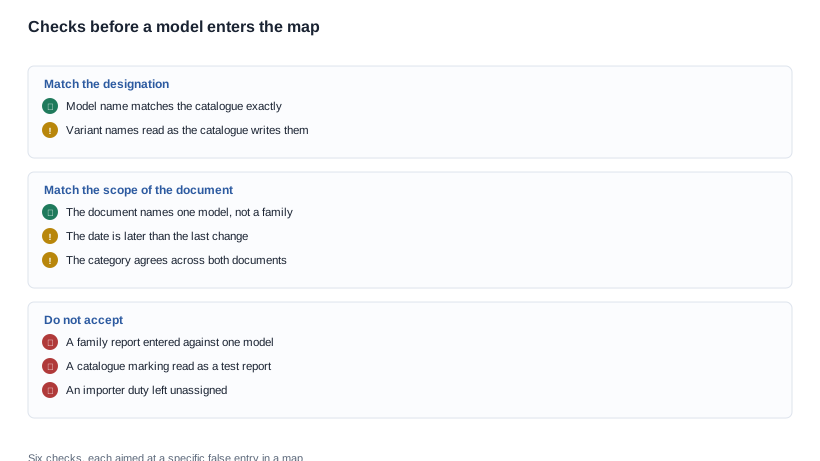
The purpose of building a map is to be able to put a model in it with confidence. Six checks govern that step, and each of them has caught a real error in this kind of programme.
Check the model designation character by character. The document must name the model in the same form the catalogue uses. Our catalogue contains at least one name that invites a transcription error — the L2 Utral publishes two variant names side by side, and the sheet records that the spelling of that name is itself an open item, with the meaning of the second variant not established. A document that names a variant the catalogue does not recognise is not evidence about your model, whatever else it says.
Check that the document covers a model and not a family. A test report covering "the camera range" or "the 5.4 product family" cannot be entered against the L1 Pro. If you are given a family document, ask for the model-level file, and record the request as open.
Check the date against the configuration history. A document issued before a component changed describes a product you are no longer buying. This is particularly easy to miss on the four camera models whose charging method is unstated, because a change in charging approach is exactly the kind of edit that leaves the catalogue row untouched.
Check that the model sits in the same category in both documents. The classification discrepancy described earlier is the practical test: if the model is a camera model in the catalogue and a sport model in the sheet, the file you receive may have been prepared against a different category assumption, which affects which frameworks were considered.
Check what the document actually asserts. A number on a certificate is not a statement that the product is compliant with a given framework in your market; read what the document is about and record that, rather than filing it under a framework you inferred from its title.
Check the retailer's obligations separately from the manufacturer's. Some frameworks impose duties on the party placing the product on the market in the destination, which for an importer or a distributor is not the factory. Those duties do not appear in a manufacturer's technical file at all, and a map built only from factory documents will leave them unassigned.
When the map is built, the working document should hold one row per model per framework. Each row carries the framework, the model designation as the catalogue writes it, the evidence state, the layer reached, the date of the document, the party that holds it, and an action if it is not closed. A map with one row per destination is a framework list and will not survive a distributor's due diligence.

Selecting the commercial scope: what the certification line has to settle
Certification work is commercial work, and it belongs in the purchase conditions rather than in a side conversation. Our own records publish no certification fee, no filing charge, no minimum order quantity tied to certification, and no lead time for the compliance work, so everything below is a line to request in the quotation, not an answer we can give you.
- Who files, and in which market. Whether the supplier files the document in its own name, in yours, or in the name of an importer you appoint.
- What a filing costs, and its basis. Whether the charge is per model, per destination, per family, or per application, and whether a repeated filing for the same model at a second destination carries a second charge.
- What is charged when nothing needs filing. Some destinations accept an existing document; whether that saves money or simply changes the question.
- Whether the sample, the tooling and the packaging share the file. A customised configuration may need its own documents, and the question of who funds that work belongs in the quotation.
- How long the file takes. A compliance lead time that is longer than the production lead time changes the launch plan, and it has to be visible in the schedule rather than discovered in week six.
- What happens if a document lapses or a framework changes. A renewal obligation, a re-test obligation, and the allocation of cost when a framework moves under a model already in the range.
- Audit rights. Whether you may see the underlying test reports rather than only the resulting certificate, and how far back that access reaches.
- Defect and recall responsibility. Which party pays when a product is withdrawn, and whether that party is the factory, the importer or the distributor.
Two negotiating points are worth taking early rather than late. The first is the model-level file as a deliverable of the purchase, not a courtesy: if the technical file is not a contractual output, the model cannot be re-sourced later without starting the compliance work again. The second is the timing of the certification spend relative to the purchase order. For destinations where the document is a precondition to shipping, committing the certification fee before the volume commitment has been agreed inverts the risk. Ask for the cost basis to be written separately from the unit price, so that a change of plan on one does not automatically change the other.
The broader destination frameworks are set out in the general product safety note, the radio conformity note and the cybersecurity requirements note; the select by market solution page is where the destination logic sits in one place.
A worked walkthrough: three destinations and eleven rows
The worked example that follows is drawn entirely from our published rows and describes no customer engagement.
A distributor is mapping three destinations and has short-listed eleven models. The first step is not to look up frameworks. It is to read the attributes. Of the eleven, six are camera models with no published Bluetooth version and two of those six publish no charging method either, so both attributes go into the map as open items rather than as facts. Four of the eleven are audio models with a published Bluetooth version and a published charging method, so their radio and power rows are closed and their map rows can be filled from the catalogue. One is a sport model with a charge time of about one hour, which changes the transport assessment for that row and nothing else.
The second step is to record the evidence state for each of the eleven. None reaches the third-party-document layer, because our published records contain no per-model certification row and no test report for any entry. All eleven therefore sit at layer two at best, with the four audio models able to identify their radio configuration from the catalogue and the six camera models needing the radio question asked in writing.
The third step is to separate the category questions. If the shortlist excludes the children's models and the three no-SKU entries, the map has no category-driven route open, which removes a whole class of framework work from the launch. If any of them is included, the map gains an item that our own records cannot answer at all.
The output of the exercise is not a compliance position. It is a ranked list of eleven models with named open items, a set of questions that have to be answered in writing before a purchase order can reference a document, and a clear statement of which destinations cannot be served by the shortlist as it stands. That is the deliverable a certification map should produce.
Selecting by market: where the map stops and the work starts
We publish specification rows and nothing else about conformity. The catalogue's export-certification page is images rather than text, no reference to CE, FCC or RoHS is written into the catalogue text, and there is no per-model certification row anywhere in it. Our product detail sheet carries the company-level claim and leaves the model-level references unresolved, and it records that no entry in the range has come with a test report, a real photograph or video. We therefore do not publish a certification map, and any map that appears to come from us would contain information we do not have.
What we can do is supply the attributes a map needs — the radio rows, the power rows, the category groupings, the charging-case states and the two IP54 markings — and say precisely which of them are silent. The EU file chain works one destination through to the level of a written file, and the UK route does the same for the United Kingdom; this guide is the method that sits underneath both.
Next step: list the models you intend to ship, read the three attributes for each, and separate what the catalogue publishes from what it does not. Then take the open items to the supplier as a written request with deadlines, and record the answer against the model rather than against the range. Every row you close is a row a distributor's audit will not have to reopen.


