

Selecting smart glasses by market uk requirements needs a caveat that the other destination guides in this series do not need, and the caveat is the point. The United Kingdom operates its own conformity marking, its own designated standards, its own radio rules and its own product-safety framework, and several of those have been in transition with changes still landing. A guide that stated a settled position would be wrong within a year, and a guide that pretended to a settled position would be worse than one that says nothing. What follows is therefore a framework and a list of questions rather than a checklist of requirements, and the honest instruction at the end is to confirm the current position with a party qualified in the jurisdiction before committing a programme to a launch date.
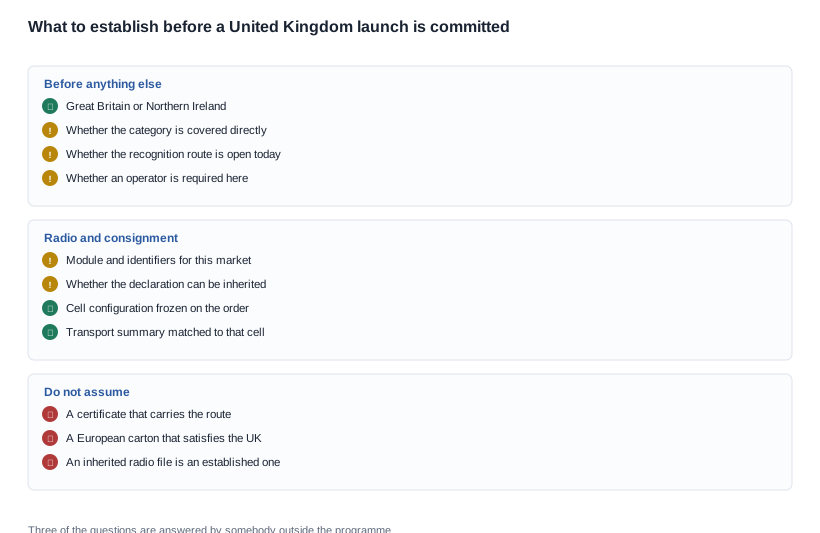
There is a second thing to establish before any of the frameworks are discussed, and it is not a technical question. A United Kingdom launch is not one destination. Great Britain and Northern Ireland are not the same regulatory destination for every product category, and a buyer who has treated the United Kingdom as a single destination has usually discovered the difference at the point of despatch rather than at the point of planning. Establish which one is being served, per category, before the rest of the work begins.
Selecting for the United Kingdom: the questions that come before the framework
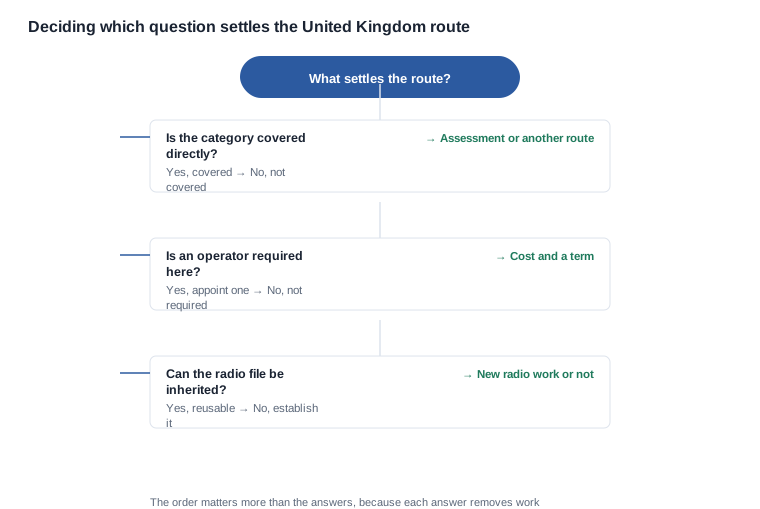
Most United Kingdom material is written as if the framework comes first and the product second. In practice the order is reversed, and the reason is that the first three questions determine which framework applies at all.
Is the product within a category that the United Kingdom regime covers directly? The answer to this is not obvious from the product description, and the consequences of getting it wrong are large: a category that is covered means a designated standard, a conformity assessment and a declaration; a category that is not covered means a different route. This is a question for a party qualified in the jurisdiction, with the product described to them.
Which marking and which recognition route apply, and what is the current state of that recognition? The United Kingdom's own marking and its designated standards run alongside a recognition route for other markings, and the recognition position has been subject to change. A buyer who plans against a recognition route has to know the route is open, for this category, on the date of the shipment.
Is a party established in the United Kingdom required, and for which categories? For certain categories the requirement is for a responsible person established in the United Kingdom rather than in the European Union. Whether a pair of smart glasses falls inside that requirement is the question, and it is the question that decides whether a United Kingdom appointment is needed in addition to, or instead of, the European Union arrangement. That appointment has a cost and a term, and it is not something to be discovered after a shipment has been held.
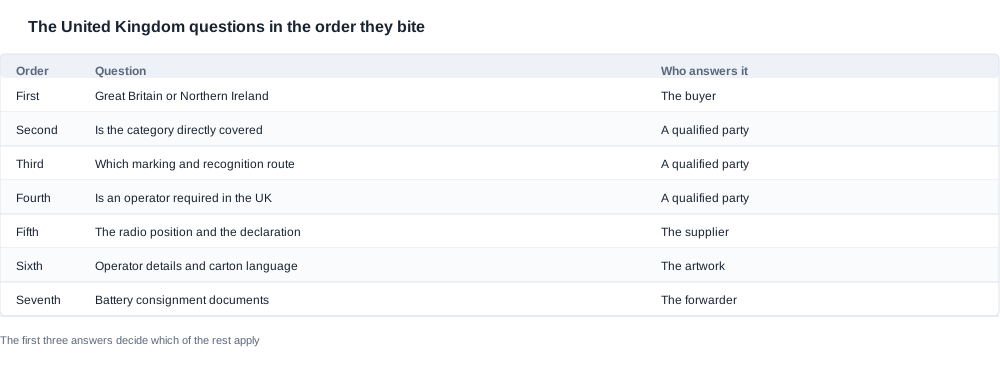
Only after these three are answered does it make sense to work through the radio, the electrical side, the labelling and the battery consignment. Working through them in the other order produces a specification that cannot be used.

Selecting the conformity route: the part that has been moving
The route itself is a sequence rather than a single step, and the sequence is what a buyer needs to plan a launch date around.
The assessment is the first step, and it takes an input: the product description and the technical documentation that goes with it. The assessment produces either a route to the next step or a request for more information, and the second outcome is the one that catches people out, because a request for information restarts the clock. The technical documentation therefore has to be complete on the first submission, which is an argument for finishing the product description before starting the assessment rather than in parallel with it.
The declaration follows the assessment, and it is a statement made by a party in the United Kingdom about a specific product. The declaration carries the product's identity, the framework it has been assessed against, and the identity of the party making it. Which means the model designation on the declaration has to match the model on the carton, the model in the test report and the model in the technical file — and if a model publishes two variant names, the ambiguity has to be resolved before the declaration is drafted rather than after.
The technical file sits underneath all of it, and it is the document that gets pulled apart when a consignment is stopped, when a retailer audits, or when a unit fails in the field. It has to allow somebody outside the programme to reconstruct the reasoning behind putting a particular product on the market. In practice that means the product description, the test reports, the instructions, the production records and the batch traceability. Our catalogue contributes the product-description elements for the range and nothing from the rest.

Two features of the route deserve a buyer's attention. The first is that it is a route and not a certificate: there is no single certificate to collect, and a supplier who offers one is offering a document that does not exist in the form described. The second is the transition. Because elements of the framework have been moving, the route itself should be confirmed against the current position rather than read from a document written this year, and the person who confirms it should be identified in the buyer's own records so that the confirmation can be re-checked when it matters.
Evaluating the answers before the assessment starts
The three category questions are the ones most often answered quickly and badly, and there is a way to make the answers usable. Three checks apply to each reply. Does it name the product category in a way that identifies what the product actually is, rather than what it is called? Does it name the marking or the route it is answering about, rather than describing the framework in general? And does it carry a date, so that the buyer can tell a current position from a remembered one?
An answer that names a category the buyer did not describe is not an answer, and the usual cause is that the product was described in commercial language. "A pair of AI glasses with a camera, a Bluetooth radio and a rechargeable cell" is a description a buyer can write; it is not a description a compliance assessor can classify. The product description in the technical file has to be a technical description, and getting there is a documentation task rather than a sales task.
There is a second failure mode worth naming, and it is the more common of the two: an answer that is correct but not specific enough to be used. "A United Kingdom conformity assessment will be required for this product" may well be true and may still be useless, because it does not say which route, on what timeline, with what documentation, and at what cost. A buyer who has four such answers has a programme whose duration is unknown and whose cost is unknown, and the natural consequence of that is a launch date set before the evidence path exists.
The third check is about the qualification of the answerer. An answer that comes from a party qualified in the jurisdiction is worth more than an answer that comes from a party that merely handles the paperwork, because the second party is frequently working from a summary that has not been updated. Where a supplier offers a compliance summary for the United Kingdom, the useful question is not whether they have one but whether they can name the party they would rely on.
Selecting the radio and the declaration: what has to be established in the UK
The radio position is the part of a United Kingdom file that most often does not transfer from an existing European file, and the reason is worth stating precisely, because "the radio file covers the product" is a sentence that is true in one jurisdiction and not in another.
A United Kingdom programme needs its own position on the radio equipment itself, and the model identifiers behind it have to be established for this market. When a supplier puts forward a radio file for a product the buyer has not configured yet, the question to put back is whether that file was built for this configuration or brought across from a different product. Our published set contains no radio identifier for any model, so an inherited file and an established one look identical until the model list is checked against the configuration list.
The Bluetooth declaration is a separate item from the radio authorisation, and it is the condition on which the Bluetooth trademark and the protocol may be used. The identifier is a Declaration ID, formally a Design Number following the QPRD v5 revision. A brand needs its own position on whether the factory's declaration can be inherited for a United Kingdom sale, and the answer determines whether the trademark may be used on the packaging at all.
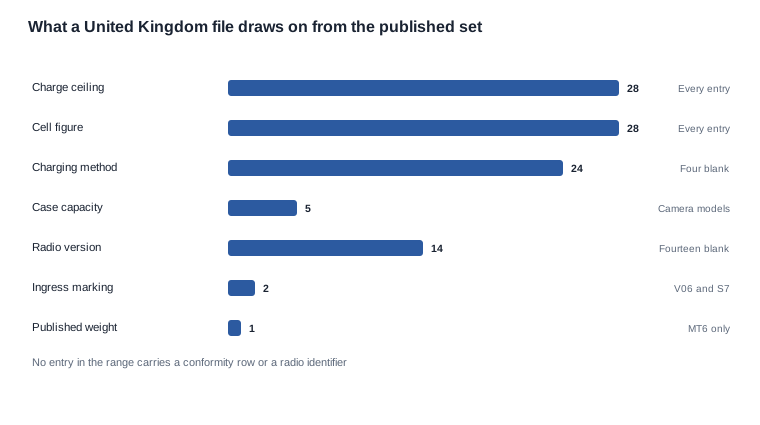
The catalogue's contribution to the radio question is the same as it is everywhere: a protocol version on fourteen of the twenty-eight entries, and nothing at all on the other fourteen. Eleven camera models publish no radio version, and the A05, the A06 and the bone-conduction entry are silent as well, so for those the radio position has to be established in writing rather than read off a row.
There is a third radio-adjacent question that belongs here rather than in the packaging section, and it is about the transmitter rather than the paperwork: which module is fitted to the model, whether it is the same in every unit of an order, and whether the regional configuration differs from the one used elsewhere. The catalogue publishes no module part number and no frequency configuration for any entry, so this is a written request against a model designation, and its answer determines whether the radio work is a new programme or a change to an existing one.

Selecting the operator, the labelling and the battery consignment
The economic-operator obligations and the labelling are connected, and separating them is the usual source of confusion.
The operator question is about identity: who in the United Kingdom is answerable for the product, where that party's details appear, and whether the same party can hold the appointment for every model in the range. If a range is going to be extended later, an appointment that is model-specific is worth avoiding, because a model-specific appointment has to be renewed when the range changes.
The labelling question is about content and language. The details identifying the economic operators have to appear on the product and on the packaging, and the safety information has to be presented in the language of the destination. The practical point for a buyer is that a box designed for the European Union is not automatically a box that satisfies the United Kingdom requirements, because the operator block, the marking and the warning content all differ. That makes artwork a compliance item rather than a design item, with a print cycle and a proof round attached to it.
The battery consignment is the one part that does not vary by destination, and it is worth stating because it is the part that is treated as though it did. The transport test summary has been a mandatory document since 2020-01-01, and the packing instructions and the state-of-charge limit apply to the consignment as a whole. The summary follows the cell rather than the finished product, which means it follows the cell configuration on the order — and our specification set publishes a cell figure for every entry, from 40 mAh in the A05 and the A06 through to 290 mAh in the L2 Utral and the CY03, and the L1 Pro and the CY05, plus a 1200 mAh folding case published separately on the MT6. On four camera models the catalogue gives a case capacity but says nothing about how the unit is charged — the CY03 and the L1 Pro, and the MT6 and the CY05 — so the cell configuration on those has to be confirmed before a summary can be matched to it.
Selecting the commercial scope: what a UK launch has to settle
Our published records contain no United Kingdom commercial terms of any kind, so each line below is something a procurement team should ask the supplier to quote, in the order it usually matters.
- The unit price for the United Kingdom build, and whether it differs from the European build and why.
- The minimum order quantity for the United Kingdom build, and whether it is a per-model floor, a range floor, or a stock-keeping-unit floor.
- The cost of the responsible person appointment, whether it is a one-off, an annual renewal, or per model, and who signs it.
- Whether the appointment can be held for a range rather than for a single model, and what happens to it when the range changes.
- The lead time for the conformity assessment, quoted separately from the production lead time and from the artwork lead time.
- The artwork charge and the artwork minimum order quantity for the United Kingdom carton, and the number of proof rounds included.
- The sample terms, and whether a United Kingdom-market sample is supplied or whether the standard sample is offered instead.
- The packaging and labelling handling, including where the operator block sits and who proofs it.
- The warranty and defect terms for the United Kingdom build, and whether they differ from the European terms.
- The tooling and NRE for a United Kingdom-specific carton, and whether a second United Kingdom market would need its own.
- What happens if the route changes after the declaration is made, and how that risk is allocated.
Two points are worth raising while the quotation is still open. The first is the artwork, because a United Kingdom carton is a separate print run from the European one and the unit price of the two is not comparable until both are quoted with the same content assumptions. The second is the model list, because a programme that can grow a second market later is worth materially more than a programme that has been documented for one, and that difference is usually free to capture at the outset.
A worked walkthrough: one camera model into the United Kingdom
The example below is constructed from the published rows. It describes no customer order.
A distributor takes a single camera model into the United Kingdom as a trial. The published rows narrow the work immediately. The model has a resolution class, a cell figure, a charge ceiling and a runtime, and those four are the product-description elements the technical file will need. The catalogue publishes no Bluetooth version for it, so the radio position has to be established in writing, and it publishes no charging interface if the model is one of the four camera models that state a case capacity without stating how the unit is charged, so the interface is a second written question against the same model.
The three questions that come before the framework are then asked of a party qualified in the jurisdiction, and their answers decide what the file looks like: whether the category is directly covered, whether the recognition route is open for it, and whether an operator must be established in the United Kingdom. Only then is there anything to assess.
What comes out of this is not a compliance position. It is a sequence with named owners, an artwork requirement that is a compliance item rather than a design item, a cell configuration to be frozen so that a transport summary can be matched to it, and a list of commercial lines to request. That is what a United Kingdom launch plan looks like when it has been built from questions rather than from a summary.
Selecting for the United Kingdom: the boundary of our published record
Our published set for this series is a specification list and nothing else. All twenty-eight entries state their cell, their charging ceiling and their runtime; twenty-four state the charging interface; five camera models state a case capacity; fourteen entries state a radio version; two carry an ingress marking; one states a weight. There is no per-model conformity row in it, no radio identifier for any model, no certificate number and no reference to any conformity mark. Our position is that we publish the rows we hold, and we do not publish a conformity position that we cannot evidence. The separate product data sheet carries the CE, FCC and RoHS entry as an organisation-level claim, leaves each model-level reference unresolved, and records that not one of the twenty-eight entries came with a test report, a real photograph or a video.
So we cannot publish a United Kingdom position, and a supplier who offers one is offering something we cannot verify. What we can do is tell a buyer which instruments the product touches, which published rows the file will need, and where the United Kingdom arrangement has to be established with a local party. The platform coverage note sets out the questions that have already been asked of the range, the United States route is the useful comparison, and the compliance position and the procurement checklist are where the two halves of the work meet. The range itself is on the oem ready products page, and the destination logic sits on the select by market page.
Next step: ask the three category questions first, in writing, against the model you intend to ship. Get the answer before you ask for anything else, because the answer decides which of the remaining questions matter.


