

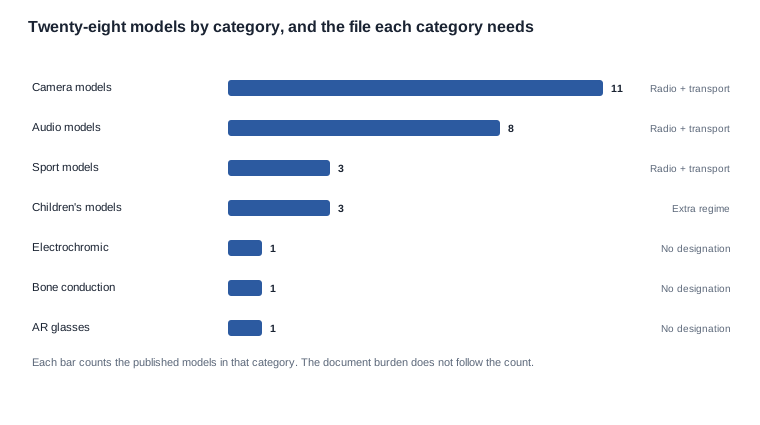
The European Union is the least forgiving market a new smart glasses brand can enter, and for anyone working through selecting smart glasses by market eu requirements the hard part is rarely the radio on its own. It is everything the radio question drags in behind it: a cell, a transmitter, on eleven of the twenty-eight models a camera, and software that can be changed after the product has been placed on the market. Each of those turns a question about specifications into a question about evidence.
Evidence has to exist in writing, in the buyer's own file, before the first consignment moves. That is why the practical work for a new brand is a sequence of gates rather than a list of certificates, and why the honest starting point is the published catalogue together with a clear account of what it does not contain.
The catalogue carries twenty-eight models in seven categories and publishes the rows that describe them: cell capacity and cell count, charge time, charging interface, published runtime, case capacity on the models where it is carried, the resolution class on the camera models, the Bluetooth version on the audio models, and a short list of feature rows such as the IP54 marking on the V06 and the S7. It publishes no per-model conformity row anywhere, and its text layer names no certificate. Everything below is therefore about what has to be requested, from whom, and in what order: the criteria a buyer applies, the questions to ask, and the evidence that closes each gate.
Selecting for the European Union: what the regime requires of this product
The Union does not ask a buyer for a certificate. It asks for a file that lets somebody who was never in the programme reconstruct why a particular product is allowed to be placed on the market, and it asks that the economic operator behind the product can be identified and reached. The Declaration of Conformity is the visible end of that file. The rest of it — technical documentation, test reports, production records, labelling artwork, batch traceability — is what a customs hold, a retailer audit or a field failure pulls apart.
Four elements carry most of the weight, and each one is a document question before it is a product question.
The model designation has to survive the file
A document is evidence for the models printed on it, in the configuration in which they were tested. Change the cell, the charging interface, the radio module or the enclosure and a product can fall outside the scope of a document issued for the earlier version, even where nothing visible has changed.
Our own catalogue makes that problem concrete rather than hypothetical. One entry is published under the designation L2 Utral and carries two variant names and two case capacities, one thousand four hundred milliampere hours and nine hundred milliampere hours, with no statement of which name goes with which capacity. Three further entries — the electrochromic one, the bone-conduction one and the AR one — are published without any model designation at all. The bone-conduction entry publishes an amplification gain of thirty-five decibels and nothing else that identifies the product.
A buyer who needs a per-model conformity file cannot assemble one out of a catalogue that does not give every entry a name. That is not an argument against the catalogue; it is the boundary of what the catalogue is for, and it is also why the platform range on the product page has to be read as a specification set rather than a conformity set.
The document has to name a configuration, not a family
The configuration field on a request is not a formality, and the catalogue's own variety shows why. Among the eleven camera models, five charge magnetically (the V03 and the KY06, and the MT5 and the V06, and the S7), two publish a Type-C interface (the V03 Pro and the L2 Utral) and four publish no charging method at all (the L1 Pro and the CY03, and the CY05 and the MT6), even though all four of those publish a case capacity. Charging cases divide three ways rather than two: the S7 and the V03, and the V06 and the V03 Pro have no case row at all, five models publish a capacity, and the KY06 and the MT5 have a case whose capacity is not published. No model in the range is published as having no case.
On the audio side the default is magnetic, with the D11 and the D12 the only two publishing a Type-C interface. A document that names a model without naming the cell and the interface leaves a question open that a customs hold is entitled to ask. How to evaluate a supplier reply starts there: compare the cell and the interface named on the document against the cell and the interface on the order, and treat any mismatch as a question rather than as a detail.
The operator has to be identified inside the Union
A brand established outside the Union needs a party established inside it who can act on the product's conformity, and that appointment carries a cost and a term the buyer has to plan for rather than discover late. The criteria for choosing that party are ordinary ones — scope of responsibility, languages covered, response time on a technical question — and they are worth writing down before the search rather than after a shipment has been held. It is also a different role from the importer of record: the importer handles the commercial and customs side, while the responsible party handles the conformity side. A buyer who assumes the two are the same company will find that the compliance obligation has no owner, and that no amount of paperwork from the factory fixes it. The question of who is responsible for the declaration of conformity is a question to answer in the contract, not in the catalogue.
The production side has to be reconstructable
Batch traceability connects the units in a consignment to the production run, and it is the document that makes a recall executable and a defect claim workable. It is also where a substitution shows up: the transport test summary for a lithium cell covers that cell, and a cell fitted after the file was built invalidates it regardless of whether the finished product appears unchanged.
The camera models add two rows to this part of the file. A camera carried on a face is a data device, so the file has to cover what the product records and where it goes; and the catalogue publishes no sensor model, no field of view, no frame rate and no storage capacity for any of the eleven camera models, so none of those can be copied from a catalogue row into a technical file.
Which catalogue rows a buyer can read, and which stay empty
Published: the model designation where one exists, cell capacity and count, charge time, charging interface, published runtime, case capacity on some models, resolution class on the camera models, Bluetooth version on the audio models, colour on two models, the IP54 marking on the V06 and the S7, and one published weight, the 158 grams of the MT6 glasses body excluding its folding case.
Not published: a per-model conformity row, any certificate number, any certification report number, the unit price, the price tier, the minimum order quantity, the lead time, the production capacity, the warranty period, the sensor model, the field of view, the brightness, the radio frequency power and the plug specification. The catalogue's export certification page is an image page whose extractable text is a heading and a page number.
| Catalogue row a buyer can read today | Where that row belongs in the file | Who signs or issues it |
|---|---|---|
| Model designation, cell capacity and count, charge time, charging interface, published runtime | The product description and the specification annex of the technical documentation | The brand that places the product on the market, supported by the factory's product data |
| Resolution class on the eleven camera models | The specification annex; no separate document | The brand |
| The IP54 marking on the V06 and the S7 | The ingress test report, which the catalogue does not carry | The laboratory that ran the test, then the brand |
| Bluetooth version on the eight audio models | The radio file, under RED (EU) 2014/53/EU | The brand, with the laboratory report behind it |
| Cell and interface on every model | The transport test summary for the cell actually fitted | The cell maker, or the laboratory that tested that cell |
| No per-model conformity row anywhere in the catalogue | The declaration of conformity and the radio file | To be established in writing before the order is placed |
Two instruments are the ones a request can name for the radio and the electromagnetic behaviour of a product: RED (EU) 2014/53/EU and EMC (EU) 2014/32/EU. They are frameworks a request may name, not documents the catalogue holds. Nothing in the published catalogue states that any model is covered by either of them, and a buyer who receives a generic claim without the model list behind it has received a claim rather than evidence.
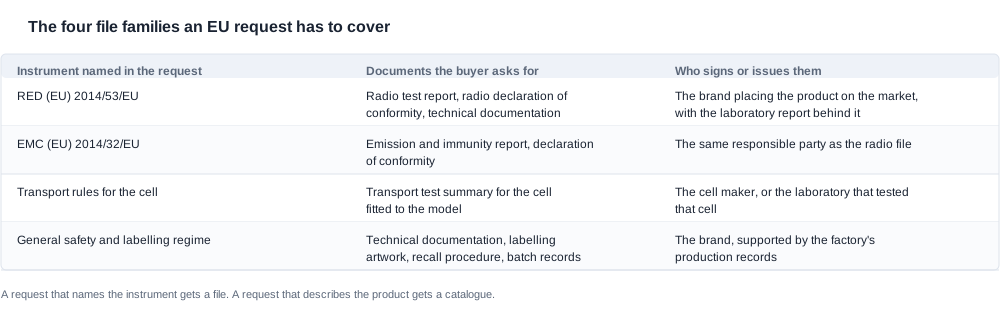

Selecting the frameworks that reach a product worn on a face
A product carried on a face reaches more of the regime than a product that stays in a pocket, and the reason is not fashion. It is the combination: a transmitter, a cell, a microphone, and on some models a camera, all inside a housing that is pressed against skin for hours at a time.
Four questions follow from that combination, and each one lands on a different part of the file.
The radio question is the same shape for every model
Every model in the range carries a radio, and the catalogue publishes the Bluetooth version for the eight audio models: 5.3 on the K01 and the K02, 5.4 on the six other audio models. For the eleven camera models the catalogue publishes no Bluetooth version row at all, while the electrochromic entry without a designation publishes 5.4.
The radio position is therefore the one part of the file whose shape is uniform across the range, even though its content is not published. A request naming RED (EU) 2014/53/EU asks for the radio test report and the declaration that covers a specific model, and how to evaluate the answer comes down to one line: the model list printed on it.
The cell question is not the same shape for any two models
Cell capacity across the range runs from 40 milliampere hours in the A05 and the A06, through 70 in the A07, 70 times two in the YKC02, 90 times two in the K01 and the K02, 55 times two in the LC-105 pair, the G07 and the YK12, 100 in the D11 and the D12, 115 in the D17, and from 220 up to 290 in the camera models.
Charge time is published for all twenty-eight models, and twenty-six of them publish two hours or less as a ceiling. Only the D17 and the ZH12 publish about one hour. The distinction matters for a file because a ceiling and a measured figure are different evidence, and because a laboratory report that states a charge condition states it for one cell configuration.
The transport test summary covers a specific cell. Two 55 milliampere hour cells and one 290 milliampere hour cell are not the same evidence, and a cell substituted after the file was built is a gap to close before the goods move, not after.
The camera question only eleven models raise
Eight of the eleven camera models publish the 8 megapixel resolution class and three publish 13 megapixels: the S7 and the L1 Pro, and the L2 Utral. Beyond that class the catalogue publishes nothing about the imaging chain — no sensor model, no field of view, no frame rate, no video format, no stabilisation and no storage capacity.
For a buyer this is a mixed result. It means the camera is not a reason to set a model aside, because the class is published and the class is a real screening criterion. It also means the camera cannot be a reason to approve one, because everything a data or privacy assessment needs has to come from a request rather than from a specification page. The questions to ask are therefore about the file and not about the specification: what is recorded, where it is stored, how long it is kept, and who can reach it. The same is true of the audio rows: a published runtime and a published cell tell a buyer how the product is specified, not what it measures.
Two of the camera models also carry the only ingress marking in the range: the V06 and the S7 publish IP54. The catalogue carries no third-party test report number for that marking, so it remains a catalogue entry rather than a document, and a buyer who needs evidence has to request the report. The ingress evidence note sets out what to ask for.
Three entries raise a fourth question before the others
The electrochromic entry, the bone-conduction entry and the AR entry are published without a model designation. The bone-conduction entry publishes no Bluetooth version row, and the AR entry's published rows stop at an indicator light and button control.
A file cannot be built for a product that cannot be named, which makes the designation question the first gate for those three and a naming question for the rest. That is a question to put to the factory in writing, with the answer recorded, rather than a reason to drop a category.

Selecting where the first shipment is most likely to stop
Most first consignments into the Union do not fail because of the radio. They fail because the paperwork describes a product that is not the product in the carton, or because nobody had to name the model until it was too late to change anything. Six stops account for most of it, and they arrive in a predictable order.
The model list does not exist yet
A request that says "smart glasses" produces a reply that says "smart glasses". Nothing has been tested, nothing has been signed, and the file is empty. The first gate is a list: every model and every configuration the buyer intends to place on the market, written down before any document is requested, and versioned so that a change later is a visible change.
The document covers a family, not the model
A family document is a marketing convenience; the file it belongs to is not. A report listing several designations covers the ones on the list, in the configuration tested, and nothing beyond it. Reading the model list is the cheapest control in the whole programme and it takes minutes, which is why it belongs at the front of the review rather than at the end. The criteria for judging a document are short enough to apply before you commit to a programme: does it name a model, does it name the configuration, and is the issuing body identified.
The cell was changed after the file was built
Substitution is the most common reason a technically complete file stops being complete, and it usually happens quietly inside the factory, after the sample was approved and before the production run. The condition that prevents it belongs in the purchase conditions, not in a request, because a request creates an obligation only where the contract creates one. The trade-offs are straightforward here: a written freeze on the cell costs one conversation at order stage, and a shipment stopped at the border costs a season of selling.
The packaging and labelling artwork was designed for another market
Language, warnings, operator details, model designation and the marking on the product and the packaging are all part of the file, and all of them are artwork with a print cycle behind it. This is the stop that most often arrives too late, because artwork is usually the last thing a brand commissions and the first thing a market requires.
The radio file was inherited rather than established
When a supplier offers a radio file for a product the buyer has not yet configured, the question to ask is whether the file was produced for this configuration or carried over from another product. The catalogue publishes no radio file for any model, so an inherited file is indistinguishable from an established one unless the model list is checked against the configuration list.
The date was set before the evidence existed
A launch date fixed before the evidence path is known is the stop that makes the other five expensive. Should you commit to a date before that path exists? Usually not, because the cost of being wrong is a redesign rather than a delay. Sequencing the gates is not administrative neatness; it is the difference between a delay and a redesign, and between a document request and a production change that invalidates everything already collected.
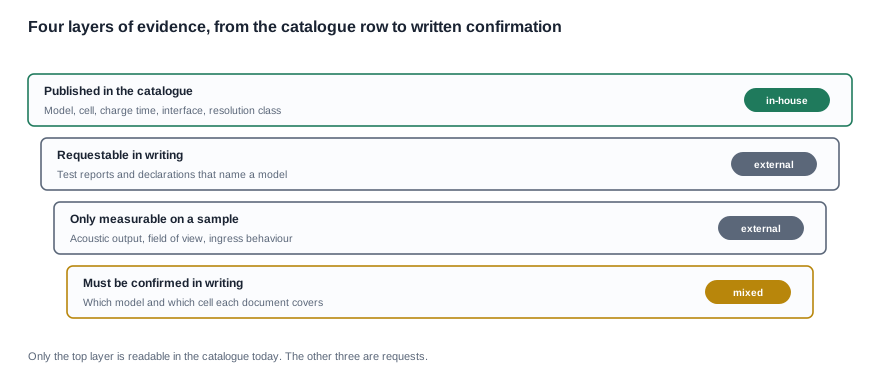

Selecting the order in which to close the file
Seven steps, in the order that keeps rework out of the programme. Each step produces an output that can be shown to somebody else. A step without a written output is a conversation, and a conversation does not survive an audit or a change of supplier.
- Write the model and configuration list. Every model, every variant name, the cell fitted, the charging interface and the intended destination market. This list is the input to every later step, and it is what makes a supplier reply checkable.
- Send the request naming the framework. A request that names the instruments the answer must address gets a file; a request that describes the product gets a catalogue. RED (EU) 2014/53/EU and EMC (EU) 2014/32/EU are the two radio-related instruments to name, and what the radio equipment directive actually requires is the background a buyer needs before writing the request.
- Check the model list on every document that arrives. Before you commit to a document as evidence, ask whether it names a model from the list, in the configuration on the list. A document that does not is not defective, it is about something else, and treating it as evidence is the error.
- Ask for the reports behind the claims. A declaration is a statement; the report behind it is the evidence. Ask in writing for the test reports, the certificate numbers and the issuing body for each model on the list, and ask for the electronic certificates rather than a summary of them.
- Match the cell against the transport summary. Confirm that the summary covers the cell actually fitted to the model on the order. Where the cell has changed, the summary is reissued before the order is confirmed rather than after the goods arrive.
- Build the labelling and packaging cycle in parallel. Language, warnings, operator details, model designation and the marking. This is the longest lead-time item in the programme and the one most often left until last, which is why it belongs in step six rather than step seven.
- Record the open items and their owners. What is still missing, who is obtaining it, by when, and what happens to the launch date if it does not arrive. An open item with a name against it is manageable; an open item buried in a file is not.
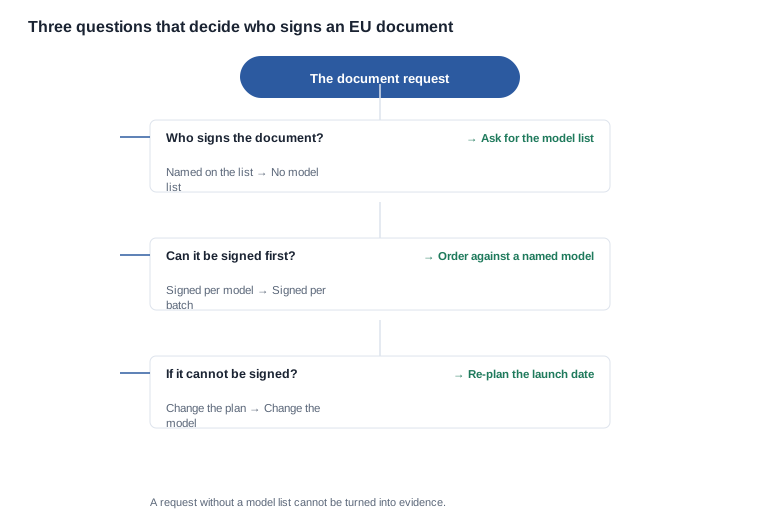
What to write into the purchase conditions
Part of the work above is a request and part of it is a contract, and the buyer has to know which is which before the order is placed rather than after the first problem appears.
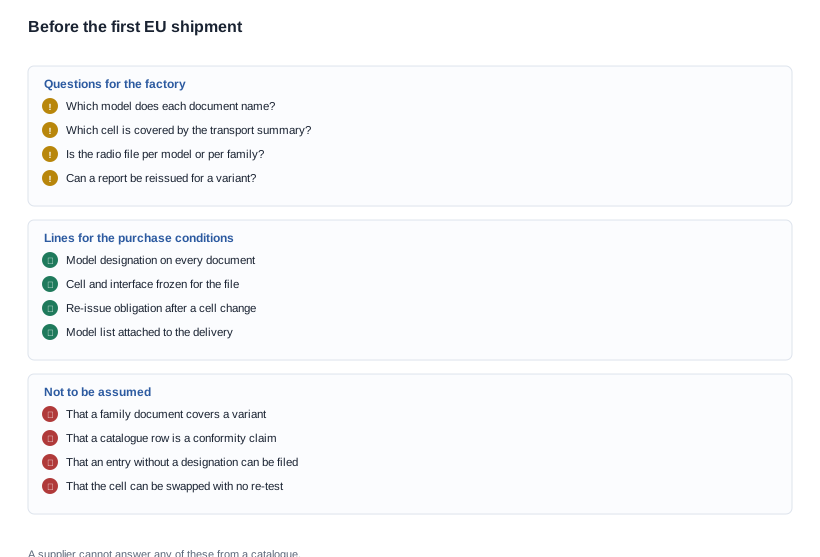
- The model designation appears on every document, and a document naming a different designation is rejected rather than accepted with a note attached.
- The cell and the charging interface are frozen for the duration of the file, and any change triggers a written re-issue obligation before shipment.
- The transport summary, the radio report and the electromagnetic report each name a model, and the buyer receives the model list as part of the delivery rather than having to ask for it twice.
- A change of radio module, enclosure or software baseline after the file is built is a documented event with a re-test obligation attached to it.
- The labelling and packaging artwork is approved against the model list before the print cycle, and the approval is recorded.
- The certification coverage note for the platform range is the right starting point for a buyer who wants to know which questions have already been asked and which have not.
Three assumptions that are red flags
A family document does not cover a variant. A catalogue row is not a conformity claim. A cell can be swapped without a re-test only in the sense that nobody checked.
These three are the recurring pitfalls in this category, and each of them converts directly into a line in the purchase conditions.
Selecting smart glasses by market eu requirements: the position we can defend
The honest summary of the position is that the catalogue answers product questions and not conformity questions. It answers them well: twenty-eight models, seven categories, and published rows that let a buyer narrow a range down to two or three candidates and state exactly which row separated them. It does not answer which document covers which unit, because that row does not exist in it. For that reason our position is narrow and deliberate — we publish the rows we have, we do not restate a certificate we cannot quote, and we treat every conformity question as a question to be answered in writing before an order is placed.
That is not a limitation to apologise for. It is a description of where a buyer's work actually begins, and it is why the gates, the questions and the sequence above are worth more to a first-time entrant than a list of names that cannot be checked against anything. The shortlist a buyer builds from the published rows is defensible; the conformity position is not, until the file is closed in writing.
Related reading
- Market certification mapping
- The United Kingdom route for comparison
- Who writes the technical file
- A practical overview of selecting by market
Send the model list, the cell you intend to fit and the target date, and we will tell you which gate the shipment hits first.


