

Selecting smart glasses by market frequency and language covers the two variables that change the product rather than the paperwork. Most market-selection work is spent on files, and files are the easy half, because a file describes a product you have already decided on. Frequency and language sit upstream of that: change either one and you have a different product, and every document, every packaging artwork and every price you agreed is now describing something else. That is why they are treated here as the first two questions rather than the last two, and why this guide is written around the decision tree rather than around a list of frameworks.
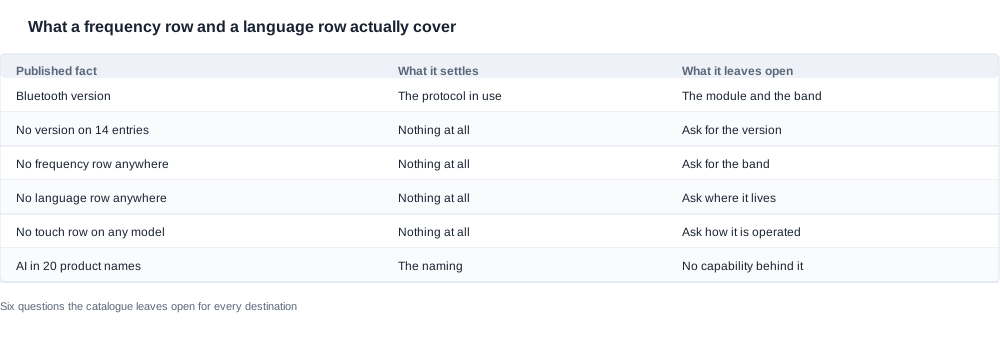
Start with the honest limit. Fourteen of the twenty-eight entries in our catalogue carry a documented Bluetooth version, and nowhere in the specification set do we publish a radio frequency, a transmit power, an antenna configuration or a channel plan. It publishes no language row, no voice-prompt set, no translation entry and no application support list for any model. Both of those silences are structural rather than accidental, and both of them are answerable — with a request rather than a page.
Selecting by frequency: what a Bluetooth version row does and does not tell you
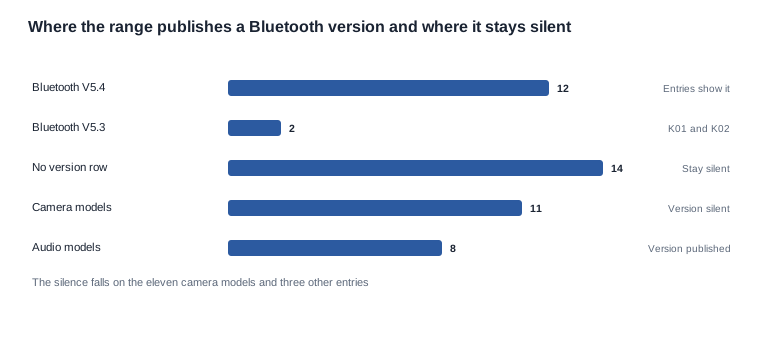
The Bluetooth version is the only radio fact in the catalogue, and it is worth being exact about what it is. It is a protocol version, published on fourteen entries: V5.4 on the D11, the D12, the LC-105-1, the LC-105-2, the G07, the YK12, the YKC02, the D17, the ZH12, the A07, the augmented-reality entry and the electrochromic entry, and V5.3 on exactly two, the K02 and the K01. It is not an operating frequency, not a power level, not a module part number, and not a conformity status.
That distinction matters more than it sounds, because a buyer reading a version row can easily slide from "this model is published as V5.4" to "this model is cleared for the destination market". Those are different statements, and only the first one is in the catalogue.
Where the catalogue is genuinely informative is in the shape of the coverage. Three groups behave differently. The eight audio models all publish a version: V5.3 on the K02 and the K01, V5.4 on the LC-105-2 and the LC-105-1, the G07 and the D12, and the D11 and the YK12. The three sport models — the YKC02, the D17 and the ZH12 — all publish V5.4. The eleven camera models publish no Bluetooth version at all, and neither do the A05, the A06 or the bone-conduction entry. So the silence is concentrated, and it falls on the group a buyer is most likely to be asked about in a market with tight radio rules.
The two V5.3 entries are worth a separate look, because they are the only published version in the range that is not 5.4, and they are identical in every other way they publish. The K01 and the K02 both publish V5.3, 90mAh*2, a charge time of two hours or less, about eight hours of runtime and magnetic charging — five standard rows each and no feature row on either page. Our product detail sheet records that any difference between the K01 and the K02 has to come from something other than the published catalogue rows. If your market plan assumes the K01 behaves like a V5.4 model, that assumption is not supported by anything we publish, and it is the sort of thing that should be a written question rather than an internal one.
The connection between frequency and market is also not one-directional. A protocol version is a global characteristic, while radio conformity is a destination characteristic, and the two are joined by the radio file rather than by the specification row. That is why the range has to be handled this way: the protocol decides what the product does, the file decides what can be shipped where, and the catalogue only publishes the first. On the conformity side the position is the same as elsewhere in this series — the catalogue text names no conformity framework and carries no per-model certification row, and our product detail sheet leaves the model-level references unresolved. A radio or language change is not a paperwork change, and a file set built for one configuration does not travel with a modified one.

Selecting by language: the second variable, and the quieter one
Language is the variable buyers forget to put in the contract, because it feels like a software setting rather than a product attribute. It is not. Language changes what is loaded on the device, and a device with different software loaded is a different product for the purposes of every file, every carton and every price agreement that was signed against the original build.
What the catalogue publishes about language is nothing at all. There is no language row on any of the twenty-eight entries, no voice-prompt set, no translation entry and no application support list. Our product detail sheet is the second source, and it is more informative, but only as a structure: it records seven customisation axes for the camera category and five for the audio category, and it records that the audio category has no logo axis and no firmware axis while adding a lens-material-and-colour axis. The sheet also records that the application and firmware customisation capability for the children's category is marked as still to be verified.
Three implications follow for a buyer, and all three are questions rather than answers.
The first is which layer the language sits in. If the language is a setting inside a companion application, the change is contained and the device hardware is unchanged. If the language is compiled into the device firmware, then the language is part of the product the file describes, and a firmware change is a configuration change with a re-issue obligation attached. The catalogue publishes no touch row for any model and no interaction row either; the only published rows that describe how the product is operated are the indicator light and button control on the augmented-reality entry. So even the basic question — whether a language change touches the device at all — has to be answered in writing before it can be planned.
The second is the relationship between the language and the AI naming. Twenty of the twenty-eight published entries carry AI in the product name. That is a naming fact and nothing more. It does not publish a language capability, it does not publish a translation function, and it certainly does not publish which languages any assistant operates in. The catalogue publishes no translation row for any model, including the K01, so a translation claim has no row behind it anywhere in the specification set. If a destination market expects a specific language, that expectation has to be met by a written configuration request with an acceptance test attached.
The third is who carries the risk of a wrong build. A language mix-up in a bulk consignment is discovered at the retail shelf or in a returned unit, which is far more expensive than a mismatch caught on a sample. The mitigation is not a bigger sample order; it is a per-lot acceptance step that checks the language actually loaded, recorded at goods-in rather than at the end of the production run.
The relationship to the technical documentation side is close enough to state plainly. The technical file note explains what the file has to describe and who assembles it, and this is one of the items the file has to describe: the language configuration of the unit that was tested.
Selecting the two variables together: a sequence that keeps them apart
Frequency and language change different parts of the product, and they fail in different ways. Keeping them apart in your process is what makes them manageable.
A frequency change is a hardware change. It may involve a different radio module, a different antenna arrangement, or the same module with a different regional configuration. It is slow, it is expensive and it invalidates the radio part of the file, because the radio file describes the transmitter that was tested. It also changes the product itself, which means a new sample, a new packaging cycle and a re-quote.
A language change is a software change. It is fast, it is cheap in parts and it is invisible from the outside. It also changes the file, because the file describes the software baseline, and a unit running a different language baseline is a unit that was not the unit described. Most buyers treat this as a minor matter because nothing about the hardware moved; it becomes a serious matter the first time a distributor's audit asks whether the shipped configuration is the documented one.
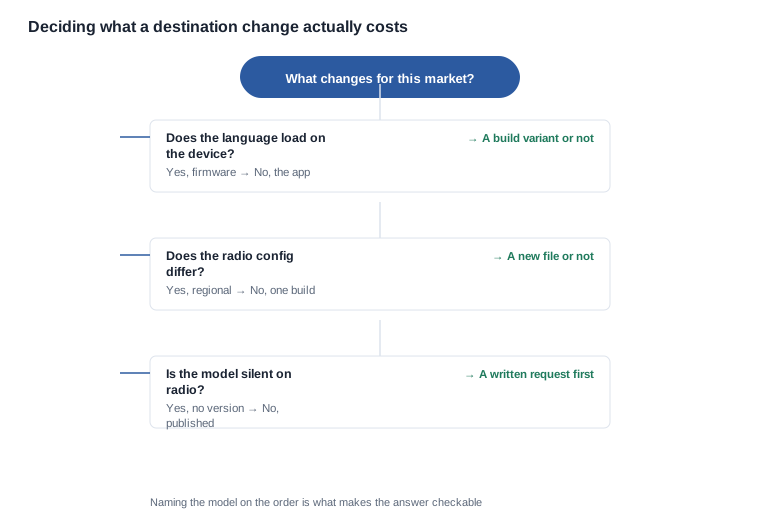
The sequence that works is short and it is worth following exactly. First, write down the destination and the language for that destination. Second, establish whether the language lives in the device or in an application — this is the single most useful answer in the whole exercise, because it determines whether the next steps are a software request or a product request. Third, check the published Bluetooth version for the model against what the market needs, and where no version is published, ask for it in writing rather than inferring it from a sibling model. Fourth, only then decide whether the radio configuration has to change, and if it does, treat it as a new product with a new file rather than as a setting.

A worked walkthrough: one range, two destinations, three variants
What follows is an illustrative exercise constructed from the published rows rather than from a customer file.
A distributor has short-listed three audio models and one camera model for two destinations that share a region but not a language. The published rows tell them almost nothing about either question. The three audio models publish their Bluetooth version, so the radio question narrows to a single written request each. The camera model publishes no version, so the radio question there is a request rather than a comparison, and it has to be raised before the model can be placed on any list.
The language question resolves first, because it is a single answer about where the language lives. If it lives in the device firmware, the destination with the different language becomes a build variant, and the distributor now has two things to manage: a model list that differs by destination and a document set that has to describe each variant. If it lives in the application, the destination split is a distribution question rather than a production question, and the two destinations can share one build.
That single answer changes the number of samples, the number of packaging artworks, the number of quotations and the shape of the purchase conditions. It also determines whether the camera model can be in the range at all, because a model with no published radio version plus a per-destination firmware variant is the combination most likely to produce a mismatch between what was ordered and what was shipped.
Three variants, in the outcome, not four: one firmware build if the language is in the application, two builds if it is in the device, and a written radio answer outstanding on the camera model either way.

Selecting a configuration: the questions to put in writing
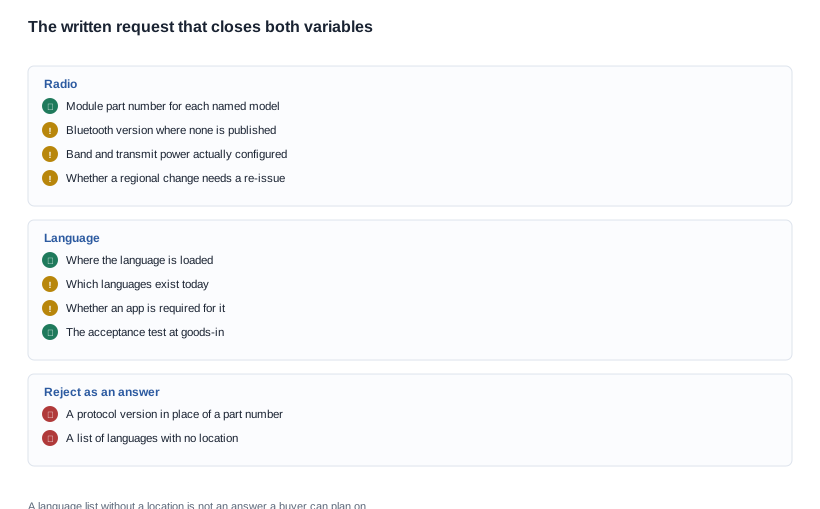
The questions below are the ones that decide whether a destination is viable for a given model. They belong in a single written request, with a date, so that the answers can be recorded against model designations rather than against the range.
- Which radio module is fitted to this model, with a part number rather than a protocol version, and whether that module is the same in every unit of the order.
- Which Bluetooth version each model actually runs, for the eleven camera models and the A05, the A06 and the bone-conduction entry, where the catalogue publishes none.
- Which frequency band and transmit power the module is configured for, and whether the configuration is regional.
- Whether changing the regional configuration requires the radio file to be re-issued, and how long that takes.
- Where the language lives — device firmware, application, or both — and what a language change touches on the shipped unit.
- Which languages are available today, and which would need to be built.
- Whether an application is required for the language feature, and whether the model works without it.
- Whether a firmware or application change invalidates any existing document, and which.
- What the acceptance test for a language is, so that a mismatch is caught at goods-in rather than on the shelf.
- What the cost and the minimum quantity of a per-language or per-region build are, and whether it is quoted per model or per market.
How to evaluate the answers before you commit the order
A written answer is not the same as a usable answer, and a procurement team that treats the first as the second will build a plan on an assumption. There are three criteria to apply to every reply, in this order, because they are cheap and because they eliminate most of the weak answers.
Does the answer name the model? Not the range, not the category, not a sibling model with a similar designation. Our catalogue contains a case where the model name itself is an open item, so a reply that identifies a product by a name the catalogue does not use is not a reply about that product. Where the catalogue publishes no Bluetooth version — the eleven camera models, the A05, the A06 and the bone-conduction entry — a reply that identifies the version by describing a neighbouring model is not evidence about the model you ordered.
Does the answer name the configuration? The radio module part number, the firmware baseline, the language set. A reply that answers the question for the standard build only is a partial answer, and the gap between the standard build and the build you are buying is exactly where a defect claim and a customs question live.
Does the answer carry a version or a date? A configuration answer without a version or a date cannot be checked against the goods when they arrive, which means the acceptance step at goods-in has nothing to test against.
When the replies come back, sort them into three piles. Closed means the answer satisfies all three criteria and can be written into the purchase conditions. Open with an owner and a date means the answer is outstanding but somebody is obtaining it, and this is a manageable state for a procurement team. Open without an owner means nobody has accepted responsibility, and an open item without an owner is not a plan, it is a hope.
The trade-offs are worth weighing explicitly rather than by instinct. Taking the write-up route — waiting for the module part number before naming a model on the purchase order — costs a few weeks and removes a category of substitution risk entirely. Taking the fast route — ordering against the standard build and resolving the module later — costs nothing up front and creates a risk that a radio change discovered after the order invalidates a document set that has already been paid for. Which one is right depends on how tight the launch window is and how much the file set has cost, and that is a decision for the procurement team rather than for a specification page.
Three red flags deserve an automatic stop rather than a follow-up question. A reply that treats a protocol version as a module identification is describing a characteristic, not a component. A reply that offers a language list without stating where the language is loaded is describing an inventory rather than a build. A reply that confirms a configuration "for the EU" without naming the destination-specific assumption is describing a family rather than a product.
The shortlist rule that follows from all of this is simple and worth applying before you order: a model that cannot produce a written answer to the radio-module question is not shortlistable for a destination where radio configuration is restricted, however good its other published rows are. The published rows are what let you build a defensible shortlist. The written answers are what let you sign an order against it.
Two answers deserve particular scrutiny because they are easy to accept and expensive to regret. The first is a protocol version offered as a substitute for a module part number. A version tells you what the radio can do; it does not tell you what is fitted, and a firmware-only change of version is a normal event that a supplier may report without treating it as a configuration change at all. The second is a language answer given as a list of supported languages with no statement of where the language lives. The list tells you what exists; the location tells you what a change costs and what it invalidates.
There is a related trap in the naming. Twenty of the twenty-eight published entries carry AI in the product name, and a buyer who treats the name as a capability list will read features into it that the catalogue has not published. We would rather say plainly that our product naming is not our specification set, and that the specification set for any model is the rows we publish for it.

Selecting the commercial scope: what a per-market variant has to settle
Once frequency and language are understood as product changes rather than settings, the commercial conversation changes shape, and it belongs in the quotation rather than in a later negotiation. Our own records publish no per-market variant price, no firmware charge, no minimum order quantity for a regional build, no tooling cost for a localisation and no lead time for either, so the items below are lines to ask for, not numbers we can give.
- The unit price of a per-language or per-region build, and how it differs from the standard build.
- The minimum order quantity for a regional build, whether it is per model, per language or per market, and whether it is higher than the product MOQ.
- Whether the regional build is charged once, per order, or per unit, which are three very different commercial arrangements.
- What a firmware or application change costs, and whether it is a one-off engineering item or a recurring per-order charge.
- Whether a radio re-configuration or a module change carries a certification re-issue cost, and whether that cost is quoted separately from the unit price.
- The lead time for a regional build, and whether it is longer than the standard build, because a programme that assumes one date for two destinations is a programme with a hidden dependency.
- The artwork cost per language, whether the packaging artwork carries a separate minimum order quantity, and how many print cycles the first year should assume.
- The warranty and defect terms for a regional build, and whether they are identical to the standard build or separate.
- The sample terms for a regional build, including whether a sample of the localised unit is included or charged, and what happens to the evaluation period if the language build arrives after the sample.
- What happens to the tooling and the NRE if a second market is added later, and whether the second market carries its own engineering cost.
The negotiation point worth raising first is the separation of the variant charge from the unit price. A buyer who accepts a combined figure loses the ability to see what a second market actually costs, and the second market is exactly the decision the whole exercise is preparing for. A second point worth raising early is the sample of the localised build. It is cheaper to receive one unit in the destination language than to discover the mismatch after a bulk consignment has cleared, and it is cheaper still to agree in advance that the standard-build sample does not count as evidence of the localised build.
The wider destination logic sits on the select by market page, the radio and connectivity detail is covered in the connectivity note, and the feature question that product naming raises is addressed in the AI features note.
Selecting by market: what this series has settled and what it has not
Our published specification set covers the power side in full — cell capacity and count, charge time, charging interface and runtime for every entry — and adds case capacity on the models that publish one, the two camera resolution classes, a Bluetooth version where an entry carries one, a small number of feature rows and a single weight on the MT6. We do not publish a frequency configuration, a language set or a conformity reference for any model, and we will not infer one from the product naming. What we publish is the specification row; where a row does not exist we say so rather than supply an estimate, which is why this guide is framed as a decision tree rather than as an answer. The protocol version tells you where to start asking; the frequency configuration and the language location tell you where the change lands. Both have to come back in writing, attached to a model designation, before a market plan can be treated as buildable.
Next step: write the destination and its language first, then ask the two questions that decide the shape of the programme — whether the language is loaded on the device, and whether the radio configuration is regional. Everything else about the two variables follows from those two answers.


