
Who writes the technical file is a question with a deceptively simple answer and a long list of complications attached to it. The party that places the product on the market as the manufacturer writes it and keeps it, and in an OEM programme that party is usually the brand. What makes it complicated is not who holds the pen. It is that the file describes a product as it is placed on the market, so the document is only as good as the configuration discipline behind it, and a file written once for a model rather than for a configuration is already out of date.
This page is written for the buyer and the product manager who have to arrange for that file to exist without becoming the person who writes every page of it. It sets out how the work divides between the party that signs the declaration and the parties that produce the evidence, what sections a file is expected to contain, what our catalogue can and cannot contribute to it, where files usually break, and the questions to settle before anyone starts drafting.
The scale of the question depends on the product. A Bluetooth product with a lithium cell, a radio configuration, an open acoustic path and a charging case is not a simple object, and the general product safety framework that applies from 13 December 2024 treats it as an object whose safety case has to be reconstructable by an authority or a consumer from the evidence. Add the Radio Equipment Directive (EU) 2014/53/EU for a product that transmits and the file acquires a second obligation with its own conformity assessment. The GPSR reference covers the framework itself; the question this page answers is the practical one of who does the work.
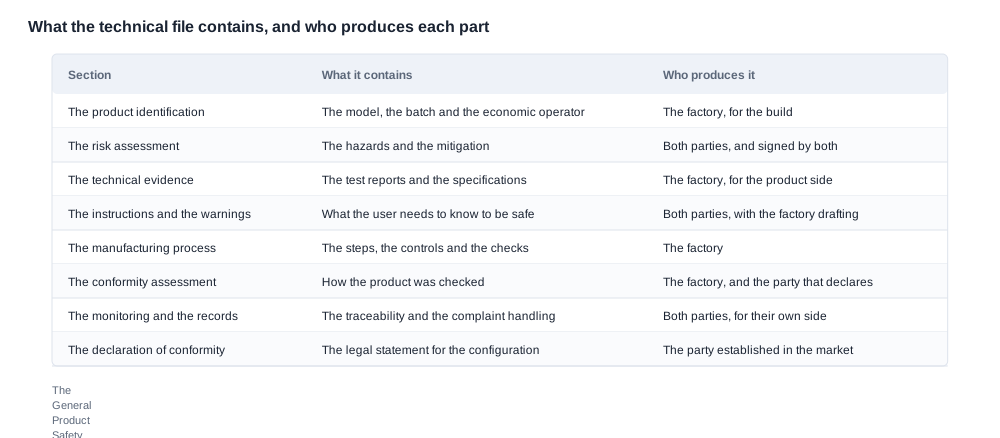
who writes the technical file: one author, several contributors
A technical file is a single controlled document with a single owner and several contributors, and most of the avoidable cost in a launch comes from mixing those two things up. The owner assembles and maintains the file. The contributors produce material that the owner incorporates. When the contributions are gathered without an owner, the result is a folder of documents from four or five parties that nobody can certify as describing the product.
The ownership question is the one settled first, because everything else depends on it. The party that places the product on the market under its own name or mark carries the declaration and therefore carries the file, and the practical pattern in an OEM programme is that the brand holds the master while the factory supplies the engineering evidence. That arrangement works, and it is the most common one, but it has to be stated rather than assumed, because the alternative — a factory that keeps the file and lets the brand rely on it — produces a brand that cannot answer an authority question about a product it is selling.
Four contribution streams are involved, and they arrive from different places with different lead times. The technical description — what the product is, what it is made of, how it is built, what the components are — comes from engineering and, in an OEM programme, from the factory. The test evidence — reports, measurements, and the records behind them — comes from whoever performed the testing, and again usually the factory. The risk assessment and the use instructions — what can go wrong, who the product is for, how it is used, what warnings apply — are the brand's, because they follow from how the brand intends the product to be used and sold. The market-specific information, the labels, the packaging and the listing content, are the brand's as well.
The hardest of those four to get right is the risk assessment, and it is the one most often delegated. A risk assessment that was written by the factory for the factory's version of the product, and then adopted unchanged by a brand that intends a different market, a different channel or a different user, is a document that describes a product that does not exist. The same applies to the instructions: a set of instructions written for a general consumer is not a set of instructions for a brand that sells into a professional application, and the difference is not stylistic.
A second structural point matters for the timeline. The file is not a project that starts when compliance begins. It is a by-product of engineering decisions that were taken months earlier — the cell selected, the enclosure material chosen, the radio configuration fixed, the accessory set decided. The file records those decisions and the evidence behind them, so a brand that asks for a technical file after the product is designed is asking for a reconstruction, and reconstructions are slow, incomplete and occasionally impossible for decisions that were never written down anywhere.

The sections a file is expected to contain
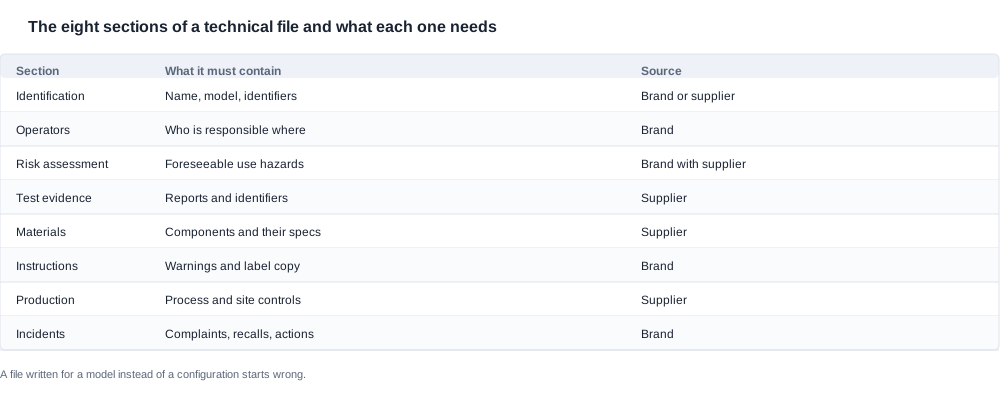
A buyer assessing a supplier's documentation capability should be able to name what a file has to cover. These are the sections to expect, and they are listed here as a structure to check against rather than as a legal template, because the precise composition depends on the product and the market.
- Product description and identification. What the product is, what it is called, what distinguishes it from a sibling model, and the identifiers that appear on the product, the packaging and the documentation.
- The manufacturer and the economic operators. Who the manufacturer is, who is responsible in each market of sale, and where each can be contacted.
- Risk assessment. What can go wrong with the product in the foreseeable use, what has been done about it, and what the user has to be told.
- Test evidence. The reports, measurements and standards assessments that support the safety and conformity claims.
- Materials and components. What the product is made of, which components it contains, and the specifications that matter to its safety.
- Instructions and labelling. The user instructions, the warnings, the label content and the packaging artwork as supplied.
- Manufacturing and quality control. How the product is made, what checks are applied, and what records are kept.
- Incident and accident information. Any incident, complaint or recall data that the manufacturer holds, and what was done with it.
Two of those eight carry most of the weight in a review, and a buyer who has limited time should spend it there. Section four, the test evidence, is where a supplier's capability is revealed: reports that exist, are identifiable, cover the configuration being sold and are still current. Section eight, the incident and accident information, is where most files are simply empty, because most programmes never build the process that fills it, and it is the section that determines how a brand answers the first difficult question it receives from a market surveillance authority.
The sections also fail in characteristic ways, and a buyer can check for them. A product description that names a family rather than a configuration will have no version marker to indicate a change. A risk assessment that has no link to the instructions means the two documents were written by different people at different times. A test evidence section with reports but no report identifiers cannot be re-checked when a component changes. An incident section that has never been populated has either been unused or has been populated and not carried forward.
What our catalogue can and cannot contribute to a file
Our catalogue is a specification document, not a compliance file, and the difference is worth being precise about because the boundary determines what a buyer has to source elsewhere. What the catalogue contributes is the product description. Every one of the twenty-eight entries publishes rows that belong in section one and section five: cell configuration and count, rated runtime, charge time, charging method, charging-case capacity where one is published, camera resolution class, colour where it is published, the ingress marking where it is published, and, for one entry, a weight.
What the catalogue cannot contribute is section four, and it cannot contribute it because our product record states that none of the twenty-eight entries comes with photography, video or test-report evidence. There is no test report to forward for any model in the range. Section six is also unavailable: the label wording, the instructions and the packaging artwork are not published. Section seven is not published in any form — the catalogue carries no manufacturing-process or quality-control description, and no manufacturing site information for any model.
Section one is where the catalogue helps and also where it is ambiguous, and the ambiguity is significant enough to name model by model. Three entries — the AR model, the electrochromic model and the bone-conduction model — are published without a formal SKU, so there is no published identifier to carry into a file. The L2 Utral publishes two variant names and two case capacities without stating which capacity goes with which variant, so a file that says "the L2 Utral" is ambiguous in a way that the catalogue itself does not resolve. The A05 and the A06 publish identical parameters with the difference between them marked unconfirmed in our records. The MT5 carries a doubtful product classification, and the V06 and the S7 carry page references that do not agree with the document layout. A buyer building a file from these rows has to resolve each of those points with the supplier first, and it is cheaper to resolve them at the specification stage than at the declaration stage.
Section four also has a second gap that is specific to this range and specific to radio. The eleven camera models publish no Bluetooth version at all, while the eight audio models do publish one — V5.3 on the K01 and the K02, V5.4 on the other six. For a radio product the file has to describe the radio configuration that was assessed, and where the catalogue is silent on the radio version of a camera model, that description has to come from the test evidence rather than from the specification page. Twenty of the twenty-eight entries carry an AI function line, which means the software behaviour is part of the product description in a way that a purely mechanical file would miss.
Section two and the certification position need one more sentence of honesty. The catalogue carries a company-level export certification page holding ten patent certificates — eight appearance designs and two utility models — and the catalogue text contains no reference to CE, FCC or RoHS. There is no per-model certification row anywhere. The position is the same across categories rather than partial in one of them, and only two things vary: for the sport category the IP54 marking on the V06 and the S7 is a catalogue annotation with no third-party test report number behind it, and for the children's category nothing at all is published. Those are the lines a buyer must not carry into a file as if they were evidence, and they are also the lines a supplier has to answer.


Where the file usually breaks
Five failures account for most of the technical files that turn out to be inadequate, and all five are avoidable with a small amount of discipline at the specification stage.
The buyer who can assess these five risks in advance holds a materially better position than the buyer who finds them later, and the difference is measured in launch dates rather than in penalties. The assessment itself is short. The shortlist criteria are simple: for which model and which configuration can every one of the eight sections be evidenced today? Take one configuration of each model on the shortlist, list the eight sections against it, and mark what exists, what is ambiguous and what is absent. Ambiguity is the category worth pricing, because an absent document is a request that can be made, while an ambiguous identifier has to be resolved before anyone can even make the request. Running the assessment on one configuration per model rather than on the range as a whole produces a shortlist that reflects what will actually ship.
The file was written for the model rather than the configuration. This is the most common failure and the easiest to check. Our published range gives four different examples of why the distinction is real: the L2 Utral publishes two variant names and two case capacities with no stated correspondence between them; four camera models publish a charging-case capacity but no charging method, so two units with the same cell figure are not the same product; four further camera models publish no charging-case row at all, so what ships in the box is not defined by the catalogue; and colour is published for two camera models only. A file built from the model name inherits all four ambiguities.
The software changed after the file was signed. The file describes a product, and on a connected product the product includes its behaviour. Twenty of the twenty-eight entries in our catalogue carry an AI function line. If the assistant behaviour, the voice trigger set or the pairing behaviour is changed, the risk assessment has to be revisited, because the hazard analysis may have been written against the earlier behaviour. A brand that has no change-notification route from the supplier will find out about this from a customer.
The artwork drifted from the file. Label wording, packaging artwork and the online listing all sit on the compliance surface, and all three are produced by people who are not the file owner. Artwork is usually commissioned early, reviewed by marketing rather than by engineering, and never re-checked. The most common finding in a documentation review is not a missing report; it is a warning on the box that does not appear in the instructions.
A second manufacturing site entered the picture. The catalogue publishes no manufacturing site for any model, so a buyer cannot see from the specification whether a product is single-sourced or dual-sourced. A new site does not only change the supply chain; it changes the technical file, because the evidence was produced at a particular site with particular process controls.
The file stayed with the factory. This is the failure that has no technical content and is the most expensive. The brand carries the declaration, the brand answers the authority, and the file is in the supplier's building. The remedy is procedural and cheap at the start of a programme: the brand holds the master, the supplier holds the evidence and sends it, and a named person on each side is responsible for the file's accuracy. The certification checklist reference sets out the wider document set that sits around the file, and it is worth reading alongside this page because the file is one part of a larger evidence chain rather than a standalone document.
The questions to settle before the file is written
Eight questions settle most of the practical risk, and they are far cheaper to answer before drafting than to correct afterwards. They are also the questions that decide whether the file can be maintained at all.
- Who is the named owner of the file, by name and role, and where does the master live?
- Does the file cover the configuration — model, variant, colour, case, accessories and firmware — and how is that written so a reader can tell?
- Who holds the test evidence, and can it be supplied for the exact configuration rather than for a family?
- Who performs and signs the risk assessment, and against which use scenario and which market?
- Who writes the user instructions and the label, and how are they reconciled with the risk assessment?
- What change notification does the supplier give, and what is the trigger for re-opening the file?
- Is there a manufacturing site other than the one the evidence came from, and how is that recorded?
- What is the incident and complaint route, and who is named to receive and action it?
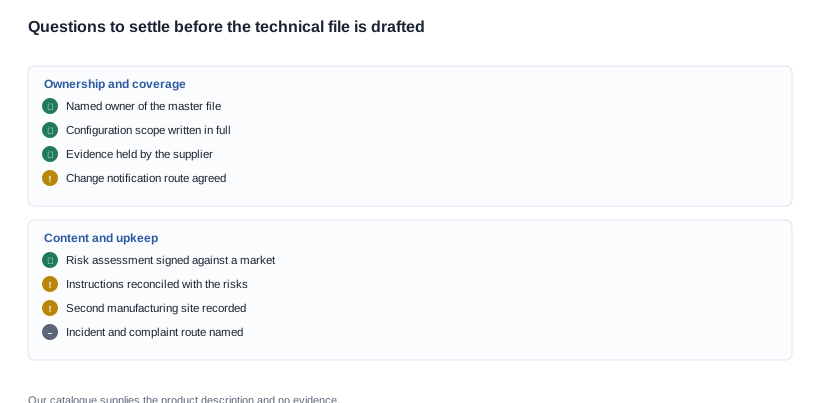
The eight questions are best treated as a due diligence checklist rather than as a drafting brief, and the order in which they are answered decides how much of the file can be salvaged later. Run before you order, they tell you what the supplier can evidence and what the brand has to write; run afterwards, they tell you what is missing from a file you have already committed to. Which model the file is for matters less than the stage at which the questions are asked, because every one of them is cheaper to answer while the specification is still open than after it is frozen. The trade-off is time at the front of a programme against a file that cannot be completed at the end of it.
The fifth question deserves more attention than its position suggests. Instructions and warnings are where a risk assessment becomes visible to a user, and they are also where a brand's commercial interest and its compliance interest diverge most often. A warning that is too weak creates a liability; a warning that is too heavy discourages the use the brand is selling, and in a channel where the product is sold on convenience, a warning that reads like a disclaimer costs more in demand than it saves in risk. The way through that is to have the risk assessment and the instructions written against the same scenario, by the same person, and reviewed together — which is a question about how the work is organised rather than about the documents themselves.
Questions three and six are the ones that decide whether the file is a living document or an archive. A supplier that can produce evidence for the configuration being shipped, and that tells the buyer in advance when something changes, turns the technical file into a maintained object with a named owner. A supplier that cannot do either leaves the brand maintaining a file it cannot keep current, which is a commitment the brand cannot honour in its own market.
The line we draw on this question
We do not publish a technical file for any of the twenty-eight entries, and we will not present a company-level patent page or an annotation as a substitute for test evidence. What we do publish is the product description that a file would start from: twenty-eight entries across the camera, audio, sport, children's and three SKU-less categories; a cell configuration, runtime, charge time and charging method published for every entry, with the charging method unpublished on the L1 Pro and the CY03, and the MT6 and the CY05; a charging-case capacity published on five camera models, a case shown without a capacity on two more and no charging-case row on four; a camera resolution class published on all eleven camera models and nothing further published about any camera in that range; IP54 on the V06 and the S7 as an annotation without a third-party report number; a weight published on one entry only, the MT6 at 158 grams for the glasses body excluding its folding case; and colour published on two camera models only.
We will also tell you where our own catalogue cannot serve as the source, because a file assembled on incomplete rows is a defective file: no test reports, no photography, no video and no per-model certification row exist in our published material for any model, and the open items we record — three entries without a formal SKU, the L2 Utral's two variant names, the identical A05 and A06 parameters, the doubtful MT5 classification, the V06 and S7 page references, the children's category certification position and the bone-conduction entry's 35 dB amplification gain — all have to be closed with a supplier before a file can name the product accurately.
What we will not do is write the file on a brand's behalf and then hand it over, because a file that was never held by the party that carries the declaration is not a maintained file and will not survive its first change. If you tell us the model, the configuration and the market, we will tell you which published rows can populate the product description, which of them are blank, which open items have to be resolved with us first, and how the remaining sections should be sourced and allocated.


