

Selecting smart glasses by market middle east requirements is a decision that starts with a region rather than with a country, and that is where most of the difficulty sits. A buyer entering "the Middle East" is usually entering several regulatory systems at once, each with its own conformity mark and its own importer paperwork, and the parts that are shared between them — the Arabic copy, the artwork, the plug, the retailer network — are the parts that scale. The parts that are not shared are the parts that multiply the compliance cost. Getting this wrong does not produce a stopped shipment so much as a range that has been designed for one market and cannot be sold into the rest of the region without rework.
The argument below runs in the order a sourcing team actually needs it. What the region is, and why "one market" is the wrong mental model. The artwork problem, because Arabic changes the structure of a carton rather than the wording on it. The product-condition questions, where the catalogue happens to publish something unusually useful. The claims boundary, which is where the most expensive rework in this category usually originates. And the commercial shape of a multi-country launch. Throughout, the published rows are what the catalogue contributes and the rest is a written request.
Selecting for the Middle East: one region, several regulatory systems
The Gulf Cooperation Council states are commonly treated as a single conformity destination, and in practice they share a conformity mark that is used across several of them, with national variations in the detail. Around that core sit markets with different arrangements — Jordan, Iraq, Egypt and Lebanon among them — which do not use the same conformity route and which a buyer frequently assumes are covered by the same file because they are in the same commercial conversation.
The practical consequence for a procurement team is a distinction between three things that are routinely collapsed: the conformity route, which is what the destination requires before the product can be placed on its market; the technical file, which is the evidence the route is built from; and the economic operator obligations, which attach to whoever imports or places the product on that market. A single file can often feed several destinations. A single conformity route frequently cannot.
That produces a workable structure, and it is worth stating it plainly because it is the difference between a plan that scales and one that does not. The shared layer covers the technical evidence: the radio position, the electrical safety work, the cell and transport documentation, the test reports behind any performance claim. That layer is largely destination-independent and should be built once. The per-destination layer covers the conformity mark and its national variations, the importer or agent appointment, the labelling content, the plug, the registration of the product where the destination requires it, and the local-language consumer information. That layer is multiplied by the number of destinations and cannot be shared.
So the first question a buyer should ask is not which countries, but which layer is being discussed. A request framed as "certification for the Middle East" will get a generic answer. A request framed as "the shared technical file, plus the conformity route for each of these five destinations" will get a usable one.
There is a second regional feature that changes how a range is planned rather than how it is filed. Retail and distribution in this region are organised around a small number of large buyers, each with its own specification, its own packaging expectations and its own compliance audit. The consequence for a brand is that a handful of accounts can absorb the whole volume, which makes the technical file worth building properly and makes the packaging artwork the item that decides whether those accounts will take the product at all. It also means the per-account requirements — carton dimensions, barcode placement, language panel layout, the certification mark on the outer carton — are negotiated with a counterparty that has real leverage, and they are worth getting agreed before the print cycle rather than after.
Selecting the language and artwork: Arabic changes the carton, not just the copy
Arabic is not an English carton with the words replaced. The script runs right to left, the reading order changes, and the layout of a multilingual panel changes with it. A carton that was drawn for a left-to-right layout cannot simply have an Arabic panel added to it; the artwork has to be re-composed, and the carton structure — panel order, where the certification mark sits, where the importer's details go, where the barcode lands — may have to change with it.
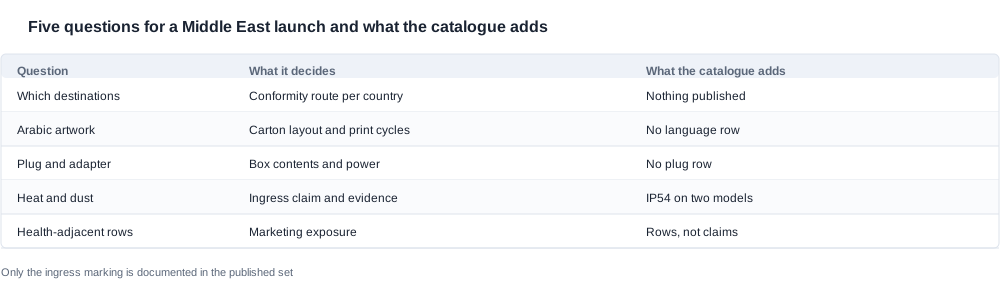
Not one of the twenty-eight entries in our specification set carries a language row. Nothing in the set describes the language of the interface: no prompt list, no translation row, no application support list. What our product record adds is a structural note — seven customisation axes recorded against the camera category, five against the audio category, the audio set carrying neither a logo axis nor a firmware axis, and adding a lens-material-and-colour axis of its own instead, while that record leaves the children's category unverified on both application work and firmware work.
That means the language work in this region has to be scoped rather than assumed, and the questions a buyer should ask are specific:
- Which language is loaded on the device, and whether Arabic and English are separate builds or one build with a setting.
- Which languages the packaging carries, and whether Arabic is mandatory, additional, or destination-specific.
- Whether the on-device language and the packaging language are one decision or two, since the first is a build question and the second is an artwork question with different lead times.
- Whether a bilingual carton is acceptable to the destination accounts or whether each account requires its own artwork, which is a quantity question as much as a design one.
- How the certification mark, the importer's details and the barcode are positioned in a right-to-left layout, and who checks that before the print run.
- The minimum artwork quantity, whether it is per language or per account, and how the print lead time compares with the production lead time.
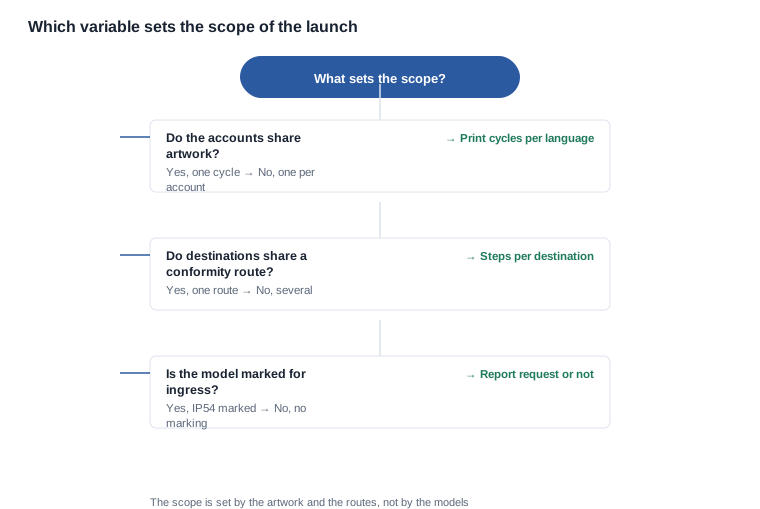
The trade-off here is worth naming for a procurement team because it is easy to get backwards. A bilingual carton costs more per unit than a single-language carton and constrains the layout, but it serves every destination in the region from one print cycle. A single-language carton per country costs more in setup and produces several print cycles, and it is the right answer when an account specifies its own artwork — which, in this region, is common among the larger accounts. The decision belongs with the buyer and depends on the account structure, not on the catalogue.
The adjacent variable is the plug, and the region uses more than one. The plug standard is a property of the destination and, frequently, of the account within the destination, and it decides whether the unit ships with an adapter and which adapter. Our specification set publishes no plug row and no adapter row for any of the twenty-eight entries, so the plug question cannot be answered from the catalogue at all — it has to be raised as a written request, model by model, and it has to be answered before the packaging is designed. The mechanical detail of how the power variable and the packaging variable interact is set out in the packaging and plugs note.
There is also a connectivity question that this region raises more sharply than most, and it is unpublished. Several destinations in the region rely on mobile networks for the way consumers expect connected devices to behave, and a buyer targeting those destinations has to establish whether the product is a Bluetooth-only unit or a networked one. Our published rows cover the Bluetooth version on the entries that carry one and say nothing at all about cellular or network connectivity for any entry. If a networked configuration is required, that is a product decision with a schedule attached, and it has to be raised before the range is fixed.
Selecting the product conditions: heat, dust and what the catalogue actually marks
Here the catalogue contributes something unusually useful, and a buyer should know exactly what it contributes and what it does not.
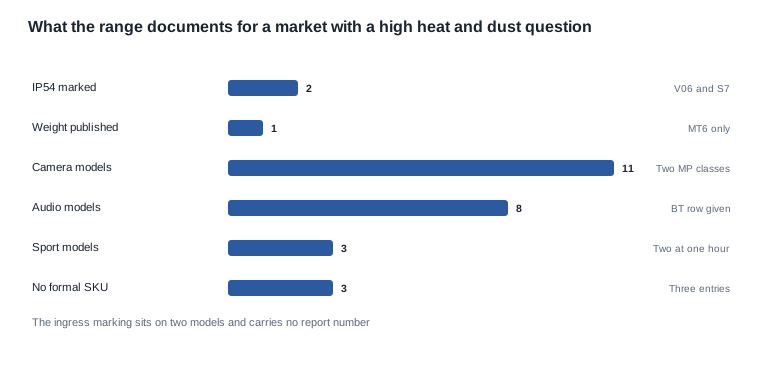
Exactly two entries in the whole range carry an ingress marking: the V06 and the S7, both published with IP54. That is the only ingress marking in the specification set, and it sits on the two models whose published feature rows also describe an ergonomic frame design and a removable inner frame. Everything else is unmarked. Two of the eight camera models are marked and nine are not, which is not a quality signal but a documentation signal — the other nine simply have no published ingress claim.
The important caveat is the one our own records carry: the IP54 marking is a catalogue marking without a third-party test report number behind it. For a market where dust and heat are routinely raised by the retailer, that difference matters commercially as well as technically. A listing that repeats IP54 without a report behind it is making a claim that a retailer auditor may ask to see evidence for. The right move is to request the report, and to treat the absence of a report as an open item rather than as a confirmation.

Two further product-condition questions belong in the same request. The first is about the cell and the charging behaviour under sustained heat, because the catalogue publishes a charge time as a ceiling for twenty-six entries and about an hour for the D17 and the ZH12, but publishes no operating-temperature row and no cycle-life row for any entry. A buyer should therefore not treat a published charge time as a statement about performance in a hot environment; it is a charge time, and the ambient conditions behind it are unpublished. The second is about the charging case, because the camera group splits three ways: five models publish a case capacity — 1400 mAh on the L1 Pro, the CY03 and the CY05, 1200 mAh in the folding case on the MT6, and 900 and 1400 mAh in a single row on the L2 Utral — two more have a case with no published capacity, the KY06 and the MT5, and three have no case row at all. Which of those applies to the models in the shortlist determines the retailer's charging expectation, and it has to be settled in writing.

Selecting the claims: the boundary that protects a programme from rework
The most expensive rework in this category is usually caused by a claim rather than by a certificate, and this region is where the exposure is highest because the retail and regulatory attention to health-adjacent claims is stronger.
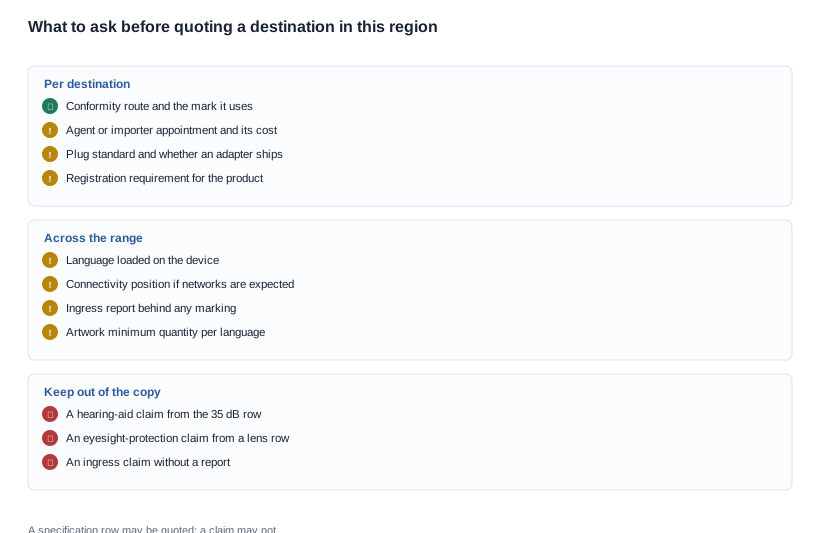
Our specification set contains one row that a careless listing can turn into a regulated claim. The bone-conduction model publishes an amplification-gain row of 35 dB. That figure is a catalogue row and it can be quoted as a catalogue row. It is not a hearing-aid specification, it is not a treatment claim, and it is not evidence that the product is intended for or suitable for people with hearing loss. Our own product record already flags the bone-conduction category as the highest compliance risk in the range, with its customisation capability undisclosed. The boundary is set out in the medical boundary note, and for a buyer the operational rule is simple: the 35 dB row belongs in a technical specification and in a supplier file, and it does not belong in a marketing claim in this market or anywhere else.
The same rule applies to the children's rows, with a different twist. The catalogue does list feature rows for the A05 and the A06 — a fogging unit, prompts for correct and incorrect posture and distance, and lens clarity and lens fogging. Those rows exist and they may be quoted as catalogue rows. What they may not be presented as is protection against myopia, prevention of near-sightedness, or any eyesight-protection or therapeutic benefit. The A05 and the A06 also publish identical parameters, with the difference between the two recorded internally as unresolved, and the A07 publishes a 70 mAh cell with about twenty hours of runtime where the A05 and the A06 publish 40 mAh with the same runtime figure. A buyer who needs to separate the A05 from the A06 is asking for a data confirmation, not for a sample.
The general principle is worth stating because it applies to every model and every destination in the series, not only to this region. Every published row is a specification. A specification can be quoted. A performance claim, a health claim, a comparative claim or a certification claim is a different category of statement, and the catalogue supplies the first kind and not the second. Twenty of the twenty-eight product names in the catalogue include the term AI, and a name is not a capability — the same rule applied to a different row.
A worked walkthrough: three destinations, one audio group
This scenario is constructed from the published rows and does not describe a customer order.
A distributor takes four audio models into three destinations in the region. The published rows settle several things before any request goes out. All four audio models publish a Bluetooth version and a charging method, so on this group the radio and the power questions get answered by paperwork rather than by a product change — and the runtime differences are visible too, with about eight hours published on the LC-105-1 and the K01, and the LC-105-2 and the K02 and about six hours on the G07 and the YK12. Two of the four publish a surround-sound row, the D11 and the YK12, while the other two publish none, so the acoustic question is per model rather than per group.
What the published rows do not settle is everything the region asks about. There is no plug row, no adapter row, no language row and no connectivity row, so those four questions have to go out as a written request with the destinations named individually. The conformity mark and the agent appointment are per destination and cannot be bundled into one request.
The result is a launch with a shared technical file, three per-destination conformity steps, one artwork cycle if the accounts accept a bilingual carton, and a per-destination plug decision. The outcome the distributor needs to produce before ordering is a matrix: destination by destination, showing the plug, the artwork, the conformity step and the open items. Anything left blank in that matrix is a blocker for that destination, and it is cheaper to know that before the first bulk order than after it.

Selecting the commercial scope: what a multi-country launch has to settle
A multi-country launch has more cost lines than a single-country one, and a procurement team that has not priced them will find them in the quote. Our own records publish no price, no minimum order quantity, no lead time, no certification charge and no artwork cost for any destination, so each item below is something to ask for in the quotation rather than something we are able to state.
- The unit price per destination, and whether the differences come from the build, the plug, the artwork, the conformity step or the agent.
- The minimum order quantity per destination, and whether it is a per-model floor, a per-destination floor or a per-artwork floor.
- The artwork cost and minimum quantity per language, and whether a bilingual carton is quoted as one line or two.
- Whether artwork is customer-specific, and if so what the per-account artwork charge is and who owns the artwork file.
- The plug and adapter position per destination, and whether the adapter is included, optional or excluded from the box.
- The conformity step cost per destination, and whether it is charged per model, per destination or per range.
- The agent or importer appointment cost, whether it is a one-off, an annual retainer or a share of the consignment value, and who signs the appointment.
- The lead time per destination, with artwork, the file and the conformity step shown as separate dates rather than one.
- The tooling and NRE for a destination-specific build, and whether the second destination carries its own engineering cost.
- The warranty and defect terms per destination, and how a defect found in one destination is handled in the others.
- The sample terms, including whether a destination-specific sample is supplied, at what cost, and whether a longer lead time changes the evaluation window on the sample.
Two negotiation points deserve to be raised before the quotation rather than after it. The first is the split between the shared technical file and the per-destination steps; a quotation that prices three destinations as three wholly independent programmes should be challenged, because the technical work behind them is largely common and the separation is a matter of structure. The second is the artwork, because a bilingual carton and three single-language cartons are different products with different unit economics, and the difference is largest at the moment when the account list is still short and negotiable.
The audio models available for this market are on the bluetooth audio glasses page, and the general structure of a per-market file is set out in the certification mapping guide. The procurement-side checklist that applies across destinations is the certification verification checklist, and the destination logic sits in full on the select by market page.
Selecting for the Middle East: the boundary of what we publish
We publish specification rows and nothing more. Every entry carries a power row, a runtime row and a charge-time row; case capacity appears where a case is published, the camera models carry a resolution class, and the entries with a radio carry a Bluetooth version. The ingress marking sits on two models and one weight is published. No certificate row, no test report number and no conformity mark appears in the published text, and our product record leaves the model-level identifiers unresolved. We do not publish a plug, an adapter, a language, a connectivity position or a price, and we will not estimate them for a buyer.
That boundary is what makes this guide useful rather than decorative. The Middle East adds two things to the standard market work: a set of destinations that share a technical file but not a conformity route, and a set of claims where the catalogue's silence is the safest ground to stand on. Both are workable, and both become expensive only when a buyer treats a shared file as a shared approval or a specification row as a marketing claim.
Next step: list the destinations separately, and for each one write down the plug, the artwork, the conformity route and the open items. Ask for the shared technical file once. Then take the four claims questions — the 35 dB row, the children's rows, the AI naming and the ingress marking — into the supplier request in writing, so the answers are attached to a model rather than assumed.


