

Selecting smart glasses by market packaging and plugs covers the two variables a buyer can photograph. Everything else in this series is a document; the plug and the carton are objects, and they are the two parts of a market decision that a buyer can verify with a photograph, a tape measure and a sample unit. That makes them unusually useful, and it also makes them unusually neglected, because both are usually treated as a final step rather than as a design decision with a cost attached.
Our catalogue is informative on the device end of the power variable and completely silent on the box end. It publishes a cell figure and a cell count for every entry, a charging interface on twenty-four of the twenty-eight, and a charging case on some of the camera models with three different kinds of silence around the case itself. It publishes no plug standard, no adapter, no carton dimension, no artwork and no label wording for any entry in the range. So the published rows tell you what the unit does with power, and they tell you nothing about how it reaches a wall socket or what the buyer receives.
Selecting the power variable: the plug and the adapter are not product details
The charging interface published for each model is an internal question. The plug standard is an external one, and the difference between the two is the difference between a specification and a market decision.
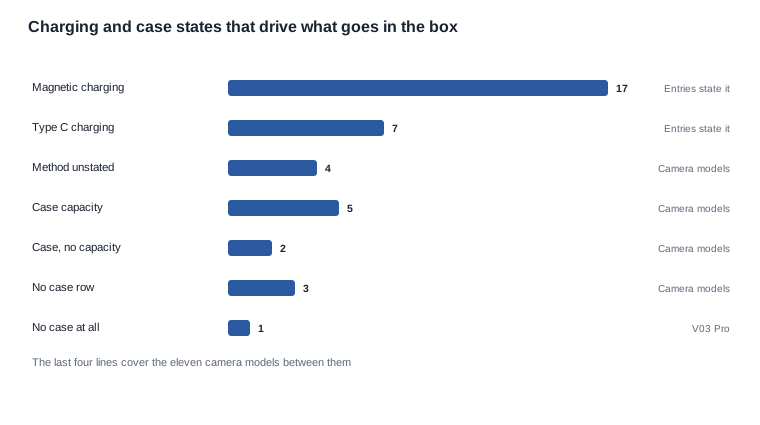
The catalogue publishes the internal side precisely. Seventeen entries charge magnetically, seven publish a Type-C interface, and four camera models — the MT6 and the CY03, and the L1 Pro and the CY05 — publish a case capacity while leaving the charging interface unstated. That last group is worth pausing on: those four are the ones where a buyer cannot even confirm from the catalogue how the unit is charged, and where the physical unit in a sample is the fastest way to settle it.
None of that tells you what the buyer plugs into. A destination determines the plug standard, and the catalogue publishes no plug row for any of the twenty-eight entries. So the plug question is always open, and it has three commercial consequences that a buyer should price before the order rather than discover afterwards.
The adapter question. If the product ships with a mains adapter, the adapter is a separate item with its own supply chain, its own certification treatment, its own labelling, its own warranty position and its own packaging line. If it ships with a cable only, the buyer needs the local mains supply, which changes the retail proposition entirely. Our specification set does not answer this for any entry, and it is the first question to ask because every downstream decision depends on it.
The customs question. A mains adapter supplied in the box is generally capable of being treated as a distinct article for customs purposes rather than as part of the wearable, and a treatment that differs from the wearable's changes the landed cost of the consignment. We are not going to quote a tariff treatment or a duty rate here, because the correct figure depends on the destination, the product and the consignment — but a buyer who assumes the adapter is invisible to the customs paperwork will get a surprise on a first shipment, and it is much cheaper to ask the broker the question before the cartons are printed than after.
The inspection question. A unit that will be sold in a market with a different plug standard either ships with an adapter, ships with a country-specific cord, or ships with a plug that has to be changed by the buyer. The third option is the one that generates returns, and it is decided in the packaging specification rather than in the product specification.
There is a fourth consequence, which is the one a buyer is most likely to miss: the plug standard interacts with the charging case. A magnetic-charging model with a folding case, which is the MT6 with its 1200 mAh folding case, presents a different carton problem from a model that charges by Type-C and whose catalogue page prints no charging-case line. The carton is a function of the whole box, and the box is a function of the configuration.

Selecting the carton: what has to appear on the box
A carton carries two kinds of content: the commercial information a retailer needs, and the regulatory information a destination requires. The first is a choice. The second is a condition of sale, and it arrives late in every programme that treats it as a choice.
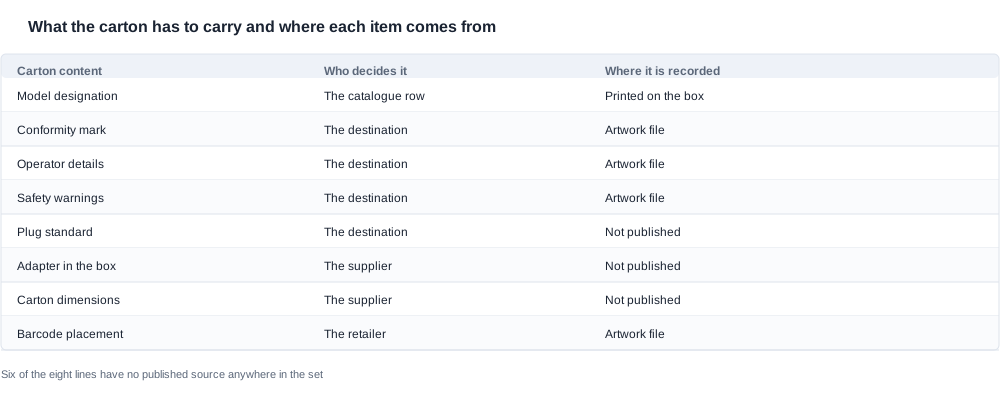
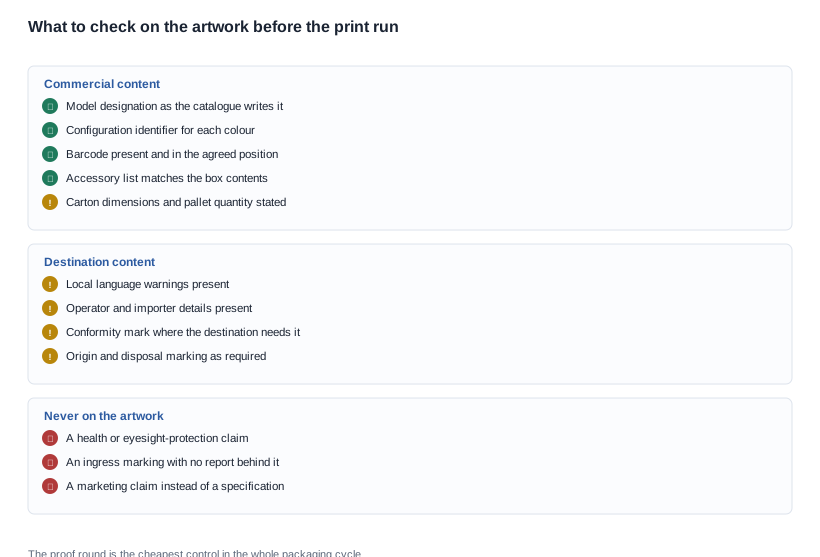
The commercial content is straightforward enough to list: the product name as the brand wants it, the model designation, the colour or configuration identifier where a model publishes several, the box quantity, the barcode and its position, the accessory list, the carton dimensions and the pallet quantity, the country of origin statement where a destination requires one, the customer or importer details for the market the carton is built for, and the operational code and lot marking that make the consignment traceable.
The regulatory content is destination-specific and needs to be confirmed rather than assumed. The conformity mark or declaration reference where a destination requires one, the economic operator's details where they must appear, the safety warnings in the local language, the instructions or a pointer to them, the battery or transport information where the destination requires it, and the disposal or recycling marking. Our catalogue contributes nothing to this list beyond the model designation, and the export documentation note is the right place to see how the document side is normally handled.
Two items deserve a specific note because they are decided by the model rather than by the market.
The designation. The designation printed on the carton has to be the designation the file names, and one of our entries publishes two variant names in a single row with no published correspondence between them and the two case capacities it lists. A carton cannot carry both, and the ambiguity has to be resolved in writing before artwork. It is a small issue that becomes a large one at the moment a distributor's audit compares the box against the technical file.
The warnings. The warning content is a destination question, but its existence is a product question, and for the three children's models it is the most sensitive item in the range. the catalogue lists feature rows for the A05 and the A06 covering a fogging unit, posture and distance prompts in both a correct and an incorrect form, and lens clarity and lens fogging. Those rows may be quoted as catalogue rows. They may not be turned into a claim about eyesight protection or the prevention of near-sightedness, and the certification status note for the A05 is the place to see why our own records treat the children's category as the one where the certification position is not provided at all.


Selecting the packaging scope: regional carton or one per market
The second decision is how many carton versions the programme carries, and it is a decision with a unit-cost consequence that runs for as long as the product is sold.
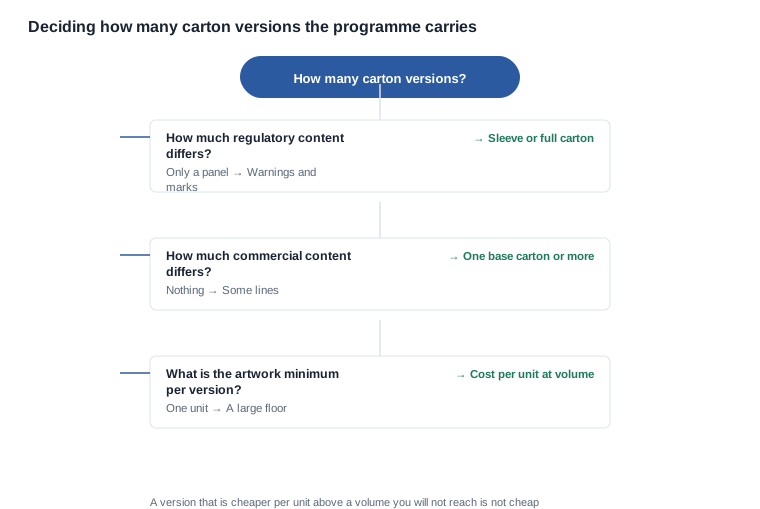
There are three arrangements in practice. One carton for the whole programme works only when every destination in the programme shares a language, a plug and a regulatory content set — a rare condition, and it is the reason some distributors sell a single-country range. One carton per destination is the normal arrangement and the most expensive to administer, because every change to the artwork repeats per destination and every new destination starts a new print cycle. A base carton plus market-specific labels or sleeves sits between the two and is often the right answer when the regulatory content is short and the commercial content is long, because the base carton absorbs the artwork cost and the market-specific layer absorbs the variation.
The choice is not really a packaging preference; it is a function of two facts a buyer can establish early. First, how much of the regulatory content actually differs between destinations. Second, how much of the commercial content differs. If the differences are confined to a language panel and a plug, a sleeve is cheap. If they extend to warnings, markings and operator details, the carton has to be rebuilt and the artwork cost follows the destination.
The arithmetic that decides it is the packaging minimum order quantity. Our published set contains no packaging figures at all — no minimum, no unit price, no tooling charge and no lead time — so the decision has to be made against the supplier's own numbers, and the right way to make it is to ask for three artwork versions with their minimum quantities and their unit prices side by side, then compare the per-unit cost at the volume the programme is actually going to reach. A version that is cheaper per unit at a volume the programme will never achieve is not the cheap option.
The logo and packaging note covers the branding side of the same decision, and the certification note for the Bluetooth audio glasses covers what a file has to say about a product that carries a radio and a cell.

Selecting the models: how the catalogue shapes the packaging work
The catalogue is more useful here than in most market questions, because the box contents differ by model in ways that are published rather than assumed. The camera group is the clearest case, and the case states divide three ways.
Five of the eleven camera models state a case capacity. The figure is 1400 mAh on three of them, 1200 mAh on the folding case of the MT6, and a two-value row reading 900 and 1400 on the L2 Utral, where the catalogue gives no correspondence between the two variant names and the two figures. The KY06 and the MT5 add a case with no capacity stated. A third group — the V03 and the V06, and the V03 Pro and the S7 — lists no case row at all in the specification set, and a missing row is silence rather than an excluded feature, so a buyer who treats it as an excluded feature has made a packaging decision the catalogue never gave them.
That is three different carton problems inside a single group of eleven models, and it is the kind of difference that quietly doubles a packaging programme. The first is a carton with a case in it, whose dimensions and weight are driven by the case. The second is a carton for a case of unknown size, which cannot be finalised until the case specification is answered. The third is a carton for a model whose box contents are not documented at all, which is an open question on a product you are about to ship, and it is the one a buyer cannot close with a catalogue row, so the specification has to be requested in writing before the carton is tooled.
Two further published facts shape the physical box. The MT6 is the only entry in the range that publishes a weight, and that weight — 158 grams for the glasses body, excluding the folding charging case — tells a buyer what the unit weighs and says nothing about the carton, because the case is the heavier half of the box. And two entries carry an ingress marking, the V06 and the S7, both published with IP54 and, in our own records, without a third-party test report number behind the marking. A carton that repeats an ingress marking puts a claim on the outside of the box where a retailer's auditor will see it, which makes the report request more urgent for those two models than for the rest.
Assessing a packaging specification before you sign it off
A packaging specification is a technical document and it deserves the same scrutiny a product specification gets, which it rarely does. Five checks cover almost every failure mode seen in this area, and they can be applied to a sample carton before anybody signs anything.
- Does the box content list correspond to a model? A specification that describes the box without naming the model inside it cannot be checked against the goods on arrival, and a carton whose contents differ from the list is the single most common cause of a shipment that has to be reworked.
- Is every dimension confirmed rather than estimated? An approximate carton length is an acceptable working figure during a costing exercise and an unacceptable one in a purchase order, because freight, pallet fit and the customs declaration all depend on it.
- Is the plug and adapter position explicit? "As required by the destination" is not a specification; the standard has to be named for each destination the carton will ship to.
- Are the regulatory elements marked as destination-specific? A carton that does not distinguish between the elements fixed by the brand and the elements required by a market cannot be reused, and the buyer will pay for a new version each time the destination list changes.
- Is the artwork file owned, versioned and transferable? This is the one question with a long tail: an artwork file that is not secured is re-bought at the next supplier change, at a price nobody negotiated because nobody expected to need it.
Four red flags are worth treating as stop conditions rather than as items for clarification. A dimension marked "approximately". A box content list described as "as required" rather than enumerated. A packaging minimum order quantity larger than the programme's entire first order. And a carton whose content list names a charging case without stating its capacity, which is exactly what happens with the KY06 and the MT5 and with four further camera models where the catalogue lists no case row at all.
Two comparisons are worth making before a packaging proposal is accepted. The first is between two packaging arrangements on the same basis — the same volume, the same destinations, the same artwork content — because packaging quotes are rarely comparable otherwise, and a proposal that looks cheaper is often cheaper only because it excludes the second market. The second is between a single carton and a base carton with market-specific layers, evaluated on the total cost per unit at the volume the programme will reach, including the setup charges and the minimum quantities, because those two numbers dominate the unit price at realistic volumes.
There is a trade-off in the proof stage that the buyer should price rather than leave open. More proof rounds cost time and money; a reprint costs considerably more, and it also delays the launch by the length of the print cycle. The cheapest arrangement is usually a written specification that is checked by both sides, followed by a single physical proof of one carton per market, with the proof round explicitly scoped in the quotation.
Our published set contains no packaging commercial terms whatsoever, so the items below are what to ask for in the quotation rather than what we can state. They are listed in the order they usually matter.
- The artwork charge per carton version, and whether it is a one-off setup or a recurring per-order cost.
- The artwork minimum order quantity per version, and whether a per-market carton carries a higher floor than a base carton.
- The tooling or NRE for a new carton, and whether a second market needs its own tool or only new print plates.
- The carton unit price at the volume the programme will actually reach, quoted at two or three volumes so the buyer can see the break point.
- The carton dimensions, the gross weight and the units per pallet, and whether they are confirmed or estimated at quotation stage.
- The lead time for artwork, quoted separately from the production lead time, because artwork is almost always the longer of the two.
- The lead time for a market-specific sleeve or label, if that arrangement is being considered.
- The accessory list per carton, and whether the charging case is listed as a separate line with its own weight.
- The labelling and marking process, including who proofs it, who signs it off, and how many proof rounds are included.
- Who owns the artwork file, and what happens to it if the programme moves to a different supplier.
- The packaging defect terms, and how a damaged or mislabelled carton is handled in the first shipment.
- The cost of a second carton version later, quoted now, so that the decision to extend the programme comes with a known price.
Two matters are worth raising with the supplier before the quotation lands rather than after it has been accepted. The first is the artwork file itself, because a brand that has not secured ownership of it has to commission a second set of artwork when it moves supplier, and that cost is entirely avoidable at the outset. The second is the confirmation of the carton dimensions and weight, because they feed the freight calculation and the customs declaration, and an estimated figure at quotation stage becomes a discrepancy at the port.
Selecting by market: the boundary of the published record
What we publish about the power side is the device end of it: a cell figure and a cell count for every entry, a charging interface on twenty-four of them, and a case capacity on five camera models. What we publish about the box end is nothing at all — no plug, no adapter, no carton size, no artwork and no label wording for any of the twenty-eight entries, and no packaging commercial terms of any kind. We will not estimate a carton dimension or a packaging minimum order quantity, because those are figures a buyer has to be able to hold a supplier to.
That boundary is also the reason this guide is worth the time it takes to read. The plug and the carton are the two parts of a market decision that can be checked physically, and checking them physically is what stops a programme discovering at the port that the box it shipped does not match the product it filed. The catalogue gives you the unit side; the sample, the artwork proof and the carton specification give you the rest.
Next step: ask three questions before anything is drawn — does a mains adapter ship, which plug standard does the destination use, and what does the box contain for this specific model. Then have the artwork proof checked against the model list and the destination requirements before the print run, not after it.


