

Selecting smart glasses by market southeast asia requirements is a regional problem, and the regional scale is what makes it different from the single-destination decisions elsewhere in this series. A South East Asian launch is not one market with one set of rules; it is a set of national regimes — each with its own type approval, its own language policy, its own plug, its own registration process and its own distributor structure — sharing a geography that makes distribution expensive and a trade structure that makes a single-country strategy the wrong unit of planning. The practical consequence is that a buyer who treats "South East Asia" as one destination will build one programme and then discover six.
This article works through that problem as a worked example, because the regional case is the only way the trade-offs become visible. The scenario below is constructed from our published rows and from the structure of regional trade; it describes no customer order and names no customer. What it produces is a method: how to choose a starting range, how to build the country matrix, what to model commercially, and what the first two quarters should look like.
Selecting for South East Asia: why one-country thinking fails here
Three characteristics of the region combine to make single-country planning unworkable, and each of them maps onto a decision a buyer has to make.
The first is that the conformity work is national. Type approval in this region is administered country by country, and the approvals do not transfer between the jurisdictions in the way a single regional mark would. A buyer who expects one approval to cover a group of countries will find the first refusal at the first consignment, and the correction is not a letter but a programme: a separate submission, a separate timeline and a separate set of fees per country.
The second is that the languages are national as well. A distributor selling in six markets needs, at minimum, packaging and instructions in Bahasa Indonesia, Thai, Vietnamese, Malay and Filipino, with English alongside in the markets where it is a working language. That is an artwork and an instruction-manual problem, and it is a bigger recurring cost than the conformity work because it repeats with every print run and every product revision.
The third is that the logistics penalise a single-country assumption. The region is archipelagic, and last-mile distribution into the outer islands and the outer provinces carries a cost structure that a buyer who has modelled European road freight or even standard sea freight has not seen. The consequence is not that the product cannot be sold; it is that the landed cost is not the unit price times a small freight factor, and a range that was priced against a factory unit price can be commercially underwater before it reaches a customer.
Those three together mean the unit of planning is not the country and not the region. It is the destination matrix: one row per country, one column per variable, and every cell either filled from a published fact or marked as an open item with an owner.

Selecting the starting range: the published rows do the narrowing
Before any country work starts, the buyer has to decide what is being taken into the region, and here the published rows are unusually helpful — not because they say anything about the region, but because they say which models are documented well enough to be worth taking.
The comparison is straightforward. Our specification set publishes a Bluetooth version on fourteen entries and leaves the other fourteen without one, and the remaining rows that stay silent are the A05, the A06 and the bone-conduction entry. It publishes a charging interface on twenty-four entries, with the four exceptions again being camera models — the MT6, the L1 Pro, the CY05 and the CY03. On the audio side, all eight models publish both a radio row and a charging method: the K02 and the K01 publish V5.3 with magnetic charging, the D11 and the D12 publish V5.4 with Type-C charging, and the LC-105-2, the LC-105-1 and the G07, and the YK12 publish V5.4 with magnetic charging. The sport group is complete too: the YKC02, the D17 and the ZH12 each publish a radio row and a charging method.
That makes the audio group the natural place to start, and the reason is documentary rather than commercial. A model that publishes no radio row and no charging method generates two open items per country before a single unit is ordered, and six countries turns twelve open items into a schedule. A model that publishes both generates a request rather than an investigation, and the request can be answered once and reused.
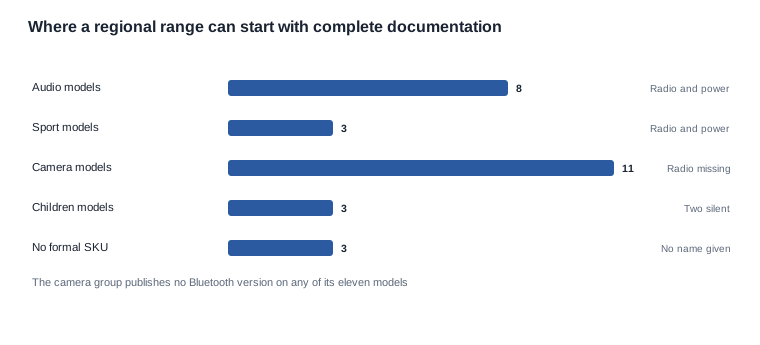
The camera group can still be included, and there are reasons to include it — the resolution classes are published and real, the V06 and the S7 carry the only ingress markings in the range, and the MT6 is the only entry with a published weight and a folding case. But the buyer should include them knowing that the radio position has to be asked per model, that the four models with an unstated charging method need a second question each, and that the eleven-model group is where the documentation effort will go. A range built from the audio group and one camera model is a defensible first programme; a range built from all twenty-eight is not a first programme.
Two catalogue facts constrain the range further and are easy to miss. The three entries that carry no formal SKU — the augmented-reality unit, the electrochromic unit and the bone-conduction model — cannot be filed against at all until the internal naming is resolved, so they cannot be in a first regional shipment. And the three children's models carry a different risk profile: our own records give no certification position for that category at all and flag safety and health claims in it as high risk, which in a region with a young population is a decision that belongs to a brand and a local adviser rather than to a sourcing team.
The per-country request that the model list generates
The model list is the input to the request, and the request is generated from it rather than written from memory. For each destination on the list, six questions go out against the models that have been shortlisted, and the same six apply to every country even though the answers differ.
- Which national conformity route applies to this product category, and what the current timeline is for a first submission in this country.
- Who must be appointed locally — importer, agent or holder of the type approval — and what the appointment costs per year.
- What language is required on the carton and in the instructions, and whether a bilingual instruction set is acceptable.
- Which plug standard is used, and whether the product is supplied with an adapter.
- What marking has to appear on the product itself, rather than only on the packaging.
- Whether the product must be registered before it is sold, and what triggers the registration.
The six questions are deliberately narrow. They are the ones the catalogue cannot answer and a local party can, and a buyer who sends a general request for approvals across the region will receive a general answer that cannot be used in a matrix. The destination is named in every question, the model list is attached, and the answer is required against a date.
Selecting the country set: the matrix a regional launch needs
The matrix is the deliverable. One row per destination, one column per variable, and every cell either carries an answer with a source or carries an owner and a date. A matrix that has blanks is not a failure; a matrix that has blanks with no owners is.
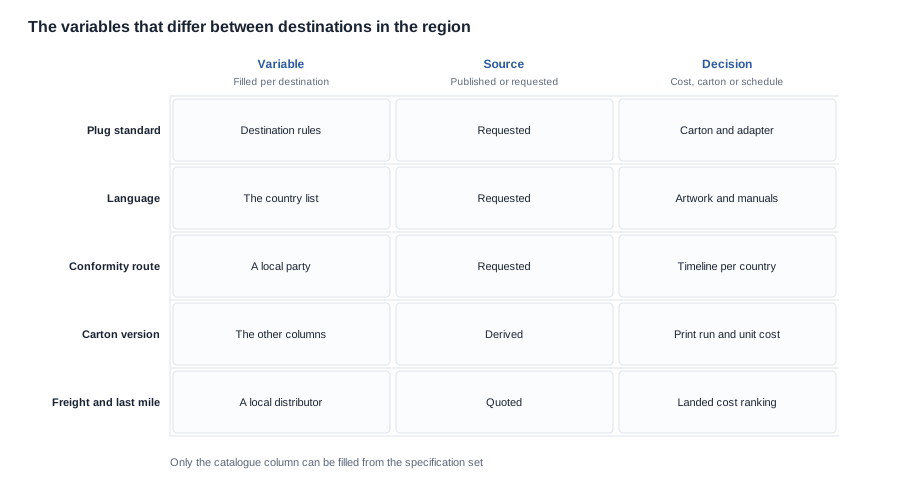
The columns below are the ones that change between countries in this region, and each one has a source that is or is not the catalogue. The last column is the one most often missing, and it is the one that determines whether the matrix is actionable.

Three of the columns cannot be filled from anywhere except a written request or a local party, and a buyer should accept that early rather than searching for them in the catalogue. The conformity route and its timeline is national and has to come from someone who knows the current process for that country. The plug standard and whether an adapter ships determines the box, and our specification set publishes nothing about it for any entry. The agent or importer arrangement is a commercial decision that also carries the compliance obligation, and it differs by country.
Two of the columns are partly informed by the catalogue. The language is not published at all, but the number of languages is a function of the country set, which is a decision the buyer makes. The carton follows from the plug, the language and the regulatory content, so it cannot be finalised before those two columns are.
One column is a logistics fact rather than a compliance fact, and it is the one that decides the commercial case: the freight and last-mile structure of each destination. The battery transport position applies to every consignment in the region on the same terms as everywhere else, and it is set out in the battery transport note. What differs by destination is the inland distribution, and that is the part a buyer has to model.

Selecting on landed cost rather than unit price
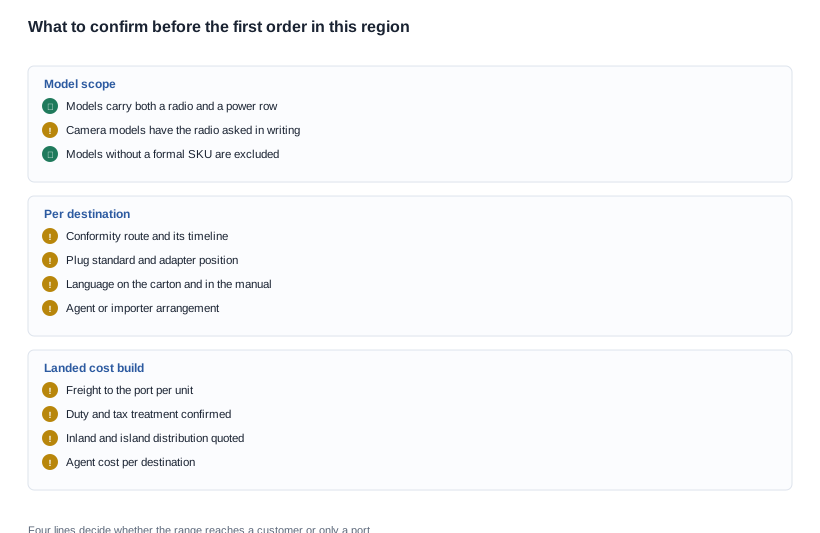
The commercial mistake in this region is nearly always the same one: comparing supplier quotes and then adding a freight estimate, rather than building the landed cost from the bottom. Four lines belong in that build, and each of them is larger here than it would be in a single-country launch.
Freight per unit, to the port. The sea freight element is comparable to other destinations, but the packaging position makes it worse than it looks, because a carton that carries a charging case is a heavier carton, and the case states differ by model across the camera group. Five camera models publish a case capacity, two publish a case with no capacity, three publish no case row and the V03 Pro is published as having no case at all. A buyer who has priced freight on the assumption of a carton without a case has understated the freight on most of the camera range.
Inbound duty and tax treatment. The treatment of the glasses product and of a mains adapter can differ, and an adapter in the box changes the consignment rather than merely adding to it. We do not publish a tariff treatment and will not estimate one; the number comes from a broker for the specific destination and the specific consignment.
Last-mile and island distribution. This is the line that makes regional economics different, and it is the one that is hardest to obtain from a supplier because it is not the supplier's cost. It has to come from a local distributor who will quote it, and it varies by destination in a way that a single regional average will hide.
Local agent and registration cost per destination. The recurring cost of an appointment, per country, for a range of a given size.
Comparing two destination plans on one basis
Regional planning fails at the comparison stage more often than at the research stage, because two proposals for the same region are rarely built on the same basis. One includes the agent appointment and the other treats it as a distributor's cost; one quotes freight to the port and the other quotes door delivery; one assumes a single carton and the other assumes a carton per country. Each proposal is internally reasonable and the two cannot be compared.
The way to fix it is to fix the basis before the numbers are compared, and the basis has four components that always move together: the same model list, the same carton assumption, the same freight scope, and the same treatment of recurring local costs. With those four aligned, the comparison becomes a comparison of landed cost per unit and of time to first shipment, and the second of those frequently decides the sequence rather than the first.
There is a second comparison worth running, and it is the one that protects the programme. Compare the two-country opening against the six-country opening on total cost rather than on first cost. The six-country plan costs more in documentation and in artwork, and it carries six independent chances to delay. A plan that opens two countries and prepares four has a lower total cost across the first two quarters and reaches the same end state, with the difference that only two things have to go right before the first shipment.
Once those four lines are in place, the total cost per unit is comparable across destinations, and so are the products against each other. A buyer who compares supplier unit prices will find a destination that looks attractive and then discover that the freight and last-mile structure consumes the margin. The certification verification checklist is the procurement-side control that goes with this build, and the range itself is on the oem ready products page.

Selecting the launch sequence: the case worked through
Returning to the scenario. A distributor is planning a South East Asian range over two quarters, with six countries on the list and a first shipment due at the end of the second quarter. The three mistakes they would make without a method are these, and each is worth naming because each is common.
The first mistake is to open all six countries in the first quarter. The conformity work is national and it is the slowest of the four columns. A realistic sequence is to open two countries in the first quarter — chosen for distributor readiness rather than for market size — and to prepare the artwork and the documentation for the remaining four so that they are ready when the first two have cleared. A first shipment in two countries and a second shipment in four is a normal outcome; a first shipment in six is a programme with six independent chances to fail.
The second mistake is to price the range on the unit price. With the four landed-cost lines built properly, the ranking of destinations changes, and in a region with long inland legs the difference between the cheapest and the most expensive destination is a fraction of the unit price, which is large enough to decide the sequence.
The third mistake is to include the children's models in the first programme. The category's certification position is not provided in our records, and the claim risk is the highest in the range. That is a decision for a brand and a local adviser, and it is not a decision a sourcing team can make by adding a model to an order.
The register that carries the programme
A regional programme tends to fail in the gap between two countries rather than inside either of them, and the mechanism is always the same: an open item in the first country is closed by somebody who assumes it is closed in the second as well. The register is what prevents that, and in a regional launch it needs one extra column that a single-market programme does not: the destination an item belongs to, and the destinations it has been assumed to cover.
The second rule is that a model joins a destination only when its row in that destination's matrix is closed. A partially specified model is a shipping risk with a model name on it, and it is the reason a regional launch ends up with a range that differs from country to country in ways nobody designed.
That last point has a commercial consequence worth stating plainly. A range that varies by country is a different set of stock-keeping units in each country, which changes the minimum order quantity per country and changes the artwork count. Buyers who intend that should price it; buyers who do not should treat it as a failure rather than as a regional strategy.
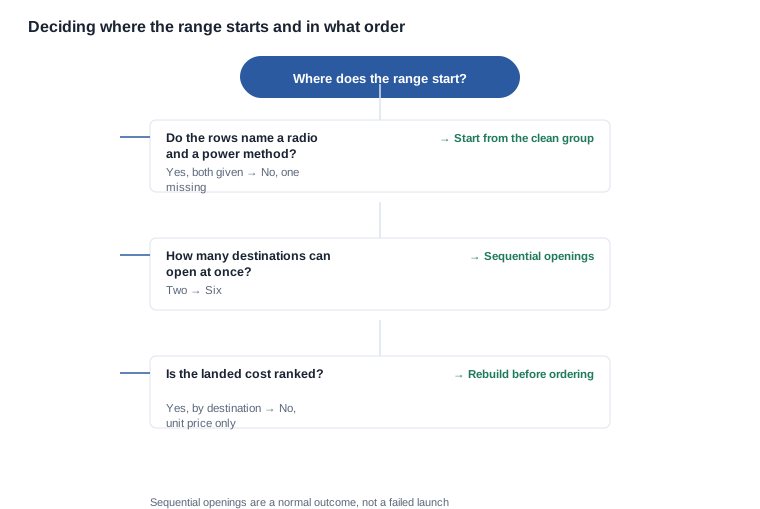
What the worked example produces is a matrix with six rows and about a dozen columns, of which the plug column, the language column and the conformity column start empty and are filled by a written request, and the freight column is filled by a local distributor's quote. The outcome is a two-country first shipment, four countries prepared, an artwork plan with five languages, and a register of open items with owners and dates.
Selecting for South East Asia: the boundary of what we publish
Our published set for this region is the same specification set as everywhere else, and it is worth being clear about the division. It describes the units: cell figures and cell counts, charge ceilings, charging interfaces on twenty-four entries, runtimes, case states, resolution classes, Bluetooth versions on fourteen entries, two ingress markings and one weight. It says nothing at all about the national conformity regimes, about plug standards, about languages, about agents or about freight. Those are the columns of the matrix, and every one of them has to be filled from outside the catalogue.
That boundary is what makes the method work. The catalogue is genuinely good at telling a buyer which models are documented well enough to be worth taking to six countries at once, and it is silent on almost everything that makes the region expensive. A buyer who asks a supplier for the radio version of a camera model is doing something the catalogue cannot do for them, and a buyer who asks a local distributor to quote the last-mile cost is doing something the catalogue cannot do for them either. Both questions are worth asking before the first order, because in an archipelagic market the difference between a product that reaches a customer and a product that reaches a port is most of the business.
Next step: choose two destinations rather than six, pick the models whose published rows are complete, and build the matrix with the plug, the language, the conformity route and the freight as the four columns that have to be filled from outside the set. Send the request with the model list attached, and let the matrix tell you which country goes first.


