

A brand asking how to select smart glasses for the United States market is usually carrying a supplier playbook built somewhere else, and the playbook assumes the target market is one thing. It is not. The United States market is a stack of obligations that belong to different bodies, are enforced at different points in the channel, and fail in different ways. One of them stops a shipment at customs. One of them is written into a retail contract. One of them is a state law with a chemical exposure test attached. One of them belongs to a trademark programme rather than a regulator, and one of them is enforced by a platform whose rules change without notice.
The failure mode is predictable. A team treats "US ready" as a single yes or no, a supplier answers it with a single yes or no, the sample arrives, and the first hard stop surfaces four to eight weeks later — during a production window that has already been paid for. By then the trade-off has been made for you: you either pay for a compliance re-run, you ship without the marking, or you pull the listing.
The purpose of this article is not to tell you which files exist in the abstract. It is to give you a sequence for selecting a supplier and a model set for the United States, and to be explicit about which parts of that sequence your supplier can answer from published documentation and which parts they can only answer from documents they hold but do not publish. That distinction is the whole game.
It is worth naming what a brand is actually buying when it selects a smart-glasses supplier for this market. It is not buying a pair of glasses with a radio in it. It is buying a file that lets the goods be imported, a product that satisfies the channel's contractual standards, a manual that survives legal review, and a reference object that lets a dispute in month eight be settled by comparison rather than by argument. The hardware is the visible part and it is the part everybody negotiates hardest. The file is the invisible part and it is the part that decides whether the launch happens on the date in the plan.
One more framing point, because it changes how the whole article should be read. "United States requirements" is not a fixed target that you can hit. Each of the layers below has its own owner, its own evidence and its own pace of change, and the layers do not all move at once. A selection decision that is defensible in one quarter can become indefensible in the next, because a marketplace changed a listing rule or a retail customer wrote a new clause into a contract. What you are really selecting is a supplier who will keep you informed about that movement — not one who will guarantee a static answer.
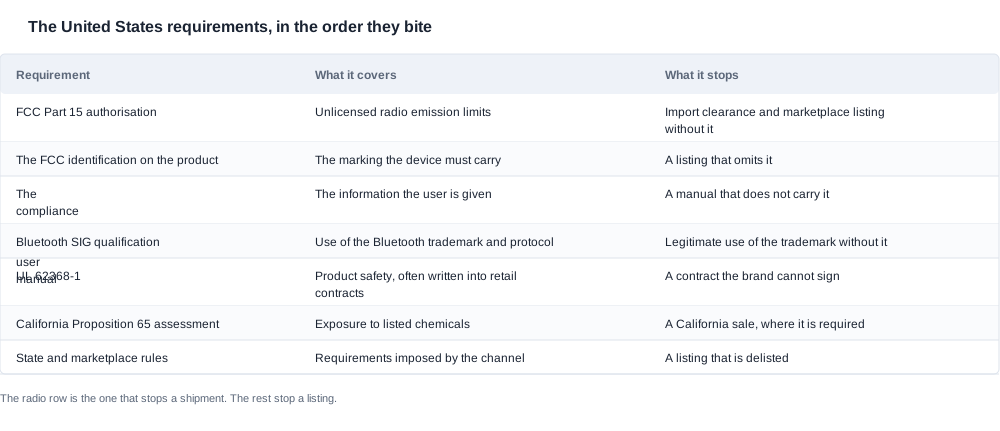
Selecting smart glasses by market: the requirements in the order they bite
The order below is not alphabetical and it is not the order they appear in a supplier's folder. It is the order in which they stop your programme.
Radio authorisation for unlicensed radio equipment. Any wireless device sold into the United States needs an authorisation under the Federal Communications Commission's Part 15 rules. The evidence is an identifier issued to the party responsible for the equipment, and it has to travel with the product into the market. This is the requirement with the most commercial weight, because without it the goods cannot be imported and cleared, and because marketplace enforcement on radio-authorised products is fast and unforgiving. It is also the one where the answer is a binary fact about a specific model under a specific legal entity — which is exactly why it belongs first.
The authorisation identifier on the hardware itself. Holding the authorisation and marking the device are two separate obligations. A supplier who will quote the number for the file but cannot show you the marking printed, laser-etched or labelled on the product has given you half of what you need, and the half they gave you is the half that is easy. The marking is what an inspector or a marketplace reviewer looks for.
The compliance statement in the user manual. A radio device sold in the United States carries a compliance information statement in its user manual. The manual is a physical artefact: it has to be designed, printed, shipped in the box, and re-ordered if it is wrong. This obligation bites late because manuals are usually drafted after the product design is frozen and frequently copied forward from a previous model. If the manual is wrong, the correction is a reprint cycle, not an email.
Bluetooth programme qualification. Separate from the radio authorisation, and governed by the Bluetooth SIG rather than by a regulator. The identifier is a Declaration ID, and conformance testing is run at a qualified test facility. For an importer, the question is legal-entity specific: does the qualification held by the factory attach to the goods you are importing, or does your own entity need its own position? That is a question to raise under the programme's current rules, not to assume in either direction.
Product safety to a retail contract standard. UL 62368-1 appears in large retailer supplier contracts as a contractual requirement even where it is not a legal obligation in the same way. It appears in the contract, it has to be answered, and the answer is a test report rather than a marketing claim. Contractual compliance has a different failure mode from regulatory compliance: nobody stops your container, but a category manager can stop your replenishment.
The state chemical law. California Proposition 65 requires an assessment against listed chemical exposures for a sale into California, and it is enforced by private notices as much as by regulators. For a product worn against the face — with a frame coating, a battery, a circuit board and adhesives — the substance declarations behind that assessment are worth having on file regardless of whether California is your first market.
State and platform rules. On top of the federal and state layers, the channel imposes its own: marketplace listings, platform-specific labelling rules, and state-level requirements that layer on top of the federal baseline. This is the fastest-moving layer in the whole stack and the one most likely to invalidate a decision made six months ago.
A seventh item sits outside the regulatory stack entirely and belongs in the same conversation: the golden sample. Not a compliance item, but the reference object against which the production run will be judged. If the golden sample is not an agreed, signed, physically-held artefact, every downstream dispute about colour, finish, fit or function becomes an argument rather than a comparison. Selecting a supplier for the United States means selecting who holds that reference and how it gets controlled.

Selecting the evidence stack: what has to be true before a model qualifies
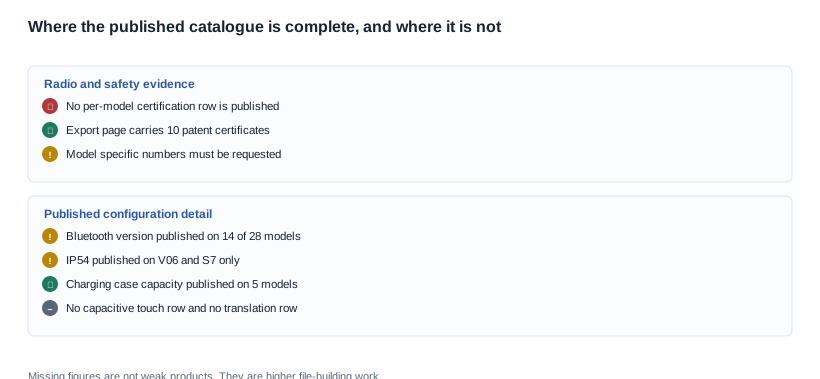
Here is the uncomfortable part, and it should be stated early rather than discovered late: our published catalogue does not carry a per-model certification row. The export-certification page we publish is a picture page — ten patent certificate images, eight design patents and two utility models — and there is no table anywhere in the catalogue that maps a model to a radio authorisation number, a safety report or a chemical declaration.
That is a deliberate publishing choice rather than a gap, and it has a direct consequence for anyone selecting a supplier. If you need a number, you have to request it; you will not find it on a product page. The reason for the choice is simple: a certification number is only meaningful when it is bound to a specific model under a specific entity at a specific date, and a number published on a catalogue page tends to outlive the fact it describes. A supplier who quietly prints a number that belongs to a predecessor model, or to a different legal entity, has done something worse than publishing nothing.
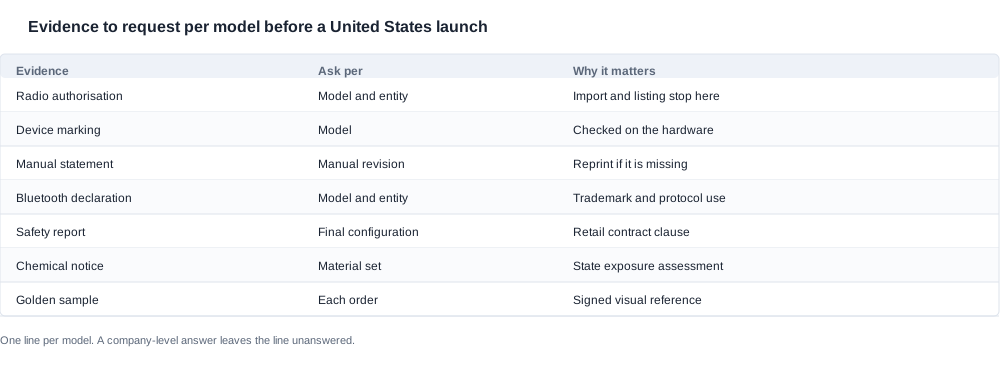
So the request to a supplier should be a list, and each line should be answered per model rather than per company. Any answer given at company level — "we are certified", "our factory is certified" — should be treated as an unanswered line.
- Radio authorisation identifier, per model, per legal entity, with the entity named, plus confirmation that the identifier is marked on the product.
- User manual compliance statement, per model, ideally a redline against the manual you intend to publish.
- Bluetooth Declaration ID, with the question of inheritance or separate qualification answered explicitly rather than implied.
- Safety test report against the standard your retail customer has written into contract, with the report covering the final production configuration.
- Chemical substance declarations covering the frame, coatings, adhesives, battery and board.
- Patent position, where it matters for your own industrial design — our export-certification page publishes the certificates we hold, and we will identify which ones correspond to which designs on request.
- Golden sample definition, including what is fixed and what is allowed to vary, and the tolerance bands attached to each.
Seven lines, answered per model. That is the shortest defensible form of a due diligence request for a United States programme, and it is the form that survives a negotiation, because it converts "is this supplier US ready" into a set of answerable questions.
Selecting a supplier path: the questions that expose gaps early
Most suppliers will answer all seven questions. The differences show up in the quality of the answers and in what happens when the answer is "not yet". Those differences are what you are selecting for, and they are visible early if you look.
A supplier that answers with a document and a date has told you something about how it works. A supplier that answers with "we are working on it" has told you something else, and it has told you before you have committed. The second is not disqualifying; it is a scheduling fact that has to enter your plan rather than a risk to be discovered in month four.
The questions worth asking in the first quotation round, before any tooling or artwork is commissioned:
- Which models in your range carry a radio authorisation identifier today, and under which legal entity?
- Which models have a user manual that already contains a compliance statement, and can you send the manual so we can see the section rather than hear about it?
- Does the Bluetooth qualification sit with your entity or with the importer, and has that been determined in writing?
- Does the safety report cover the exact configuration we would order, or a predecessor configuration?
- Which of your published models have a charging case with a published capacity, and which have a case with no published figure?
- Which of your published models carry an IP marking, and on what basis was it tested?
- What is the process and cost for extending a certification to a customised configuration, and who owns that process?
Those last two questions are the ones most often skipped, and they are the ones with the largest effect on a launch schedule. Certification is tied to a configuration. Change the radio module, the antenna, the battery, the enclosure, the firmware, or the charging method, and the question of whether the existing evidence still applies becomes live. A supplier who can answer that question clearly — with a process, a cost basis and a timeline — is a different commercial proposition from one who says the certification "covers it".
The configuration point deserves emphasis because it is where the purchasing team and the engineering team disagree most often. Purchasing sees a quotation for a model that already carries the evidence. Engineering sees a product with a new logo, a new colour and a different charging method, and correctly suspects that "the same product with your brand on it" is not the same regulatory object. Both are right, and the resolution is a written statement of which changes do and do not affect the file. Get that statement at quotation stage and it becomes a line item; leave it out and it becomes a surprise with a laboratory invoice attached.
Note the specific commercial facts in the published catalogue that make this concrete. Our range publishes a Bluetooth version for 14 of 28 models; the remaining models do not publish one, which includes all 11 camera models, the A05 and A06 kids models, and bone conduction. Our range publishes an IP rating on exactly two models, V06 and S7, both at IP54; nothing else in the catalogue carries an IP marking. Our range publishes a charging method for most models but not for CY03 and MT6, and L1 Pro and CY05. Our range publishes a charging case capacity for exactly five models — CY03, L1 Pro and CY05 — each at 1400 mAh, L2 Utral at 900 or 1400 mAh, MT6 as a 1200 mAh foldable — with a case present but no published capacity for KY06 and MT5, and no case row at all for S7 and V06, and V03, with V03 Pro explicitly published as having no case.
Read that pattern as a supplier-selection signal rather than a product list. The models with published figures are the models whose configuration has been described in enough detail to be described honestly. The models where a figure is missing are not necessarily worse products; they are the ones where your file-building work will be higher. If your market plan needs a Bluetooth version on the datasheet for every model in the launch, then the camera range — which is the largest published block at 11 models — is where your questions will land.

Selecting a market sequence that avoids rework
The sequence matters because the artefacts differ in how long they take to change. A radio authorisation that turns out to belong to a different entity is a legal problem. A missing chapter in the user manual is a reprint. A revised chemical declaration is a laboratory question. A platform rule change is a listing edit. Dealing with them in the wrong order turns a reprint into a production hold.

The sequence that minimises rework runs from the heaviest to the lightest:
- Establish the radio position for every model you intend to launch, including the entity question. Nothing else should be committed until this is answered, because a product that cannot be imported is not a product.
- Establish the Bluetooth position for the same model list, in parallel but tracked separately, because it has its own lead time and its own paperwork.
- Confirm the safety and chemical positions against the file set you are building for the retailer, since both belong to the same evidence package rather than to separate workstreams.
- Reconcile the manual with all of the above, so the printed document matches the file rather than being drafted afterwards.
- Fix the golden sample once the documentary position is settled, so the physical reference and the paperwork describe the same object.
- Check platform rules per listing, last, because they move and because the requirement depends on what you are listing, not on what you are selling.
Two negotiation points belong to steps one and two. First, get the entity question answered in writing before you agree to a quotation that assumes your entity qualifies — this is the single most common source of a late and expensive surprise in this category. Second, agree at quotation stage what happens to cost and schedule if a certification has to be extended to your customised configuration, rather than discovering it as a change order after the golden sample is signed.
A third point belongs to the retailer relationship rather than to the supplier, and it is easy to overlook because it is not a regulation. When a large retail customer writes a safety standard into the supplier contract, that clause creates an obligation the brand has to satisfy through its supplier. The clause is not negotiable on the retailer's side, but the cost of meeting it is, and it is negotiable at quotation stage as an engineering and testing allowance rather than as an afterthought. Ask for the standard to be named in the quotation, and ask what the supplier's position is for the specific configuration you are ordering. A supplier who quotes the standard by name, and who tells you plainly that a particular model has not been tested against it, is saving you a discovery. A supplier who says "we can do that" without qualification has told you nothing you can use.
Selecting a first launch model versus a scale programme
Most brands do not have one problem; they have two, and they arrive in sequence. The first launch needs a model that clears the channel quickly, survives scrutiny, and does not consume the team's attention. The scale programme needs a model set that shares components, shares a certification posture and survives a second and third channel without rework. Choosing badly between those two is a common and expensive mistake, because the model that is fastest to launch is rarely the model that is cheapest to scale.
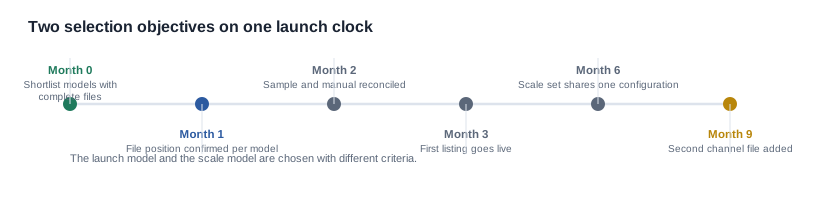
The trade-off is concrete in our published range, because the catalogue's published detail is uneven by category. The audio range publishes a Bluetooth version for every model in it, with the exception of bone conduction, which has no model string and no published version. The sport range is three models — YKC02, D17 and ZH12 — with YKC02 carrying two 70 mAh cells, and D17 and ZH12 the only two models in the entire catalogue publishing a charge time of about one hour; the other 26 models publish "2 hours or less", which is a ceiling rather than a figure. The camera range publishes a runtime for all eleven models, with camera batteries in the 220–290 mAh band and a rated runtime of roughly five to eight hours, but publishes no test condition for that figure, so the number cannot be compared across brands without the condition behind it.
For a first launch, the practical question is which of your candidate models has the most complete published position, because a complete published position is the fastest route to a complete file. For a scale programme, the question is which models share a configuration, and the charging case is the sharpest example of why: a case with a published capacity is a merchandising asset, a case with no published capacity is a question, and the difference between the two shapes a product page, a packaging insert and a retail conversation.
If the United States is the first market, start from the models with the most published detail and confirm the file position with the supplier before you commit to a launch model. If the United States is a second or third market, start from the model architecture you will scale and treat the file position as a condition of the architecture rather than a task for launch week.
There is a version of this decision that looks efficient and is not. It is the decision to launch on one model because it is ready, then rebuild the range around a different model later because the scale model had better published detail. Every piece of that rebuild is duplicated cost: the file, the manual, the packaging, the listing, the support material, and the negotiation you thought you had finished. It also separates you from the supplier for exactly the period when the relationship matters most, because the second model is where the supplier learns whether you are a one-model buyer or a programme buyer — and where they price accordingly.
The reverse error is no better. Committing to a scale set before you have confirmed the file position for a single model means you have chosen an architecture whose regulatory viability is still an assumption. Confirm one model completely, then extend the same discipline across the set. The supplier who can tell you, model by model, which files exist and which do not is the one you want holding the second and third models as well.
Selecting a supplier for the United States: what to ask us
Tell us the models, the channel and the launch window, and we will tell you which of the obligations described here your programme depends on, which of them our documentation already reaches, and which ones we would have to request from the certifying body before we could put them in front of you.
The channel context is on the select by market page, the platform range is on the oem ready products page, and the broader compliance position is described in the market compliance centre. Our own published position is deliberately narrow: we publish the models, the configurations and the figures we can stand behind, and we do not publish radio authorisation numbers, prices, minimum order quantities, lead times or sample fees that we cannot quote you directly.
Related reading
- The United States route in full — fcc compliance
- The verification sequence — certification verification checklist
- The coverage question — oem ready platforms certification coverage
Tell us the models and the channels, and we will tell you which of these requirements your programme depends on and where our own documentation does not yet reach.


