

Oem ready smart glasses platforms certification coverage is a phrase that carries two different questions, and the distance between them is where a procurement team gets caught. One question is whether a platform is certified at all. The other is which models are covered, by which legal entity, under which numbers, with what conditions, and what is excluded. A brand that inherits a platform inherits an answer to the first question and is very often assumed to have inherited the second, which is the single most expensive assumption in this category.
The purpose of this article is to separate the two questions, to state exactly what our own published material does and does not settle, and to convert the remainder into the request a buyer has to make before an order rather than the request they have to make after a customs inspection.
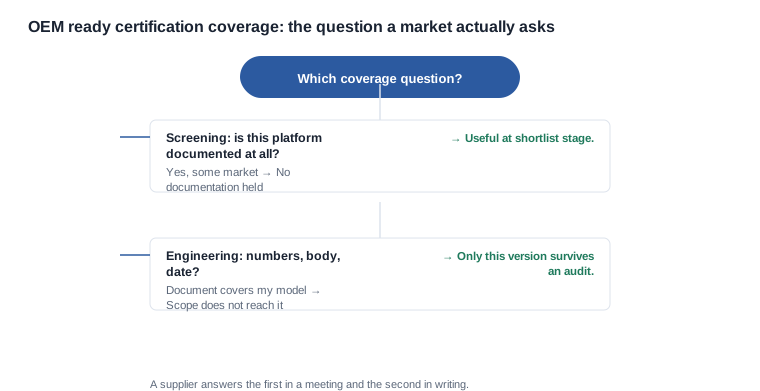
OEM ready certification coverage: two meanings of one question
The first meaning is the screening question. Does this platform carry conformity documentation that is accepted in the market I intend to sell into? A platform answer to that question is worth something: it means a supplier has done the work at some point, on some model, for some market, and the buyer does not begin from zero.
The second meaning is the engineering question. For this model string, in this configuration, in this destination market, under which numbers, issued by which body, on which date, covering which variant list, and excluding what? That is the question a technical file answers, and it is the only version of the question that survives an audit, a tender questionnaire or a product liability claim.
Most suppliers are set up to answer the first question fluently. Brochures, web pages and quotation templates are all built for it, because it is the question that closes a meeting. The second question is answered slowly, in writing, by someone with access to the file, and it needs a model string and a market to be answerable at all. A buyer who asks the second question in the language of the first — "is it certified?" — will receive the first answer and record it as if it were the second.
There are three structural facts in our published range that make the distinction unavoidable rather than academic.
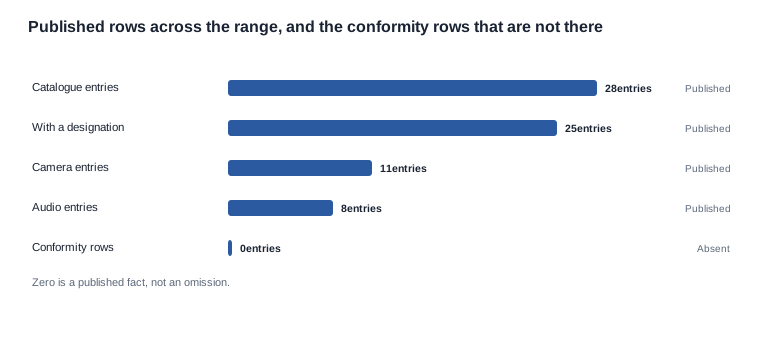
The range is uneven in exactly the way that matters. Twenty-eight entries sit across seven categories, twenty-five of them carrying a model designation and three published without one. The audio group publishes a Bluetooth version for every one of its eight entries; the camera group publishes none for any of its eleven. Whatever else that tells you, it tells you that the radio position cannot be inferred from the product pages of a camera entry, and that a documentation file for a camera model cannot be assembled from the published rows the way a file for an audio model might be.
The certification record is not published per model. There is no per-model certification row anywhere in the catalogue, and no certificate number tied to a designation. That is not a deficiency in the record; it is the shape of what a range catalogue holds, because the scope of a conformity document belongs to a specific configuration and a specific market rather than to a product family.
Three entries have no designation at all. The electrochromic entry, the bone conduction entry and the AR entry are published without a model string. A platform without a model string cannot be quoted against a specific designation, ordered against a document, or listed under a stable identifier, which makes the coverage question for those three unanswerable in its own terms. Any documentation work for them starts with creating a designation, not with obtaining a certificate.
The practical consequence for a buyer is a sequencing rule. The screening question belongs in the shortlisting stage, where it removes suppliers cheaply. The engineering question belongs before the purchase order, where it still has time to change the answer. A programme that asks only the first question until the goods are booked has compressed a question it needed answered in February into a question it will answer in August.

What the catalogue publishes and where it stops
The export page in our catalogue is artwork rather than a record. Its content is ten patent certificates — eight appearance-design patents and two utility-model patents — reproduced as images, and it carries no extractable text beyond its heading. That page describes design work at the company level. It is not a conformity document, it is not tied to a model, and it should not be read as a statement that any particular entry is certified for any particular market.
The rest of the catalogue is equally plain about conformity. The catalogue text names no CE, no FCC, no RoHS, no REACH, no RED and no EN 18031, and there is no per-model certification row and no per-model certificate number anywhere in the range. Nothing in the published material ties a regulatory statement to a specific entry, and nothing in it tells a buyer which model a document would cover.
That position is worth stating plainly rather than defensively, because it is the honest starting point for any procurement conversation and because it is also commercially useful. A buyer who arrives expecting to inherit a certificate file is disappointed; a buyer who arrives knowing that the scope has to be obtained in writing for a named configuration gets exactly what they need. The catalogue publishes product rows, and product rows are what narrow a twenty-eight-entry range to two or three candidates. The compliance scope is what the supplier has to supply, and it is supplied per configuration, not per range.
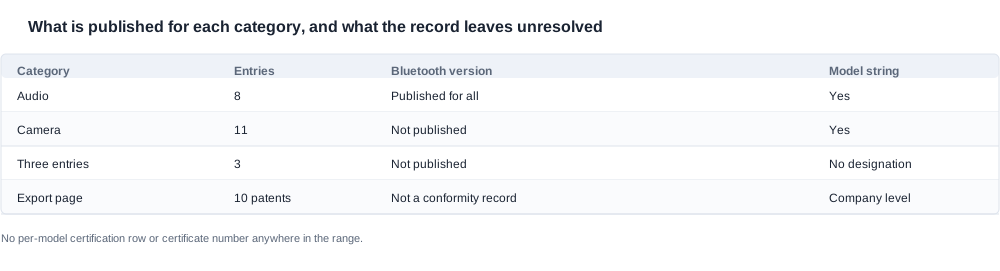
| Category | Entries | What the record publishes | What it leaves open |
|---|---|---|---|
| AI camera glasses | 11 | Resolution class, cell, runtime, charging rows | Any conformity statement tied to a model |
| Bluetooth audio glasses | 8 | The above plus Bluetooth version for all eight | Any conformity statement tied to a model |
| Sport glasses | 3 | The above plus a remote shutter on two entries | Any conformity statement tied to a model |
| Children smart glasses | 3 | Cell, runtime, charging rows, feature rows | The certification position is entirely not provided |
| Electrochromic entry | no designation | Cell, runtime, charging row | Designation and scope |
| Bone conduction entry | no designation | Cell, runtime, charging row | Certification not provided; description question |
| AR entry | no designation | Two feature rows only | Certification unknown |
Three published facts change what a request has to contain. The ingress marking appears on two entries only, the V06 and the S7, as a catalogue annotation with no third-party report number behind it, so any brand that leans on it is leaning on material that has to be produced rather than copied. The colour list appears on two entries only, the V03 Pro with three options and the V06 with four, which means a configuration request that leaves colour unstated is a request that may be answered with a different product. And the camera group publishes no Bluetooth version at all, so the radio documentation for a camera configuration cannot be anticipated from the published rows — it has to be requested.
Two further rows belong in this section because they are easy to misuse. A charging case appears with a capacity on five camera entries, appears without a figure on two, and is absent as a row from four, so a request that specifies a case has to name the entry rather than assume the case is standard. And one entry publishes a weight figure at all — the 158 g MT6 glasses figure, which excludes its folding case — so the shipping weight of that entry is a separate number that has to be derived rather than read, and it belongs in the freight model rather than in the specification.

Why a company-level page is not a model-level answer
A company-level artefact and a model-level answer differ in three separate ways, and all three have to hold for the answer to be usable.
Scope. A company-level artefact describes the entity. A model-level answer describes a product. The move from one to the other is not a formality: it requires a named designation, a named configuration, a named market and a dated document, and it requires somebody to have done the work that connects them. Nothing on a company page establishes that the work was done for the configuration a buyer intends to buy.
Subject. Patents and conformity documents are different instruments answering different questions. A patent protects a design or an invention; a conformity document records that a product was assessed against a named standard by a named body. The export page carries ten patents. Reading that as a conformity position is a category error, and it is the most common error made by buyers who have been handed a picture of a certificate rather than a document.
Entity. A document is issued to a legal entity, and that entity is not necessarily the entity a buyer signs a purchase order with. Both arrangements are legitimate — a manufacturer can issue for its own product, a brand owner can be the applicant, an entity with a documented relationship to the manufacturer can be named — but a surprise at this point is expensive, because it means the documentation has to be re-issued rather than transferred.
Two consequences follow for the way a platform route is evaluated. The first is that the criteria for accepting a documentation answer have to be written before the request, not after it. "Is it certified" is not a criterion; "a document naming this designation, this configuration and this destination market, issued by a named body, with a number that resolves and a date we can file" is. The second is that a buyer should evaluate the answer for the specific entry rather than for the platform, because the entries differ so much in what they publish that a platform-level answer is not a meaningful unit.
There is one more trap that catches platform buyers specifically, and it concerns rebranding. A new brand means a new model string, and a new model string means a new scope question — the previous scope was written against the previous string. A logo on the temple is the only change in this category that reliably leaves the documentation untouched; a change of designation, of the optical configuration, of the companion application or of the radio build can each reach the file. How to choose between a branding route that is documentation-neutral and one that is not is a question to settle before the artwork is approved, not after.

Questions that establish scope for a market
The following is the request set we would send before a purchase order, and it is written to be answered rather than discussed. It has five parts.
On the model. Which exact designation is covered, including the variant list, and does that list include the configuration we intend to buy? A document that covers a family and names a designation that differs from the one on the carton is worse than no document at all, because it passes a casual check and fails a formal one.
On the market. Which destination market is the document for, and which instruments does that market apply to? A buyer shipping into more than one market is asking for more than one scope, and the second market is never covered by the first document.
On the configuration. Which colourway, which case, which accessories and which packaging level was the assessed configuration? A conformity position follows the configuration, and a change to the lens, the radio build or the optical configuration can reopen it.
On the evidence. What is the number, who issued it, on what date, against which standard, at which laboratory, on how many samples? Can the number be checked in a public register where the regime provides one? A number that cannot be checked is a claim, and a claim cannot be filed in a tender.
On the exceptions. Which models, markets, features and configurations are outside the scope? This is the part of the request most often not sent and the part most worth sending, because the exclusions are what determine whether the platform can be extended later without a new programme.
The same five parts have to be asked in writing for each category in the range, and the answers will not be the same. The children's entries record their certification position as entirely not provided, and the record separately identifies the additional requirements that apply to products for children in Europe and the United States, with the relevant standards named as matters to be confirmed. A brand entering that range is not extending an inherited file; it is starting one, and the start is the expensive part, which is why it belongs in the commercial rows of a quotation rather than in the schedule of a launch plan. The bone conduction entry records its certification position as not provided as well, and carries a separate question about how a product with its published amplification gain may be described. That is a description question before it is a documentation question, and it is better settled before a design is frozen than after.
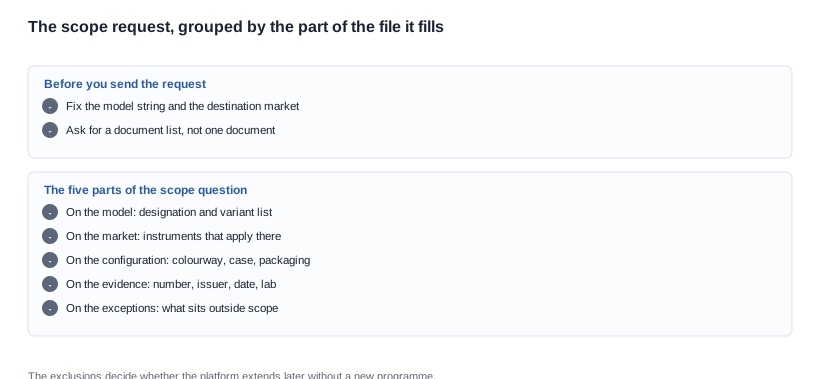
Two rules make the request cheaper. Fix the model string and the market before sending it, because an answer that arrives for an unspecified entry is an answer to the wrong question. And ask for the document list rather than for a single document, because a conformity position is rarely one artefact — it is a declaration, the reports behind it, the radio approvals by region, the battery transport summary and the change-control record that keeps them valid.
What a documentation file has to contain
A file that will survive a due diligence review has a recognisable shape, and the shape is worth specifying before it is requested. The buyer is not asking for a certificate; the buyer is asking for a set of linked records.
The header of each document. The model list it covers, the standard it was assessed against, the issuing body, the document number, the date of issue and the laboratory. Without those five rows a document cannot be filed, cannot be matched to a product and cannot be re-checked at the next audit.
The configuration the assessment was made on. The sample description, the build revision, the variant list, the accessory configuration. This is the row that connects the file to the unit in the carton, and it is the row most often missing from a summary.
The reports behind the declaration. A declaration states a conclusion; the reports show how it was reached. A buyer needs the method, the sample and the date for each claim that matters to the market being entered, and a supplier who can produce the reports can usually produce them quickly.
The market-specific approvals. The radio position per region, the conformity declaration for the European market, the battery transport summary, and anything the destination market requires for the product category rather than for the product type.
The maintenance record. Who owns the file, who updates it when a component changes, what triggers a re-assessment, and how a change is communicated. A file has a life, and the buyer who inherits a platform inherits that life as well.

The order in which these arrive matters as much as their content. A model string and a market produce a scope. A scope produces a document list. A document list produces the artefacts. The artefacts produce the file. Any step that is skipped produces a gap that is only visible at the last one, which is usually the last one. How to evaluate a supplier's answer at each step is a question about what they can show rather than what they can assert, and the supplier that can show a model list on a header is a supplier that has already done the work.
What we will do with any of this is take a specific model and a specific destination market, tell you which instruments apply to that combination, and tell you where our own published material stops and the written material has to begin. We publish the configurations, the electrical rows, the interfaces, the case rows, the Bluetooth versions, the camera resolution classes and the colour options we hold, and we mark the rest as Not published rather than leaving them off the sheet. We do not publish certificate numbers, because we do not hold them in a form a buyer could check, and we will not print an acronym where a document should be. Unit prices, minimum order quantities, production lead times and warranty terms are settled per enquiry, because each depends on configuration, quantity and the state of the current schedule.
Two questions decide how much of this work is worth doing before the first sample is built. The first is whether the destination market applies an instrument to this product category at all, because the answer is not the same for every market and not the same for every category inside one market. The second is whether the model string is already settled, because a file that names the wrong string has to be refiled rather than amended, and refiling costs more than amending.
Related reading
- The verification sequence — certification verification checklist
- What a change does to the file — customization options certification impact
- The platform range itself — oem ready platforms low risk entry
- The full range and its published rows — oem ready smart glasses platforms overview
- Where the compliance context sits — market compliance centre
Tell us the model and the destination market, and we will tell you which instruments apply, where an oem ready platform's published material ends and the written material has to begin.


