

A trend is a claim about movement over time, and this catalogue is a single snapshot, so the honest first move is to be clear about which kind of statement a snapshot can support. It cannot support a claim about what buyers will want next year, or about which family is growing, or about where the industry is heading — there is no time series here, no shipment data, no market figure and no forecast. What it can support is a claim about configuration: which capabilities exist in the range, how many models carry them, and how concentrated they are. That is a narrower claim, but it is the one that actually changes a specification, because a capability that has appeared in one model is a capability your factory can now be asked to extend, and a capability that has appeared in a family is a capability your competitor's buyers will already be comparing.
This page is about the structural reading, the limits of it, and the questions that turn one snapshot into a history you can actually defend.
Smart eyewear range category trends: what a single catalogue can and cannot show
It is worth being precise about the difference, because the two kinds of claim get confused in a range review and only one of them survives contact with a factory.
The claim a snapshot supports is of this form: within this range, a feature row for a remote photo control sits on two sport models and on no audio model; the range carries a photochromic lens row on a single camera model; a colour line is published for two camera models; two models publish a charge time of about an hour and no others do; one model in the entire range publishes a weight. Every one of those statements is checkable page by page and it is stable. It also has a direct commercial consequence: each of them tells a buyer which capability is a family standard, which is a single-model proposition, and which is a one-off that a buyer may want extended to more models.
The claim a snapshot cannot support is of this form: camera models are taking over the category, the two-cell configuration is becoming standard, the open-ear form factor is about to be replaced, or a feature that appears on one model today will be on five within a year. Each of those is a forecast, and a forecast needs a baseline and a series, and the catalogue provides neither. A catalogue that has been published in its current form for a single season cannot tell you what changed, because there is no earlier version to compare it with. It can tell you what exists now, which is a different and more useful thing.
There is one further limit worth stating, and it is the one that trips up experienced buyers. Even a genuine time series would not settle the question, because configuration movement and demand movement are not the same variable. A factory adding a colour line to a model says something about the model's role in the line and nothing directly about the colour's popularity. A new capability appearing on a model says that the engineering is available and says nothing about how many customers will pay for it. What the range can show is the direction of the factory's own attention, and the honest way to describe that is not "the market is moving" but "the factory has already built this, which means you can ask for it in a different model".
That is a smaller claim than a trend, and it is also the one that changes a specification today.

The four structural shapes a capability can take in a snapshot
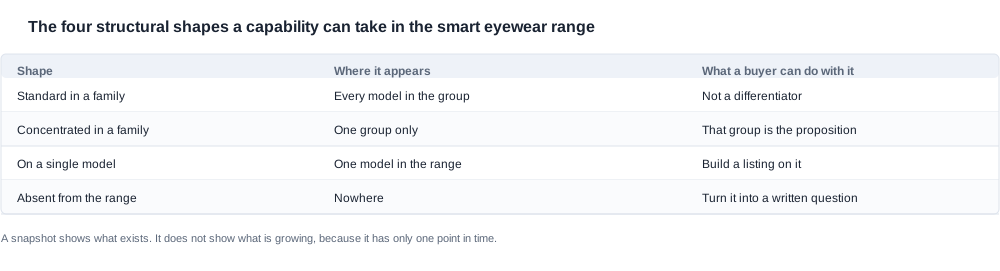
Within a catalogue, a published capability takes one of four shapes, and each shape implies a different thing for a buyer who wants to specify it, extend it or drop it.
Shape one: the capability is standard across a family. A field appears on every model in a group, so it is not a differentiator and it is not a decision point. A cell configuration published across a family, a charging method published across a family, a radio version published across a family — these are the fields on which the models in that group are simply like each other, and a specification built on them is built on nothing. The exception is when the family is not internally uniform, which is common: the same family can carry a magnetic interface on most models and a Type-C interface on a couple, and then the interface becomes a decision point again.
Shape two: the capability is concentrated in one family. A field appears across a family and on no other, which means it is that family's proposition. A remote photo control row sits on two sport models and on no audio model; a photochromic lens row sits on one camera model; a removable inner frame appears on two camera models along with the only ingress markings in the range. A buyer reading this shape should understand two things at once: the capability is real and available, and the models that carry it are competing against each other rather than against the rest of the range.
Shape three: the capability sits on a single model. The field appears once in the whole catalogue, which makes it a single-model proposition and a possible point of differentiation for a channel that wants one. The photochromic lens row on one camera model, the remote-control row where only two models carry it, the published weight on one model, the published case capacity on some camera models and not others — these are the fields where a listing can be built on a difference that the rest of the range does not have. The commercial question for each one is the same: can the capability be extended to a second model, and what would that cost in engineering and in documentation?
Shape four: the capability is absent from the range. Some things are simply not there, and a buyer who has assumed they are will be disappointed later. The range publishes no touch control row for any model. It publishes no ingress marking for any model outside the two that carry one. It publishes no charging method row for four camera models. It publishes no radio version for the camera models or for two of the children's models. It publishes no acoustic figure anywhere, no microphone specification anywhere, and no frame weight anywhere except the single published case.
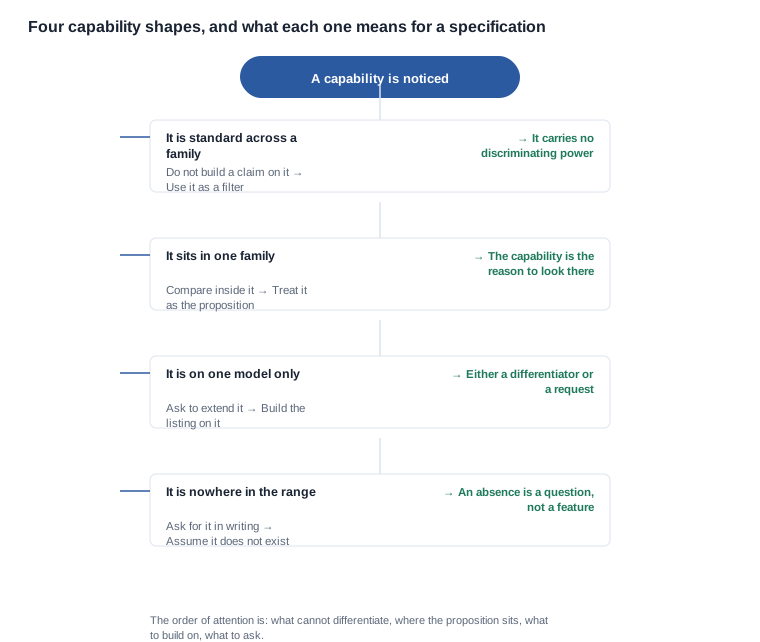
The four shapes are worth a buyer's attention in a particular order. The first shape tells you what you cannot differentiate on. The second tells you where a family's proposition lives. The third is where a listing can be built. The fourth is the list of things to ask about, and it is the longest of the four, because an absence is always a question rather than an answer.
Reading the present configuration as a direction of travel
Once the four shapes are separated, the configuration can be read as a direction of travel with a fair amount of care, and the care is in the verbs.
The honest verbs are these. A capability that appears across a family is one the factory is equipped for, and equipping is a decision that costs money and takes time, so the capability is likely to be available in a different model if you ask. A capability that appears on a single model has been built once, which means the engineering exists and a second application is a smaller piece of work than the first. A capability that is absent everywhere has either never been built or never been published, and those two cases are answered by different questions.
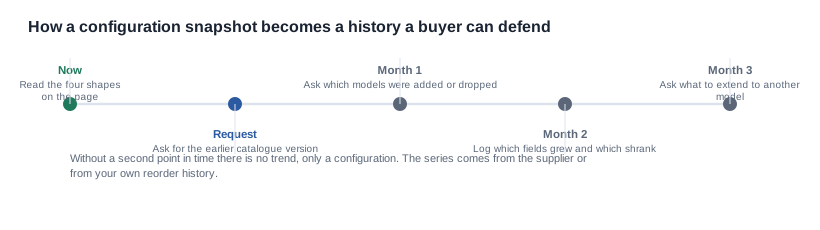
The verbs to avoid are "becoming", "emerging", "growing" and "replacing". Each of them describes a movement between two points in time, and the catalogue provides one point. A buyer who wants to use a trend argument has to supply the second point from somewhere, and there are only three honest places to get it: an earlier version of the catalogue, the supplier's own record of what has changed, or the buyer's own reorder history. All three are worth asking for, and all three are worth keeping, because a range review that can point at a series is a far stronger document than one that points at a list.
The way to use the configuration reading is in a specific place: the specification. A capability that exists in the range is one you can require in a quotation for a different model, and requiring it is how a configuration reading turns into a commercial lever. If a charging case with a published capacity exists for one model, then a case for another model is a request rather than a fantasy. If a feature row exists for a model in a family, then a feature row for a sibling is a request rather than a new development. The distinction sounds obvious and it is regularly lost, because the factory's default answer to any such request is that it is not something they do.
Two things follow from that, and both are practical. The first is that the request should be made at the specification stage rather than after a sample has been approved, because the sample approval is usually the point at which the configuration is frozen. The second is that the request should be specific about what is being asked — the model it applies to, the field that should exist on the page, and the documentation that would change with it — because "can you add a case to this model" is a question about possibility, and "publish a case capacity for this model and change the box contents line" is a question about specification.

Smart eyewear range category trends: the questions that turn a snapshot into a history
The questions below are the ones that actually convert a catalogue reading into a trend argument, and they are worth sending in writing because the answers are the series that the catalogue does not contain.
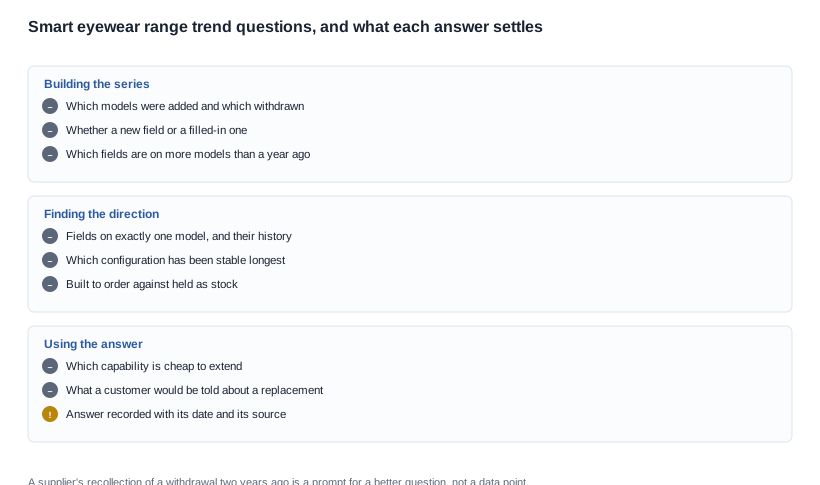
- Which models were added to the range in the last twelve months, and which were withdrawn?
- For each model added, was a new field published, or was an existing field filled in on a model that already existed?
- Which fields are published on more models now than they were a year ago?
- Which fields appear on exactly one model today, and were they on two models a year ago?
- Which published rows have not changed in a year, and which configuration has been stable the longest?
- Which models are being built to order rather than held as stock, and did that change?
- Which published capability would you extend to another model if a customer asked for it, and what would that involve?
- What is the current state of the models you have stopped quoting, and why?
- Which of the fields you publish for us are your fastest-moving configurations, in the sense that they change most often?
- What would you tell a customer who asks whether a model is being replaced?
Questions one, two and three build the series; questions four and five find the direction inside it. Question seven is the one that turns the whole exercise into a commercial instrument, because it identifies which capabilities are cheap to extend and which are not. Question ten is the one a buyer should be most careful about, because "is it being replaced" is a question whose honest answer is often about the supplier's commercial intent rather than about the product, and an answer that is read as a promise is a problem later.
The answers will be indicative, and they should be recorded with the same care as any other supplier statement: who answered, when, for which market, and against which model. A supplier's memory of what was withdrawn two years ago is not a series; it is an anecdote, and it is useful as a prompt for a better question rather than as a data point.

How to use a capability reading in a shortlist
A configuration reading is only worth the effort if it changes something, and the something it changes is almost always the shortlist. The mechanics of that are unglamorous, which is probably why they get skipped.
The first step is to write down the capability that matters to the requirement, in one sentence and without naming a model. The second is to find every model in the range that carries it, and to write the list down as a list rather than as a shortlist, because a list can be compared and a shortlist cannot. The third is to mark which of the models in that list differ from each other in a published field, and to drop the ones that do not — those are the models where the only difference is in rows a customer cannot see, and they are the ones that turn a range into a catalogue of near-duplicates. The fourth is to read the four shapes over the survivors, which tells you whether the capability is a family standard, a family proposition, a single-model differentiator, or an absence to be asked about.
From there the questions to ask have a specific form, and the form is what makes them answerable. "Can you add a case to this model" is a question about possibility, and the answer will be a discussion. "Publish a case capacity for this model, change the box contents line, and tell me what documentation moves" is a question about specification, and the answer will be a line in a quotation. Which questions to ask is a trade-off worth deciding deliberately: a question about possibility is cheap to ask and expensive to resolve, while a question about specification is more work to write and usually closes faster.
Three red flags are worth keeping in view during this work. A shortlist assembled from a family rather than from the requirement is a list of what exists, not a list of what fits, and the two are different documents. A capability request made after a sample has been approved is a change order against a frozen configuration, and the cost of that is usually higher than the capability itself. And a capability described in a way the published rows do not support — an acoustic claim, a conditions claim, an outcome claim about a child's eyes — is a claim that will be checked by a customer rather than by you, and the check will happen at the worst possible moment for the relationship.
The criteria for signing a shortlist off are short enough to write on one line, and they are worth writing before the shortlist goes out rather than after it comes back: every model on it has a published field that answers the requirement, every difference between models on it is a difference the requirement cares about, every absent field has a question attached to it with a named owner, and every capability request names the model, the field and the documentation it would change. A shortlist that meets those four criteria is one that a factory can quote against, which is the only test that matters before money is committed.
Where a trend claim would be fabrication, and where it is legitimate
The test for a legitimate claim is simple: it can be checked by someone else against a document. A statement about which models publish a remote photo control row passes, because a reader can go to the pages and count. A statement that a feature is "spreading through the range" fails, because "spreading" describes a movement the reader cannot see. A statement that a capability is "standard in the sport family" passes if the reader can verify that every sport model in question carries the row, and fails if it is used to describe the whole range.
The second test is about the subject of the claim. A claim about the factory's own direction of travel is legitimate, and it is usually useful: a factory that has published a capability on one model has the engineering, and a capability it has published across a family has the tooling. A claim about the market's direction of travel is not legitimate here, and it is the claim that most often appears in a range review, because it is the one that sounds like strategy. It would require data that this material does not contain.
There is also a third category to be careful with, which is the claim about the buyer's own market. A buyer with a reorder history can legitimately say that a requirement is growing for them, that a configuration is selling out faster than another, or that a customer keeps asking for a capability that no model in the range carries. Those are real statements about real data, and they are the most useful ones a range review can contain — and they are also the ones most often left out of a review that spends its time on the catalogue instead of on the operation.
What we will do with any of this is read the configuration with you and tell you, field by field, which shape each capability takes. What we will not do is tell you that a family is growing, that a model is about to be replaced, or that a feature is about to become standard, because the published material cannot support a sentence of that kind and we would be inventing the evidence along with the claim.
Tell us which capability you would like to see extended to another model, and we will come back with the published rows that already exist in the range so you can ask for it as a specification rather than a request.


