

Mixing categories means putting more than one kind of product into the same order, and the reason a buyer wants to do it is straightforward: one shipment, one supplier relationship, one set of commercial terms, and a broader range to sell. The reason it goes wrong is equally straightforward and much less visible in advance. A mixed order does not contain a mix of products. It contains several products, each with its own rows, its own packaging, its own file set and its own customer expectation — and the order's real cost is the number of objects that have to be managed inside it, which grows with the number of lines rather than with the number of units.
This page is about what the published rows tell a buyer about whether a particular mix will hold together, and about the order structure question that has to be answered before the mix is priced.
Smart eyewear range mixing categories: one order, several products
The distinction at the centre of this subject is between a mixed order and a mixed range, and buyers routinely intend one and get the other. A mixed range is a catalogue that contains several kinds of product and treats them as one story to the customer: one brand, one website, one promise. A mixed order is a purchase that contains several kinds of product in one transaction. The first is a marketing decision and the second is a logistics one, and they can be run independently — a channel can have a focused range and still buy two kinds of product, and it can have a wide range and buy from one family.
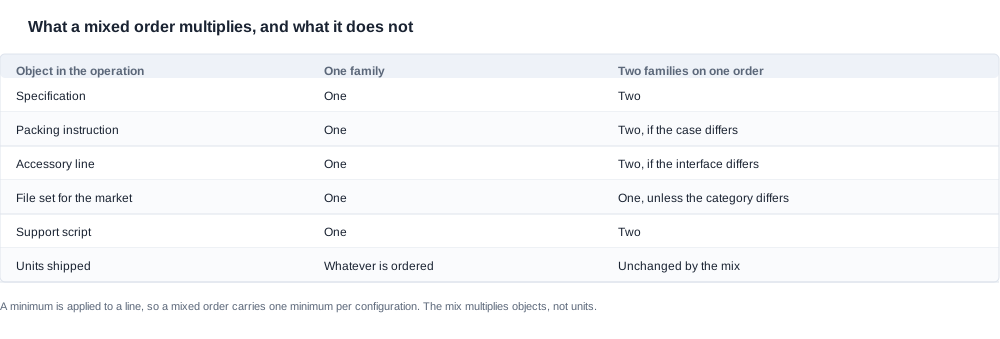
The confusion matters because the costs attach to the order, not to the range. A single-family order is one specification, one packing list, one accessory line, one support script, one set of documents for the market, and one set of expectations to manage. Add a second family to the same order and every one of those items is now plural, while the revenue is still per unit. Nothing in the published specification of either product changes. What changes is the number of things the operation has to keep straight, and that is the number that decides whether the mix is worth doing.
This is also why the question of whether to mix at all is a commercial question rather than a technical one. Two products that are perfectly compatible in a customer's hand can still be a bad combination in one order, and the incompatibility is rarely in the hardware. It is in the accessory, in the box contents, in the documentation set, in the listing copy that has to describe both without confusing the customer, and in the support script that has to answer a question about one of them without being wrong about the other.
The four dimensions on which mixes fail are worth naming in advance, because each of them has a fix that is a decision rather than a purchase.
The accessory dimension. Two products in one order that charge differently mean two accessory lines, two sets of spares and two replacement habits for the customer. Two products that charge the same way, into the same kind of interface, can share a spare stock and a support answer. This is a published fact rather than a judgement: the range contains models charging magnetically and models charging over Type-C, and the two are not interchangeable in a customer's pocket even when the hardware is otherwise similar.
The box-contents dimension. The position of the charging case differs across the range in four distinct ways — a published capacity on some models, two capacities on one, a case with no published capacity on others, and no case row at all on the rest. A mixed order that includes models from different parts of that distribution has a packing list that is not one packing list, and a warehouse that has been told to expect one will get it wrong.
The documentation dimension. This is the dimension with the most weight and the least attention, because it is invisible until it is the thing blocking a shipment. Models in different parts of the range attract different file sets, and the one that differs most sharply is the children's group, where the requirements are set by the destination market and the age band rather than by the product alone. A mixed order that includes a children's model is not simply an order with a more complicated product in it; it is an order with a second compliance determination in it, and that determination has to be made by the buyer's own compliance function before the order can be placed, not after.
The expectation dimension. Two products in one shipment will be compared by the customer, whether or not the channel intends it. If one of them publishes a remote control and a fast charge and the other publishes neither, the customer concludes that the cheaper-feeling one is the inferior one — and the channel has created a comparison it then has to manage.

Why a mixed order multiplies objects rather than units
The arithmetic of a mixed order is worth doing explicitly, because it is the part that surprises buyers. A single-family order carries one specification, one packing list, one accessory line, one documentation set, one support script and one set of customer expectations. Each additional family in the same order adds one of each of those, and the additions are close to fixed costs rather than proportional ones: a second packing list does not get cheaper with volume, and a second documentation set does not halve because the order is large.
There is a second multiplier that is not obvious and that is usually larger than the first. A minimum order quantity is applied to a line, and a mixed order with three configurations is three lines. So the smallest mixed order a buyer can place is the sum of the smallest order each configuration can accept, and that is the number that surprises people who assumed the minimum was a property of the supplier rather than of the line. It is also the number that decides whether mixing is sensible at all in a first year: a mix that is commercially attractive in units can be commercially impossible in a first order.
The third multiplier is the one that does not show up on any sheet. Each family in a mixed order brings its own open questions. A model whose page does not publish its charging method, or its radio version, or its case position, contributes questions that have to be answered before that line can be placed, and the questions do not share answers with the other lines. A mixed order with one well-documented model and one thinly documented model is not a mixed order where the thin one is easier — it is a mixed order where the whole shipment waits on the thinner documentation, because the shipment is the shipment.
None of this makes mixing a bad idea. It makes it a decision with a cost, and the cost is knowable in advance if it is counted in objects rather than in units.

The published rows that decide whether a mix works
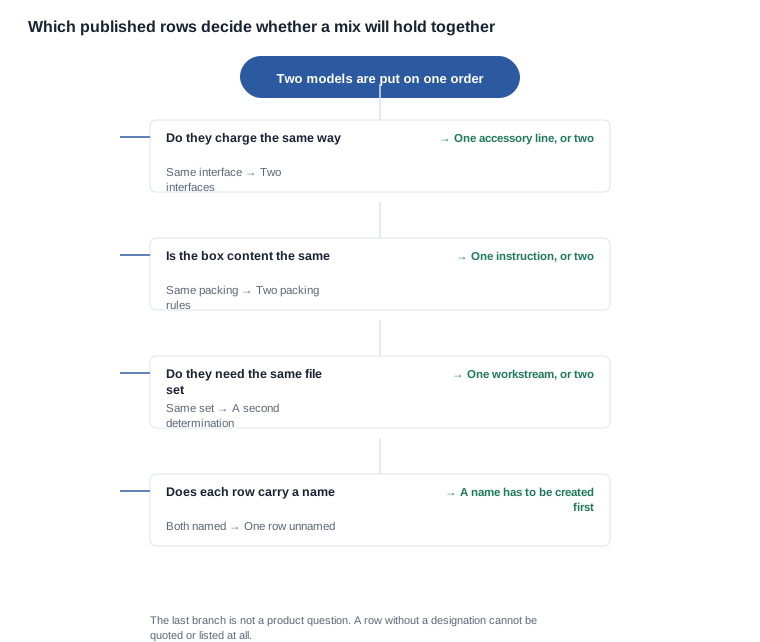
The published rows are unusually helpful here, because the question "will these two products live together in one order" is answerable from the pages rather than from a sample. Three comparisons settle most of it.
- Charging interface and accessory. If the two models charge by the same method, the accessory line can be shared, the spare stock can be shared, and the customer has one charging habit across the order. If they do not, the order carries two. This is the cheapest thing to check and the one with the clearest effect on the operation.
- Box contents. Whether the case is present, absent or published only in part decides whether one packing instruction or two are needed, and whether the shelf and the return process have to treat the products differently. A mix of a model with a published case and a model with no case row is a mix with two box instructions.
- Documentation set. Whether the two models attract the same file set for the destination market decides whether one compliance workstream or two is needed, and how much of the order is blocked while each one is assembled. The sharpest difference in the range is between a general product and one intended for children, and it is not a difference of product type so much as a difference in how the market and the age band determine the requirements.
There is a fourth check that is not about the products at all, and it is the one that decides whether the mix is even a candidate: whether every model in the order has a designation that can appear on an order line. A row without a model name cannot be quoted, cannot carry a minimum and cannot be listed, so a mix that includes one of those rows is not a mixed order until the factory has agreed to create a name for it.

Smart eyewear range mixing categories: the order structure question
The structure question comes before the pricing, and it has more options than a buyer usually considers. A mixed order can be one shipment with several lines, several shipments handled as one commercial arrangement, or one physical shipment that is assembled from several production runs. The three have different consequences, and they are not equivalent in cost.
One shipment with several lines is the simplest to arrange and the most expensive to manage, because everything arrives together and everything has to be sorted on arrival. Several shipments against one commercial arrangement gives the factory the freedom to sequence production and gives the buyer a simpler receiving operation, and it is usually the better answer for a first mixed order, because a mixed order that arrives in parts can be corrected in parts. One physically assembled shipment is the version a customer receives as a single box, and it is the one that requires the packing work to be designed rather than inherited.
The question worth asking the factory is therefore not "can you ship these together" but "can you hold them as one order with separate lines, and what does the receiving and packing look like on your side as well as ours". A factory that answers with a single delivered shipment has answered the easier half of the question, and the harder half is the one that decides whether the mix is workable.
Two further questions belong in the same conversation. What happens to the order if one of the lines is not ready — is the whole shipment held, or does the rest go? And what happens to the documentation if one line needs a determination that the others do not — is the file set assembled per order or per model? A mixed order that is held together because of one line, and a mixed order whose file set is assembled as one bundle rather than per model, are both operations that a buyer should know about before placing the order rather than after.
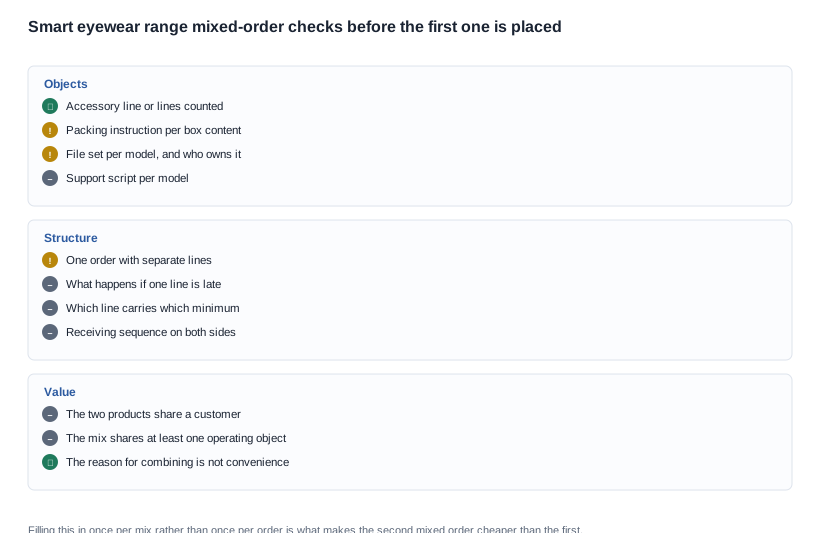
The practical form of this is a short list that has to be filled in before the order is placed, and it is worth keeping per mix rather than per model: the accessory line or lines, the packing instructions, the documentation sets and their owners, the support scripts, the line structure and the minimum that applies to each line, and what happens when one line is late. Filling it in once per mix rather than once per order is what makes a second mixed order cheaper than the first.

The order of that work matters as much as the content. Reading the pages comes first, because everything else depends on what the pages actually say and not on what the products are assumed to be. Marking the shared objects comes second, and it is the step that turns a list of models into a decision, because the count of shared objects is the count of things the mix does not double. Marking the multiplied objects comes third, and this is where the real cost of a mix appears, because the multiplied objects are the ones that consume time rather than units. The order structure is decided fourth, once the operation's shape is known, since the right answer to the structure question depends on how many objects are being carried. The late-line question is asked fifth, and it is the question that reveals whether the factory treats the order as one thing or as several things it happens to ship together.
Where mixing pays and where it quietly costs
Mixing pays in three specific situations, and the reason they work is that the objects are shared rather than multiplied. The first is when the products share a charging interface, so one accessory line serves both. The second is when the products share a customer and a use — a customer who buys one of them and then wants the other — in which case the mix increases the value of the relationship without adding a new accessory, a new packing instruction or a new compliance determination. The third is when the channel is deliberately running one story across several products, in which case the mix is what makes the story credible.
Mixing quietly costs in the opposite situations, and the pattern is consistent: it costs when the mix adds objects without adding relationship. Two products with different charging methods, different box contents and different file sets, sold to different customers with no overlap, add a second of everything and add nothing to the value of either. That kind of mix is the one that turns a first order into a project and a second order into a negotiation.
The decision criteria are therefore short, and they are about the mix rather than about the products. A mix is worth making when the products share at least one operating object and one customer. A mix is worth making when the second product sells to somebody who already bought the first. A mix is worth making when the order can be structured as one order with separate lines, so that a late line does not hold the rest. And a mix is not worth making when the only reason to combine them is that the supplier happens to offer both.
The criteria work as a shortlist test as well as a decision test, and using them that way is what keeps a mixed programme from becoming a mixed mess. Before a model is added to a mix, the question to ask is which of the four dimensions it would duplicate, and whether the duplication buys anything: a second accessory line that the same customers will use, a second packing rule that the same warehouse will apply, a second file set that the same compliance owner will produce, a second support script that the same team will read. A model that duplicates three of those and serves a different customer is not an addition to the programme, it is a second programme with a shared invoice.
There is a trade-off here that a buyer should make consciously rather than by default, and it is a trade-off between breadth and depth rather than between two products. A wide mixed programme gives a channel more to sell and more opportunities to sell a second item to the same customer; it also gives the operation more objects to manage and more ways for a single missing document to hold up a shipment. A narrow programme is easier to run and easier to describe, and it gives a customer fewer reasons to come back. Which of those matters depends on the channel and the season rather than on the catalogue, and the catalogue does not publish anything that would settle it.
There is a version of this that is worth stating for a customer-facing buyer, because it is the version that is easy to get wrong. A catalogue that mixes several kinds of product is not a mixed order, and the number of products in a catalogue says nothing about whether the operation can supply them together. The published rows are what tell a buyer whether a particular combination is workable, and they are checkable today, on the page, before anybody has committed to anything.
It is also the version that is easiest to oversell internally, because a mixed range looks like a growth plan and the pages do not support the conclusion. A channel that has six kinds of product and cannot supply two of them together on one order does not have a wide range; it has a wide catalogue and a narrow operation, and the difference shows up in the first mixed order a customer asks for. The criteria for whether a mix works are the ones above, and they are checkable before the first order is placed, which is the only time checking them is cheap. A buyer who wants to know whether a particular requirement is common in the trade should look at the demand dimension instead — how often the requirement is asked for at all, and how it is usually phrased — and that is a different question with different evidence behind it.
What we will do with a proposed mix is read the pages of the models in it and tell you, field by field, where the combination is shared and where it multiplies. What we will not do is recommend a combination, or claim that a mixed order is cheaper than two separate orders, because the published material contains no price, no freight and no minimum-order data from which such a comparison could honestly be made.
Tell us which models you are thinking of putting on one order, and we will return the published rows of each of them side by side, so you can see which parts of the operation a mix would share and which parts it would double.


