
Popularity is the second demand question a buyer brings to a range, and the answer here has to be shaped by what the catalogue actually contains. There is no popularity figure, no unit-shipped number, no revenue split and no ranking to work from, so a list of popular categories in this range would be an invention with a confident voice. What the catalogue does offer is a different kind of signal: which questions buyers and channels actually bring, grouped by the requirement behind them. That is a demand dimension rather than a demand measure, and it is useful precisely because it is honest about itself.
The pages around this one cover the demand questions from the measurement side — what you can build from your own enquiry log, and what a supplier will and will not tell you. This page works from the question side: what buyers in this category are asking about, and what the range can and cannot answer for them.
Smart eyewear range popular categories: the questions behind the category names
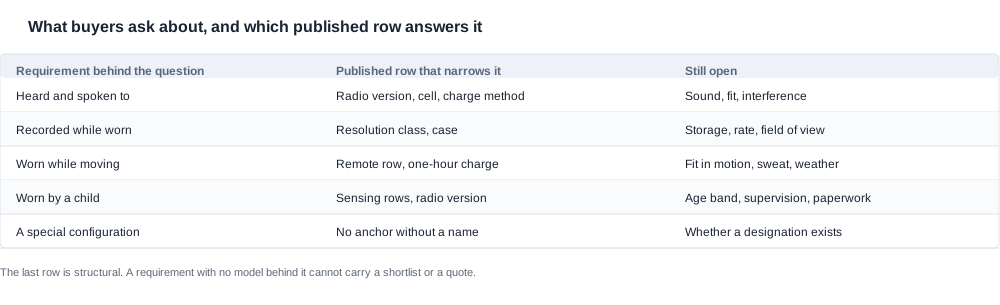
When a buyer says they want a popular category, they are usually describing a situation rather than a product. They mean a category that people ask about, a category they have heard is wanted, a category where the question comes up in conversation. Strip that back and the request is usually one of five underlying requirements, and each one lands in a different part of the range.
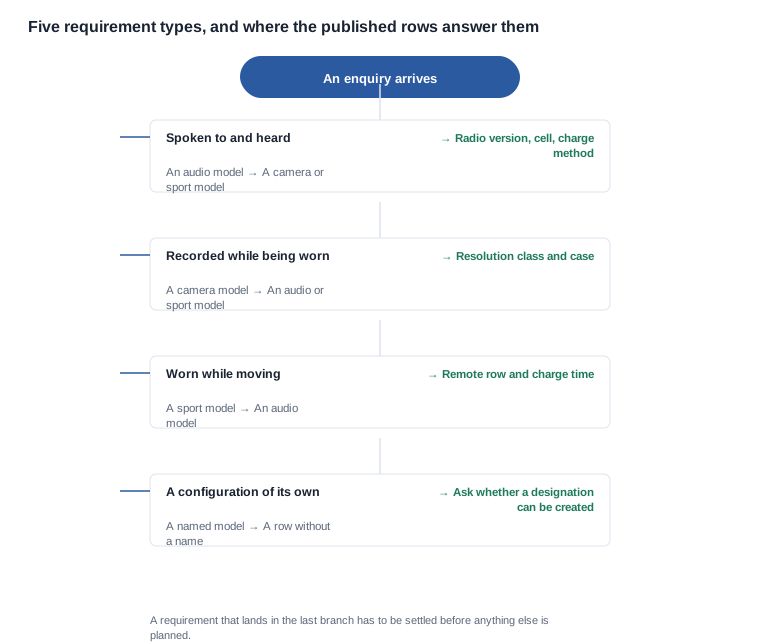
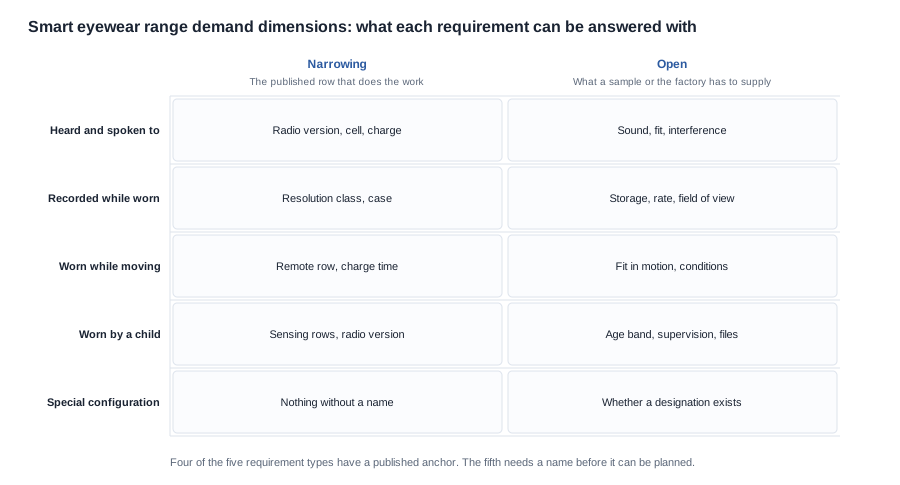
The requirement for something to be heard and spoken to. This is the audio requirement, and it arrives as "something like the open-ear glasses" more often than as a model name. The published rows that answer it are the radio version, the cell configuration, the rated use and the charging method. What the range does not answer is the half of the question that matters most in a showroom — how it sounds, how it fits, whether the customer's glasses or hearing aids interfere with it. Those are questions for a sample, and they are the reason a buyer looking for the most-asked category in the range is still a buyer who needs a sample.
The requirement for something to record. This is the camera requirement, and it arrives as "wearable" or "hands-free" more often than as "camera glasses". The published rows that answer it are the resolution class, the cell, the rated use and the case. What the range does not answer is where the footage goes, how long a recording runs before it has to be moved, what a frame rate is, and what a field of view looks like. The case in particular is a published variable within the camera family, and a buyer who has assumed a case will be present in every configuration is working from a wrong assumption.
The requirement for something to wear while moving. This is the sport requirement, and it has the most specific published shape in the range. Two of the three sport models publish a remote photo control row that no audio model publishes, two of them publish a charge time of about an hour that no other model in the range publishes, and all three publish a surround-sound row. A buyer whose requirement is "for running" is usually buying a combination of those three published features, and the range lets that combination be specified precisely.
The requirement for a child. This is the children's requirement, and it is the one where the published rows are the least like a consumer specification. Two of the three models publish sensing rows about posture and distance and lens states, and the third is an audio model with a radio version and no sensing rows at all. The requirement behind the question is almost always about a parent wanting feedback, and the range describes the mechanism rather than the outcome.
The requirement for a special configuration. This is the least frequent of the five and the most commercially valuable per enquiry, because it usually arrives with a specific constraint attached: a lens, a mount, a partner device, a colour, a market. The catalogue's unnamed rows — the AR entry with its indicator light and button control, the photochromic entry, the bone-conduction entry with its published amplification gain — sit close to this requirement, and each of them raises the same first question, which is whether it can carry a model designation at all.
What the breadth of a family tells you, and what it does not
There is one signal in a catalogue that is routinely treated as a demand signal and should not be. The width of a family — how many models sit in it — is a statement about the manufacturer's configuration and documentation work, and a buyer who reads it as a statement about customer interest will make a predictable mistake. The interesting part of a wide family is not that it is wide. It is that its members differ in ways that a listing can be built on, and that the differences are published.
The published rows make the differences legible in a way that is unusual for a catalogue. A model that publishes a feature row and a model that does not are different products, and the difference is visible on the page. A model with a published case and a model whose page has no case row are different products, and the difference is visible. A model with a colour line and a model without one are different products. What is not visible is which of them a customer wants, and no amount of reading will produce that.
So the honest reading of a wide family is that it offers more distinct propositions, not that it sells more. A channel with the capacity to test several propositions may prefer a wide family precisely because it is wide; a channel with one listing slot may prefer a narrow one. That is a decision about the channel, and it is worth making explicitly rather than letting the catalogue's shape make it silently.
There is a second thing about breadth that is worth separating out, because it is genuinely useful. In a wide family, the models that publish almost nothing are the cheap ones to evaluate and the hardest ones to write about, and the models that publish a lot are the expensive ones to evaluate and the easy ones to write about. A buyer who wants a quick evaluation should start with the bare rows, because the questions are few; a buyer who wants a proposition to sell should start with the rows that carry a descriptor, because the story is there.
That split also gives a practical way to plan a listing portfolio, which is the real decision a wide family offers. Two or three models with distinct published descriptors can support a channel that wants to test propositions, because each one can carry its own page and its own comparison, and because the differences between them are the ones the catalogue itself makes. The same wide family also contains a long tail of rows that differ only in ways a customer cannot see, and those are the listings that dilute a catalogue and consume support time without adding a choice. The test for whether a model earns a page is not whether it sells — nobody knows that here — but whether it can be described differently from its siblings using fields the factory has already published.

The demand dimensions the range can support and the ones it cannot
Pulling the five requirement types together produces a useful division, and it is a division by the kind of answer the range is able to give rather than by the size of any group.
Four of the five requirement types have a published anchor. The audio requirement has a radio version and a charging method to specify against. The camera requirement has a resolution class and a case configuration. The sport requirement has a remote control row and a charge time that appear nowhere else. The children's requirement has sensing rows and a clear distinction between the model that publishes a radio version and the two that do not. For all four, the published material narrows the field, tells the buyer which models differ from which, and hands over a specific list of questions.
The fifth has no anchor at all, and the reason is structural rather than an oversight. A requirement for a special configuration needs a model to be specified against, and the three rows without a designation cannot carry a shortlist, a quote line, a minimum or a forecast. A buyer whose requirement lands there has to establish, before anything else, whether a designation can be created for it. Everything else about that requirement — the specification, the documentation, the price, the schedule — follows from the answer, and none of it can be planned until the answer exists.
That is the sharpest limit in the range and it is worth stating to a customer who has sent a "popular category" enquiry with a special configuration attached, because it changes what the next two weeks of the conversation look like. The answer may well be yes. It is simply not in the catalogue, and the buyer should be told so at the start rather than at the point where the quotation is supposed to arrive.

How each demand dimension fails in practice
Every requirement type has a characteristic failure, and in each case the failure comes from writing a conclusion where the catalogue publishes a mechanism. Naming them in advance is worth more than a general warning, because a buyer who knows where a particular enquiry will go wrong can prepare the answer for it.
The audio enquiry fails through an acoustic claim. The range publishes a radio version, a cell configuration, a rated use and a charging method for its audio models, and it publishes no acoustic figure for any of them — no output power, no driver description, no frequency range, no microphone specification. So the listing carries numbers, and the sound has to be carried by the sample and by whatever the buyer observes on it. The enquiry that says "the one people say sounds good" is asking for a conclusion the catalogue cannot support, and the useful response is to ask what the customer is going to listen to, in what environment, and whether they wear anything on their ears or their face that might interfere.
The camera enquiry fails through a storage assumption. The resolution class is published, and almost nothing else about the imaging chain is. A buyer who assumes the footage goes somewhere automatically, or that it is held indefinitely, is assuming a behaviour the page does not describe, and the assumption shows up later as a lost file rather than as a missing feature. The question to put with the sample request is simple and it is the one that decides whether the product is usable in the customer's workflow: what happens to a recording once it has been made.
The sport enquiry fails through a conditions claim. The sport models publish a remote photo control row and, on two of them, a charge time of about an hour that appears on no other model in the range. They do not publish an ingress rating, and in the whole catalogue only two camera models carry one, so a listing for a sport model cannot say anything about sweat, rain or water. The enquiry that arrives as "for running, and it rains where I run" therefore has a published half and an unpublished half, and the unpublished half has to be answered by a written document from the factory rather than by a line of listing copy.
The children's enquiry fails through an outcome claim. The published sensing rows describe posture and distance conditions and two lens states, and a fogging unit. They describe a mechanism, and the temptation is to write them as a benefit about a child's eyes. Nothing in the published material supports that, and the correct framing of the requirement is a supervision routine rather than an outcome. This is also the enquiry where the paperwork has to be settled before anything else moves, because the documentation required for a product in that category is set by the destination market and the age band, and neither of those is published here.
The special-configuration enquiry fails through an assumption that a row is orderable. A row without a model designation cannot be quoted, cannot carry a minimum and cannot appear on a purchase order line. Until the factory confirms that a designation can be created, the requirement is a conversation, and the honest thing is to say so at the start.
How to turn an enquiry into a shortlist without guessing
The practical sequence for a buyer handling these enquiries is short, and it is the same sequence whether the enquiry arrives as a model name or as a situation.
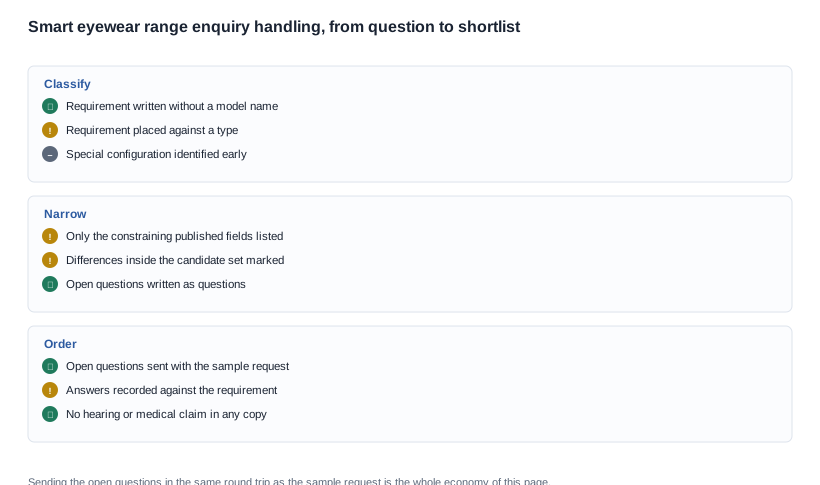
- Write the requirement in one sentence, without using a model name, and check that it lands on one of the five types above. If it does not, it is a special configuration and the first question is about a designation.
- List the published fields the requirement actually constrains, and ignore the rest of the row for now.
- Identify which published fields inside the candidate set differ between models, because those are the fields the enquiry will be judged on.
- Write the two or three questions that the published material cannot answer, and send them to the factory with the sample request rather than before it.
- Record what came back, so the second enquiry on the same requirement starts from an answer rather than from the beginning.
The fourth step is where the value sits, and it is a matter of sequencing rather than of effort. A buyer who sends the open questions together with the sample request gets the answers in the same round trip, and the sample is tested against a specification that already has its unknowns filled in. A buyer who waits for the specification to be complete before asking anything has sent two round trips and has tested a sample against nothing in particular.
The fifth step is the one that pays off over a season rather than over a quarter. An enquiry log that records the requirement sentence, the requirement type, the models proposed, the questions sent, the answers received and the outcome turns into a structured history after a few months, and that history is worth more than any number the catalogue could publish, because it is specific to your channel and your buyers. It also does something the catalogue cannot: it shows which of the published fields a customer actually asks about, which is the closest thing to a popularity signal that a buyer can own, because it is measured against the fields the factory chose to publish in the first place. The trap to avoid is collecting the history and not using it — a log that is never read at shortlist stage is a filing exercise, and the whole value sits in reading it every time a new requirement arrives.
One caution about the most-asked requirement of all, because it is the one where enquiries are most often answered in a way that later becomes a dispute. When a customer describes a hearing-related use, the published rows in this range support a bone-conduction model with a published amplification gain, and they support an audio model with a radio version. They do not support any statement about a person's hearing, about treating a loss, or about the product being an assistive or medical device. A channel that takes the enquiry and answers it in those terms has not sold the customer what was published, and the correction happens later and publicly. The safer route is to answer the mechanism question — what the unit does, what it is specified as, what has to be confirmed before anyone relies on it — and let the customer draw their own conclusion about their own situation.
What we will not do with this material is rank the requirement types by how often they are asked. We do not publish enquiry counts, order volumes or any other frequency figure, and we would have to invent the numbers to produce such a ranking. What the range does support is the mapping above: a requirement type, the published fields that narrow it, and the questions that close the rest. That mapping is stable, it is checkable against the catalogue page by page, and it is the part of a popularity discussion that a buyer can actually act on.
A last note on the shortlist criteria, since a shortlist is where this material becomes a decision. The criteria worth writing down are short: the published fields the requirement constrains, the fields inside the candidate set that differ, and the open questions that have to be answered before a sample is judged. The red flags are equally short — a requirement that names a model instead of a situation, a candidate set assembled from a family rather than from the requirement, and an open question that has been answered in a meeting rather than in writing. Deciding those three before the shortlist is circulated is what keeps a range review from turning into a preference survey, and it is what makes the resulting order defensible when the first batch comes back with something nobody expected.
Tell us the requirement in your own words, with no model name in it, and we will return the published fields that narrow it together with the questions that have to go to the factory before a sample is ordered.


