

The AI line on a smart glasses quotation is the cheapest line in the document and the most expensive one to get wrong. In this category the capability is usually named, folded into the unit price, and then never specified: no model, no language list, no latency figure, no statement about what survives when the signal disappears. A buyer who accepts that description ends up defending a product claim they cannot evidence. This article is the map of the category — the supplier shapes, the five dimensions that separate them, and the eight questions that convert a catalogue line into something a contract can hold.
Smart glasses AI features: three supplier shapes behind every quotation
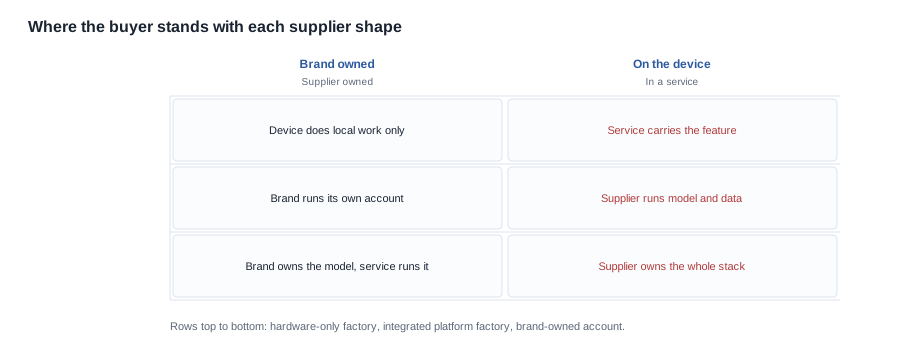
An AI capability can reach your product through three quite different arrangements, and the arrangement decides the cost model, the contract structure and the failure mode long before anybody compares two units on a spreadsheet. The difficulty is that the feature names are identical across all three, so a buyer comparing specifications alone cannot tell which arrangement they have been quoted.
The factory that builds the device and stops at the firmware boundary
This is the simplest arrangement and the one most catalogues describe. The factory assembles hardware, loads firmware and ships units. The AI capability is a feature of the platform, licensed or provided by somebody else, and the factory's involvement ends at the boundary of the firmware image. Nothing in the contract obliges anyone to tell you what happens when that boundary is crossed.
A buyer in this position can replace the factory without disturbing the feature, which is an advantage. The matching disadvantage is that the factory has no obligation to answer questions about the model, the latency or the data path, and will usually refer you to a partner. That referral is not a refusal, and treating it as one wastes a procurement cycle. The productive move is to ask the question in a form the factory can forward: which model, in which direction, measured how, and where the data is processed.
The factory that also operates the assistant platform
Here the supplier controls the model account, the backend and the companion application. This arrangement usually produces a lower unit price, because the per-device cost has been folded into the hardware, and a much higher switching cost, because the assistant is bound to that account and that infrastructure. The supported language list, the model behaviour and even the feature set can change under you, and the person who decides is not your procurement manager.
For a buyer this arrangement turns a specification problem into a contract problem. The question is not whether the assistant works but what happens on the day the agreement is not renewed, whether the supported function set can change without notice, and whether the firmware already shipped on your units will still find a service when it looks for one. Those three answers belong in the supply agreement, not in a sales email.
The brand that owns the application, the account and the data
In the third arrangement the intelligence is yours. The brand operates the application, holds the model relationship, decides the data path and answers to its own regulators. The factory's role reduces to hardware with a compute budget large enough to run whatever you decide to deploy.
This arrangement carries the highest upfront cost and the strongest long-run position, because nothing about the feature depends on a third party's continued willingness to serve. It also carries the obligation, and a buyer often underestimates how much of it lands on their own team: the privacy statement, the consent flow, the update client, the model evaluation, and the support script for a failure mode that has no hardware to inspect.
What the shape decides before the first sample arrives
Three things follow from the shape and all three belong in the request for quotation rather than in the negotiation afterwards. The first is the paper the answer will arrive on, because a factory that does not own the model will forward your question to somebody who does, and a question addressed to the wrong party comes back vaguer than it left. The second is the price structure, since a capability folded into the unit price behaves differently at ten times the volume than a capability billed per active user. The third is the exit, and the exit is what a buyer forgets: what happens to the units already in the field when the arrangement ends.
The three supplier shapes are worth setting out at this level of detail because they explain a pattern every buyer of this category meets. The same feature behaves like a specification problem in one arrangement and like a contract problem in another, and the questions that resolve it are different.
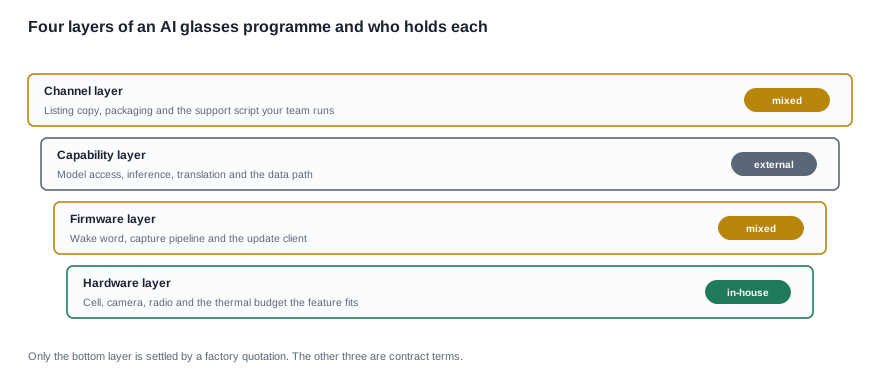
Five dimensions that decide which AI glasses family you can ship
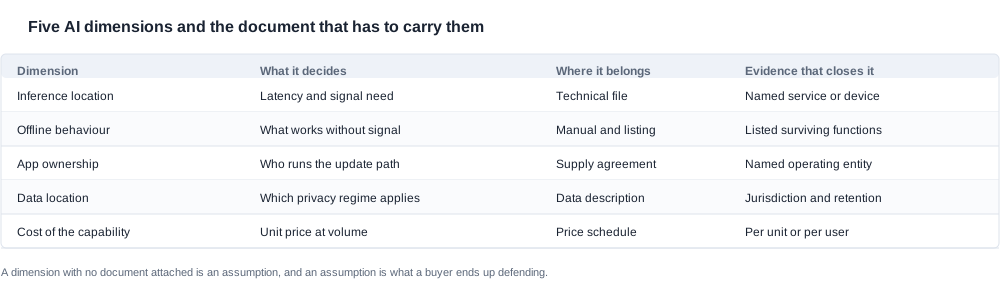
Every AI glasses programme is decided along the same five axes, and a quotation that answers none of them has not been compared with anything — it has only been received. The five are where the inference happens, what survives without a network, who operates the application, where the voice data lands, and how the capability is paid for. These are dimensions rather than preferences, which means two products can differ on all five while their datasheets look identical.
These five are the criteria for the whole selection. A buyer comparing two AI glasses quotations who works from a datasheet will compare cell capacity and camera resolution, both of which are settled facts, and will miss all five of the dimensions that the AI feature actually turns on. The practical use of the list below is as a screen: it tells you which questions have to be put in writing before the shortlist is worth building at all.
Where the inference happens
A capability processed inside the device behaves predictably: it needs no signal, it adds no latency, and it keeps the recording on the hardware. A capability processed in a service needs all three to go somewhere else. The answer determines your operating cost, your privacy exposure and the geography your product can be sold into, and it is the single answer with the widest consequences.
The honest difficulty is that a supplier may answer truthfully and still leave you with no usable specification, because "on the device" can describe a wake-word detector while the assistant itself runs remotely. The follow-up question is therefore always about the split: which part runs locally, which part leaves the device, and what the device does when the remote part is unreachable.
What survives with no network
The question has to be asked per function, because the honest answer is rarely uniform. Capture, playback and the wake word may continue while recognition, translation and summarisation stop. A product that degrades gracefully is a product you can describe accurately in a listing; a product that fails silently is a product whose support cost is set by your customers rather than by you.
This dimension decides which markets are realistic for the product. A warehouse, a basement, a flight and a market with patchy coverage are all places where the answer matters, and a buyer selling into those places needs the enumerated list of surviving functions before the order, not after the first review.
Who operates the application
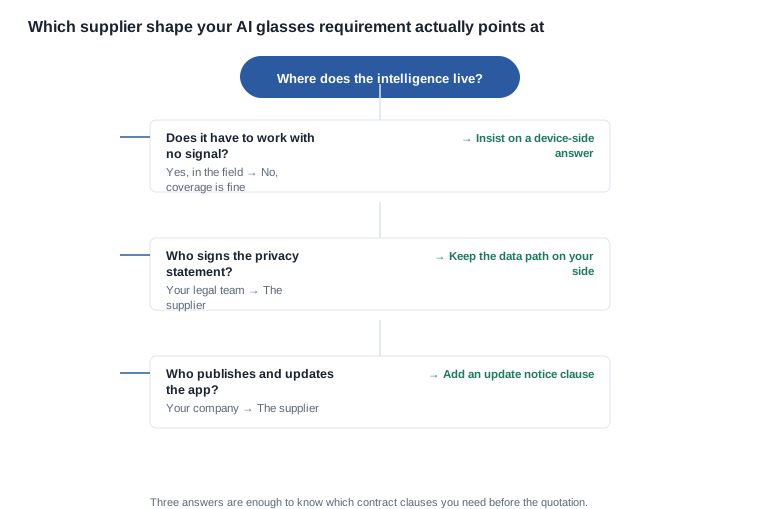
An application is a separate product with its own version cycle, its own store listing, its own privacy policy and its own running cost. In a private-label programme the application is frequently the part of the arrangement nobody discussed, because the hardware specification absorbed the conversation. Ask which company publishes it, who signs for its behaviour in each market, and what happens to the update path on the day that company decides to stop.
The termination question is the one that matters. An application the brand controls can be replaced. An application the supplier controls cannot be replaced without replacing the units.
Where the voice data lands
The second half of the processing question is jurisdictional, and it decides which privacy regime your product sits under. A device that processes locally has a short answer. A device that transmits has a long one, covering the operator entity, the processing location, the retention period and the transfer mechanism. Your compliance team will ask for the answer in writing, and the obligation to describe the data flow accurately in your own privacy statement sits with you regardless of who operates the backend.
The related question is whether the microphone can be disabled physically. A setting can be overlooked by a user and then discovered by a reviewer. A hardware control cannot be overlooked in the same way, and it is a materially stronger position in a market surveillance conversation.
How the capability is paid for
There are two questions here and buyers routinely ask only one of them. The first is whether the end customer pays, which is a product decision. The second is whether the brand pays, which is a cost-model decision and the one that determines whether the feature survives a volume increase. A quotation that bundles a per-active-user charge into a fixed unit price will not stay fixed.

The eight questions buyers ask, and what each one is really asking
Most AI enquiries arrive as eight recurring questions. Each is a reasonable question, and each one hides a second, sharper question that actually determines the answer. Learning to ask the second form is the difference between a slow procurement cycle and a settled specification.
The eight questions are worth sending as a numbered list in a single message, because a list produces a document and a conversation does not. A supplier who answers a list has a documentation habit, and that habit is worth more to a buyer than any individual answer inside it. The set of questions to ask, and the conditions each answer must carry, is what separates a quotation that can be evaluated from one that can only be admired.
Which models in the range carry the capability
The sharp question behind it is whether the capability travels with the hardware or with the account. The answer determines whether you can quote a customer one model and ship another, and whether a variant added later inherits the feature or does not. It is also the question that catches the most common listing error in this category, where an audio product is described with an assistant that only exists on the camera platform.
How to choose between the families once this is answered is a shortlist problem rather than a specification problem. The camera platform carries the assistant and the capture pipeline together, which is the only combination in the current catalogue that can serve a hands-free capture workflow. The audio platform carries translation and audio functions without a camera module, which is the combination a buyer serving a translation-led use case should examine first. Mixing the two in a single listing is the single most common commercial error we see, and it is the kind that is discovered by a customer rather than by a review.
Does it work without a connection
The sharp question is which functions continue, not whether the product works. A yes or no answer to this question is close to useless, because almost every real answer is partial. What you need is a list of functions and a state for each one, and that list becomes the degradation sentence in your listing.
Which languages, and in which direction
The sharp question is about pairs rather than counts. A figure of forty languages may mean forty one-way pairs or twenty two-way pairs, and the second reading is the one that decides whether the product works for the customer you are trying to win. You also need to know whether each pair is neural or lookup based, and whether it is available offline.
Is a subscription involved
The sharp question is what happens to the feature when the payment stops. A lapsed plan that removes the capability turns a customer into a defect case, and a lapsed plan that removes only the premium tier does not. One clause and one product page differ between those two outcomes.
Who owns the companion application
The sharp question is what happens to the update path on the day the agreement ends, and specifically whether the firmware already in the field can still find a service. This is the question that decides how expensive your exit will be, and it is the one to put in the agreement rather than the one to leave to goodwill.
What happens to the voice
The sharp question is what leaves the device, where it is processed, in which jurisdiction, how long it is retained, and who is the controller of it. A supplier who cannot describe the data path in one paragraph has not built the arrangement for the scrutiny it will receive.
How the device is updated
The sharp question is how a unit already in a customer's hand receives a fix. Firmware delivery, build retention and the treatment of a unit that falls outside a support window are three separate answers. This is also a market-access question rather than only a service one, because the cybersecurity requirements of the Radio Equipment Directive become a mandatory part of CE marking on 1 August 2025, described by the EN 18031 series of harmonised standards, and they reach secure communication, encryption, secure storage, user consent and the handling of identified vulnerabilities.
What reference identifies the claim
The sharp question is where a third party can confirm it. A certification or qualification claim without a reference number is an assertion rather than a document, and the same is true of an accuracy claim. The distinction matters because the assertion is the kind of failure that surfaces in someone else's review, long after your own team has moved on.

What the catalogue rows constrain, and what they leave open
Our own catalogue is the honest illustration, because it publishes the hardware rows precisely and the AI rows only in outline. Twenty of the twenty-eight entries in the current catalogue carry an AI designation in the product name, and eleven of them are camera models. The AI voice assistant appears as a key technology across the camera platform, which runs from the V03 and the V03 Pro through the MT6 and the L2 Utral, the L1 Pro and the KY06, the MT5 and the CY05, and the V06 and the CY03, and the S7. AI translation is described on the K01, which is an audio model rather than a camera model, and we record that as an observation from our own marketing material rather than as a published specification.
What the catalogue does not publish, for any model in the range, is the model that performs the inference, the inference architecture, the language list, the latency, the offline behaviour, the data-processing jurisdiction, the retention period, the subscription position, the application operator and the build identifier used for updates. It also does not publish the Bluetooth version for the camera series, so a buyer who needs that row for a technical file has to ask for it rather than read it.
There are hardware rows a buyer should read with the same care. The catalogue publishes the IP rating on only two models, the V06 and the S7, and a rating for the range as a whole would be a claim about a product that does not exist. The MT6 is the only entry with a published weight, and that figure is 158 g for the glasses themselves, including the 265 mAh cell and the camera, with the foldable charging case as a separate item carrying its own 1200 mAh cell and no published weight of its own.
The distinction that matters commercially is this. A published electrical row and an unstated AI row are both facts about the product, and they fail differently. An electrical row can be quoted, compared and defended. An unstated AI row has to be asked about, and until it is answered, any sentence your team writes about the feature is an assumption with your company name on it.
Those are the pitfalls this category punishes, and they all share one shape: a number or a capability name that arrives without the condition that produced it. The condition is what makes the figure usable, and the condition is the thing a supplier is least organised to supply. A buyer who has learned to ask for conditions first will catch the same failure three times faster than one who compares figures and investigates later.

From a capability claim to a purchase order
The sequence below is the one we use internally when a programme arrives with an AI requirement and no specification. It is deliberately short, because the failure mode in this category is a long evaluation that never converges on a document. The order matters: each step narrows what the next one has to resolve, and a buyer who negotiates before specifying will negotiate about the wrong number.
- Write the claim down. One sentence naming what the feature does, in the terms you would want a customer to read. Most claims cannot be written this way, and the inability to write the sentence is the finding.
- Split it into three parts. Device behaviour, service behaviour and data handling. Each part has a different owner and a different failure mode, and a single question addressed to one of them rarely answers the others.
- Send the eight questions in writing. Ask for the answer as a value, with its condition attached, not as a description.
- Test the open rows on two units. Two units of the same build, with the network absent in one of them. A feature that works on one sample has told you nothing about consistency.
- Write the survivors into the order. A criterion that lives in an email is not binding. A criterion in the purchase order is an acceptance standard, and a lot that fails it is a lot you can refuse.
- Hold a notice period on changes. Anything that alters the assistant behaviour should require notice, with a period you can brief your channel around.
Each of those steps leaves a document behind. A step with no document is an opinion, and opinions are what the eight questions were designed to replace.
The most common negotiation mistake in this category happens between steps three and five. A supplier offers to settle a row in the order instead of answering it in writing, and the buyer accepts because it appears to close the item. It closes the item on paper and leaves it open in practice, because the settlement usually takes the form of a general promise about the feature rather than a value with a condition attached. The trade-off a buyer is actually making is between a number that can be tested and a sentence that cannot, and the second is worth less than it appears until a customer or a reviewer asks for evidence.
A second timing question comes up constantly: when should a buyer negotiate? Before the sample order, once the open rows are known, because the price of a change after the specification is fixed is a retooling and re-certification cost. After the specification, the only changes still available are commercial ones — volume breaks, the number of configurations committed, the payment structure and the retention against the documentation package — and those are the terms a supply agreement is actually built from.
The limit of what we can evidence
The boundary we hold: we publish the AI capabilities our documentation supports, mark the rest as open, and would rather a buyer removes a claim than publishes one they cannot defend. That means we state the AI voice assistant across the camera platform as the catalogue does, and we state the K01 translation observation as an observation. We do not attach a model name, a language count, a language pair, a latency, an offline claim, a subscription position, a data location or a certificate number to any model in this range, because none of those is published to us and a typical value would be an invention.
We will also apply the same rule to our own pages. Where a capability cannot be sourced from the manufacturer we mark it open rather than approximate it, and we decline briefs that ask us to position an AI capability in a way our documentation cannot evidence.
What we will do is take a specific model and a specific claim, and walk the eight questions with you, saying which ones we can answer today and which have to come from a test on your own units.
Related reading
- The capabilities and where they are used — AI features
- The claims to be sceptical of — common mistakes
- The test protocol that settles them — testing AI features before ordering
- The data and update side — certification checklist
Send us the claim and the model, and we will walk the eight questions with you.


