

AI buying mistakes in this category share a structure: the buyer accepts a capability claim that could have been converted into a contractual statement. Everything on that list is answerable in writing, and almost none of it is asked.
That is smart glasses ai features smart glasses buying mistakes to avoid, and the fix for each is a question rather than a negotiation.
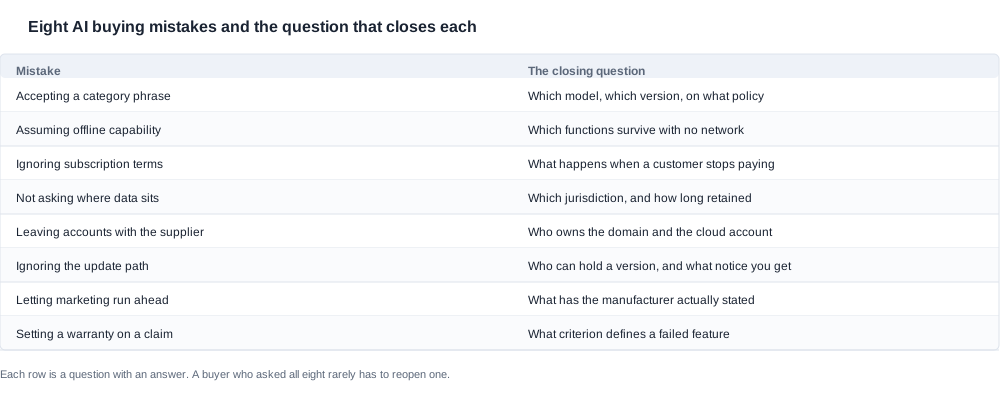
Smart glasses AI features: the eight buying mistakes
"Supports leading large language models" is a category phrase. "Supports model X, version Y" is a specification, and only the second one can be held to.
The reason the distinction matters is update risk, not credibility. If the product depends on a third-party model that is retired or replaced, the behaviour of your product changes without your involvement — and if you are marketing the AI capability, that change lands on your product and on the packaging in the warehouse. It arrives as a support ticket, a marketplace complaint and a reprinting cost, in that order.
The cost of the mistake is usually invisible at purchase and total at scale. A category phrase gives you no way to know whether the feature will still work in eighteen months, and no way to plan for what happens if it does not.
Ask: which models, on what update policy, and what notice do we get before a change. A supplier who cannot name the models is describing a category rather than a product, and that is useful to know before you have written the listing.
What each of the eight mistakes costs when you leave it open
The table below is the argument for asking all eight questions rather than the ones that seem pressing. The cost column is not a supplier's price — it is what the mistake becomes, in the buyer's own terms, when it is discovered after launch.
| Mistake | What it becomes | Where it surfaces |
|---|---|---|
| Category phrase accepted | A behaviour change nobody announced | Support tickets, then a packaging reprint |
| Offline capability assumed | A feature that stops working in the field | Returns in the markets with the weakest service |
| Subscription ignored | A margin that moves after the product succeeds | Your own finance model, after launch |
| Data location unasked | A privacy statement that does not match reality | A compliance query, in public |
| Accounts left with the supplier | A service you may not be able to recover | The worst possible week of the relationship |
| Update path ignored | Packaging that describes yesterday's product | Units already in the warehouse |
| Marketing run ahead | A claim that cannot be substantiated | A marketplace review, or a customer dispute |
| Warranty set on a claim | A claim nobody can settle | The warranty desk, per incident |
Read the third column on its own and the ordering becomes obvious. None of these failures happens at the factory. Every one of them happens somewhere the factory has no visibility and no authority, which is why the questions have to be asked before the deposit rather than resolved after it.
Mistakes two and three: assuming offline capability, and ignoring the subscription
Mistake two: assuming the feature works without a connection
Almost always assumed rather than tested, and frequently the deciding question for travel and for markets with inconsistent connectivity.
The answer that closes it is a demonstration with the network disabled. Not a statement of capability — a demonstration. Turn the network off on the sample and enumerate what still works. Capture, calls, playback, the assistant: write the list down, because that list is the product your customer has when the service is down, and it belongs in the instructions.
An online-only feature is a legitimate product with a real limitation, and it should be sold as one. That is a materially different proposition from one your customers believe works anywhere, and the difference shows up as returns and one-star reviews rather than as a support query you can answer.
Ask: which functions continue to work with no network available, and which stop. If the reply is a sentence rather than a list, the row is still open.
Mistake three: letting a recurring cost attach to the hardware without pricing it
A recurring per-unit or per-user cost changes the business model of the product you are building. Discovering it after launch creates a problem with your own customers rather than with the supplier.
Two things have to be in a document before samples. The commercial terms, including the scale rule — what happens to the unit cost at ten times your first order. And the behaviour of the feature if a customer stops paying, which is the part that is usually missing and the part that becomes a refund policy question, a contract question and a warranty question.
If there is no subscription, get that in writing too. A verbal assurance is exactly the thing that evaporates when the feature becomes popular and the supplier decides it needs a revenue line.
Ask: is there a recurring fee, on what basis, and what happens to the feature if a customer stops paying. Also ask what happens to the cost if the supplier's own provider changes — because a per-user cost is often a pass-through, and pass-throughs move.
Mistakes four and five: not asking where the data sits, and leaving the accounts with the supplier
Mistake four: not asking where the data is stored
The jurisdiction determines your own exposure under data protection law if you sell into the EU, and "secure servers" is not an answer.
Two questions settle it. Which jurisdiction the audio, images and text land in after they leave the device. How long they are kept there. Both belong in a contract rather than on a policy page, because both are commitments rather than descriptions, and a policy page can change without notice to you.
The reason this mistake is expensive rather than merely embarrassing is that it is discovered at the wrong moment. A storage jurisdiction is not a product decision you can make later, and it is not a copy edit. It determines the disclosure you must make in the listing, the consent flow in the app, the terms your customer accepts, and whether your privacy statement matches reality. A mismatch between the statement and the actual path is the kind of thing that surfaces publicly.
Ask: for this model and firmware, does any audio or image data leave the device; if so, to which jurisdiction, and for how long is it retained. Three specific answers, and if you get one sentence you have a description rather than an answer.
Mistake five: leaving the accounts with the supplier
Domain names, developer accounts, cloud credentials and store listings should be registered to you from the first day.
This is the most common post-mortem finding in consumer hardware launches, and it is entirely avoidable at the start. An account registered to a supplier's company email is an account you may not be able to recover if the relationship ends badly. An account held by the software house means the assistant — and therefore the differentiator you are paying for — leaves with them.
The version of this mistake that is harder to spot is the one where the account is technically yours but the access is not. The supplier holds the only login, the only billing relationship and the only relationship with the platform. In that case the ownership is on paper and the control is not.
Ask: who registers the domain, the developer account and the store listing, and can you see the registration details. Registration details, not a promise.

Mistakes six to eight: the update path, the claim and the warranty
Mistake six: ignoring the update path entirely
Whoever controls the firmware controls the behaviour. If the supplier controls updates and you do not, a change to how the assistant behaves lands on your product without your involvement.
Three terms decide whether that is manageable: the notice period before a behaviour change, the version-hold right so a channel or a fleet can be pinned to a build, and the change-notification scope so that a change to the assistant is notified even when it arrives inside a general release.
The mistake is not asking for these at all. The mistake is treating the update path as a technical detail of the firmware rather than as a commercial term about your packaging.
Ask: who can push a build, how much notice do we get before a behaviour change, and can a version be pinned.
Mistake seven: letting the marketing run ahead of what has been stated
A capability list written from the category rather than from the manufacturer's statement is the most expensive copy error in this category, because the claim is the part of the product you cannot change after it is printed, published or filmed.
The same functionality, described differently, is treated differently. A feature described as a translation aid and a feature described as making decisions about a person attract different levels of scrutiny, and the difference is created by the wording rather than by the hardware.
Ask the manufacturer for the capability list they will stand behind, and write the listing from that list alone. If the list is thin, the listing is thin — and a thin listing that is accurate is commercially safer than a broad one that is not.
Mistake eight: setting a warranty on a claim rather than on a criterion
A warranty written against "the AI feature works as described" is a warranty against a description, and descriptions are not measurable.
A warranty against a criterion is: the assistant answers a defined class of input, within a stated time, on a stated connection, as measured by a stated method. That is testable at the point of a claim, which an adjective is not.
Ask: what criterion defines a failed feature, and can it be measured by a sample? If the answer is that it depends on the situation, then the warranty is a negotiation rather than a process, and you should price it that way.


The pattern behind all eight mistakes
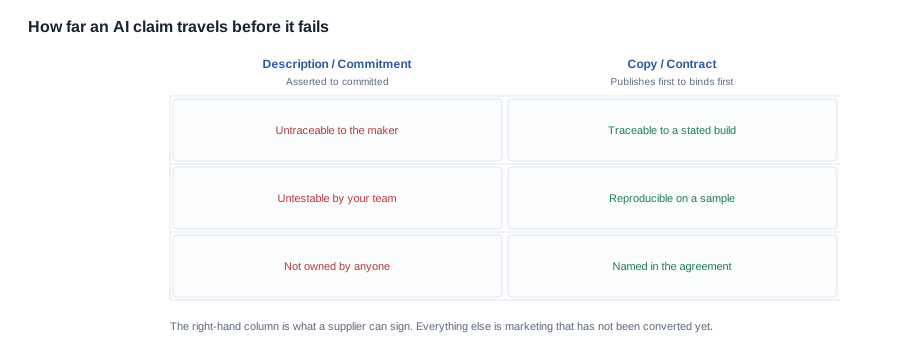
Each mistake is the same mistake: accepting a description where a commitment was available. In every case the question has an answer, and in every case the answer would have changed the buyer's position before the deposit.
The practical advice is to convert every AI claim into one of three things before you rely on it: a written commitment, a demonstration, or a stated absence. Anything that remains a description should not appear in your product copy, and it should not appear in your contract either.
The three-way test, applied to a single claim
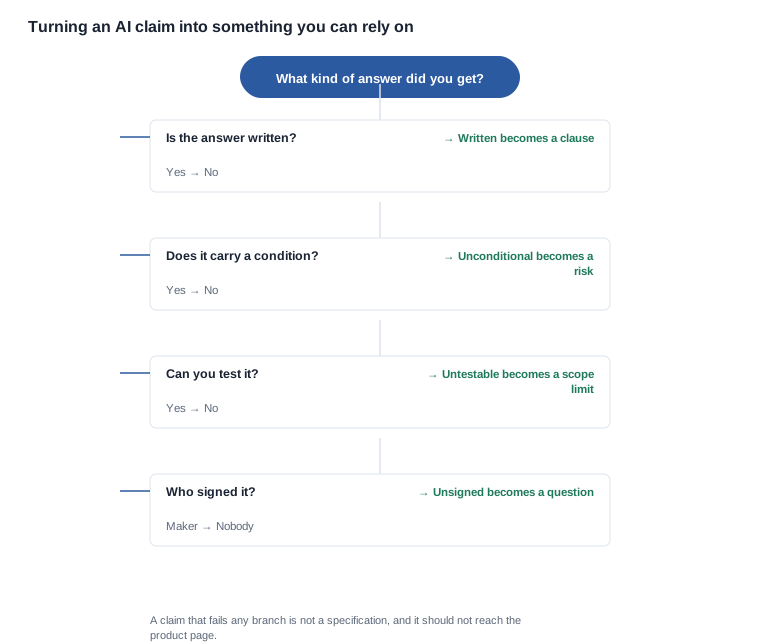
Take any AI claim in your file and put it through the test in the decision chart above. Four questions, in order:
Is the answer written? A written answer can become a clause. An unwritten one cannot, and it is worth noticing that a supplier who will not put an answer in writing has told you they do not consider it binding on themselves either.
Does it carry a condition? A claim without a condition is true everywhere or nowhere, and you will be the one asked which. A claim with a condition — this model, this firmware, this network, this language — is a claim you can rely on and a supplier can honour.
Can you test it? If it cannot be tested, it cannot be accepted into a warranty, and it cannot be given to a customer as a promise. It is marketing, and it has to be treated as marketing.
Who signed it? A claim that no named party stands behind is not a commitment, however confident the person saying it sounds.
A claim that fails any one of the four branches is not a specification, and it should not reach the product page. That single test is the whole article in four questions.
The eight questions as one brief
The eight mistakes are easier to prevent than to remember. Put them into a single brief, in the order below, and send it as one attachment with one deadline. A brief sent in eight separate emails gets eight partial answers.
- Which models and versions does this configuration use, on what update policy, and what notice do we get before a change?
- Which functions continue to work with no network available, and which stop?
- Is there a recurring fee, on what basis, what happens to it at scale, and what happens to the feature if a customer stops paying?
- For this model and firmware, does any audio or image data leave the device — if so, to which jurisdiction, and for how long is it retained?
- Who registers the domain, the developer account, the cloud credentials and the store listing, and can we see the registration details?
- Who can push a firmware build, how much notice do we get before a behaviour change, and can a version be pinned for a channel?
- What capability list does the manufacturer stand behind, and what are the stated limitations?
- What criterion defines a failed feature, and can it be measured on a sample?
Add a ninth line that is not about the feature at all: who at the supplier's side owns the answer to each of these, by name. That single line is what converts a set of questions into a process, because it tells you where to push when the reply is soft.
The commercial terms this list governs
Two commercial lines are attached directly to the mistakes above, and they are the two worth spending negotiating capital on.
The service cost structure is the more consequential of the two, because it is the one that arrives at scale. Per unit against per user, a fixed term against a rolling basis, a floor against a cap, a bundled tier against a separate subscription — these are all negotiable, and they are much easier to negotiate before the first order than after the first quarter. Also negotiable: minimum order quantity, the packaging and insert design including the market labels and the subscription disclosure, the artwork round count, delivery splitting against a documentation-review milestone, and the payment milestones — a deposit at the start of the order, a balance against the inspection before shipment, and a retention against the package.
The update and notice terms are the second line, and they protect the claim you are marketing on. A notice period for a behaviour change, a version-hold right for a fleet or a channel, and a change-notification scope that catches assistant changes inside general releases are ordinary commercial terms that a supplier can grant and a buyer can live with.
What is not a commercial lever is the certification cost or the certification elapsed time, which are fixed per product family and set by the test laboratory's queue; and the regulatory treatment, which follows from the functionality and from the wording and which no commercial term can move.
Why they have to follow that dependency chain
Ask the eight questions in the order above, and do not reorder them for a particular supplier. The order is a dependency chain: the model and version determine what the update policy means; the offline behaviour determines what you can put in the listing; the subscription determines what the margin model looks like; the data location determines what the privacy statement says; the accounts determine whether you will still own the product in two years; the update path determines whether your packaging stays true; the capability list determines what the copy can say; and the failure criterion determines whether the warranty can be settled at all.
Ask them out of order and you will collect answers you cannot yet use.
A closing note on which of these you can close alone
Five of the eight questions depend on somebody else, and a buyer who waits for all eight before moving is waiting on a dependency chain that may not resolve inside the launch window. The three you can close yourself are the ones worth starting on immediately, because they cost nothing but a sample and they change what you do with the answers.
The offline run, the latency measurement and the refusal probe are all closed on a unit in your hand, using a content set you write. Do them early, because they are the only three that tell you what the product actually does rather than what its owner says it does — and because a refusal that produces a confident, fluent wrong answer changes how much of the feature you are willing to put on the packaging.
What we publish about AI, and what we will not invent
This is the mistake we are most careful about ourselves, and it is worth stating as a principle rather than as a warning.
We publish an AI voice assistant across our camera models, and we reference AI translation on the K01, which is an audio model. Twenty of our 28 catalogue entries carry the AI designation in the name — 11 camera models, 8 audio models and one electrochromic entry with no camera. That count is a naming convention of the range, not a statement that twenty products share one implementation.
We publish nothing beyond that. No architecture, no named model, no language count, no latency, no accuracy figure, no processing location, no subscription terms, no data jurisdiction, no app operator entity and no per-model certificate number. We publish one weight in the whole catalogue — 158 g for the MT6 camera platform, excluding its foldable charging case — and no weight for an AI-equipped configuration.
We decline briefs asking us to position AI capability in a way we cannot evidence. A vague claim is commercially weaker than a precise one and legally riskier, and the buyer who understands that asks better questions at the outset.
Our position is that we will tell you precisely what our catalogue states about AI features and precisely what it does not, and that we would rather leave a question open than fill it with a plausible answer.
Tell us the AI function your channel depends on and the market you sell into, and we will say what we can confirm and what you must obtain separately. The background is under AI features in smart glasses, the procurement rows are in the AI buying checklist, and the ownership question sits in smart glasses OEM IP protection.
Related reading
Tell me the AI function and market and I will say what we can confirm.


