

Mapping an AI feature to a use case is harder than it looks, because the features in this category are named after the technology rather than after the job, and several of them serve the same workflow for different reasons. Smart glasses ai features smart glasses for different use cases maps the capabilities to the jobs that need them, and then applies the only test that matters commercially: the sentence you can put on a product page and still defend when a customer tests it.
The reason the feature names do not sort is worth stating at the start. "AI voice assistant" tells you nothing about a warehouse or a classroom or a retail floor. "AI translation" tells you nothing about whether the interaction is routine. So the job has to be named first, deliberately, and the feature selected afterwards — and in three of the five jobs below, the capability that carries the proposition is not the AI capability at all.
Our published position is what makes the rest of this a hypothesis rather than a specification. We publish an AI voice assistant as a key technology across the camera tier — the 8 MP group on the V06 and the V03, the MT6 and the MT5, and the KY06 and the CY05, and the V03 Pro and the CY03, and the 13 MP group on the L1 Pro and the L2 Utral, and the S7 — and across the audio tier. We publish AI translation on the K01, which is an audio model, and we publish the smart noise reduction technique for the Bluetooth audio family. We publish no implementation detail, no offline capability, no language list, no latency, no accuracy figure, no subscription status and no data-flow detail for any of them. Every use case below is therefore a hypothesis until a demonstration confirms it.
Smart glasses ai features: name the job first
A buyer who starts from the feature list ends up with a product page that lists three capabilities and a buyer who cannot say why anyone should buy it. A buyer who starts from the job ends up with a proposition and a much shorter list of capabilities to evidence.
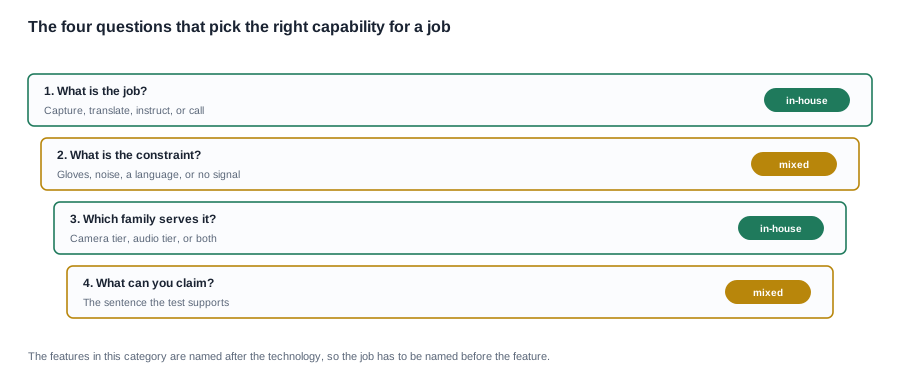
The four questions in the diagram above are the sequence, and each one removes options rather than adding them.
What is the job? Capture, translation, voice control, call quality, or documentation. These five are the ones this category genuinely serves, and they are different enough that a product can be strong in one and irrelevant in another.
What is the constraint? Gloves, ambient noise, a second language, or no signal. This is the question that decides the model family, because the constraint determines which published rows matter — a gloved-hand workflow needs a published assistant, a noisy environment needs the published noise reduction technique, and a market with weak connectivity needs a published offline behaviour, which does not exist for any model in this range.
Which family serves it? The camera tier or the audio tier. The camera tier is AI camera glasses and the audio tier is Bluetooth audio glasses, and the two carry different published capabilities, different accessory sets and different runtime figures.
What can you claim? The sentence the test supports. This is the last question, not the first, and a buyer who answers it first has already decided the answer.
The failure of this sequence in practice is that most channels contain one strong job and two weak ones, and the product page ends up describing all three because each of them was added by a different person at a different time. The job mapping is also the way to find out which one is strong, and it takes less time than a second supplier round.

Five jobs, and the capability that actually carries each one
The five jobs below are described with the capability that carries them, the capability that merely supports them, and the published basis for each. Where the published basis is thin, that is stated, because a use case with no published basis behind it is a use case you have to test.
Job one: hands-free capture where the hands are occupied
This is the strongest job in the category, and the capability that carries it is the camera, not the assistant.
The proposition is first-person video capture without reaching for a phone — a technician documenting a panel, a surveyor recording a site, a trainer recording a demonstration. The camera tier publishes 8 MP and 13 MP variants for exactly this, and the assistant is a convenience inside the workflow rather than the reason to buy.
The claim you can publish: a first-person camera with a hands-free capture workflow, named per model, with the resolution stated. The test that supports it: a capture run in the real workflow, on two units, with the file checked on a computer rather than on the phone.
The trap: marketing the assistant and selling the camera. The product and the message then disagree, and the customer notices the assistant is the weaker half.
Job two: cross-language contact
The catalogue records AI translation as a stated feature on the K01, an audio model. If your channel is genuinely built on cross-language contact — a retailer serving tourists, a clinic serving a mixed-language catchment, a training operation across two countries — this is a defensible proposition.
The claim you can publish: translation on the K01, with the language pairs named in a direction, and the offline behaviour either stated or explicitly excluded. The test that supports it: a fixed phrase list in your market's language pair, judged by a native speaker, plus the network-off run.
The trap: a translator that needs connectivity is not the same product from one tunnel to the next, and a language count with no list behind it is the claim most likely to be challenged by a customer in one specific language.
Job three: voice-driven control where touch is impractical
In an active or gloved-hand environment, voice control is the difference between usable and not. The published basis for this is the stated AI voice assistant capability, and the published basis for the numbers behind it is nothing at all.
The claim you can publish: a voice assistant on the named models, with the command set and the trigger described, and the failure behaviour stated. The test that supports it: the command set triggered in the condition that matters, with the trigger reliability recorded and the false activation rate measured.
The trap: the false activation rate is the usability gate rather than a technical footnote, because a device that interrupts a customer's conversation is a device that gets taken off, no matter how well it works when it does activate.
Job four: clear calls in a noisy channel
The smart noise reduction technique published for the Bluetooth audio family operates on the microphone path, not on the output. It improves what the far end hears. It does nothing for the wearer's own listening quality, and a listing that presents it as a listening improvement is over-claiming in a way customers can hear.
The claim you can publish: a call in a noisy environment, with the processing path named and the measurement taken at the far end. The test that supports it: a real call on a real network, scored by the person at the other end.
The trap: writing the claim about the wearer rather than about the call. Every claim about this technique has to be a claim about the other end hearing better.
Job five: a spoken record of a task
A workflow that needs first-person capture and a spoken record — an inspection, a safety walk-through, a handover — needs the camera tier and a microphone that works in the environment. The published rows for cell capacity and runtime matter here more than in the other four jobs, because the recording is continuous.
The claim you can publish: first-person capture with continuous recording, with the published runtime band for that model and the recording time stated as a test result. The test that supports it: a full recording run at the end of a normal working day, on the unit you will ship, with the file checked for completeness.
The trap: quoting a published runtime as though it were a recording time. The two are different measurements, and the difference is the number of hours of footage a customer actually gets.
Choosing between two jobs when a channel has both
Most channels are not one job. A retailer serving tourists and a busy floor is two jobs, and the product page can only lead with one of them. The criteria below are how to decide which, and they are worth running before the first sample arrives rather than after.
The criterion that decides it first: which job is the reason the customer buys. A buyer who needs a record of an inspection buys the camera. A buyer who needs to be understood in a second language buys the translation. The job that is the reason for the purchase is the one that goes on the page, and the other becomes a supporting line.
The second criterion: which job survives the conditions you sell into. A capture job survives anywhere. A translation job survives only where there is connectivity, unless the offline behaviour has been enumerated, and it is not published for any model in this range. A call-quality job survives in a noisy environment, which is the point of it. So the job that depends on a condition you cannot guarantee should not be the one you lead with.
The third criterion: which job is cheapest to evidence. A capture claim needs a camera specification and a recording test. A translation claim needs a phrase list, a native-speaker judgement and a network-off run. The assistant claim needs a command set and a trigger measurement. The questions to ask here are simple: which of the five jobs can you put a pass condition against, and which one would take a month to evidence?
The fourth criterion: which job is the competition also leading with. If a competitor's page leads with the assistant and your strongest job is capture, leading with the assistant puts you on their ground with a weaker version of their claim. The checklist for this is short: look at the four listings in your category, note what each one leads with, and check whether that is the job your channel actually has.
The red flags in this step are specific. Leading with a feature because the customer asked for one. Leading with a job you cannot evidence in the market you are launching into. Leading with a job that only works where you have no signal, in a market that has signal. And carrying three jobs on one page because three people added one each.
What the demonstration has to prove before the page is written
Before any of the five jobs can go on a product page, four things have to be established, and the order is the same for each job.
- The model designation, matched against the capability list, so the job is attached to a product that carries it.
- The condition, written down and reproduced in the test: the environment, the network, the language, the duration.
- The failure mode, observed rather than assumed, and published as a degradation rather than hidden.
- The total cost of the claim, which is the reprint, the listing correction and the support load, and which is what a narrowed claim buys back.
These four are the criteria we would put in front of a buyer evaluating any of the five jobs. A use case that clears all four is a proposition. A use case that clears two is a line in a feature list, and that is still a useful thing to have — it just cannot be the reason somebody buys.
The sentence test: what you can write for each job
The commercial test for a use case is simple and it is the same for all five: can you describe the feature's failure mode, can you say what it does without a network, and can you say what happens to the data. A feature that passes all three can be written into a listing as a proposition. A feature that passes one of them is a line in a feature list. A feature that passes none of them should not appear in the listing at all.
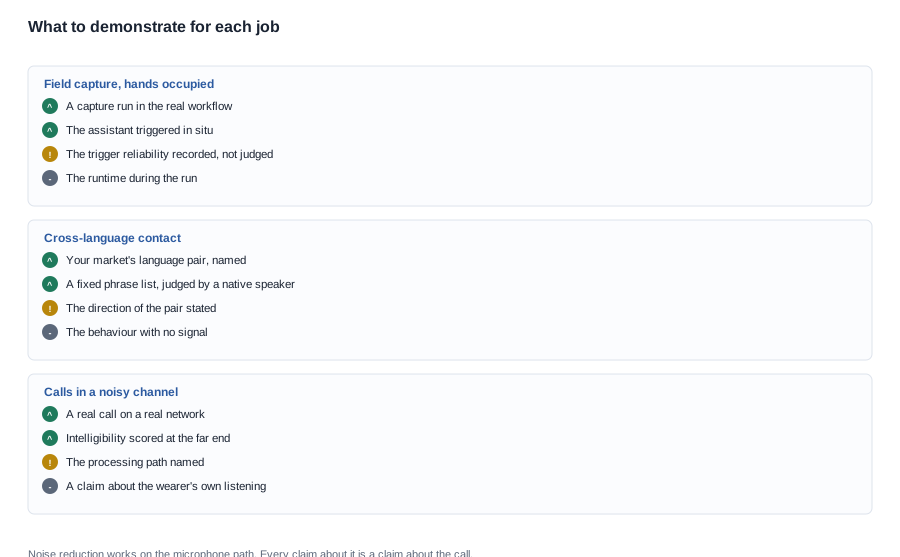
The checklist above is per job, and the questions to ask a supplier are the same in every case: the capability list per model designation, the functions that survive with no network, the language pairs with the direction of each, the data path and the operating entity, the subscription status and the lapse behaviour, and the certificate numbers naming the exact model.
Two of the questions deserve more weight than the rest, because they decide whether a use case can be published at all.
The language pair is only useful in a direction. A pair is two directions, and they are not equivalent. A buyer who writes "supports English and Spanish" without saying which way the translation runs has made a claim that will fail in half the conversations it is meant for.
The offline enumeration is the boundary of the claim. Whatever survives with no network is what you can describe offline. Whatever does not is the part a customer in a basement will believe is broken. A use case whose whole value depends on connectivity has to say so, or it has to be a different product.

Building the demonstration for the job you are leading with
Once the job is chosen, the demonstration is a short piece of work — but the order of it is what makes it evidence rather than an anecdote.
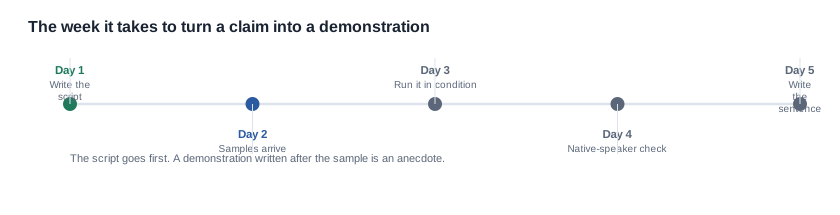
Day one: write the script. The script is the deliverable, not the preparation for the deliverable. Ten commands, a fixed phrase list, or one continuous capture run — whatever the job needs — with a pass condition for each line and the condition the product will be used in written next to it. A script written after the sample is a description of what happened.
Day two: confirm the model. Read the designation off the unit and match it against the capability list. This is the step that stops a use case being attached to a model that does not carry the capability, and it is the step most often skipped because the sample "looks the same".
Day three: run it in the condition. Gloves, noise, a real network, the actual language pair, a full working day of recording. The demonstration in an office is a demonstration of the office.
Day four: record the failures as carefully as the successes. A feature that fails visibly is better than one that fails silently, and you cannot choose which unless you have watched both. The failure list is also what the support script is written from, later, at no extra cost.
Day five: write the sentence. The listing sentence, the manual sentence and the support answer, all the same length, all the same scope. If the sentence is longer than the script supports, it is too long, and the trim is the most valuable half hour of the week.
The commercial terms follow from the demonstration rather than preceding it. The demonstration script itself is negotiable as a document, and a supplier who will sign it is agreeing to be measured in a way you can publish. The offline function list and the lapse behaviour are negotiable commitments, and they are the two that protect the listing. Minimum order quantity, the packaging and insert design including the market labels, and the payment instalments — a deposit against the artwork and the first build, a balance payable at the point the inspection is passed, and a retention on the document set — are the standard areas. Certification cost and certification time are not a commercial lever, because the fee is per product family and the elapsed time belongs to the test laboratory. Tooling is a one-off, and the useful question is over what volume it is amortised.

Narrowing the claim, and the three questions that survive
The most valuable thing a use-case mapping does is tell you which claim to drop. Three of the five jobs above have a capability that supports them and a capability that carries them, and a product page that cannot tell the difference will end up leading with the weaker one.
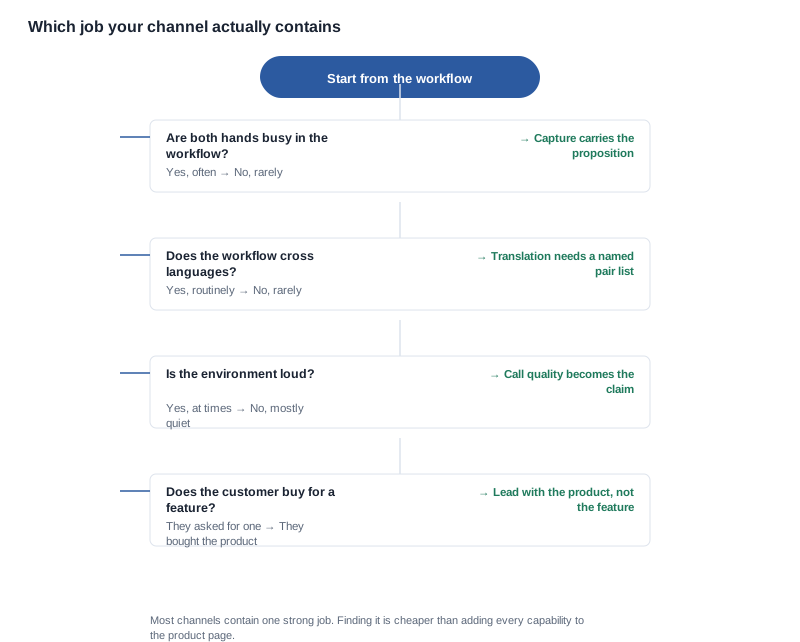
The four questions in that diagram are a way of finding the strong job. A channel where both hands are busy has a capture proposition. A channel that crosses languages has a translation proposition, if the pair list survives testing. A channel that is loud has a call-quality proposition, but only one you can state about the far end. And a channel whose customers asked for a feature rather than a product has the weakest case of all, because a feature-led message has to be defended against a competitor who will name the feature too.
Three questions then decide what the page says. Which capability carries the proposition — and if it is not the AI capability, say so in the copy, because that is what makes the page credible. What is the condition — the environment the claim holds in, written on the page. What is excluded — the offline position, the languages not covered, the models that do not carry it.
A narrowed claim is not a weaker commercial offer. It is the difference between a listing that survives a review and one that does not, and between a support queue that answers a question and one that absorbs an argument.
What we will and will not put behind a use case
We publish the AI capabilities our documentation supports and mark the rest as open, and every use case in this article is a hypothesis until a demonstration confirms it. We publish an AI voice assistant as a key technology across the camera tier and the audio tier, AI translation on the K01, and the smart noise reduction technique for the Bluetooth audio family, and we publish no implementation detail, no offline capability, no language list, no latency, no accuracy figure, no subscription status and no data-flow detail for any of them.
We will also be direct about which job the category is genuinely strong in, because it is not the one the marketing usually leads with. The strongest case is capture in a workflow where the hands are occupied, and the assistant is a convenience inside it. We will not put a translation claim behind a use case whose language pairs have not been tested, and we will not put a call-quality claim behind a use case that is really about the wearer's listening experience.
What we can do is map your channel to the jobs it actually contains, design the demonstration for the one you want to lead with, and write the sentence your test supports. Send us the workflow, the market and the price band, and we will tell you which capability carries it and which ones you can leave out. The background is under AI features, the channel framing is in retail and education and distributors and retailers.
Where the mapping comes from
Tell us the workflow and we will write the demonstration script with you.


