

Every AI feature in this category performs well in a demonstration, and the reason is not that the demonstrations are dishonest. It is that a demonstration is a controlled environment: a quiet room, one cooperative speaker, a prepared phrase, a known-good network and a unit that somebody set up in advance. A customer brings none of those things. The gap between the two is not a defect in the product. It is the difference between the conditions a supplier chooses and the conditions a customer arrives with, and this article is about that gap, because it is the gap that decides whether a feature gets used.
Smart glasses AI features: why the demo and field numbers differ
The buyer and the number they were given
The reader is a brand product manager or a sourcing buyer who has just received a figure. It came from a supplier's test, a competitor's marketing material, or a demonstration in somebody's office, and it was presented as a performance characteristic of the product. The buyer's problem is not that the figure is wrong. The problem is that a figure without a condition is not a measurement, and a buyer who puts it in a specification is buying a promise that the customer will test and the supplier will not be accountable for.
There is a second version of this problem that is more common in this category and more expensive. The buyer has a figure that is perfectly valid — a wake rate obtained in a quiet room, a translation accuracy obtained on a prepared sentence — and the figure simply does not describe the conditions the customer will be in. Nothing about it is false. It is simply the wrong number for the decision.
That distinction is why the first thing to establish is not the number but the conditions attached to it, and why the right response to an unconditioned figure is a request for the conditions rather than an argument about the value.
The published position, and what it means for the comparison
Our catalogue names an AI voice assistant among the key technologies for the AI camera glasses family, and our independent site describes AI translation on the K01, which is a Bluetooth audio model rather than a camera model. We treat that second one as an observation from our own marketing material rather than as a verified specification, and it carries less weight than a catalogue row.
We publish no wake rate, no false activation rate, no command success rate, no latency figure, no recognition accuracy, no translation accuracy and no offline behaviour for any model. We will not estimate them, and we will not quote a figure from the industry for a function we have not measured, because the whole point of this article is that a number without a condition is not a measurement.
What we publish is the hardware, and it is published completely: the camera models run from 8MP to 13MP with cell capacities from 220 mAh to 290 mAh, charge ceilings at or under two hours, and runtime bands from about five to eight hours, with charging cases at 1400 mAh on three models, a 900 or 1400 mAh option on L2 Utral, a 1200 mAh folding case on MT6, and cases of unpublished capacity on KY06 and MT5. IP54 is marked on V06 and S7 only, and the 158 g figure on MT6 is the only published weight in the catalogue.
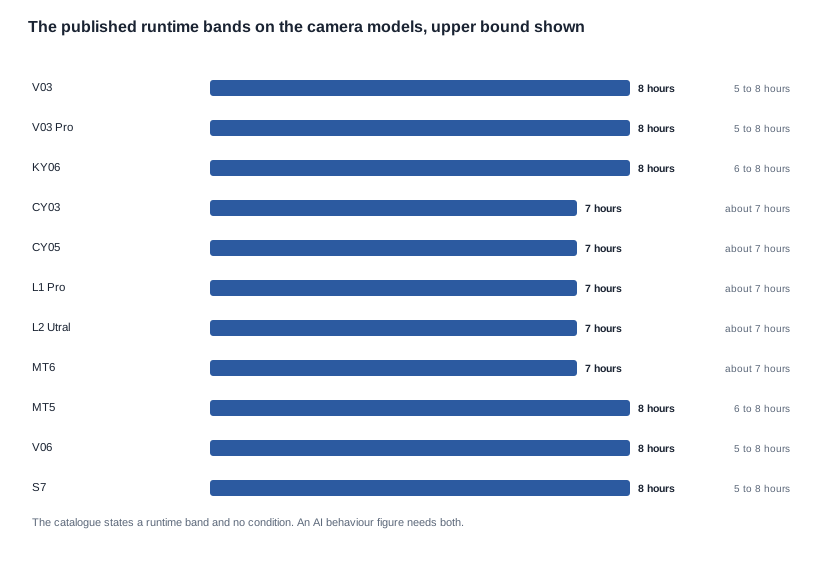
That asymmetry is the point of the chart above. The catalogue publishes a runtime band and no condition. An AI behaviour figure needs both, and that is the difference between a number a buyer can plan around and a number a buyer has to test.

The five variables that change between the room and the street
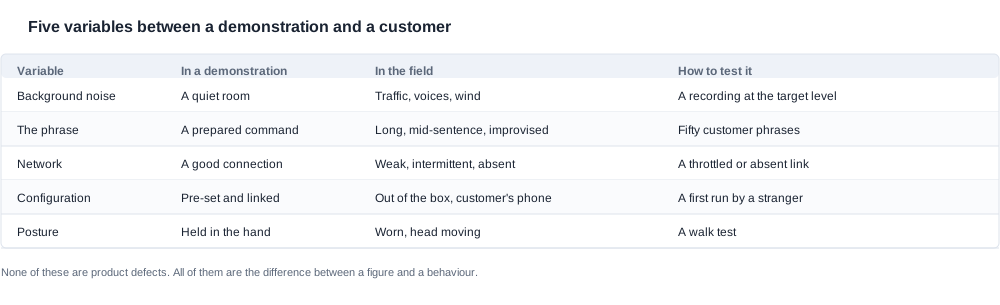
Background, phrase, network, configuration, posture
The background. A wake rate measured in a quiet office is a number with almost no predictive value, because the trigger is a problem in noise and the office was chosen because it solved it. The street, a café and a car are where the rate collapses, and it collapses unevenly, because a steady background is easier to reject than an intermittent one.
The phrase. A demonstration uses a short, common, well-formed command. Real users speak in longer sentences, use the product's name in the middle rather than the start, and invent syntax. Recognition accuracy measured on a prepared phrase is not an estimate of recognition accuracy in the wild.
The network. A demonstration is usually recorded on a good connection, and the response appears instantly. In real use the latency varies with the signal, and a feature that responds in under a second on a good connection can take several on a poor one. The user experiences that as unreliability, even though the feature is working.
The unit. A demonstration unit has the language set, the region configured, the account linked and the update path working. A unit out of the box, on a customer's phone, on a customer's network, in a customer's language, is a different configuration. This is the most common source of a first-week failure, and it is entirely a configuration question rather than a product question.
The posture. A demonstration is held. A customer wears the device, and wearing it means the microphone is on a moving head, the user is looking elsewhere, and the gesture that starts the interaction is a hand movement near a face rather than a button press.

The variable buyers most often leave out
There is a sixth variable that is not on any list, because it is not a property of the environment. It is the expectation the customer arrived with, and it is formed by the listing copy rather than by the product.
A buyer who writes "understands your commands and answers your questions" creates an expectation of a conversation. A buyer who writes "answers short spoken questions when connected" creates an expectation of a tool. Both devices may behave identically and produce completely different satisfaction levels, and the difference is entirely in the copy.
This is why a field test that measures only technical behaviour will understate the problem. The observation sheet has to record what the user believed was going to happen as well as what happened, because the gap between the two is the return.
The first-run session, which is where features are decided
The pattern, and why it is fixable
There is a specific pattern in how AI features fail in the field, and it is worth naming because it is fixable.
A customer takes the product out of the box, puts it on, and tries the feature. It does not work, because the language is not set, or the account is not linked, or the network is not configured, or the phrase was not the one the demonstration used. The customer concludes that the feature does not work, and in most cases the product goes back in the box.
The fix is not technical. It is that the first-run experience has to be designed: the product has to tell the user what it needs, in the product's own interface, before the first use rather than after a failure. The supplier's demonstration is a marketing asset, and the marketing asset is not the thing that determines whether the feature is used. The onboarding is.
The cost of getting it wrong
The commercial cost of a failed first run is disproportionate to the technical cause, because the product is returned rather than the feature being abandoned. A customer who cannot make the feature work does not usually conclude "the AI part needs configuring"; the customer concludes "this product does not work". That is a return, a refund, a negative review and a restocking cost, all of them caused by a setup step that took thirty seconds.
This is also the reason a first-run test is the highest-value single test in this category. It finds a failure mode that every other test misses, and it finds it before the product is in a customer's hand rather than after.

Running a field test with your own users
Six steps, two days, no laboratory
- Fix the twenty customer phrases. Not a supplier's phrases. The phrases your own customers use, including the awkward ones: proper nouns, numbers, a phrase that has two readings, a request that should be refused.
- Test the first run with a stranger. Give the unit to somebody who has not seen it, in the language they speak, with their own phone, and watch what happens without helping them.
- Repeat in the target environment. Noise, motion and a poor network, not only a quiet room.
- Repeat with the network removed. This is the step most brands do not run, and it is the step that reveals a service dependency the way a laboratory never does.
- Measure the false activations. Not just the wake rate. A feature that interrupts people is a feature that gets turned off, and the false activation rate is the number that predicts that.
- Rewrite the copy from the results. Not from the intention. The listing should say what the test showed.
What the sheet has to record
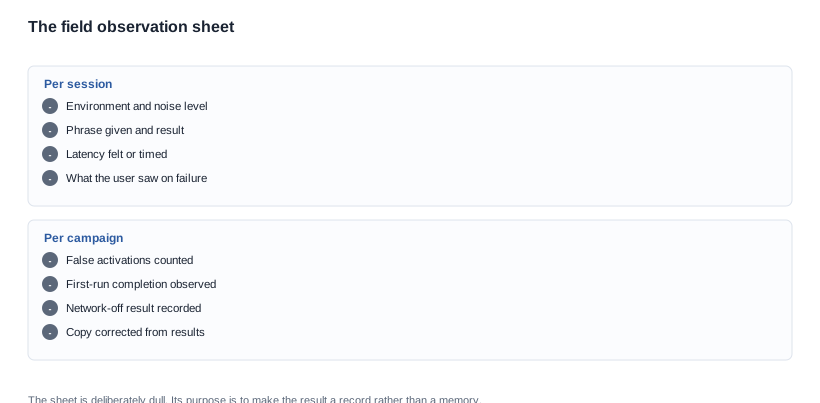
The observation sheet is deliberately dull, and that is its virtue: its purpose is to make the result a record rather than a memory. Per session, four items — the environment and the noise level, the phrase given and the result, the latency felt or timed, and what the user saw on a failure. Per campaign, four more — the false activations counted, whether the first run was completed unaided, the result with the network removed, and whether the copy was corrected as a result.
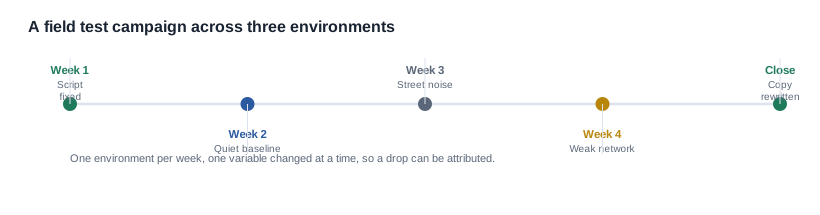
The campaign itself should change one variable at a time and one environment per week, so that when a rate drops, the drop can be attributed. Three environments is usually enough: quiet, ordinary and poor.
Turning the result into a commercial decision
The field test produces a number, and the number produces a decision about the product's positioning. If the feature works reliably in the quiet environment and fails in the ordinary one, it is a demonstration product and a product page should not lead with it. If it degrades rather than breaks, it is an enhancement and the copy can say so with a described gap. If it breaks, the product's core job has to move to something that does not depend on it.
That last outcome is worth stating plainly because it is the one buyers avoid. A test that returns "the feature breaks" has still done its job, and the result is a product that can be sold, rather than a product that returns.
The acceptance criteria to write before the test runs
A field test that has no thresholds agreed in advance produces a report rather than a decision, and a report gets argued about. The criteria to fix before anyone starts are short, and they are the same criteria a buyer would write for a production acceptance run.
Set the number of the twenty customer phrases that have to succeed, and set it per environment rather than as one global figure, because the environment is the variable being measured. Set the latency ceiling in the target environment, not in the office. Set the number of false activations that is acceptable in a conversation, which is a judgement about the product's use rather than a technical figure. Set the offline result, which should be an enumeration rather than a pass or fail. And set the first-run completion criterion: what proportion of first-time users complete the task unaided, which is the single number that predicts the return rate.
Which model you test matters as much as the thresholds. Test the model, the firmware build and the configuration you intend to ship, because a result obtained on a different combination of those three does not transfer, and this is where a buyer loses a week. Ask for the build identifier on the result sheet, and record it.
The decision that follows the test
There are three decisions available once the numbers exist, and the trade-offs between them are commercial rather than technical.
The first is to keep the feature and narrow the claim. The product ships, the copy describes the behaviour, and the return rate is governed by the gap between the copy and the behaviour. The second is to keep the feature and the broad claim, which is available only when the field results are close to the demonstration results. The third is to descope the feature from this product and plan a separate variant that is designed around it, which is the expensive option and the right one when the field result shows the feature cannot work in the environment the product is sold into.
Which one to take is a question about total cost rather than about performance. The narrow claim costs reprinting the artwork once and a lower conversion rate on the listing. The broad claim costs returns, refunds and marketplace exposure at a rate proportional to how prominent the feature was. The separate variant costs a second product line, a second certification and a second set of packaging, and it is only justified when the feature is the reason the channel wants the product at all.
What to insist on before you order
Before you order, put three things in writing. The enumeration of what still works with the network removed. The notice period before a firmware or model change that alters the assistant's behaviour, with a defined period. And the requirement that the marketing and label wording match the manufacturer's stated capability list.
Those three are the clauses that stop a field result from expiring. Without them the copy stays as it was written at launch, and the copy was written from a demonstration.

A worked scenario: a tourism channel testing translation
This is a hypothetical scenario rather than a client project, and it is here to show the decision sequence.
Assume a tourism channel brand that has put an AI voice assistant on a camera-equipped model and is selling it into three markets, with a guide-facing use case at the centre of the proposition. The brand's marketing team has a translation figure from a supplier demonstration and wants to put it in the listing. The brand's buyer has a general question about AI features rather than a specific claim to interrogate.
Step one: the conditions behind the figure. The brand asks what the demonstration was. It was a prepared sentence, in a quiet room, on a good connection, on a unit the supplier had set up. The figure is valid and irrelevant, and the brand does not have a number it can use.
Step two: the twenty phrases. The brand writes the twenty things a traveller or a guide would actually say — a street name, a price, a place with an unfamiliar spelling, a phrase that should be refused. The supplier runs them on two units of the shipped build.
Step three: the environments. The brand runs the same set in a quiet office, on a busy street, and on a weak connection. The street results are materially worse than the office results, which is expected and now measured.
Step four: the network-off run. The brand runs the set with the network removed. Capture and playback continue; transcription and translation do not. That is a describable degradation, and it is now a written fact rather than an unknown.
Step five: the decision. The brand concludes the feature is an enhancement rather than the reason to buy, writes the copy accordingly, and states the connectivity requirement and the language set explicitly. It does not lead the listing with the assistant, and it stops the guide-facing workflow from depending on the feature being available.
Step six: the commercial consequence. The brand puts the enumerated offline behaviour, a notice period for behaviour-changing updates and the copy-match clause into the purchase order, and it asks for a second evaluation round to be funded in case the acceptance run on the production build produces different results from the pilot build.
The decisive step was the first one. The supplier's figure was not wrong; it simply described a different product from the one the customer would hold, and the buyer had to establish which product the copy was going to describe.
The figures we publish, and the ones we will not invent
Our position on field measurement
The working rule we apply: the distance between a demonstration and a customer is the most important unmeasured variable in this category, and a supplier who quotes demonstration figures as if they were field figures is doing the buyer a disservice. We would rather run the test in the conditions that matter and tell you what the numbers are, including the ones that are not flattering.
What we can do is supply a unit in the configuration you intend to ship, and walk through the first-run experience and the real-world tests with you, so that what you publish is something you have seen. We will run the twenty commands you wrote, in the environments you named, on the build you specify, and we will report the results as they come out rather than as they would be ideal.
The measurement sheet that settles this kind of question is at measuring AI features, the test protocol for a sample is at testing AI features before ordering, the claim mistakes to avoid are covered under common mistakes, and what works without a connection is set out at using it offline. The platform background is under AI features in smart glasses.
Where your customers will be using it
Tell us the environments your customers will be in, the languages they will use, and the build you intend to ship, and we will build the real-world test with you: the twenty commands, the first-run session with somebody who has not seen the product, and the network-off run. Then we will tell you what the results were, and you can write the listing from them.
Related reading
- The measurement sheet that settles it — measuring AI features
- The test protocol for a sample — testing AI features before ordering
- The claim mistakes to avoid — common mistakes
- What works without a connection — using it offline
- How to test before ordering
Tell us the environments your customers will be in, and we will build the real-world test with you.


