

Smart glasses battery life is the row every buyer reads first and almost none of them can compare. Our catalogue publishes twenty-eight models, and those twenty-eight runtime figures sort into five classes that behave like five different products: a reminder class near twenty hours on forty and seventy milliampere-hour cells, a long audio class near eight hours on dual-cell platforms, a shorter audio class near six hours, a mixed group spread across seven and eight hours on cells from 100 to 200 milliampere-hours, and a camera class that mixes ranges with point figures. Every one of the twenty-eight publishes an hours figure; what none of them publishes is the condition behind it.
That leads to one operational rule for procurement, and it holds whatever a supplier tells you: rank nothing on runtime until you know which class each figure belongs to. Two models with an identical 100 mAh cell sit at eight hours and at seven hours, and the difference between them is not capacity. Decide the duty cycle first, read the charge path second, treat every hours figure as a ceiling, and ask for the workload behind anything you intend to put on a listing. The battery and power pillar collects the measurement methods; this article is the map that tells you which row to open.
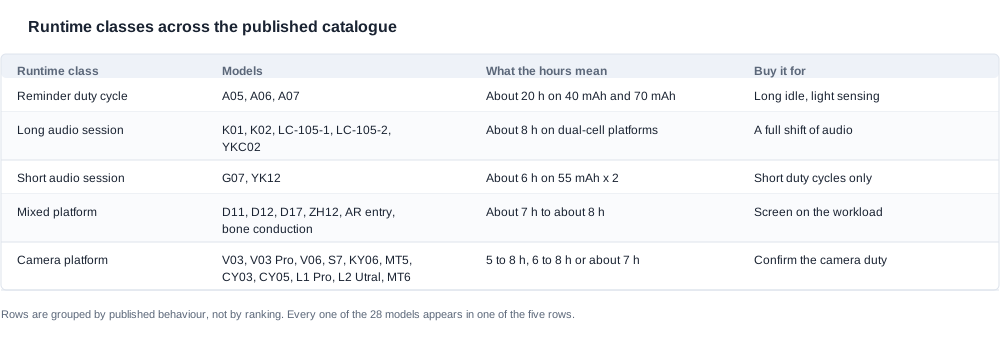
Smart glasses battery life: one table, five runtime classes
The classes below are built from the published rows, not from a ranking. Read them as behaviour groups, because that is what they are.
The reminder class covers the A05, the A06 and the A07, which publish roughly twenty hours each. The A05 and the A06 carry forty milliampere-hour cells; the A07 carries seventy. Two very different capacities producing one identical hours figure can only be coherent if the number describes a light duty cycle with long idle periods rather than a continuous session. That is exactly what a posture and distance sensing product does: it samples occasionally and spends most of the day asleep. Read as continuous use the twenty-hour figure is nonsense; read as a duty cycle it is coherent, and the difference between those two readings is the difference between a twenty-hour product and a three-hour product.
The long audio class covers the LC-105-1 and the K01, and the LC-105-2 and the K02, which publish about eight hours. Every one of them is a dual-cell architecture: ninety milliampere-hours on each side for the K01 and the K02, and fifty-five on each side for the LC-105 pair. The sport models sit outside that class on their own rows — the YKC02 publishes about eight hours on seventy milliampere-hours per side, the ZH12 about eight hours on a single 100 milliampere-hour cell, and the D17 about seven hours on a single 115 milliampere-hour cell. If you compare a 110 mAh total against a 100 mAh single-cell figure, you are comparing two architectures rather than two products, and the comparison tells you nothing about endurance.
The shorter audio class is the G07 and the YK12, at about six hours on the same fifty-five milliampere-hour dual-cell architecture as the LC-105 pair. Two platforms with identical published electrical rows and a two-hour difference in rating is a reminder that the hours figure carries a workload the catalogue does not state. Neither number is inflated; they describe different conditions.
The camera class covers all eleven camera platforms, and it is the only class that publishes its runtime in two different shapes. Six of them publish a range — five to eight hours on the 220 mAh V03 and the V03 Pro, five to eight on the 260 mAh V06 and the S7, six to eight on the 260 mAh KY06 and the 220 mAh MT5 — and the remaining five publish a bare point figure of roughly seven hours: the L2 Utral and the CY05, and the L1 Pro and the CY03 on 290 mAh, and the MT6 on 265 mAh. A range is an honest acknowledgement that the figure moves with conditions, and a point figure is a single measurement presented as typical. Neither is usable as a listing number without a condition attached, because the consumer of a range has no way to know which end describes their product, and the consumer of a point figure has no way to know what it was measured on.
The camera tier is where the missing information concentrates, and what is missing is the condition, not the number. All eleven camera platforms publish a runtime figure, and not one of them publishes the workload behind it: no capture duty cycle, no brightness, no volume, no radio state, no ambient temperature, no start state and no end state. The tier publishes no average power draw either, so the 290 mAh cell on the CY05 and the CY03, and the L1 Pro and the L2 Utral cannot be turned into a working day by any arithmetic on the sheet, and no cycle life is published for any of them, so every figure describes a unit on the day it ships. This is the largest gap in the published data set, and it sits exactly where a buyer is most inclined to assume. The correct move is to ask for the condition in writing, with the workload attached, rather than to infer it from a sibling model.
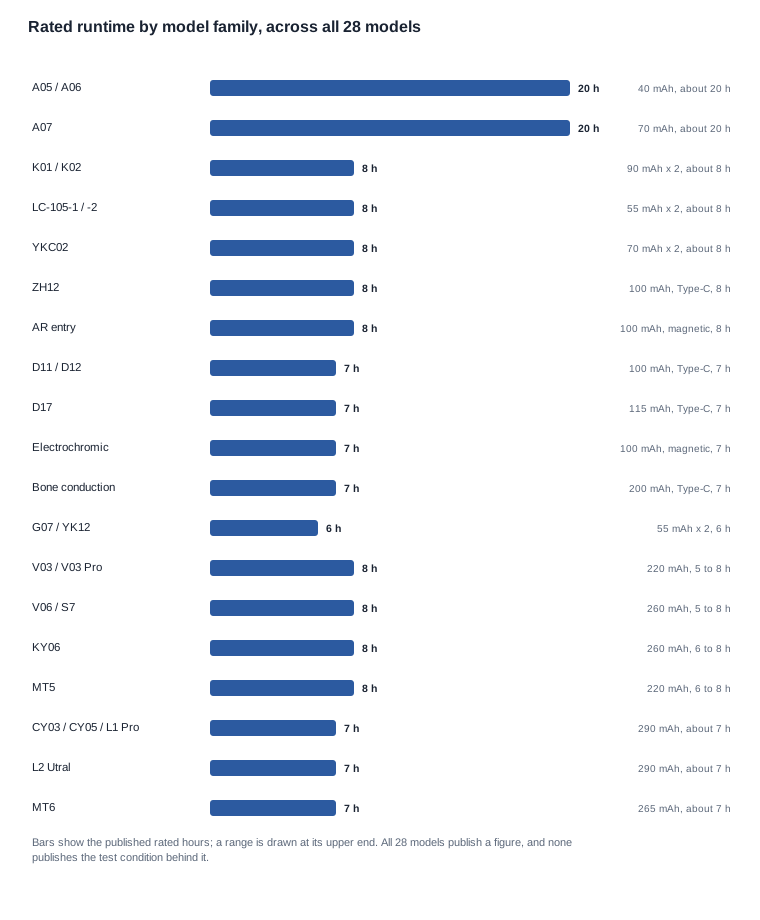
One group deserves a warning because it breaks the rule that capacity predicts endurance. Four entries carry a 100 mAh cell: the AR entry at about eight hours with magnetic charging, the AI electrochromic entry at about seven hours with magnetic charging, the D11 and the D12 at about seven hours with charging over Type-C, and the ZH12 at about eight hours with charging over Type-C. Same capacity, four different hours figures, and even the charging interface does not separate them cleanly. Whatever produces the difference sits inside the platform, which means it cannot be read off the specification row by a buyer.
Who is deciding what, and which number each of them is shopping for
The same runtime row means different things to different buyers, and asking which one you are is the cheapest way to avoid an expensive mismatch.
A brand-side product manager opening a new SKU needs a figure that can be defended on a listing and in a marketplace review queue. What they are shopping for is a number with a condition attached, because the number itself is easy to obtain and the condition is what makes it survivable. The failure mode here is a listing built on an eight-hour figure that was measured with the camera idle, followed by a cluster of reviews describing a product that dies mid-afternoon.
A channel buyer adding a model to an existing range is shopping for something else: comparability with the stock they already hold, a unit price tier that sits beside their existing lines, and a case or packaging strategy that does not double their freight. The CY03 and the CY05, and the L1 Pro publish a 1400 mAh case, the L2 Utral publishes 900 or 1400 mAh as a configuration, the MT6 publishes a foldable 1200 mAh case, and the KY06 and the MT5 are published with a case whose capacity is not published. That is a range question about packaging and freight weight, not a runtime question, and it deserves a different shortlist.
An e-commerce selector is shopping for claim wording. They need to know whether the supplier will stand behind a specific number, because a claim that cannot be defended becomes a refund and a review, and in a thin-margin category the volume of those decides whether a listing is viable.
A solution integrator is shopping for a shift. They need to know how many case charges cover a working day and a working week, whether the cell tolerates a full day of charging cycles, and what the device does as the charge runs down. They also need to know who performs a cell replacement, because in most of these products the cell is not user-replaceable and a battery replacement is a service operation rather than a customer operation.
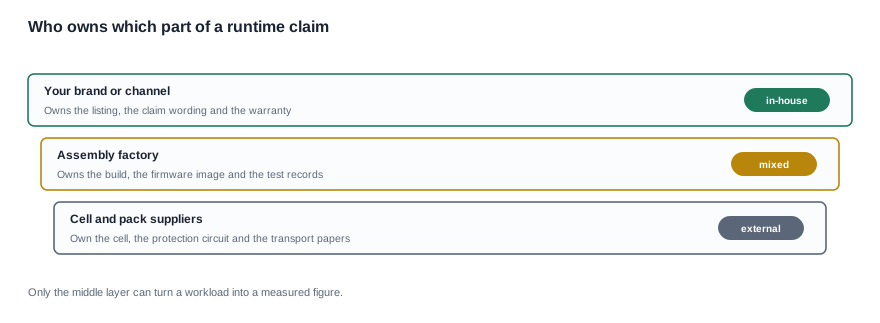
The question to ask yourself at the start is therefore not "which model has the best runtime". It is "which figure will end up in my listing, in my purchase order and in my warranty, and who measured it". Once that is answered, the catalogue rows become a screening instrument instead of a ranking.
The six selection dimensions behind a runtime figure
Six dimensions decide whether a runtime row is usable for your programme. Each of them has a reading, a decision and a failure consequence, and all six have to be closed before a purchase order is signed.
Cell architecture. Read the capacity per cell, and note whether the product carries one cell or two. The published range runs from 40 mAh on the A05 and the A06, through 55, 70, 90, 100, 115 and 200 mAh, to 220, 260, 265 and 290 mAh, with several models publishing a doubled figure. A buyer who adds the two cells and compares the total against a single-cell figure is comparing architectures. What it decides: whether a capacity increase in a future revision is even possible without a mechanical change.
Workload class. Determine what the device does while the hours count. Continuous audio playback, continuous camera capture, and intermittent sensing are three different workloads on the same hardware, and the published figures are not interchangeable between them. The camera is the largest single consumer on any camera platform, so a camera figure measured without the sensor active describes a product nobody buys. What it decides: whether the figure on the box matches the product in the customer's hand.
Charge path and case. Magnetic charging, magnetic charging with a case, and Type-C are three different charging stories, and the case capacity changes the retail proposition entirely. It also changes the freight weight, the packaging dimensions, the transport documentation set and the number of full sessions a customer gets between charges. What it decides: whether the product survives one working day or one working week, and what the unit economics of the packaging are.
Radio and its load. The radio is active throughout a session in a way that the camera is not, and a radio working to maintain a weak connection draws more current than one holding a strong one. The catalogue publishes a Bluetooth version for fourteen models: 5.3 on the K01 and the K02, and 5.4 on the D11, the D12, the LC-105-1, the LC-105-2, the G07, the YK12, the YKC02, the D17, the ZH12, the A07, the AR entry and the AI electrochromic entry. The remaining fourteen, including all eleven camera models, publish no version. What it decides: nothing on its own about runtime, and everything about which rows you still have to request from a supplier.
Duty cycle and idle behaviour. A device used in short bursts through a day can run all day on a charge that would not survive two hours of continuous recording, and the published standby behaviour of the platform is what separates those two cases. This is also the variable behind the twenty-hour reminder class. What it decides: whether the product is specified for a continuous session or for intermittent use, and therefore which class of model belongs in your range at all.
Documentation and compliance burden. A lithium cell inside a product that crosses a border brings its own documentation requirement regardless of the runtime figure. The transport test summary produced under the United Nations Manual 38.3 test standard records the battery maker, the laboratory, the report number and the cell model, and it has to match the cell in the goods. The portable lithium cell safety standard, IEC 62133, is a separate file about the cell in use. Neither is the same document, and a supplier who conflates them has not read either. What it decides: whether the first shipment clears a carrier, and whether a future cell change reopens the whole file.
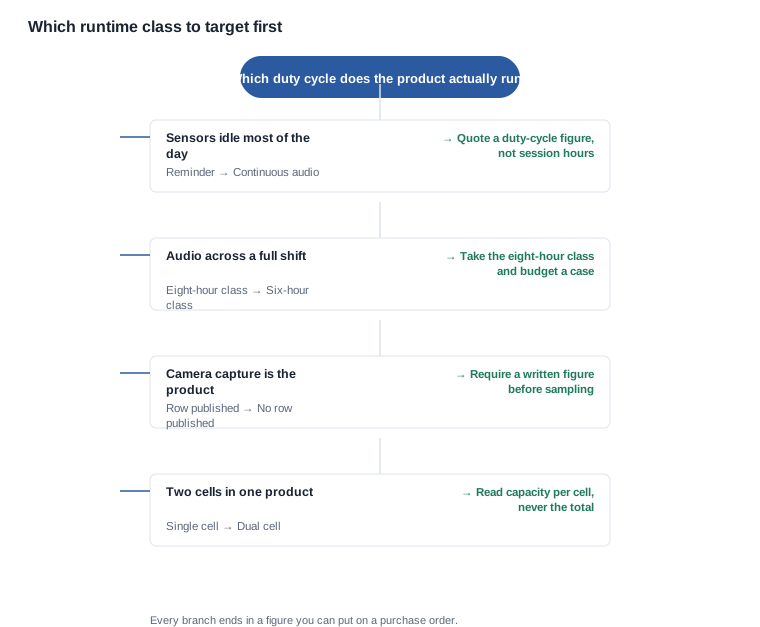
One warning carries across all six dimensions: these figures are not directly comparable across suppliers, and the reason is usually the measurement rather than the product. Until the workload, the start state and the end condition are stated, two numbers in the same row are two different measurements, and the comparison is a comparison of test conditions neither party can see.

Three supplier types, and the questions each one can answer
The runtime claim reaches you through one of three supply structures, and each one has a different answerability profile. Knowing which structure you are in tells you which of your questions will get a real reply.
A platform-owning factory designs the hardware and the firmware, holds the tooling, and controls the test records. This is the structure that can actually answer the questions that matter: what workload the published figure was measured under, what the cell's rated cycle life is, what the charge curve looks like, and how the figure changes between production lots. Their weakness is that they are conservative about committing to a figure in writing, because a written runtime becomes an acceptance criterion in a purchase order. What to ask: the measurement method behind the published row, and whether they will place the measured figure in the contract. What to write: the workload definition and the acceptance threshold, so the reply becomes binding.
An integrator using another company's platform has a much thinner answerability profile, and it is honest to say so. They cannot change the cell, they cannot change the firmware, and they may not control the test data at all. Their risk profile is different too: a platform withdrawal mid-programme leaves you with tooling that matches a product nobody sells. What to ask: who the platform owner is, how much notice you would receive of a platform change, and whether the published rows for the platform are available to you in writing. What to write: a notice obligation on platform or component changes, and a right to requote on a cell or radio revision.
A trading company can quote every configuration in the catalogue and holds none of the evidence. The unit price you receive may not be the factory's price, and the technical answers you get back may be second-hand at best. This structure is not disqualifying; it is simply a different procurement relationship with a different document set. What to ask: the legal name of the manufacturer, the factory address, and the model designation that will appear on the conformity paperwork — because a family-level document does not cover a specific model and the model string is the check that catches a substitution. What to write: a requirement that the named manufacturer appears on the order.
Whichever structure you are in, the useful negotiation is not over the unit price. It is over the per-configuration minimum, the artwork round count, the payment nodes, the notice obligation on component change, and the requirement that the measured figure and the workload definition end up in the purchase order.
A screen that turns twenty-eight published rows into three candidates
This is a worked screen rather than a client project, and it is written to show the decision sequence. Assume a brand-side product manager in Europe who needs a camera product for a field-service channel, whose customers work eight-hour shifts outdoors and whose listings may not make a runtime claim without a condition attached.
Step one, define the duty cycle in writing. The manager writes the workload before opening any catalogue: continuous camera capture for a minimum of four hours, because a technician documents a job with the camera running. That single sentence removes the reminder class and the audio class from consideration, and it tells the manager that the camera tier is the only relevant family.
Step two, apply the published rows. Every camera platform in the range publishes a runtime figure, so any of them can be screened on runtime before a supplier is even approached. The V03 and the V03 Pro publish five to eight hours on 220 mAh, the KY06 publishes six to eight on 260 mAh, the V06 and the S7 publish five to eight on 260 mAh, the MT5 publishes six to eight on 220 mAh, the CY03 and the L2 Utral, and the L1 Pro and the CY05 publish roughly seven on 290 mAh, and the MT6 publishes about seven on 265 mAh. What none of them publishes is the test condition behind the figure, which is the part a buyer still has to write into the specification.
Step three, apply the charge path and the case. An eight-hour outdoor shift with the camera running cannot be finished on one charge, so the case is a gate rather than an accessory. Six of the camera platforms publish a runtime band and five publish a bare point figure, and the manager keeps the band, because a range tells him the figure moves with the condition behind it and a point figure does not — the six are the S7 and the V03, and the V03 Pro and the MT5, and the KY06 and the V06. The V06 and the V03 Pro, and the S7 and the V03 publish no case at all and fall out on that gate, which leaves the KY06 and the MT5. Both ship with a case whose capacity is not published, so the manager keeps the two and asks for that capacity in writing.
Step four, apply the radio and the paperwork. None of the camera models publishes a Bluetooth version, so the radio rows are open for every one of them, and open means requested rather than assumed. The manager also checks the model designation, because three of the entries in the catalogue carry no model string at all, and a product without a formal designation cannot be correctly listed on a document, correctly packaged or correctly described at customs.
Step five, price the open items. The shortlist is now two models rather than twenty-eight, and the file contains a written workload, a requested test condition per candidate, a requested Bluetooth version per candidate, a requested case capacity, and a requirement that the measured figure appears in the purchase order. The unit price was never the deciding step, and the manager has not yet asked for it.
The result is a screen that took under an hour of document work, a shortlist of two, and a list of open items that a supplier can answer or decline. The point of the walk-through is that the decisive filters were the duty cycle and the charge path, and both of them were known before any quotation arrived.
What the catalogue settles, and what it leaves open
Our published position is narrow on purpose, and it is worth stating exactly where the line sits.
We publish the cell capacity for every model, the charging interface for the twenty-four models that carry one, the rated runtime for every model, the case capacity where the catalogue states one, the Bluetooth version for the fourteen models that carry one, and one weight figure in the entire range. We do not publish a test condition behind any runtime, a usable capacity, a cycle life rating, a charge curve, a thermal figure, or a weight for any model other than the MT6. We will not estimate any of them from typical industry values, because an estimated figure quoted on a listing becomes a warranty claim the moment a customer quotes it back.
On weight, the published figure is the MT6 at 158 g, and it is the weight of the glasses body, including the 265 mAh cell and the camera, excluding the foldable charging case. The case holds 1200 mAh and its own weight is not published. The rest of the range publishes no weight at all, including every bare frame, so any statement about frame weight in this category should be treated as unverified.
What we can do is more useful than a converted number. Give us a model and a workload — a capture duty cycle, a playback volume, a target temperature, a shift length — and we will tell you which published rows apply to it, which rows are open, and what has to be measured to produce a number you can put on your own listing and defend in a customer dispute. The battery and power pillar holds the measurement methods, and the AI camera glasses range holds the platform detail for the camera models.
Related reading
- Reading a competitor's runtime claim — manufacturer claims
- The audio platforms behind the eight-hour class — bluetooth audio glasses
- The variables the field adds — real world performance
- The published rows and what they omit — battery life specifications
- The test that settles it — testing battery life before ordering
Send the model and the workload, and we will run the figure with you.


