

The mistake that costs most is not the one buyers expect. Almost nobody ranks smart glasses by milliamp-hours and stops there — buyers know that capacity is not runtime. The expensive mistake is subtler: treating a rated figure as a specification when it is only an observation, and then building a product claim on top of it. Five mistakes sit in that family, and they are set out below in the order in which they are usually made, because the order is the point.
Two of the five are about how a number is read, two are about how a configuration is priced, and one is about a clause that was never drafted. Each is cheap to prevent at the ordering stage and expensive to discover afterwards, and the prevention in every case is a question or a sentence rather than a negotiation.
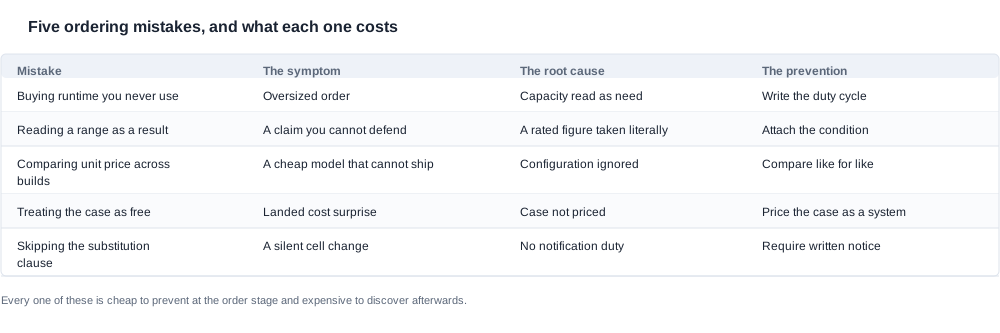
Smart glasses battery life: mistake one, paying for unused runtime
Capacity converts to runtime at whatever rate the workload draws, and a buyer who chooses on the published runtime without stating the workload will systematically mis-buy in both directions at once.
The published data in this range shows how far apart the ends of the scale are. The camera platforms carry 220 mAh to 290 mAh and publish runtimes in the five-to-eight-hour band. The children's entries carry 40 mAh and publish roughly twenty hours. The audio platforms sit between, at 55 mAh × 2 on the LC-105-1 and the YK12, and the LC-105-2 and the G07, and 90 mAh × 2 on the K01 and the K02, with published runtimes from roughly six hours on the G07 and the YK12 to roughly eight on the K01, the K02 and the LC-105 pair. A buyer who wants an intermittent sensing product and chooses on the twenty-hour figure will buy three times the cell capacity they need, and a buyer who wants continuous capture and chooses on the six-hour audio figure will buy a device that dies mid-task.
The symptom of this mistake is a specification that nobody can explain. The team asked for "eight hours" and got "eight hours" on the quotation, and the reasoning that produced the number was never written down. When the product is in the field and the figure is not met, there is no baseline to argue against, because the requirement was a number rather than a scenario.
The prevention is to write the duty cycle as a scenario before the first quotation goes out, and to require the supplier to answer in hours for that scenario rather than in hours for the catalogue. If a supplier cannot answer in those terms, that is a finding about the configuration and it is much cheaper to receive it at the quotation stage than at the launch stage.

Mistake two: reading a rated range as a measured result
Two suppliers quoting eight hours are not making the same claim unless the test condition is identical, and in this category it essentially never is.
Our catalogue states a charge time of two hours or less for nearly all twenty-eight models, with around one hour on the D17 and the ZH12. It states rated runtimes from roughly six hours on the G07 and the YK12 audio platforms, through roughly seven hours on the D11, the D12, the D17 and the MT6, to roughly eight hours on the LC-105-1, the K01 and the LC-105-2, and the K02, and up to roughly twenty hours on the A05 and the A06 children's entries. Not one of those runtime figures states the volume, the temperature, the pairing state, or whether the defining feature was active during the measurement. The camera tier publishes ranges such as five to eight hours, while several models publish a single figure such as roughly seven hours.
So when you compare two datasheets you are comparing two undocumented conditions. The numbers being close tells you nothing at all, and the numbers being far apart tells you even less, because the gap may be entirely a difference in test rig rather than a difference in product.
There is a second, quieter version of this mistake inside the buying organisation. A rated range travels. Somebody writes "eight hours" into a product brief, the brief becomes a specification, the specification becomes a listing, and the range quietly becomes a point figure with no range attached. By the time a customer compares it against another product, the condition is gone and unrecoverable.
The prevention has two parts and both are cheap. At the comparison stage, treat two figures as incomparable until someone states the condition behind each, and be suspicious of any figure whose condition is the same sentence in every document you have received. At the internal stage, write the condition into the same cell as the number, every time, so the two travel together by construction.
Mistake three: comparing unit price across different cell architectures
This is the mistake that produces a purchase order nobody can defend afterwards: the quotation looks cheap, the landed cost does not, and the reason is that two configurations were compared that are not the same product.
The range contains at least three configurations that break a naive price comparison. Dual-cell against single-cell. 55 mAh × 2 on the G07 and the LC-105-1, and the LC-105-2 and the YK12, 70 mAh × 2 on the YKC02, and 90 mAh × 2 on the K01 and the K02 are architecturally different from the single-cell models, and the per-cell documentation, the failure behaviour and the packaging are all different. Case against no case. The L1 Pro and the CY03, and the CY05 and the L2 Utral ship with a charging case, the KY06 and the MT5 ship with a case whose capacity is not published, and the V03 Pro has none. Interface against interface. Magnetic charging on the majority of the range, Type C on the V03 Pro, the L2 Utral, the D11, the D12, the D17, the ZH12 and the bone conduction entry, with the L2 Utral row also listing a 900 or 1400 mAh case option.
Compare a unit price from a no-case configuration against a unit price from a case configuration and the second looks expensive by the cost of the case, which is a comparison that tells you nothing about whether either configuration serves your use case.
The prevention is a rule rather than a calculation: quote like configurations against like configurations, and put the case, the interface and the cell count into the comparison line rather than treating them as options added afterwards. A buyer who wants the platform-level detail for the audio class has it on the bluetooth audio glasses range page, and the same discipline applies to every tier in the catalogue.
How to choose between two configurations that are not comparable
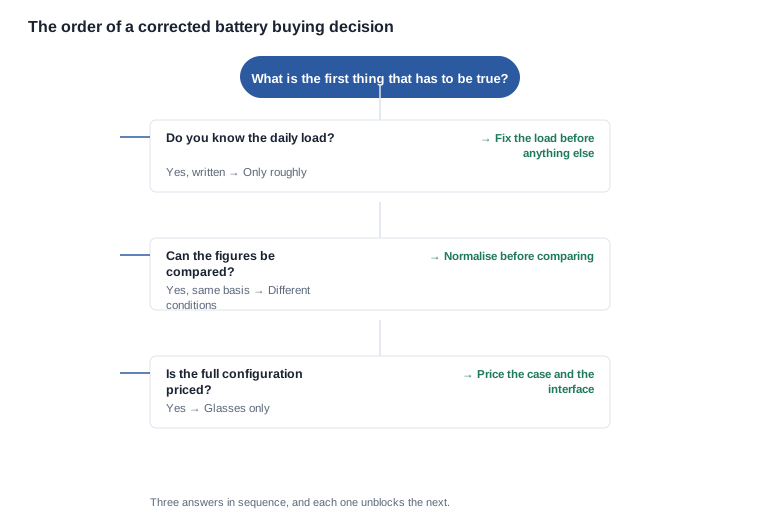
When two quotations describe different products, the criteria for choosing are not in the datasheets and they are not in the prices. They are in three places, and a buyer should assemble all three before any comparison is attempted.
The workload match. Which configuration's published runtime was measured under something closer to your duty cycle, if either is known. This is not a good measure of either product; it is simply a way to tell which quotation is worth opening in detail.
The cost of the difference. The full cost of moving from the cheaper configuration to the one your requirement actually implies. That figure usually includes a case, an interface change, a different packaging dimension and a different shipment weight, and it is almost always larger than the gap in the unit price that made the comparison tempting in the first place. A total cost calculation built at this stage costs an afternoon and frequently reverses the apparent answer.
The reversibility. Whether a decision made today can be changed at the next production run without a retooling and a re-certification. If it can, a buyer can take the cheaper option now and correct it later, and the whole comparison becomes less urgent. If it cannot, the comparison has to be right the first time, which is an argument for spending more time on it rather than for choosing faster.
Two of these three are cheap to calculate and one is a judgement. The mistake is reaching for the unit price first, because the unit price is the only number that arrives on its own.

Mistake four: treating the charging case as a free accessory
The case is a real cost line and a real commercial lever, and buyers who negotiate the glasses without pricing the case correctly discover the landed cost later.
The published case capacities are 1400 mAh on the CY03 and the CY05, and the L1 Pro, 900 mAh or 1400 mAh on the L2 Utral, and 1200 mAh in the foldable case on the MT6. The MT6 is also the one entry in the catalogue with a published weight, at 158 g for the glasses themselves, including the 265 mAh cell and the camera; the foldable charging case is a separate item carrying its own 1200 mAh cell, and no weight is published for the case itself. So a configuration that adds a case to the box also adds a second cell to the transport documentation, a second ageing curve to the programme and a measurable volume to the shipment.
The commercial case runs the other way as well, and this is why the mistake is so common. A case raises the achievable basket value and supports a "try it, then carry it daily" retail story, and in a channel where the margin is thin that difference can be the difference between a viable and a non-viable line. Buyers who price the case only as a cost have seen half the picture.
The prevention is to treat the case as part of the configuration in every quotation, comparison and price schedule, and to ask for the case price at the planned volume rather than the frame price with a case added on request. It is also worth asking whether the case is offered in more than one capacity, because the L2 Utral row lists both a 900 mAh and a 1400 mAh option, and two capacities for one configuration is two price tiers and two logistics plans.
Where the case sits in the negotiation
The case is one of the few items in a battery programme where a brand genuinely has room to move, because the case configuration is a choice rather than a consequence. Three things are worth putting on the table before you order, and the order in which they are worth discussing is not the order in which they are usually raised.
The capacity tier comes first. Where a model offers more than one case capacity, the higher capacity supports a longer day between charges and a stronger retail proposition, while the lower one reduces the shipment weight and the unit cost. Both are defensible and the choice depends on the duty cycle, so it should be decided before the price rather than after it.
The volume tier comes second, and it is where a brand with a real programme gets the most. A case is a manufacturing item with a repeat order pattern, so the price at the second and third order is usually better than the price at the first. Ask for the price schedule across the first three orders rather than for a single figure, and ask whether the case tooling is amortised across those orders or charged once.
The packaging decision comes third, and it is the one that affects the channel rather than the factory. A case that is presented as a separate line in the box supports an accessory business and a higher perceived value. A case that is presented as part of the kit sets a single expectations baseline and simplifies the listing. Neither is a technical question and both are settled before you order.
What is not negotiable is the cell itself and the transport documentation that travels with it, because those follow from the configuration rather than from the volume.


Mistake five: leaving the cell substitution clause unwritten
This is the cheapest mistake to prevent and the most expensive one to discover, and it is the one that is usually missed because nothing happens at the moment it goes wrong.
No battery chemistry, no cycle life and no field replaceability is published for any model in our catalogue, and the same is true of most suppliers in this category. If your product involves a serviceable pack, a defined warranty position on the cell, or a regulatory file requiring cell specification, you are buying into an open question unless you close it in writing.
The clause itself is short and there is only one sentence in it that matters. Ask whether the supplier will state the cell part number on the file and notify you in writing before any substitution. A supplier who agrees to name the part number but not to notify you has agreed to nothing, because a part number without a notification duty is a number that can change silently, and the moment it changes the transport documentation and the certificate coverage have quietly separated from the product in your hand.
The second half of this mistake is the one that is genuinely overlooked: every model in the catalogue is battery powered, which brings transport obligations that non-battery electronics do not. If a logistics plan assumed a general-goods shipment, this is the first thing to correct, because it changes packaging, labelling and documentation before a single unit is produced. The shipping and logistics material covers the obligations, and the sample evaluation protocol is the route to a measurement you own rather than one you inherited.
The four questions to ask before you order
If a buyer takes only one thing from this article, it should be the set of questions that closes all five mistakes in a single exchange. Four questions, sent together in writing before the purchase order is drafted, are enough.
- What is the cell part number for this configuration, and will you notify us in writing before any substitution? This closes mistake five and, as a side effect, tells you whether the transport documentation is tied to a specific cell.
- What runtime do you measure for this model under a duty cycle we describe, and under what conditions? This closes mistake one and mistake two together, because the answer has to be a number and a condition at once.
- What is the unit price of each configuration we are considering, with the case and the interface stated, at our planned volume? This closes mistake three and mistake four, because the answer has to arrive as a configuration and a tier rather than as a single price.
- Which of these answers are covered by a document, and can we have that document? This is the one that converts the other three from statements into evidence, and it is the question most often omitted because it feels redundant after three detailed replies.
The order matters. Asking the document question first, in the same message as the technical questions, produces a shorter and more complete reply than asking it afterwards, because at that point the supplier has already written the answers they expect to be asked about.
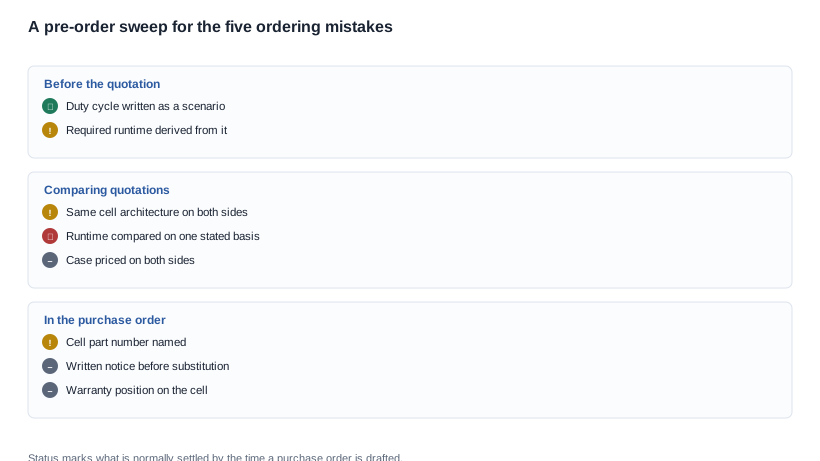
How the five mistakes arrive in sequence, and the position we take on them
The five are listed separately because each has its own prevention, but they rarely arrive separately. The typical sequence runs like this.
The specification is written from a datasheet rather than from a scenario, which is mistake one and the origin of the others. Because the requirement is a number rather than a scenario, the runtime figure is treated as a promise, which is mistake two. Because the requirement is a number, two configurations can be compared on price without noticing that they are different products, which is mistake three. Because the comparison was on price alone, the case is excluded from the quote and appears later as a cost surprise, which is mistake four. And because none of this was ever written down, the cell specification and the substitution question were never raised, which is mistake five.
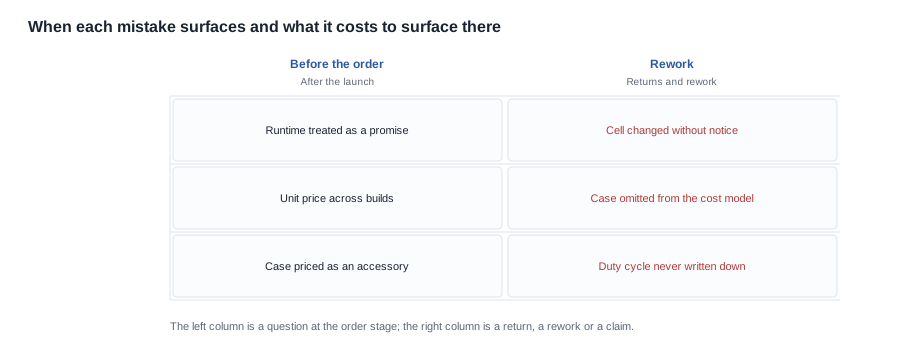
Each step makes the next one more likely, which is the practical argument for catching them early: the cost of a mistake caught before the purchase order is a question, and the cost of the same mistake caught after the launch is a rework, a return rate or a claim.
There is a second reason the sequence matters, and it is about the people involved. Each step happens at a different point in the chain and usually at a different desk. The specification is written by a product owner, the comparison is made by a buyer, the price is set by a commercial manager, and the cell clause is nobody's because it was never assigned. That is why the prevention for all five is the same shape: each one needs to be written into a document that already exists, rather than remembered by a person who is also doing three other things.
A closing test, and it is the one we would use on our own programme. Take the specification, the purchase order and the price schedule side by side and ask a single question: if the cell were changed tomorrow, by the supplier, without telling us, which document would stop us finding out from a customer? If the answer is none of them, that is mistake five, and it is the cheapest one to fix today.
The position we take on these mistakes
We publish the capacity, rated runtime, charge time, interface and case capacity exactly as our documentation states them, and we tell you plainly that the test conditions behind those figures are not published.
That last sentence is the honest core of this article. We are a supplier describing a gap in our own documentation, and we would rather you plan around the gap than discover it during a launch.
The measurement methods are covered under smart glasses battery life and power, and the platform-level detail for the audio class is on the bluetooth audio glasses range page.
Related reading
- What a runtime figure does not tell you — battery spec sheet explained
- Trading runtime against unit cost — battery cost vs performance
- Transport obligations for battery products — shipping and logistics
Tell us your workload and we will tell you which of these five rows we can confirm for your configuration.


