

Every battery specification sheet in this category contains roughly the same set of rows, and the rows carry very different amounts of information. A buyer who treats them as equally weighted spends the negotiating time on the ones that cannot separate suppliers and arrives at the end of a call with a shortlist that is still three models wide.
The reason is that a parameter's usefulness is relative. It has to be judged against three things: the tier of product being bought, the workload the product will actually create, and the amount of work a supplier has to do to answer. Capacity is decisive across tiers and useless inside one. Charge time is nearly identical across the whole range and therefore almost never decisive. A row the supplier cannot answer without running a test is a row that carries real information, and it is also the row a buyer should be willing to pay for.
The practical version of this is a ranking. The rows below are ordered by how much they change a decision, not by where they sit on a datasheet. The first rank decides the shortlist. The second rank narrows it. The third rank should not appear on the request at all, because asking for it spends credibility with the supplier and returns nothing.
Smart glasses battery life: published parameters that separate one supplier from another
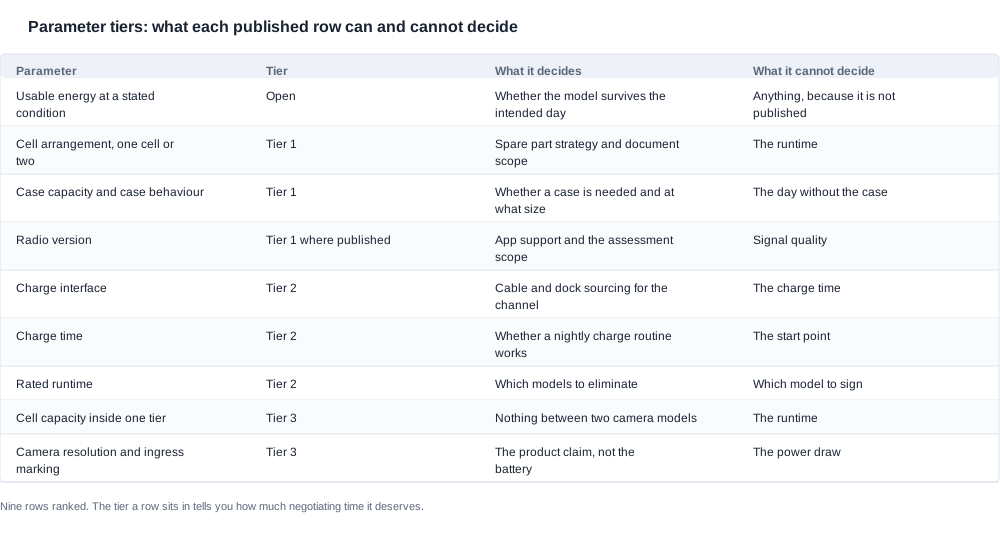
The buying task behind this page has a specific shape. A brand-side product manager or a channel buyer has a duty cycle in mind, a price band, a destination market and a candidate list. The job is to work out which of the published rows can be used as a specification and which cannot, and then to convert the workload the customer creates into a runtime target that the supplier can be held to.
The commercial risk being managed is not an incorrect purchase order. It is a product that meets its published figure and fails on the afternoon it was designed for, which reaches the customer as a return, reaches the support team as an argument nobody can settle, and reaches the finance team as a warranty provision nobody sized.
The useful way to think about the published rows is as a three-tier list, and the tiers are not about importance in the abstract. They are about how much a row changes a decision in a given purchase.
Rank one rows change what you can sell and what you have to prove. They are the rows a buyer cannot get from a brochure, which is precisely why they are worth requesting.
Rank two rows narrow a shortlist without closing it. They are useful for elimination and useless for selection.
Rank three rows look decisive on a page and discriminate nothing. They are the ones that generate the most discussion and the least movement.
A fourth group sits outside the ranking: the rows that are simply not published for any model. Those are not rank three, they are gaps, and they are where the real specification has to be written. Across our range the unpublished rows are the test condition behind any runtime, the usable capacity as distinct from the nominal figure, the cycle life rating, the behaviour of the device at the moment the runtime expires, the charge time of the charging cases, the number of additional sessions a case adds, and the chemistry of the cells.

Rank one: the rows that change what you can sell and what you have to prove
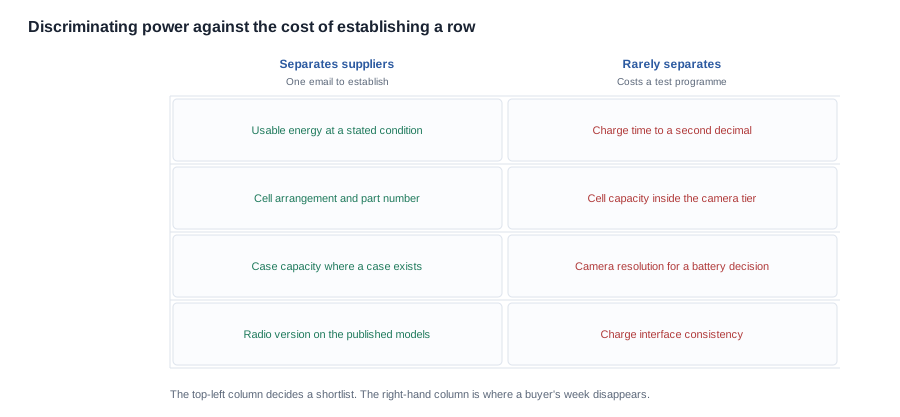
Four rows belong in rank one, and all four are open rather than published.
Usable energy at the stated condition. This is the row the whole category lacks, and it is the one a buyer has to create, because the supplier's rating does not contain the condition. Ask for the runtime under a workload that matches the intended use, and ask for the protocol behind the answer. A supplier who has measured a camera-active runtime and a camera-idle runtime can answer, and the difference between those two numbers is frequently the difference between a product that works and a product that returns.
Cell arrangement and part number. Our catalogue publishes a capacity per cell and, for several models, publishes two cells. The LC-105-2 and the LC-105-1, and the YK12 and the G07 publish 55 mAh on each of two cells, the YKC02 publishes 70 mAh on each of two cells, and the K01 and the K02 publish 90 mAh on each of two cells. What is not published is how the two cells are arranged, and that single fact determines the pack voltage, determines what a single cell substitution would do, and determines whether one weak cell pulls the pair down. It also determines the spare part strategy, which is a commercial decision a channel buyer has to make before the first order.
Case capacity and case behaviour. The case is the cheapest lever in the category and it is a rank one parameter because it changes the product rather than describing it. The CY05 and the L1 Pro, and the CY03 carry a 1400 mAh case, the L2 Utral carries a 900 mAh or a 1400 mAh case as a configuration choice, the MT6 carries a foldable 1200 mAh case, the KY06 and the MT5 ship with a case whose capacity is not published, and the V03 and the V03 Pro publish no case at all. The behaviour that matters is measured, not nominal: how many additional sessions a case adds, and whether the case charges the glasses while it is plugged in. Neither is published for any model.
The radio version, where it is not published. Our catalogue publishes the radio version for fourteen of the 28 models: version 5.3 on the K01 and the K02, and version 5.4 on the A07, the D11, the D12, the LC-105-1, the LC-105-2, the G07, the YK12, the YKC02, the D17, the ZH12, the AR entry and the electrochromic model. The eleven camera models, the two children's protection models and the bone-conduction entry publish none. For those fourteen models, the radio version is a rank one parameter for two reasons. It scopes the conformity file, so it changes the documentation work. And it determines the radio module, which determines the power budget, which determines what the published runtime is actually measuring.
What to do with a rank one row the supplier cannot answer
A rank one row will sometimes come back empty, and the correct response is a procedure rather than a second request. The fallback is a buyer-run measurement on a sample from the actual production batch, which is more valuable than a catalogue number precisely because it describes the buyer's own units under the buyer's own conditions.
The protocol has four parts, and each of them has to be fixed before the first reading. The workload, written as a duty cycle: how long each function runs in an hour, and how long the unit is idle. The environment: the ambient temperature and the signal condition. The starting state: the state of charge, and how long the unit was rested before the run. The pass condition: the runtime that counts as acceptable, which has to be a number the buyer has decided rather than one derived from the previous model.
Two details make the difference between a measurement and an opinion. Record the result on the second day rather than the first, because a cell that has been cycled once behaves differently from a new one. And measure a sample rather than a single unit, because a single unit tells a buyer about that unit. A buyer who skips both will end up with a number that cannot be defended in a warranty discussion, which is the only situation in which a measurement was worth doing.
Rank two: rows that narrow a shortlist without closing it
Charge time. Our catalogue publishes a charge time of two hours or less across most of the range and roughly one hour for the D17 and the ZH12. Across twenty-eight models with capacities from 40 mAh to 290 mAh, that is a narrow spread, and it discriminates between almost nothing. It remains useful for one decision: whether a charge fits inside a break or has to happen overnight, and therefore whether a nightly charge routine is viable for the customer. It is also a row with a hidden condition, because the charge time is meaningless without a start point and a source output.
Charging interface. Magnetic across most of the range, and Type-C on the V03 Pro and the L2 Utral, the D17 and the D12, and the D11 and the ZH12 and the bone-conduction entry. It is a rank two parameter because it is a genuine channel decision: it determines the accessories a buyer has to source, the cable question that follows, and whether the package needs to contain a cable at all. It becomes rank one on any product where the customer is expected to charge the device themselves and the source is not in the box.
Rated runtime. The published figures are a screen and nothing more. They eliminate a model, and they cannot select one, because the condition behind each figure is not published. A buyer who treats the runtime as a ranking criterion is comparing measurement conditions they cannot see, and this is where a lot of buying time goes to waste.
Case configuration, as distinct from case capacity. Whether a case ships in the box at all, and at which capacity, decides whether there are one price point or two. It belongs in rank two because it is a merchandising decision with a specification attached, not a technical gate.

Rank three: rows that look decisive and discriminate nothing
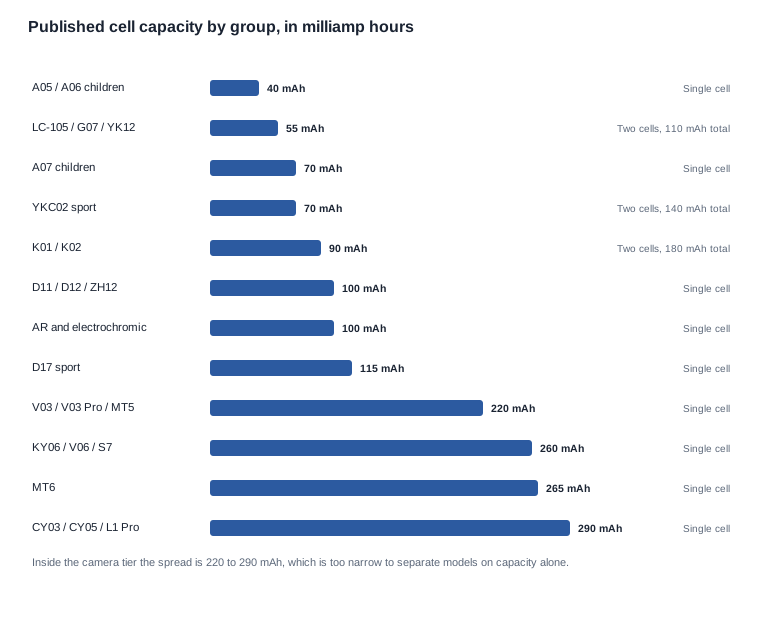
Three rows account for most of the noise in this category, and they are all rows that a buyer can check in ten seconds and therefore tends to check first.
Cell capacity inside a tier. This is the clearest case. The camera models in our range carry 220 mAh on the V03 Pro and the V03, and the MT5, 260 mAh on the S7 and the V06, and the KY06, 265 mAh on the MT6, and 290 mAh on the L1 Pro and the CY05, and the L2 Utral and the CY03. The spread is 220 to 290 mAh. Two camera models that differ by 70 mAh are, in practice, the same product from a battery decision, because the load dominates. Comparing them on capacity is a conversation about a row that cannot change the outcome.
Camera resolution. A megapixel figure decides what the product can be marketed as, not how long it works. It reaches the battery only indirectly, through the sensor's draw, and that effect is already inside the published runtime range. Asking about resolution during a battery evaluation spends attention on the wrong question.
The ingress marking. IP54 appears on the V06 and the S7 in our catalogue and on no other model. Where a marking exists it is a real commercial asset in an outdoor or sport channel. Where it does not, the marking says nothing about the product's ability to survive its environment, and it says nothing at all about the cell.
There is a fourth noise row that is not a catalogue row at all: the marketing adjective. A large battery, an all-day battery, a long standby, fast charging without a start point, and high energy density without a cell and a rating. None of these can be put into a specification, and each of them generates a request for a document that does not exist. The way to handle them is to ask what measurement would settle it, which converts the adjective into a request and usually ends the discussion.

Why a parameter only discriminates inside a tier
The most common purchasing error in this category is comparing across tiers and drawing a conclusion that does not hold. The range contains three product families with completely different duty cycles, and the published figures reflect that.
The children's models publish 40 mAh on the A05 and the A06 and 70 mAh on the A07, and all three publish roughly twenty hours of rated use. The camera models publish 220 mAh to 290 mAh and, where they publish a figure at all, five to eight hours. The audio models publish dual cells of 55 mAh, 70 mAh or 90 mAh per side alongside single 100 mAh and 115 mAh cells, with roughly six to eight hours. The bone-conduction entry publishes 200 mAh and roughly seven hours.
Put the children's models next to the camera models and the comparison looks absurd: a quarter of the capacity and four times the runtime. It is not absurd, and the reason is that the figures describe different duty cycles. The children's figure describes a light cycle with long idle periods; the camera figure describes a device with a sensor, a radio and a power-hungry load. Cross-tier comparison of runtime tells a buyer nothing about which product better serves a given use.
The rule that follows is simple and worth writing into a buying process. A parameter discriminates within a tier and, occasionally, across tiers where the duty cycle happens to match. So the first question in any evaluation is which tier the workload places the product in, and the second is which parameters the workload actually makes relevant.
The rows that decide within each tier
Within the camera tier, capacity cannot decide, and the deciding rows are the case configuration, the charge interface, the radio version where it is unpublished, and the measured camera-active runtime. The V03 Pro is a good illustration: it has the same 220 mAh cell as the V03 and publishes the same five to eight hours, but it charges over Type-C while the V03 charges magnetically, and it publishes no case. Those two differences are real purchasing decisions; the capacity is not.
Within the audio tier, capacity is more useful, because the load is closer to constant and the runtime tracks the cell. The G07 and the YK12 publish 55 mAh on each of two cells and roughly six hours, against roughly eight hours for the LC-105 pair at the same cell size and for the K01 and the K02 at 90 mAh on each of two cells. Identical cell figures, different runtime figures, which means something in the design differs and a buyer who wants to understand it has to ask rather than infer.
Within the sport tier, the deciding row is the charge interface and the charge time, since the D17 at 115 mAh publishes roughly one hour and the ZH12 at 100 mAh publishes roughly one hour over Type-C, while the YKC02 at 70 mAh on each of two cells publishes roughly eight hours over magnetic.
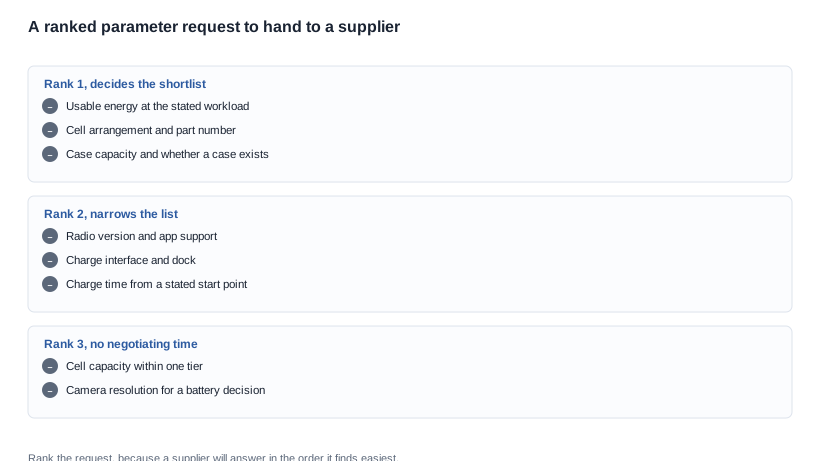
A ranked parameter request to hand to a supplier, with the priority attached
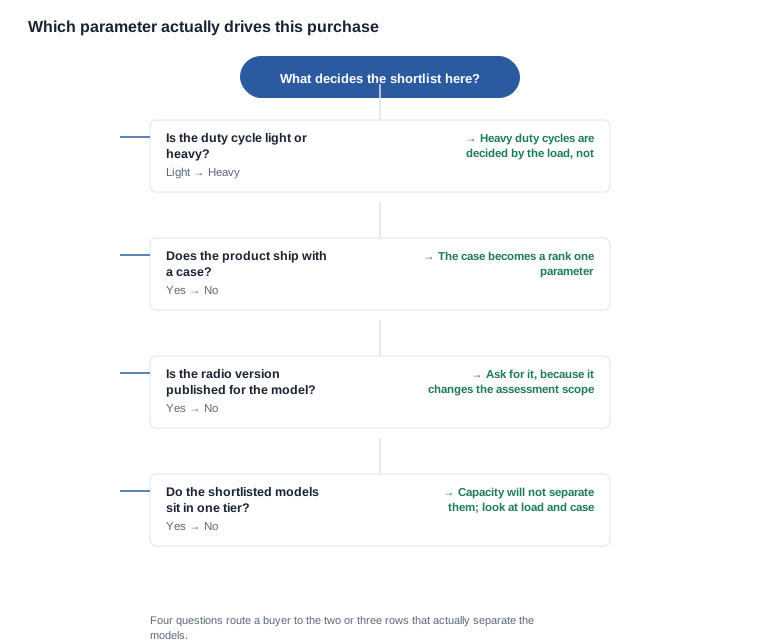
The request is usually the point where a buyer loses the most. A list of twenty questions goes unanswered in the order the supplier finds easiest, and the two answers that arrive are about charge time and capacity. A ranked request inverts that: the supplier answers the top of the list first, and the buyer gets the rows that decide the purchase before the rows that merely describe it.
Rank one, and it decides the shortlist. The runtime under the stated workload, with the protocol behind it. The cell arrangement and the cell part number. The case capacity for the configuration ordered, and the measured number of additional sessions the case adds. The radio version for the model, where the catalogue does not publish it.
Rank two, and it narrows the list. The charge interface and the dock. The charge time from a stated start point, at a stated source output. Whether a case charges the glasses while plugged in. The end-of-runtime behaviour, including whether the product warns and which function stops first.
Rank three, and it should not be on the request. Cell capacity within a tier. Camera resolution. A marketing adjective with no measurement attached.
The final instruction to the supplier matters as much as the ranking. Ask for every model on the shortlist in the same words, and ask for the answer as a document or a number rather than as a summary. A supplier who answers the same question the same way for six models has a measurement process. A supplier whose answers vary in kind between models is quoting from a catalogue, and the buyer's next step is a sample measurement rather than another email.
There is one commercial point worth making internally before the request goes out. A rank one row is, by definition, a row the supplier has to do work to answer, and the supplier knows it. That is where the leverage is. A buyer who accepts a generic answer on a rank one row has paid a unit price for an unknown, and a buyer who asks for a written answer on the same row has converted a marketing claim into a contractual term. The negotiation value is not in the unit price at all.
Our own catalogue publishes the rated runtime, the charge time, the cell capacity, the charging interface and, on the models that carry one, the case capacity, and it publishes them exactly as the catalogue states them. It publishes no test condition behind any runtime, no usable capacity, no cycle life rating and no end-of-runtime behaviour for any model, and we will not estimate them from typical values. We will not convert a rated runtime into a usable one by applying a typical efficiency figure, because the efficiency is a property of the specific design rather than a general constant.
What we will do is take your workload, your session length, your duty cycle and the models you are considering, and tell you which published rows apply to that workload, whether the catalogue figure is a usable target or a ceiling for it, and which of the items above our documentation can answer and which need a test or a written confirmation from the company. The published rows are at battery life, the interface and charge-time decisions are at charging solutions, the case options are at AI camera glasses, and the way to check a delivered unit is at sample evaluation.
Related reading
- The published rows and what they omit — battery life
- The charging decisions behind a longer day — charging solutions
- The case capacities across the range — AI camera glasses
- The way to check a delivered unit — sample evaluation
Tell us the usage pattern, the session length and the duty cycle, and we will say which published rows apply and what has to be confirmed.


