

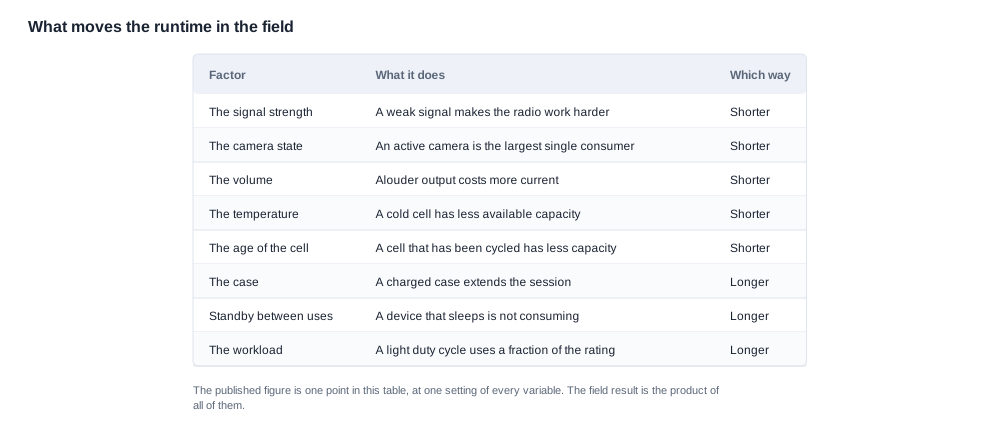
A published runtime is one point in a table with eight variables, and every one of those variables is set by the user rather than by the factory. Which means the number in the catalogue and the number in the customer's hand are the same number only in the conditions in which the catalogue figure was taken, and the catalogue figure does not state those conditions. This article works through the variables, because a buyer who understands them can plan a use case and a buyer who does not will be surprised by their own customers.
Smart glasses battery life smart glasses real world performance is therefore a translation problem rather than a specification problem. The catalogue gives you a rating; your programme needs a working figure, and the distance between the two is decided by four variables you can name and measure: the radio load, the sensor load, the ambient conditions and the age of the cell. The practical consequence for procurement is that you should buy a measurement, not a number.
That makes how to choose a platform an unusual question in this category, because the catalogue cannot answer it. The criteria are narrow enough to write on one page: does the published row state a workload, does the charge path match the duty cycle the product runs, and is a case available for the working day. Where a supplier cannot answer those three, the correct decision before you order is to treat the runtime as unknown and price the measurement into the sample budget rather than into the launch budget.
Smart glasses battery life: why the published and working figures differ
The rating in the catalogue is a ceiling. It is the runtime obtained when the platform's own test conditions hold, and those conditions are not published for any model in our range. Nothing in a 220 mAh camera platform's five-to-eight-hour range tells you whether the sensor was active while the hours were counted, whether the radio was connected, or what the volume was set to. A figure with no condition attached is a boundary rather than an expectation, and the gap between the two is where customer complaints live.
Four variables do most of the work in that gap, and they are worth separating because each one can be tested independently.
The radio load. A radio working to maintain a weak connection draws more current than one holding a strong one, and the radio is active throughout a session in a way that a sensor is not. A customer in a basement, a lift or a rural area will see a shorter session than a customer in an open office, using the same product, on the same day. This is the variable buyers most often forget, because it is invisible on the product and it varies by building rather than by setting.
The sensor load. On a camera platform the image sensor is the largest single consumer, and whether it is recording is the difference between a short and a long session. On an audio platform the sensor does not exist, which is a large part of why the audio platforms cluster at six to eight hours while the camera platforms publish a range that starts at five.
The ambient conditions. A cold cell has less capacity available, which is why a device left in a vehicle over winter feels as though it has lost an hour of charge. The same effect runs the other way in high heat. This is a seasonal effect on how a product is perceived, and it is not a defect — but it arrives at a support desk as a defect unless someone has already answered it.
The age of the cell. A cell that has been through hundreds of charge cycles holds less than a new one, so a product that reached its customer with a good runtime in its first year delivers less in its third, and the perceived quality of the product falls even though nothing has failed. For a brand with a two-year replacement cycle, this is not a defect case; it is a design-of-expectation case.
Two variables pull in the opposite direction and are worth naming in the same breath. A charged case is the largest extension available, and the published case capacities are worth planning around: 1400 mAh on the CY03, the L1 Pro and the CY05, 900 or 1400 mAh as a configuration option on the L2 Utral, and a foldable 1200 mAh case on the MT6. The KY06 and the MT5 are published as coming with a case and the capacity is not published, and the V03 and the V03 Pro are published without a case. And a device used in short bursts through a day consumes a fraction of the rating, which is why the children's platforms publish about twenty hours on 40 mAh and 70 mAh cells — a figure that is coherent as a duty cycle and absurd as continuous operation.

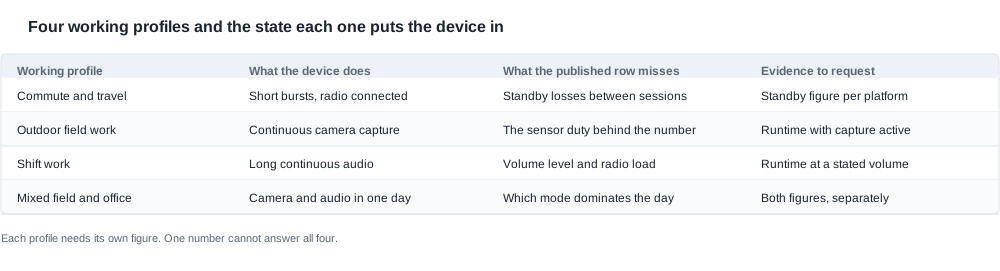
Four working profiles, and the device state each one creates
The same product behaves differently in four common working conditions, and a programme that sells into more than one of them needs a different figure for each. These are the profiles that recur most often in smart glasses procurement, and they are described here by the state they put the device in rather than by the customer segment they serve.
A shortlist that spans two of these profiles therefore has to be built on the workload rather than on the catalogue row, and the questions to ask a supplier differ by profile. This is also where the total cost of an unstated condition appears: a figure that has to be measured after launch lands in the engineering budget rather than in the procurement budget, and it lands there with a schedule attached.
Commute and travel. Short bursts of use, a connected radio, and long idle periods between them. The published row is a poor predictor here because the number is dominated by standby losses rather than by active work. What the buyer needs from the supplier is the standby behaviour and the wake behaviour, because a product that survives two hours of continuous audio will not necessarily survive eight separate short sessions. The evidence to request is a standby figure per platform, with the measurement condition attached, and a statement of what the device does after an extended period unused.
Outdoor field work. Continuous sensor activity, wide temperature swings, and a device that is often carried rather than set down. Here the published rating is dominated by the sensor load, and a rating obtained with the sensor idle is close to meaningless. The figure to request is the runtime with the capture duty active, at the volume or frame rate the product actually ships with. The models to examine are the camera platforms: the V03 and the V03 Pro publish five to eight hours on 220 mAh, the KY06 publishes six to eight on 260 mAh, and the MT6 publishes about seven on 265 mAh with a foldable 1200 mAh case. Note that the seven camera models with no published hours row are exactly the ones a field programme cannot screen without asking.
Shift work. Long continuous audio at a volume the customer actually sets, with the radio connected. The amplifier draws more as the signal gets larger, so a high volume in a quiet environment is close to the worst case for the battery, and most buyers do not treat it as such. The figure to request is the runtime at a stated volume rather than at a nominal one, and the D11, the D12, the D17 and the ZH12 are the models where the charge path and the platform both matter, since all four are Type-C platforms with cells between 100 mAh and 115 mAh.
Mixed field and office. A camera platform used for part of the day and audio for the rest. Here no single figure works, and the mistake is to publish the more flattering of the two. The correct output is two figures, each with its workload, so that the listing can state which mode delivers which figure — and, more importantly, so that the support script and the warranty can reference the right one.
The commercial consequence of treating these four profiles as one is a listing claim that cannot survive a customer who is working outdoors. The consequence of treating them as four is a specification file with four figures per model, which is more work at the quotation stage and much less work at the returns stage.
The measurement protocol that produces a figure you can publish
A useful field measurement needs no laboratory and takes a working day, but it only works if the protocol is written before the first reading. A protocol designed afterwards is a description of what happened, and it cannot be defended to a supplier, to a customer or to a marketplace reviewer.
The criteria for accepting the result are worth writing at the same time as the protocol: how many units, which profile, which environment, what counts as the end of the session, and what happens to a lot that fails the run. Those five rows are the whole checklist, and a purchase order that contains them turns a measurement into an acceptance standard. The usual trade-off is a slightly longer sample stage against a much shorter dispute later, and the arithmetic favours the sample stage every time.

Write the workload down first. Not a description of the product, but a duty cycle: what the device does, for how long, in what order, and with which features active. If the product is a camera platform, write the capture duty, because a duty cycle of two minutes of capture every hour and a duty cycle of continuous capture are different products wearing the same number.
Record the start state and the end condition. A runtime measured from a partly depleted cell is not a runtime, and a device that becomes unusable at five per cent while still drawing power has run out before its own display says so. Both boundaries need writing down, because both are the kind of detail that turns out to be the actual difference between two suppliers.
Run the same duty cycle on three separate units. A spread between units from the same production lot is normal and is worth knowing about, because it determines how you write your own customer-facing claim. A single unit tells you what that unit did; three units tell you what the product does. If the spread is wide, the number in your listing needs to be the conservative one.
Repeat the run in the environment the product lives in. A bench measurement and a warehouse measurement are different results, and the second one is the one your customer will reproduce. The point is not to make the number worse; it is to make it real.
Write the measured figure and the workload into the purchase order. This is the step most programmes skip and the one that pays. If the criteria live in an email, they are not binding. If they live in the order, they are the acceptance standard, and a lot that fails them is a lot you can refuse or a claim you can settle.
The three most common questions about this protocol are practical rather than technical. Do you need instruments? For a runtime measurement, a clock and a written protocol are enough. How many units? Three is a sensible minimum for a screen; more if the result goes into a warranty. How long does it take? One working day per unit per profile, plus the time to write the protocol, which is the part people forget to budget.

What a working day costs, hour by hour
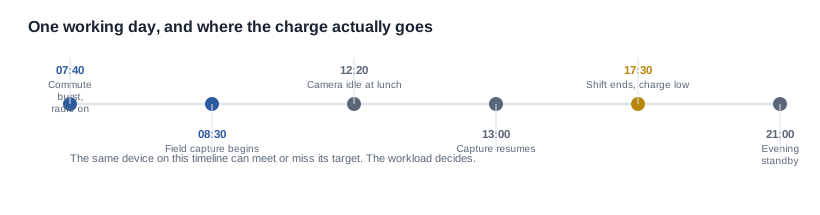
The clearest way to see why a rating and a working figure diverge is to walk a single day on a single device and account for where the charge goes. Nothing in this walkthrough is a measured result for a specific model; it is the structure a buyer should use when they run their own measurement, and it also produces the decision rule for when to demand a case, when to demand a longer rated figure, and when to accept that the product is a session product rather than a day product.
A technician leaves home at 07:40 and connects the device to a phone for a short call. The radio comes up, the pairing holds, and the device returns to a low-power state within a minute or two. That burst is short, and the charge it consumes is a function of the wake behaviour rather than of the runtime rating.
At 08:30 the camera starts running and does not stop until the job is documented at 12:20. This is the block that consumes most of the charge, and it is the block whose duration the published rating almost never accounts for. A four-hour continuous block is the figure that decides whether the product finishes the shift.
At 12:20 the camera goes idle while the technician eats, and the device sits in a warm vehicle or a bright yard. The idle draw over that period is small in absolute terms, and it is large in relative terms over a nine-hour day. This is the block that separates a device designed for a working day from one designed for a working session.
At 13:00 capture resumes and runs for another four and a half hours, by which point the charge state depends entirely on whether the morning block was budgeted correctly.
At 17:30 the shift ends. At this point the useful output of the measurement is not a single number but two: the hours survived, and the gap between this day and another day in a different building. A product with a ten per cent gap between days is predictable. A product with a forty per cent gap is not, and that inconsistency is a support cost that no specification sheet will ever show you.
At 21:00 the device has been idle for three and a half hours. Whether it is still usable tomorrow morning, and whether it needs a case charge or a cable, is the last question the day should answer.
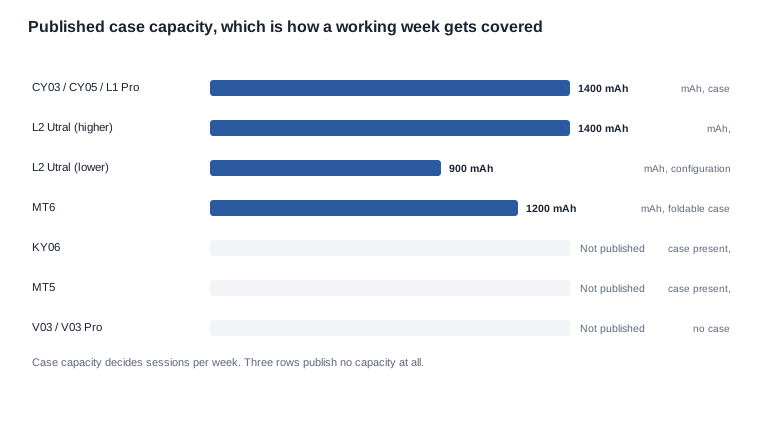
Two questions belong to this walkthrough and nowhere else. What does the device do as the charge runs down — does it warn, does it save, does it degrade gracefully — because that behaviour is what determines whether the customer has a warning or a surprise. And how many case charges cover a working week, which is arithmetic on the published case capacity once you know the hours per charge from the measurement above.
Where the gap between rating and reality becomes a commercial problem
The gap is not an abstract quality issue. It has a price, and a buyer should be able to name the line it lands on. The pitfalls in this category are rarely technical — the measurement is usually available and usually agreed. They are procedural, which is why they survive into launch.
A listing claim that is wider than the product. The most common version of this is a runtime figure quoted from the catalogue without its condition, then written into product copy as a flat statement. The customer compares it with their own day, finds a difference, and the resulting complaint is a return and a review. In a category where the margin is thin, the volume of those returns decides whether a platform is viable, and the deciding factor is rarely the technology — it is the distance between the number on the box and the number in the hand.
A duty cycle that was assumed rather than declared. Some of our published figures are unmistakably duty-cycle figures: the A05 and the A06 publish about twenty hours on 40 mAh cells and the A07 publishes about twenty hours on 70 mAh. A buyer who treats those as continuous-session ratings will build a product brief that cannot be delivered, and the gap surfaces at the sample stage, when it is most expensive.
A case that is not in the packaging. The models with a published case are the KY06 and the CY03, the MT6 and the L1 Pro, and the L2 Utral and the CY05, and the MT5. Two of those publish no case capacity at all. If your brief assumes a customer can carry a week of charge in a pocket and the case in the box is a different unit than the one in the photograph, the returns arrive without any product having failed.
A fleet replacement cycle that outruns the cell. If your channel replaces devices every two years and the cell loses a meaningful share of its available capacity well before that, the failure does not arrive as a broken product. It arrives as a slow erosion of how the product is judged, which is far harder to attribute and far more expensive to correct.
The remedy is not to publish a lower number than the catalogue. It is to publish the number with its condition, so the customer's expectation is set correctly the first time, and to keep the measurement record that supports it.
What we publish about runtime, and what we will run with you
Our catalogue publishes the cell capacity, the charging interface, the rated runtime and, on the models that carry one, the case capacity. It publishes no test condition behind any runtime figure, no usable capacity, no cycle life rating, no charge curve and no thermal figure for any model, and we will not estimate any of them. We would rather show you a gap than fill it with a number that nobody measured and that a customer will quote back at you in a dispute.
The same applies to weight, where the published figure is narrow in a way that is easy to misread. The catalogue publishes one weight in the entire range: 158 g for the MT6 glasses body, including the 265 mAh cell and the camera and excluding the foldable charging case. The case holds 1200 mAh and its own weight is not published. No bare frame weight is published for any model, so any statement about how light these products are has to be checked against the figure that exists rather than assumed from it.
What we will do is run the measurement with you, against your workload rather than ours. Give us a model, a duty cycle, a volume level, an ambient temperature and a session length, and we will tell you which published rows apply to that combination, which rows are open and have to be requested, and what a first measurement should look like so that the number in your listing is one you produced and can defend. That is the due diligence we can offer on this question, and it is a more useful answer than a converted figure would be. The battery and power pillar holds the measurement methods, the AI camera glasses range holds the platform detail for the camera models, and the sample evaluation page covers how the first units are handled.
Related reading
- The published rows and what they omit — battery life specifications
- Turning a use case into a target — choosing a runtime target
- The case capacities across the range — AI camera glasses range
- The way to check a delivered unit — sample evaluation
- The case capacity behind the working week — charging solutions
Tell us the usage pattern and the model, and we will say which published figure applies and what to measure.


