

Smart glasses battery life: questions before a sample
Four questions decide a battery decision in this category, and three of them are routinely asked too late. The first is how long the product runs, which is the number everybody quotes and the number that means the least on its own. The second is how long it takes to charge, which is the number that sounds like a plan and is not one, because it is published without a starting state and without an end criterion. The third is what happens when the charge runs out in the middle of a task, which is a product behaviour and a support-script line rather than a specification, and which is decided by how the product is designed rather than by what the supplier promises. The fourth is what the charging case does, because in this catalogue the case is not an accessory — it is a second battery with its own rotation, its own charging discipline and its own logistics line, and it is the part of the battery story that is usually left out of the commercial discussion.
- How long does it run, under what load? A figure with a load, a source, a temperature and a starting charge state beats a figure without any of them.
- How long does it charge, from what state, to what state? Without those two conditions the number cannot be turned into a shift-handover plan.
- What happens when the charge runs out mid-task? A product behaviour and a support-script line, decided by the design rather than by a supplier's promise.
- What does the charging case actually do? A second battery with its own rotation, its own logistics line and its own failure mode.
The order matters because the first two questions are about the product and the last two are about the operation, and a buyer who answers only the product questions has designed a product rather than a service. A channel that sells to a warehouse, a retailer or a field team does not sell runtime; it sells a shift in which the product keeps working and a way of putting the charge back before the next shift starts. The number that decides whether the programme works is therefore not a published figure at all. It is the time between the end of one use and the start of the next, measured in the buyer's own operation.
The catalogue publishes three battery-related numbers for every model it lists: the cell configuration, the rated runtime, and the charge time. For twenty-six of the twenty-eight models the charge time is two hours or less, and for two it is about one hour. It does not publish the starting state of charge for any of them, the criterion for a full charge, the discharge curve, the behaviour at low battery, or the cycle life of the cell. The consequences of that are set out below, and the underlying figures are on the battery life technology page.
The commercial reason to settle this before the sample is simple. A battery that cannot carry a shift is not a product problem, it is a returns problem, and a returns problem in this category is expensive because the unit usually comes back and has to be diagnosed, and because the channel that experienced it will not reorder for two or three quarters. A buyer who settles the battery question in writing at the quotation stage pays for one exchange of email. A buyer who settles it in the field pays for a return rate.
The three published numbers and the two missing conditions
The three published numbers are the cell configuration, the charge time and the rated runtime. All three are real, all three are useful, and all three are conditional in ways the catalogue does not spell out.
The cell configuration is published as a cell value and a cell count rather than as a total, which is the correct way to publish it. A two-cell product and a one-cell product with the same total behave differently in the field: they degrade differently, they charge differently, and a single failed cell in a two-cell design leaves the product with reduced runtime rather than with none. The configuration is the first thing to check when comparing two quotes that look identical on runtime.
The rated runtime is a figure measured under conditions the supplier chooses, and the conditions are what matter. Volume level, source content, whether the microphones were active, ambient temperature and the starting charge state all change the result. A rating taken at a low volume is a rating of a quiet product, and a buyer who sells into a noisy environment should not assume it transfers.
The charge time is the most misused of the three, and the reason is the two conditions it does not publish. There is no starting state — a charge time measured from empty is not the same figure as one measured from a part-charged unit — and there is no termination criterion, which is to say no statement of what percentage of charge counts as finished. Without those two conditions, a charge time cannot be turned into a shift-handover plan, because the buyer cannot know what state the product is in when the clock stops.

Why two runtime figures in the same catalogue are not the same product
Two models with a similar cell and a similar rated runtime are not interchangeable, and the reason is visible in the published table. Some models publish a range and some publish a single figure, and the ranges in this catalogue run from five to eight hours to six to eight hours. A range is a better disclosure than a single number in one sense and a worse one in another: it is honest about the conditions, and it tells the buyer that the figure can move by a large proportion depending on load.
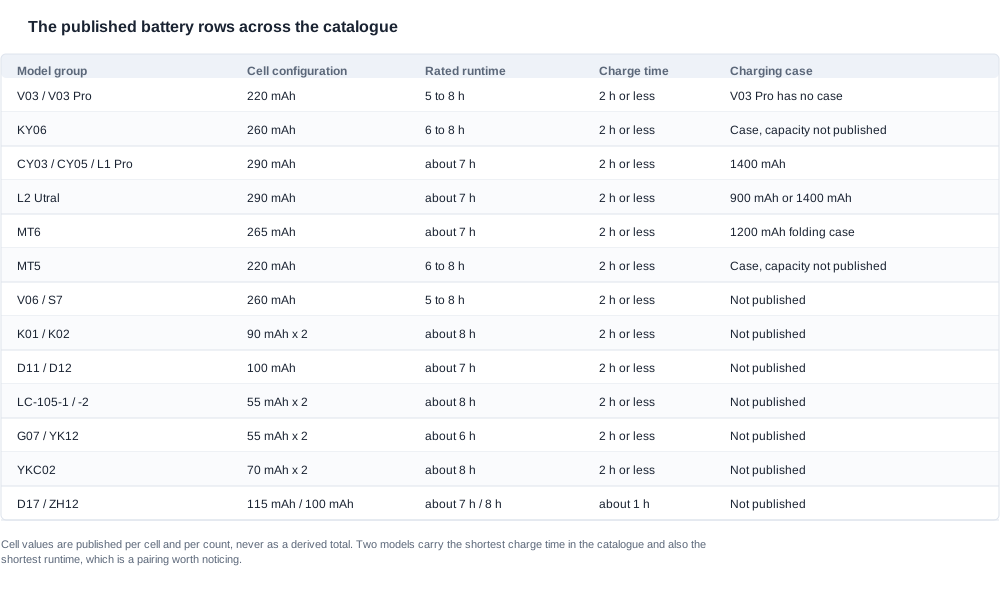
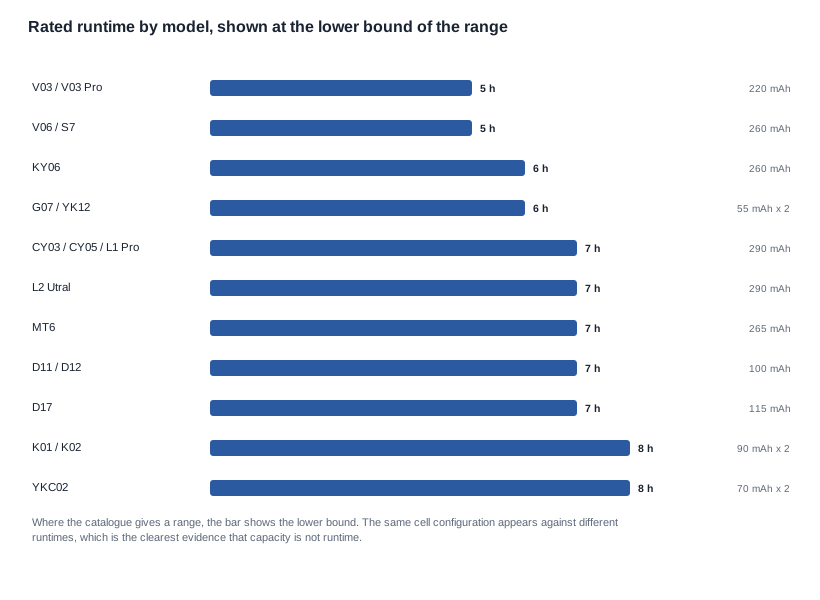
The table is the full battery picture the catalogue holds, and it is worth reading across rather than down. Read across the charge-time column and one thing jumps out: charging time barely varies across the whole range, because it is published as a bound rather than as a measurement. Read down the runtime column and the interesting structure appears: the camera models sit in a band between five and eight hours, the audio models split into a group around six to eight hours and a group at roughly seven or eight, and the two models with the shortest published charge time are the ones that also carry the shortest published runtime. A buyer who is optimising a shift plan should be looking at that relationship, not at any single row.
Capacity is not runtime, and the catalogue shows both
The single most common reasoning error in battery discussions is to treat the cell configuration as a runtime proxy. It is not, and the catalogue is unusually well placed to demonstrate why, because it publishes the same cell figure against visibly different runtime outcomes. The 55 mAh × 2 group is the clearest case: three models in it publish roughly eight hours, roughly eight hours and roughly six hours. The cell configuration is identical, so the difference is coming from the rest of the design — the transducer loading, the amplifier, the frame and the intended use of the product.
The same pattern runs through the camera models, where the cell figures range from 220 mAh to 290 mAh and the runtimes range from five to eight hours with no monotonic relationship to capacity. That is not an error in the catalogue; it is what a real product portfolio looks like when the rating is measured rather than derived.
The practical rule for a buyer is to treat capacity as a cost and logistics input — it determines the cell price, the weight, the transport documentation and the case sizing — and to treat runtime as a specification that has to be measured for the application. A buyer who selects on capacity is optimising the wrong variable, and the error is invisible until the field reports that a six-hour product is being asked to cover an eight-hour shift.
Charging time is not a turnaround plan
The charge-time figure is published for every model, which makes it easy to assume it is directly usable. It is not, for the two conditions already described: no starting state and no termination criterion. There is a third limitation that is worth stating separately, because it is the one that breaks re-order logistics. A charge time describes the interval between a device being connected and a device being at some unspecified state. It says nothing about how many devices can be charged at once, how many chargers a site needs, how long the queue is when a whole shift's worth of units comes back at the same moment, or how quickly a unit can be turned around when it fails mid-shift.
That last point is the one that decides the operational model. If a unit fails at the start of a shift, the question is not how long it takes to charge; it is whether the site holds enough charged units to cover the gap, or whether the model is unsuitable for the operation. A buyer who has a spare-unit policy is buying a battery-driven decision without ever discussing the battery, and a supplier who is not asked about the spare-unit ratio has not been asked the question that matters.
The same logic applies to the language in a listing. "Charges in under two hours" is a specification. "All-day power" is a claim, and the claim is only defensible if somebody has measured the working day and it is longer than the shift. Buyers should expect to be asked which of the two the supplier intends to use, and should be explicit about which one they will accept.
The case is a second battery with a rotation problem
Where a charging case is part of the configuration, it changes the battery design of the product rather than adding a convenience. In our catalogue the case capacities are published for four camera configurations: L1 Pro and CY03, and CY05 carry a 1400 mAh case, L2 Utral is offered with a 900 mAh or a 1400 mAh case, and MT6 carries a 1200 mAh folding case. Two more camera configurations have a case with no published capacity, and V03 Pro has no case at all.
The commercial consequence of a case is a second logistics line and a second quality line. It adds units to the packing list, volume to the shipment, and weight to the freight calculation, and it adds a component whose failure mode is different from the device's. A case that sits unused on a desk is a second cell that degrades slowly, and a buyer who is tracking warranty exposure has to decide whether the case is a supplied accessory or a supplied consumable.
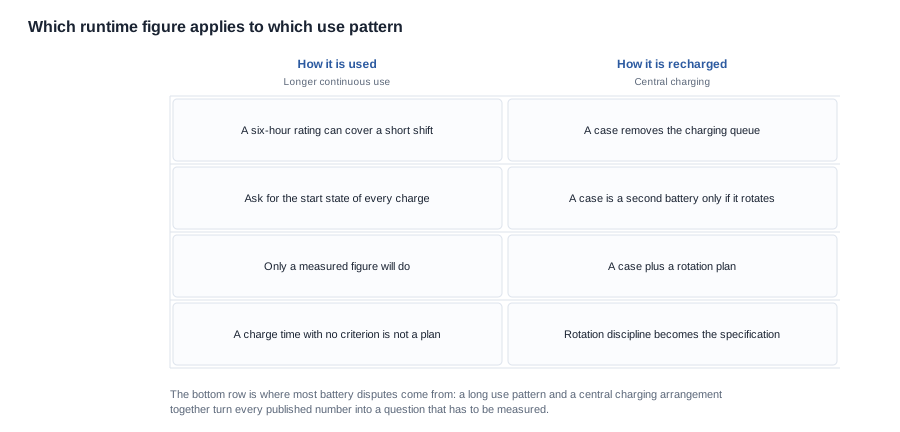
The operational consequence is a rotation problem. A case-based product is charged in batches rather than individually, which produces a queue at the end of a shift and a storage requirement in between, and it produces a second failure mode when a case is left empty: the case has to be charged on its own schedule, and that schedule is somebody's job. The rotation plan is therefore part of the battery specification, and a buyer who has not written one will discover that the product spends a third of its life in a drawer.
There is one more decision that the case forces, and it is a commercial one rather than a technical one. If the case is what makes the product viable for the shift, then the case is a line in the warranty, a line in the quality inspection plan and a line in the spare-parts calculation. A supplier who quotes the case as an optional extra and a supplier who quotes it as part of the battery system are quoting two different products, and the difference shows up in the return rate rather than in the invoice.

A battery protocol you can run on five sample units
Battery verification is the easiest part of this category to do properly, because the measurement is repeatable, the conditions can be written down, and the result is visible without a laboratory. What makes it fail is not difficulty; it is that the protocol is written after the sample has already been shown to a buyer, so the conditions are chosen by the supplier.
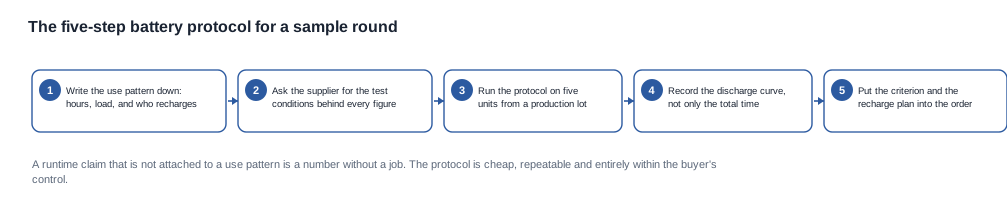
Step one: write the use pattern before you touch the unit. Hours per shift, what the product is doing during them, how many units per site, who recharges them, and how quickly a failed unit has to be replaced. Everything after this step is measured against that pattern. A protocol written without a pattern produces a number that is correct and useless.
Step two: get the conditions behind every published figure. Volume level, content, microphone state, ambient temperature, starting charge state, and whether the measurement ends at a voltage the product still recognises as full. Ask for the supplier's own test protocol, not just the result. A supplier who can hand over a protocol has a number they are willing to defend; a supplier who cannot has a number they picked.
Step three: measure on at least five units, from a production lot rather than a showcase. The spread between units is the finding. A single unit that performs well tells the buyer nothing about the tail, and the tail is what a warranty is priced on. Record the earliest unit to fail, not the average, and note the lot the units came from so that a later claim can be traced back to a production run.
Step four: record the discharge curve, not just the total. Total time to empty is a number; the curve tells you where the product becomes unusable. A product that holds a usable state for most of the discharge and then drops sharply is a different product from one that fades gradually, and the first one suits a shift pattern where the last hour is a winding-down hour. The curve also makes the replacement planning possible, because it shows the point at which a spare unit has to be in use.
Step five: write the criterion and the recharge plan into the order. A measured runtime, at a stated load, on a stated number of units, with a stated pass rule, attached to the purchase order. And alongside it, the recharge plan: charger count, the rotation policy, who owns the case or the charging hub, and the spare-unit ratio. These are the two documents that stop the battery question from becoming a returns question.
A runtime evaluation for a shift-based channel
The sequence below is a hypothetical case, written to show how the decision would be made rather than to report a client outcome. Assume a channel buyer supplying a uniform and inspection product to logistics sites, where units are carried by staff across a full shift and are returned to a depot at the end of it. The buyer's constraint is not weight and not price; it is that a unit which stops working mid-shift is removed from service and cannot be reissued, so the site's spares absorb the loss.
Step one: the use pattern is written down. The shift is eight hours, the product is in continuous use with the audio and capture functions active, and the depot recharges overnight in a batch. The buyer works out immediately that a published five-to-eight-hour range is not a shift plan and a seven-hour figure is not a shift plan either. The question is no longer "which model runs longest" but "what has to be true for a unit to survive the shift".
Step two: the shortlist is cut on the charge interface and the cell configuration. The depot recharges in batches, so the charging method and the case configuration become the deciding rows, not the runtime column. Two camera configurations with a 1400 mAh case and one with a 900 mAh or 1400 mAh case survive on the logistics side; the configuration with no case at all is eliminated before any battery measurement is taken, because there is no overnight route back to a charged state.
Step three: the measurement. The buyer runs the protocol on five units per shortlisted model, at the real load, through the full shift and into the tail, and records where each unit becomes unusable rather than only when it stops. The result is a pass rule that is written in terms of the shift: a unit is acceptable if it remains usable for the full eight hours under the stated load, with a stated tolerance, on a stated number of units.
Step four: the recharge plan is attached to the order. Charger count per site, the case rotation, the number of units held in the depot charged and ready, and the failure swap procedure. The supplier is asked to confirm that the case charging method is compatible with the depot's overnight batch, and the answer is written into the order rather than assumed from a sample.
Step five: the claim is narrow. The listing states the measured figure with its conditions, or states the published rating as a rating. The buyer's channel is given a support script that distinguishes "the unit is finished for the day" from "the unit has failed", because the two produce completely different returns and completely different costs.
The walk-through did not settle the battery question by finding the longest runtime. It settled it by finding which units can be recharged in the buyer's operation, then by measuring whether they survive the shift, and then by writing the recharge plan down before the goods shipped.

The battery failures that appear after the goods land
Four battery-related failures recur in this category, and all four are information failures rather than engineering failures. Each one has a symptom, a root cause and a prevention available before the first shipment.
The unit does not last a shift, and the supplier's figure was correct. The symptom is a cluster of returns from one customer type with a description that mentions battery. The root cause is that the rating was measured at a lower load than the buyer's operation, and nobody wrote the load down. The prevention is the use pattern and the load, written at the quotation stage, and the measurement taken against them.
The charge time is treated as a turnaround, and the site runs out of charged units. The symptom is a fleet that works on Monday and cannot be recharged fast enough on Tuesday. The root cause is that the buyer treated a bound with no starting state and no termination criterion as a schedule. The prevention is to write the recharge plan — charger count, batch policy, spares — into the order, and to have the supplier confirm the charging method works with the buyer's actual infrastructure.
The case is fitted but never charged, and the product loses half a day every cycle. The symptom is that the product performs well in the morning and poorly in the afternoon, and the pattern is invisible in a total-time measurement. The root cause is that the case was treated as a storage accessory instead of a second battery with a rotation. The prevention is to make case charging part of the recharge plan with a named owner, and to include the case in the spare-parts and warranty calculation.
The cell degrades faster than the warranty assumed. The symptom is a return pattern that appears in the second year rather than the first, concentrated in units stored in vehicles or in hot environments. The root cause is that cycle life was never specified, so the warranty was written against a runtime figure with no cell-life assumption behind it. The prevention is to write the storage condition and the cycle expectation into the order, and to keep the published runtime and the cell configuration visible in the file so that a later claim can be assessed against what was actually agreed.
How to buy runtime without paying for it twice
The commercial structure of a battery-driven order has three layers, and they behave differently enough that a buyer who negotiates them together loses leverage. The variable layer is the unit price, where the negotiation is about volume tier and forecast confidence. The setup layer is tooling and the first-article work, where the negotiation is about amortisation and about whether the battery configuration you have chosen locks the tooling in a way a later variant cannot change. The third layer is the recurring layer — the consumables, the replacement units, the charger infrastructure and the support cost of the returns — and it is the layer that the buyer should be sizing first, because it is the one that decides whether the programme is worth doing at all.
Four terms are worth asking for explicitly. The first is a written runtime criterion attached to the order, so that a lot that fails it is a lot the buyer can refuse. The second is a stated cell configuration per model, so that a substitution between a one-cell and a two-cell design is caught rather than discovered in the field. The third is the case and charger arrangement as an explicit line in the quotation, with the case capacity or an explicit statement that it is not published, because a case that is quoted as a free accessory is a case that is not in the warranty. The fourth is a replacement-unit price that is valid beyond the first order, because the second order of spare units is where the real volume often sits.
Before the order is placed, a buyer who wants to compare two quotations in this category needs a checklist rather than a preference: the cell configuration per model, the rated runtime with its conditions, the charge time with its two missing conditions made explicit, the case configuration and its capacity or the statement that it is not published, the low-battery behaviour, and the acceptance criterion that will be attached to the order. That checklist is short, and working through it before you order is what stops the total cost of the programme from being decided by the returns rate. The red flags are equally short: a supplier who quotes a runtime without conditions, a charge time offered as a turnaround, and a case that is described as an accessory rather than as a second battery.
One cost is not negotiable in any useful sense. The battery transport documentation under UN 38.3 is a per-cell and per-product exercise with a laboratory queue attached to it, and the cost and the duration are a property of the test house rather than of the order size. The same applies to the radio conformity work under the Radio Equipment Directive (EU) 2014/53/EU, which is a separate instrument from the EMC directive and is fixed in both cost and duration. The useful question is not whether a supplier can make them cheaper; it is whether the documentation covers the exact cell, the exact model and the exact markets the buyer is shipping into, because a battery programme that ships with a transport document naming a different cell is a programme that stops at the border.
What our catalogue publishes about batteries, and what it does not
We publish the cell configuration, the rated runtime and the charge time for every model we list, and we publish the case capacity where the catalogue states one. We do not publish the starting state of charge, the termination criterion, the discharge curve, the cell cycle life, the behaviour at low battery, or a frame weight for any model except the single one where our catalogue states a weight for a different product family. We do not publish a capacity total for the two-cell configurations, because the catalogue publishes the cell value and the cell count and a derived total would read as an official figure when it is an arithmetic result.
What we will do is walk a buyer through the published rows, say which configurations exist and which do not, and state plainly where a battery requirement in the brief is one we do not hold. If a runtime requirement is specific, the productive next step is to write it as a load, a duration, a unit count and a pass rule, and to put that in front of a supplier who is willing to be measured against it. That is the whole basis on which runtime is bought, and the battery life technology page is where the published figures behind it sit.


