

A runtime figure without its test condition is not a specification, it is a claim, and the difference between two quoted runtimes can be a factor of two. The second thing a spec sheet does not tell you is that the cell configuration is not a capacity total: our catalogue publishes cell values and cell counts, and a buyer who adds them together has produced a derived number that nobody published. The third is that the charge time, which every entry in the catalogue does publish, still cannot plan a shift handover — because the state the device starts from and the point at which a charge counts as finished are both missing. Those three gaps are the subject of this article, and each one has a specific question attached to it.
Smart glasses battery life: claim, not specification
The buying task that produces the question
The reader here is a brand-side product owner or a channel buyer who has two or three quotations in front of them, all of which print a runtime, and who is trying to work out which one will still be working at the end of the day in the environment the product is sold into. The comparison that gets made is runtime against runtime, and it is close to meaningless unless the conditions match.
What they are afraid of is not the unit price. It is a listing that promises a working day and a product that lasts four hours, a returns rate that rises in month three and cannot be explained, and a second shipment that arrives with a cell lot whose behaviour is different from the first because nobody asked for a minimum value or a retention expectation.
The fix is not a better runtime figure. It is a condition attached to the figure, and a condition is a question you ask the supplier before the order rather than a specification you discover you need afterwards.
How to compare two runtime quotations that both look complete
When two quotations each print a runtime, the comparison fails in a predictable way: the buyer aligns the two numbers and reads the difference as a quality difference. The method that avoids it is to align the rows around them first, because the number is the least informative of the four things that have to match.
Align the use profile. What was the product doing while the cell drained? A continuous-play figure and a mixed-use figure with a call every twenty minutes are different measurements of different products, and a supplier who quotes the mixed-use figure against a competitor's continuous-play figure is not being dishonest — they are being careless, and the buyer who spots it first has the better quotation.
Align the state of charge. The published figure does not say whether the device started full or empty, and the same supplier may quote the same product differently in two documents, because the figure comes from a lab note rather than from a fixed protocol.
Align the cell basis. Two products with the same nominal milliamp-hour figure can have different cell configurations, as the doubled configurations in this range demonstrate, and a doubled configuration behaves differently at the end of its discharge.
Align the service life. A figure for a new unit and a figure for a unit that has been cycled are different rows, and only one of them supports a two-year or a five-year replacement programme.
Once those four are aligned, the runtime numbers can be compared at all, and a difference between them is a real difference rather than an artefact of the document. Where they cannot be aligned, the honest conclusion is that the two quotations are not comparable, which is itself a useful result: it tells the buyer to ask the two suppliers the same four questions and compare the answers instead of the prices.
What the published runtimes look like across the range
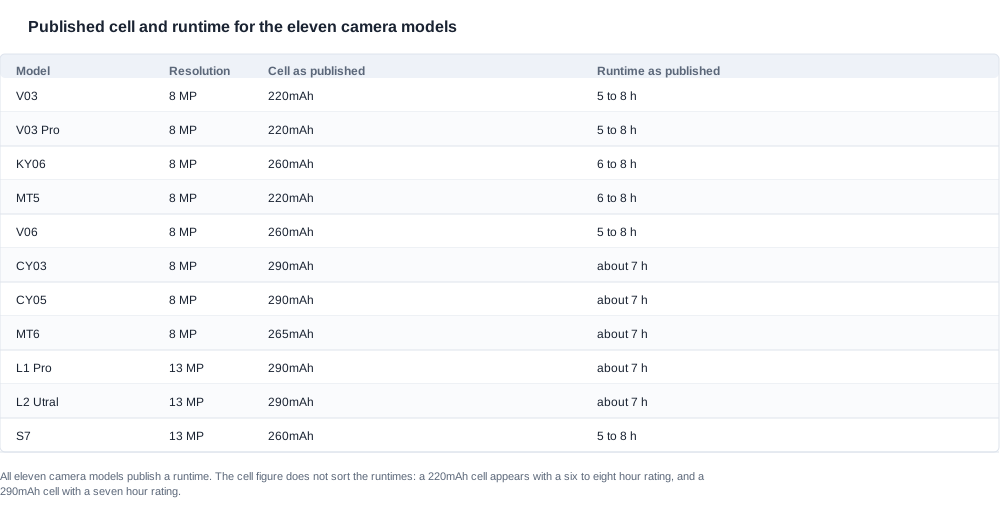
The eleven camera models in our catalogue publish their runtime, and the shape of the published data is worth reading carefully because it explains why runtime comparisons go wrong.
Seven of the eleven publish a range — five to eight hours, or six to eight hours — and four publish a single figure of about seven hours. That difference is not cosmetic. A range means the supplier expects variation across units or conditions, and the lower end of the range is the number the channel actually experiences, because the customer who complains is the one at the bottom of the distribution. A single figure of about seven hours means something slightly different: it is a typical value with a tolerance that has not been published.
The cell column tells you even less than the runtime column. In the table above, the same 220 mAh cell appears against a five-to-eight-hour range and against a six-to-eight-hour range, and a 290 mAh cell appears against a flat seven hours. The cell figure is a component specification; the runtime is a system behaviour; and the two are produced by different processes. Using one to predict the other is the most common arithmetic error in this category, and it produces a conclusion that is defensible on paper and wrong in the field.

The cell configuration is published, and it is not a capacity total
Why a doubled cell is not a doubled capacity
Our catalogue publishes the cell configuration as the catalogue states it, as a value and a number of cells: 90mAh2 on the K01 and the K02, 55mAh2 on the G07 and the YK12, and the LC-105-2 and the LC-105-1, 70mAh*2 on the YKC02, and a single 100mAh on the D11 and the D12.
A buyer who writes 110 into a comparison column has made an arithmetic step that is fine inside a spreadsheet and wrong on a product page, because the figure reads as a factory statement once it is set next to the others. The distinction that matters is that a doubled configuration is a different physical arrangement: two cells, and therefore a different enclosure, a different charging path and a different cell-management behaviour, and in several cases a different runtime for the same nominal figure.
The clearest example in the range is the 70 mAh. It appears as a single cell in the A07, a children's audio model with a published runtime of roughly twenty hours, and as a doubled configuration in the YKC02 with a published runtime of roughly eight hours. The same number appears in two completely different products, and the second one carries a running and charging behaviour the first one does not.
The cells across the range
The rest of the range runs from 40 mAh on the A05 and the A06, through 55, 70, 90, 100, 115 and 200 mAh, up to 290 mAh on the L2 Utral, the CY05 and the CY03, and the L1 Pro. The runtime that sits behind those figures varies independently of the capacity, and the audio tier shows the pattern most clearly: four models share the 55mAh*2 configuration, and two of them are published at about eight hours while the other two are published at about six hours.
The practical reading is that a buyer should treat the runtime row as the only row that answers the question, and should treat the cell row as a row that answers a different question: how the product is built, and therefore what the enclosure, the charging architecture and the transport paperwork look like.
The charging case is a second cell and a separate decision
Seven entries in the catalogue ship with a charging case, and the case capacity is published for five of them: 1400 mAh on the L1 Pro and the CY03, and the CY05, 900 mAh or 1400 mAh on the L2 Utral, and 1200 mAh on the MT6's foldable case. The KY06 and the MT5 have a case whose capacity is not published.
Two rules keep this row from being misread. The first is that a case capacity is not additive to the device cell in any sense that a customer experiences: the case is a separate device with its own cells, and the number of complete charges it can deliver is a function of the conversion losses, not of the arithmetic. The second is that the case has its own transport and its own certification treatment, which is why the freight documentation for a case-based product is a different question from the freight documentation for the device alone.
Charge time is published for every entry, and it still cannot plan a shift
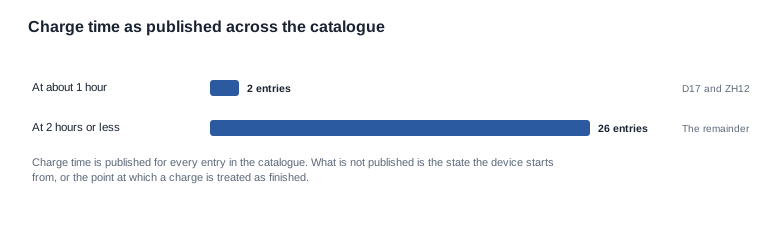
Every entry in our catalogue publishes a charge time. Twenty-six of them are published at two hours or less, and two — the D17 and the ZH12 — are published at about one hour.
That is a genuinely complete row, and it is worth saying so, because a buyer who goes looking for a catalogue in this category often finds charge time missing and concludes that the supplier is careless. Ours is published, and it still does not answer the question a buyer actually has, for three reasons.
There is no starting state. A charge time quoted for a device at a low state of charge is not comparable with one quoted for a device that is nearly full, and the published figure does not say which it is. A buyer who plans a shift handover needs the second number, because the handover happens with a partially charged device.
There is no termination criterion. A charge time does not say at what point the device is treated as charged, and the difference between a full charge and a charge that has merely stopped drawing current is exactly the difference between the published figure and the usable one.
There is no voltage. Our range does not publish a cell voltage, which means two products with the same milliamp-hour rating are not comparable on paper at all, and the comparison table a buyer builds has to carry the caveat that the charge rows are indicative rather than equivalent.
The practical consequence is that a charge time belongs in a product page and a training guide, and it does not belong in a shift plan. The number that belongs in a shift plan is the time to a usable state from the state the device will actually be in, which is a measurement and not a catalogue row.

Turning a rated runtime into an acceptance criterion
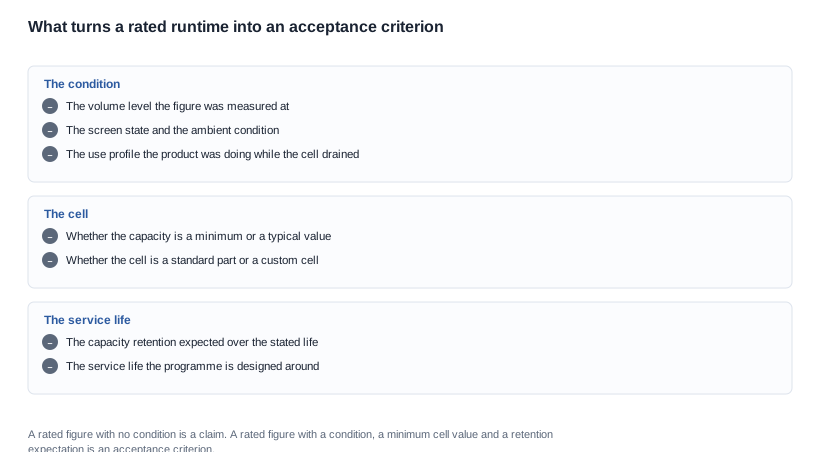
A rated figure with no condition is a claim. A rated figure with a condition, a minimum cell value, a retention expectation and a written protocol is an acceptance criterion, and the difference is worth about a returns rate.

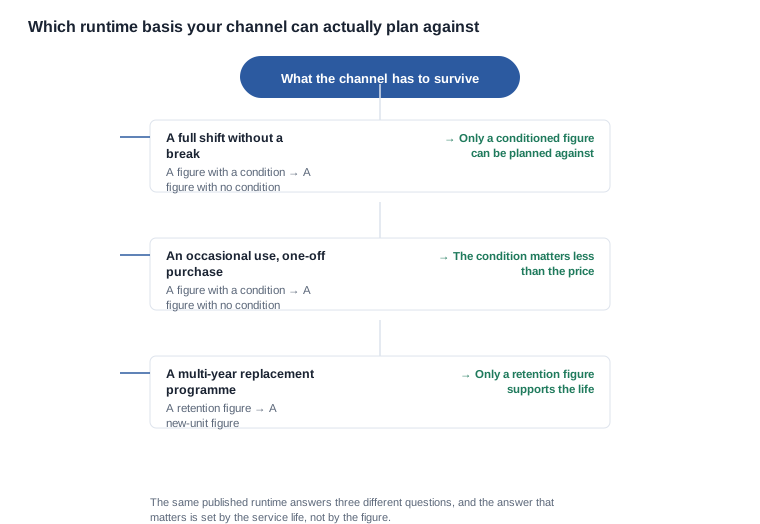
The same published runtime answers three different questions, and which one matters is set by the service life rather than by the figure. A channel that needs a full shift of continuous use needs a conditioned figure and a measurement, because only a figure with a condition can be planned against. A channel selling an occasional purchase is buying price rather than endurance, and the condition matters less than the price. And a programme with a multi-year replacement cycle needs a retention figure, because a new-unit figure cannot tell it what the product will do in year three.
The five rows in the checklist are the whole method. The condition row establishes what the product was doing while the cell drained, because a continuous-play figure and a mixed-use figure with a call every twenty minutes can differ by more than half, and comparing them produces a conclusion that is arithmetically correct and commercially wrong. The cell row establishes whether the capacity is a minimum or a typical value, which is what determines how the product behaves at the cold end of the tolerance band, and that is where the returns come from. The service life row establishes the retention expectation over the period you intend to sell.
The protocol in the flow is what converts the first row into a number you own. Write the use profile before the test, not after, because the profile is what makes two suppliers comparable. Run three new units, because one unit tells you about that unit and three tells you whether the spread is real. Run a cycled unit as well, because a programme with a two-year replacement cycle and a programme with a five-year one have completely different battery requirements, and only one of them is served by a figure quoted for a new unit.
A worked example: a brand with a two-shift channel
A note on what follows: the case is constructed, it is not a client project, and it is written to show the sequence of choices rather than an outcome.
Assume a brand selling a camera product into a logistics channel, where the device is on for a full shift and the product has to be recharged overnight. The binding constraint is that the channel has started returning units, and nobody can explain the pattern.
The use profile is written down first. The brand asks its own team what the device does during a shift, and the answer is not continuous recording: it is intermittent capture, a long idle period, and a short period at the end of the shift. That profile is the definition of the runtime the channel cares about, and it is not the profile behind a continuous-play figure.
The published runtimes are read against the profile. Two models publish five to eight hours, and one publishes about seven. The brand now knows that the published figure describes something other than its own shift, and it knows which way the error runs.
The supplier is asked for the condition behind the figure. The answer is that the condition is not published to us, which the brand records as an open row rather than as a disagreement.
The brand runs its own protocol. Three units, the brand's profile, the brand's definition of the end point, and one cycled unit for comparison. The result is lower than the published figure, and the brand now has a number that is its own.
The acceptance criterion goes into the order. The profile, the protocol, the sample size and the tolerance are written as an acceptance line, so a lot that falls short is a lot the brand can refuse, and a lot that meets it is a lot the brand can defend to the channel.
The retention question is asked separately. The channel replaces devices on a cycle, and the brand needs a cell retention figure for that period, which is a different question from the runtime of a new unit.
The result is a returns trend that can be explained, because the brand has a figure that matches its own use. The decisive decision was the use profile, and it cost an afternoon to write down.

Where a battery programme loses money
The battery is where these programmes most often lose money, and the reason is almost always a specification gap rather than a supplier failure. A cell quoted by capacity alone, without the chemistry, the tolerance and the retention expectation, is a cell whose replacement cost is unknown. Where a programme has a long service life, the question worth asking is whether the cell is a standard catalogue part or a custom cell, because a custom cell inherits the supplier's minimum order quantity and its lead time, and both of them end up in the schedule.
A battery-equipped product also carries a transport obligation, and that obligation has a cost and a lead time of its own. The transport test for a lithium cell is the UN 38.3 test, and the documents that travel with the goods are the acceptance criteria a freight forwarder will check before a container moves. A buyer who treats that as a formality discovers it at the point of booking rather than at the point of ordering, which is the wrong order.
The clauses worth having in the agreement are the cell specification and its minimum value, the retention expectation for the stated service life, the transport documentation set that travels with the goods, and the rule for a cell-related defect claim. Where a supplier offers a battery warranty beyond the product warranty, that offer is worth taking at face value and putting in the agreement, because cell failures are among the most common reasons a device comes back in year two.
The total cost of a programme is the unit price plus the returns reserve plus the documentation route plus the cost of the second shipment. Which of those to negotiate hardest depends on where your own programme is weak, and the trade-off is settled in the quotation rather than after the first shipment has been paid for.
What our catalogue publishes on cells and runtime
Here, we publish the rows we have and mark the ones we do not, and in this category the published set is the electrical one.
We publish the cell configuration as the catalogue states it, including the cell count, the charge time for every entry, the rated runtime, and the charging method. For the camera tier that means the eleven rows in the table above, with the 8 MP models carrying 220, 260 or 290 mAh and the 13 MP models carrying 290 or 260 mAh. For the audio tier we publish the doubled configurations as they are written, and the runtimes attached to them, including the shorter runtime published against the two slimmer-temple models.
We do not publish the test condition behind any of those runtime figures, and we will not convert a rated runtime into a continuous-use claim, because the condition is not published to us and we will not invent one. We publish no cell voltage, no cell chemistry, no tolerance band, no minimum capacity value and no retention expectation. We will not estimate them, and we will not present a charge time as a shift handover plan, because the starting state and the termination criterion are both absent.
What we will do is take the models you are comparing, agree a use profile and a protocol, and run the measurement on units of the configuration you intend to order, and report the numbers with the conditions attached. That is the difference between a rated figure and a measurement, and it is the difference between a specification and a claim.
If you are evaluating this category, send us the models, the use profile, the service life you intend to sell and the target market, and we will tell you which configurations exist, which rows of the runtime data are settled, and which rows a sample could close. The background is under smart glasses battery life and power, and the case options are set out under charging solutions and case models.
Related reading
- smart glasses battery life and power
- verifying battery claims with a supplier
- charging solutions and case models
Send the configuration, the quantity and the market, and we will say which parts of the runtime data are settled and which are yours.


