

Bluetooth version numbers are one of the easiest specification points to write into a buying comparison and one of the least useful ones to decide on. The reason is that a version is a protocol generation, not a feature list, and the features buyers actually care about — multi-device connections, range, codec support, latency and the update path — are not determined by the version number. Our own catalogue demonstrates this better than any general argument could, because it states a version for some models and states nothing for others while publishing the same underlying radio technology throughout.
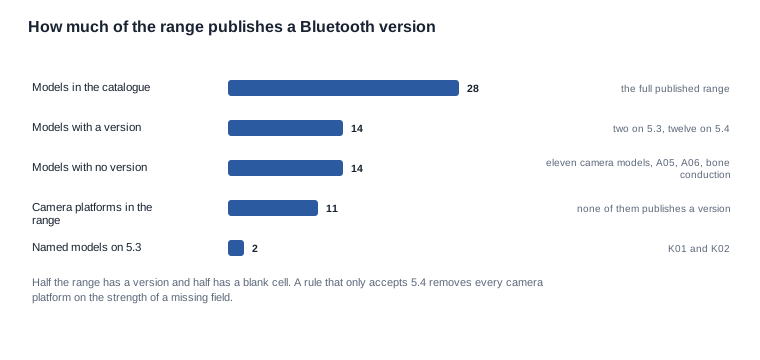
The more uncomfortable finding is about the middle of the range rather than the ends. Our published data states a version for fourteen of the twenty-eight models: Bluetooth 5.3 on the K01 and the K02, and Bluetooth 5.4 on the A07, the D11, the D12, the LC-105-1, the LC-105-2, the G07, the YK12, the YKC02, the D17, the ZH12, the AR entry and the light-responsive entry. The remaining fourteen — the eleven camera platforms, the A05, the A06 and the bone conduction entry — publish no version at all. That is not because they use an older radio, and it is not a statement about the radio itself. It is a gap in the documentation, and it means a buyer who writes a rule of the form "we only buy 5.4" would exclude almost every camera model in our range on the basis of a blank cell.
Smart glasses Bluetooth version: a weak proxy, not a data point
A proxy is a row that stands in for a row you cannot get. It is useful when it is a good proxy and dangerous when it is a familiar one, and the version column in this category is the second kind.
Read the version rows as what they are: partial documentation. Where they are present, they are consistent with the current generation. Where they are absent, nothing can be concluded — in either direction. A blank cell does not mean an old radio, and it does not mean a weak radio. It means that whoever compiled the catalogue did not record the number, which is a fact about the catalogue rather than about the product.
This matters more than it first appears, because blank cells are systematically concentrated. The omissions in our range are not spread evenly across the catalogue: they are concentrated in the camera platforms, which are the models with the most demanding radio workload and the most to lose from a compatibility problem. The buyers for whom radio detail matters most are the buyers with the least of it available, from us and from much of this industry.
Three rules follow, and they are rules about how to read a comparison sheet rather than about the radio.
A rule that requires a value removes products for administrative reasons. If the requirement is "5.4", then the camera platforms fail a rule they are not being judged against. The correct requirement is "a stated version, or a written supplier position where the row is not published", and that formulation keeps the rule honest without weakening it.
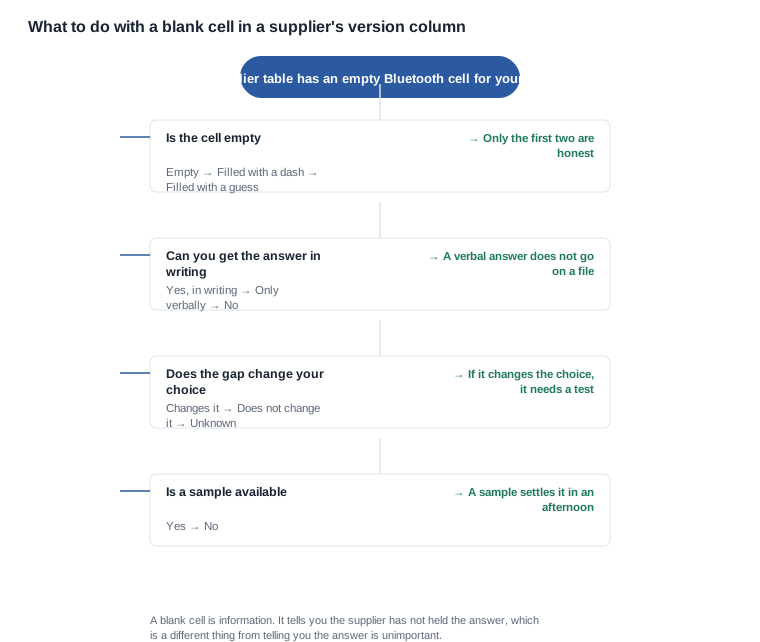
A blank cell is information, and it should be recorded as a blank. A comparison sheet that leaves the cell empty is a sheet where a reader will supply their own assumption, and the assumption will differ between readers. A cell that reads "not published" is a cell that says something true.
A weak proxy gets worse when it is applied to a subset. On a full range the version column looks like a usable row because most cells are filled and the filled ones look consistent. Narrow the range to the models where radio behaviour actually decides the outcome — the camera platforms — and the column is empty across the subset, which is precisely the subset where the question was going to be asked.
What the published rows actually let you compare
What our catalogue does publish, across the full range, is the electrical set: cell capacity, rated runtime, charging method and, where one exists, the case capacity. These are the rows a comparison sheet should be built on, and they are the rows that change a buyer's decision.
Cell configuration. The range runs from single cells to dual cells, and the dual configurations are themselves a decision rather than a detail. 55 mAh × 2 on the LC-105-2, the LC-105-1 and the G07, and the YK12; 70 mAh × 2 on the YKC02; 90 mAh × 2 on the K01 and the K02; 100 mAh on the D11, the D12 and the ZH12; 115 mAh on the D17; 40 mAh on the A05 and the A06; 70 mAh on the A07. Any two of these are a different product, and the difference is visible in the published data.
Rated runtime. Published for every one of the twenty-eight models, from roughly twenty hours on the A05, the A06 and the A07 through roughly six to eight hours on the audio tier to roughly five to eight hours on the camera tier. What the camera tier does not publish is the condition behind the figure — no workload, no start state, no end state — and that is why its runtime question is the hardest one to answer from the catalogue.
Charging method and the case. Magnetic charging on the K02 and the A07, the LC-105-1 and the K01, the YK12 and the G07, and the LC-105-2 and the YKC02 and the AR entry. Type C on the D17 and the D12, the D11 and the V03 Pro, and the ZH12 and the bone conduction entry. Seven models have a charging case, and five of those publish its capacity: 1400 mAh on the L1 Pro and the CY05, and the CY03, 900 or 1400 mAh on the L2 Utral, and a 1200 mAh folding case on the MT6.
The camera tier as a separate class. Eleven models carry a camera, at two published resolution tiers — 8 MP on the CY05 and the KY06, the V06 and the V03 Pro, and the CY03 and the V03, and the MT6 and the MT5, and 13 MP on the L2 Utral and the L1 Pro, and the S7 — with cell capacities from 220 mAh to 290 mAh and a 265 mAh on the MT6. The camera class is a different sourcing problem from the audio class, with a different bill of materials, a different compliance scope and a different radio workload, and a comparison sheet that mixes the two will produce a shortlist that makes no sense.
The general principle is worth stating separately from the rows. A comparison is only as good as the weakest row it is built on, and a row that is empty for half the range is not a weak row, it is an absent one. Before a sheet goes out, every column should be checked against the candidate list, and any column with gaps should either be marked as gaps or replaced.
How to build a comparison sheet that survives a second buyer
A comparison sheet is usually built once, for one buyer, and then read a second time by somebody who was not there when it was made. That second reader is the test the sheet should be written to pass, and it is where weak rows do their damage.
The practical criteria for a row that earns its place on the sheet are three. It has to be answerable in writing by a supplier. It has to be comparable between two suppliers, which in practice means the conditions behind the number have to be stated. And it has to change the outcome, at least sometimes, because a row that never changes the outcome is a column of reading rather than a column of deciding.
Applying those three criteria to a typical sheet for this category gives a shortlist of rows that is usually much shorter than the sheet people actually use: the cell configuration and capacity, the rated runtime, the charging method, the case configuration, the camera class and its resolution tier, the regulatory position per destination market, the model list on the documents, the quoted unit price at the volume you are actually buying, and the lead time. The Bluetooth version is on that list only as a traceability reference, and the reason is that it fails the third criterion on our own published data: two models on different versions are selected identically.
Two habits make the difference. The first is to write the conditions under every number in the sheet, so that a runtime figure from one supplier and a runtime figure from another are not read as equivalent when they were measured differently. The second is to put an explicit blank in a cell where the supplier did not answer, with the date of the request against it, because an empty cell in a comparison sheet is an invitation to somebody else to fill it in with an assumption.
What to ask for, and in what order, is the subject of a separate question that is worth more than the sheet itself. A sheet assembled from five answers gathered in one email is comparable across candidates; a sheet assembled from a mix of emails, catalogue rows and verbal assurances is not, and it is very hard to tell which kind you have once it is on a slide.
What a version number cannot tell you about a radio
Multi-device connections. Whether a device can hold two connections at once is a stack configuration decision. It is not implied by the protocol generation, and it is not published for any model in our range. It is also one of the rows that is most often assumed from a version number, because simultaneous connections have been marketed alongside newer generations for years.
Codec support. Whether a high-quality audio codec is available determines whether the product sounds like a phone call or like a pair of headphones, and it is not published for any model in our range. This is the row that would change a buying decision most often, and it is the one buyers most often do not ask for.
Range and stability in a real environment. The difference between the two generations in our range is at the protocol level — improvements in stability and energy efficiency, and additional security capability in the newer generation. Neither is a range figure, and neither predicts performance on a street with two million Bluetooth devices competing for the same band. Range is set by the antenna, the transmit power and the environment, and none of those three is published for our models.
Latency. Whether the camera shutter and the audio path feel immediate is a property of the firmware and the application, and it varies far more between two products on the same generation than between two generations.
The update path. Whether a unit bought today can still be updated in five years is a firmware and chipset question, and it is the question that determines the end-of-life cost of the product. It is not published for any model in our range, and it is the row that most affects a decision to put a model into a long-lived programme rather than a single season.
The host constraint. What the customer actually gets is the intersection of the device, the phone and the application. If the fleet is a particular operating system version or a particular phone mix, that bounds the usable feature set regardless of the radio. This is the constraint that ends up in the support log when a product is blamed for a defect it does not have.
None of these is a version property, and each of them is a question a buyer can put to a supplier in a single email. The version number is the row a supplier can answer without opening a file, which is precisely why it gets quoted and precisely why it should not carry a decision.

The cost side: where a generation bump does and does not move money
This is the part worth understanding before you use the version to argue a price down.
The chipset itself is a small share of the bill of materials in a device with a battery, a camera module, a radio and a frame. A version bump does not meaningfully move the unit cost. What it moves is everything around it: a newer chipset usually means a newer firmware baseline, which means more validation work, more documentation and more of the compliance file to produce. It may also change the availability of a chipset at the volume you need, which is a supply question rather than a technology question.
The one place the version has a real financial consequence is regulatory, and here the direction of travel is worth understanding rather than arguing about. The cybersecurity requirements of the Radio Equipment Directive become a mandatory part of CE marking from 1 August 2025, and the EN 18031 series of harmonised standards describes secure communication, encryption, secure storage and a patch-handling process. A radio design that already supports modern encryption is closer to that requirement than one that does not, so choosing the newer generation is a compliance investment that reduces later work. That is a real argument, and it is an argument about paperwork rather than about features.
The second financial consequence is the one that arrives as schedule rather than as money. A generation change inside a platform means a new radio module, which means a new radio approval, a new trademark qualification, a new technical file revision and a re-test. None of those costs is large. All of them have an elapsed time set by a test laboratory and a review queue rather than by the factory, and elapsed time is what damages a programme.
So the cost answer is this. A version difference between two products in the same platform costs nothing at all. A version change to a platform costs a new set of approvals and a new schedule, and nothing else. Neither of those is a unit-price argument, and a buyer who uses the version to argue a discount is arguing about the smaller of two numbers while the larger one — the elapsed time on the approval — goes unexamined.
How to evaluate a version change on elapsed time rather than on price
The total cost of a version change is mostly time, and the way to evaluate it is to put the steps on a single line with a duration against each, then look at the longest one rather than the sum. The sum makes a version change look expensive; the longest step is what determines the launch date.
The steps are recognisable: the radio approval for each destination market, the trademark qualification for the new implementation, the technical file revision, the firmware validation on the new baseline, the re-test, and the sample programme that has to be repeated because the previous sample is no longer representative. Three of those six have an elapsed time that the factory does not control, because they sit with a test laboratory or a review queue.
Once the steps are on a line, the negotiation becomes specific rather than emotional. The first question is which of the three externally-timed steps can be started in parallel rather than in sequence, because most of the schedule risk comes from doing them one after another. The second is whether the programme actually needs the change, and the test for that is whether a named feature depends on it — if no feature does, the change is buying a future option, and the honest way to price an option is to say what it costs in schedule today. The third is what happens if the change is accepted and then the approval does not cover the model, which is a risk that a documented change-control route and a written undertaking to notify on a module revision are designed to reduce.
The point of doing this on the elapsed-time basis is that it stops the version from being argued as a price lever at all. Once the schedule consequence is on the line, the only remaining question is whether the programme is buying something, and that is a commercial decision a buyer can take with a clear head rather than a technical one with an incomplete document.

Five questions that replace the version number in a quotation
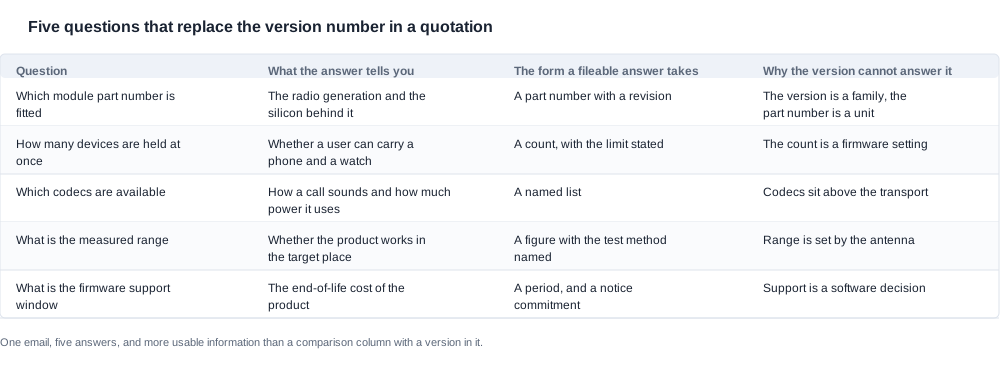
Ask for five things instead of the version number. One email, five answers, and more usable information than a comparison column with a version in it.
- The chipset or module, with its part number. This is the row that actually determines the radio behaviour, and it is more informative than the version because it identifies the unit rather than the class. It is also the row that answers four of the other questions at once: which generation it implements, which profiles the part supports, and what its expected power draw is.
- Whether multi-device is supported, and how many simultaneous connections. If a customer moves between a phone and a laptop, this matters more than any version.
- The available audio codecs. Ask for the list, not a description, and ask separately for playback and for a call, because the two paths are separate and a product can support one without the other.
- The measured range under the conditions you care about, or at least the test method the supplier used. A range figure without a method is not comparable to another supplier's range figure.
- The firmware update policy, including how long builds are kept and what the end-of-life position is. This is the row that decides whether the product is worth putting into a programme that will still be running in three years.
Ask those and you will learn more in one email than in a version comparison. If a supplier can only offer the version number, that tells you something useful about how much radio work they have actually done — not that the product is bad, but that the questions have to be answered on a sample instead of on paper.
How we mark the rows we cannot fill
Here, we publish the version where the catalogue states it and mark it as not published where it does not, and we will not infer a version for a model whose row is blank or present a protocol generation as a performance claim. We publish Bluetooth 5.3 on the K01 and the K02 and Bluetooth 5.4 on the A07, the D11, the D12, the LC-105-1, the LC-105-2, the G07, the YK12, the YKC02, the D17, the ZH12, the AR entry and the light-responsive entry, and for the eleven camera platforms, the bone conduction entry, the A05 and the A06, the row is open.
We do not publish codec support, multi-device behaviour, range or an update policy for any model, and we will not estimate them, because a typical figure cannot be checked and therefore cannot become an acceptance criterion.

We will also not tell you that a newer version is automatically a better product, because on our own evidence it is not one. If the radio matters to your proposition, send us the models, the quantities, the destination markets and the devices your customers use, and we will answer what our documentation supports, mark the rest as open, and tell you which of the five questions above can be answered from what we hold and which have to come from a test on your own units.
Related reading
- The connectivity rows across the range — Bluetooth connectivity
- The models that carry a published version — Bluetooth audio glasses range
- The regulatory direction the newer generation points at — certification checklist
- How to test a radio in the place it will be used — sample evaluation
Tell us the devices your customers will connect with and the environments they will use them in, and we will say what our published connectivity rows can and cannot support for that use.


