

Smart glasses Bluetooth version: one number, seven layers
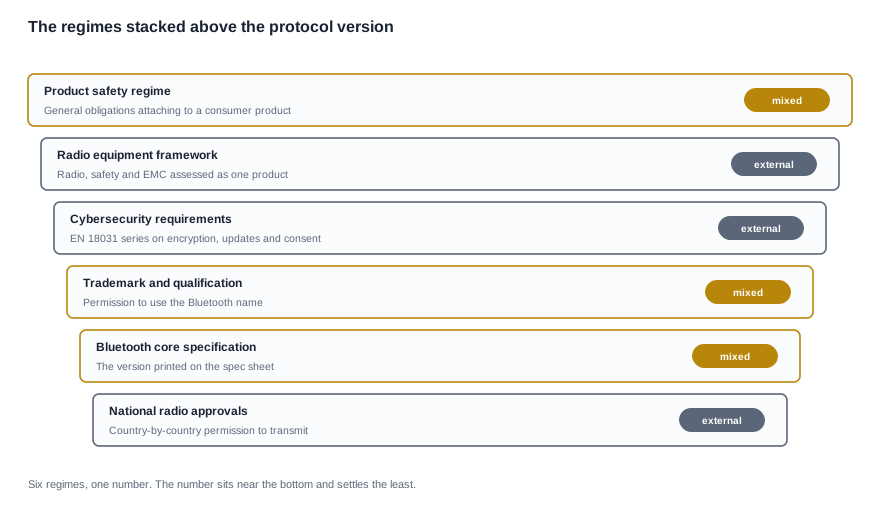
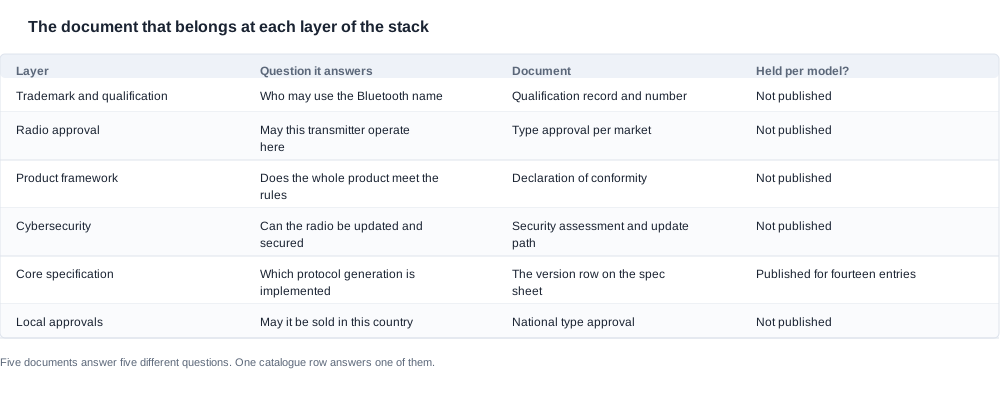
A Bluetooth version number is the least consequential line in the standards stack that a Bluetooth product sits inside. Below it there is a radio module with its own approval record; above it there is a trademark permission, a product conformity framework, a cybersecurity requirement, a general product safety regime, and a set of country-by-country national approvals. Each of those is a separate instrument with its own holder, its own validity period and its own failure mode, and a buyer who organises a compliance file around the version number ends up with a file that answers the wrong question. This article walks the stack from the top down, sets out which document belongs at which layer, and explains which layer each of the decisions in a launch actually turns on. The short version for a procurement team: the version tells you the protocol generation and the direction of encryption support, and it tells you nothing about whether you may use the trademark, whether the radio may transmit in the destination market, whether the finished product has been assessed, or whether a unit in the field can be patched. Across our own catalogue the version is published for 14 of 28 entries and the layer above it — the trademark permission — is published for none.
The reader who needs this map
The person who benefits from the stack is usually a product or compliance lead at a brand or a distributor who has inherited a file from a predecessor, or who has been asked by a channel partner to evidence a claim that a supplier sheet implied. He is not a radio engineer and does not need to become one. What he needs is a way to answer three questions without becoming an expert: which document closes which decision, which of those documents a supplier actually holds, and what it costs to obtain the ones they do not.
Two situations make this urgent. The first is a multi-market launch, where a single product has to satisfy several national regimes and the team has been treating them as one approval because the product is the same. The second is a re-order or a range extension, where the paperwork from the first programme is being reused for a configuration that was never assessed, and nobody noticed because the version row matched.
What he wants to avoid is the specific failure where a compliant radio is shipped inside a product that cannot be sold, and the version on the spec sheet is quoted in the file as though it settled the question. Every layer of the stack has to be closed independently, and the version is at the bottom of the pile.
The layers, and why the order of the stack matters
The stack is easiest to reason about from the top, because the top layer is the one that determines whether the product can be sold at all, and it is the one most often left until last.
The general product safety regime sits above everything. It applies since 13 December 2024 and it attaches to the product as a consumer product placed on the market, with obligations about traceability, on the manufacturer's or importer's records. It is the layer that determines who the buyer is when a problem happens.
The radio equipment framework covers the radio, the safety requirements and the electromagnetic compatibility of the product assessed together. For a European launch that framework is the Radio Equipment Directive 2014/53/EU. It is a product-level assessment, not a chip-level one, and that distinction is the reason a change to the housing or the antenna becomes a compliance event rather than a design preference: the frame is physically part of the radio environment, and the assessment is made on the finished geometry.
The cybersecurity requirements became a mandatory component of CE marking on 1 August 2025, described by the EN 18031 series of harmonised standards. They cover secure communication, encryption, secure storage, user consent, and a process for handling identified vulnerabilities. This is the layer the version number is least able to speak for: a product on the newest protocol with no update path and no secure storage is not in a good position, and a product on an older protocol with a documented patch process may be.
The trademark and qualification system is a separate system entirely, not a regulation at all, and it is the layer most often ignored by buyers who assume a compliant product may carry the name. The Bluetooth trademark may be used only by a party that has qualified. Qualification is a legal permission rather than a technical approval, and it is issued as a Declaration ID, now formally called a Design Number.
The Bluetooth core specification is where the version number lives. It describes how the protocol behaves and it is what the chipset and the firmware implement. A higher version means a later generation of protocol behaviour, including the AES-CCM encryption capability that 5.4 adds, and that is genuinely relevant to the cybersecurity position one layer above.
The national radio approvals are the bottom of the stack in terms of sequence even though they sit at the top in terms of volume of work. They are country by country, they are the layer that turns a launch in one market into a launch in six, and in most markets outside Europe and the United States they involve a local representative.
Why the version number is the row everybody reaches for first
It is a single number. It is easy to compare. It appears on every competitor's sheet. And it is the row that decides the least.
A version tells you the protocol generation. It does not tell you the chipset, the profiles, the codecs, the multipoint behaviour, the range, the update path, whether the brand is qualified to use the trademark, or whether the product has been assessed in the market you are shipping into. Those are the rows that decide whether the product links to a customer's phone, whether it can be updated in the field, whether the packaging may carry the name, and whether it can be sold at all.
The more useful way to read the version is as a weak but real signal about two things. The first is the encryption direction, which is what the cybersecurity layer cares about. The second is the maturity of the chipset, since a newer generation is generally a better-documented and more widely supported part, and that shows up in the firmware and app ecosystem around it rather than in the radio specification itself. A buyer treating the version as the deciding criterion is using the one row that tells them the least, and the most quoted.
What our catalogue publishes inside this stack
Two radio generations appear in our published documentation. The older one is carried by the K01 and the K02, and the newer one by twelve further entries: the D11, the D12, the LC-105 pair, the A07 and the YK12, the YKC02 and the D17, and the G07 and the ZH12, and the electrochromic and AR products. The AI camera glasses family states no version, and neither do the bone conduction model, the A05 or the A06.
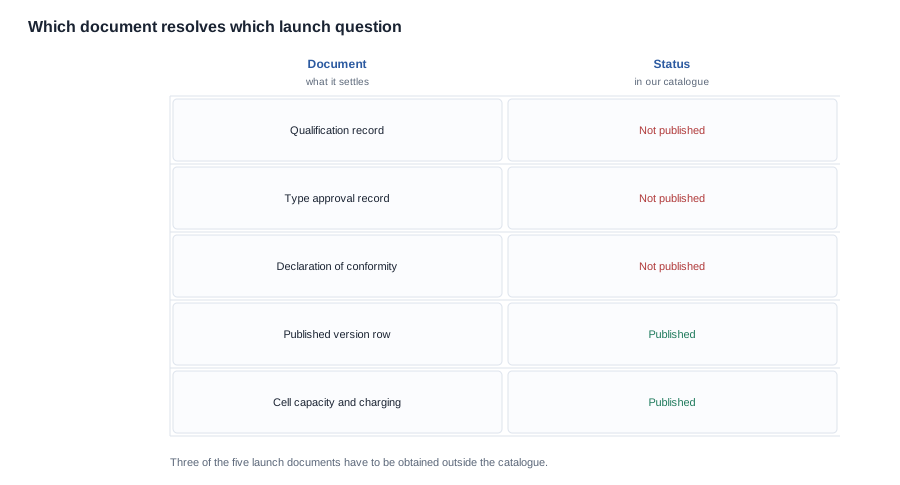
We publish no chipset, no module part number, no profile list, no codec list, no multipoint figure, no range figure, no update method and no qualification position for any model. We do not publish model-level certificate numbers either, and the general product safety regime sits above all of this as a separate obligation. Publishing the version while publishing nothing above or below it is honest, but it does mean the catalogue answers exactly one layer of a seven-layer stack, and a buyer who treats that as a complete answer has made an assumption rather than a decision.
Which document belongs at which layer, and the thresholds to hold
For each layer, the threshold a buyer should hold is the same shape: the document has to identify the subject, it has to cover the configuration being shipped, it has to be valid in the destination market, and it has to be checkable by someone who is not the supplier. Those four conditions are what separate a usable instrument from a piece of paper.
Threshold one — identity of the subject
What it must do. Name the thing it applies to. For a radio approval that is a module or a transmitter. For a conformity declaration it is a list of model designations. For a qualification record it is the qualified product and the qualifying entity.
The pass line. The model string on the document has to match the model code on the purchase order character by character. Where several models share the same electrical rows — the D11 and the D12, or the LC-105 pair — the string comparison is the check that catches a substitution.
What a defective instrument amounts to. A document that names a family, a platform or a project rather than a model.
Threshold two — coverage of the configuration
What it must do. Extend to the configuration actually shipped: the frame, the antenna, the radio module, the firmware baseline and the charging interface.
The pass line. The evaluation was performed on the production geometry and the shipped firmware, not on an engineering sample. A radio assessed in a development housing can behave differently in a production housing, and that is exactly the kind of difference a certification assessment will notice and a bench measurement will not.
What a defective instrument amounts to. An assessment performed on a pre-production configuration, then carried forward to a production one without a re-check.
Threshold three — market validity
What it must do. Be valid where the product is sold.
The pass line. Each destination market has its own route and its own record, and a European route does not cover a national approval elsewhere. Where two markets share a route, that is a genuine saving and should be recorded as one workstream rather than two.
What a defective instrument amounts to. A single document treated as covering several national markets. It is the most common shortcut and the one most likely to surface at a border inspection.
Threshold four — third-party checkability
What it must do. Be verifiable by a party with no relationship to the supplier.
The pass line. The record carries a number, an issuing body and a validity date, and the number resolves in a public register. This is the only condition that converts assurance into evidence, and it is the condition that fails most often.
What a defective instrument amounts to. A PDF attachment with no number, a claim of "certified" without a reference, or a record with a validity date that has already passed.
The warning about comparing standards across suppliers
Standards written in the same area are not automatically comparable, and the differences that matter are rarely the technical ones. They are differences in scope: whether the assessment covered the module or the finished product, whether it covered the band you are shipping, whether it was made on the production geometry, and which model string it names. Two suppliers can both hold valid approvals for the same framework and still be shipping products that their respective documents do not cover, for entirely different reasons. This is why the version row is not comparable across suppliers either — the same number on two sheets can sit on two different chips in two different modules.
A due diligence checklist for this category, in the order a procurement lead should work it:
- Market list and route per market — one line each, so the number of approval routes is a fact rather than an assumption.
- Configuration list — one line per configuration that will actually ship in the first year.
- Document per layer, with the holder named — the layer table, which is the file.
- Model string match on every document — character by character, against the purchase order.
- Register check on every reference number — the only third-party check available.
- Inheritance question answered in writing — for the trademark layer especially.
- Controlled items named in the order — radio module, frame, antenna, charging interface, firmware baseline.
These seven steps are what to ask before you order, and they are also the questions to ask when a supplier's quotation is being compared against another one. The trade-off a buyer is making is between a shorter document set and a shorter programme, and the checklist is what tells you which one you have actually been offered.

How to work down the stack and find what is actually missing
The verification path for a standards stack is a descent, and the order below is deliberate: each step assumes the step above it passed, and a failure at any step tells you what the step below it would have told you.

Step one: write down the market list and the configuration list. These two lists determine how many layers you actually have to close. They are usually shorter than a team first assumes, because two member states often share a route and because most programmes start with one configuration even if the range will grow.
Step two: for each layer, name the document and who holds it. Four columns: layer, document, holder, status. The status column takes one of three values — held with a number you can verify, held but not transferable to your brand, or open. This table is the compliance file, and it is a better file than a folder of PDFs because it says what is missing.
Step three: verify every number in the public registers. Find the qualification record, the radio approval reference, the certificate numbers. Confirm the model string, the scope, the market and the validity date. An hour per record, and it is the only check that survives an audit.
Step four: identify the inheritance question explicitly. The trademark layer is the one most often closed by accident, and the question — can the record held by the factory be inherited by your brand — has a document behind it or a clear no. Neither is the same as silence.
Step five: turn the open items into commissioned work with dates. For each open layer, record what has to be produced, who produces it, what it costs and how long it takes. An open item with no owner is an open item that will surface at launch.
Step six: freeze the configuration and control the changes. Every layer above the radio is sensitive to a change in the radio module, the frame, the antenna, the charging interface or the firmware baseline. The purchase order needs a notice obligation on those items and a re-issue obligation on the documentation pack.

Where standards work breaks down in a private-label programme
A family-level document is used to cover a branded configuration. The symptom is a customs query, a marketplace rejection or a warranty claim that cannot be settled. The root cause is that the layers were treated as one document set. The prevention is to make the exact model designation a condition of the order and to check the string on the units at receipt.
The trademark question is assumed rather than asked. The symptom is artwork that has already been approved with the logo on it and a supplier who cannot produce a qualification record for your brand. The root cause is that the qualification system is not a regulation and therefore does not appear on anyone's compliance checklist. The prevention is to ask in writing in the first email and to treat the answer as a procurement input rather than as a legal detail.
A configuration change invalidates the layer above it. The symptom is a unit that ships outside the assessed configuration. The root cause is that the change control rule lists the colour and the battery but not the radio module or the firmware baseline. The prevention is to name the controlled items.
The cybersecurity layer is assembled from a datasheet. The symptom is a technical file that cannot answer how a unit in the field is updated. The root cause is that the layer was treated as a specification rather than as an operational commitment. The prevention is to ask for the update method, the build retention window and the vulnerability process in the same message as the approval reference.
Two markets were assumed to be one. The symptom is a shipment held at the border in the second country. The root cause is that the market list was written as a region rather than as a list of routes. The prevention is to write one line per market, with the route and the record for each.
Where the money and the calendar actually sit
The costs at the top of the stack — the conformity assessment, the laboratory work, the qualification — are fixed in character per product family and per market. They are not price points, they are queues, and pressing on them produces a later date. The costs that move are the ones the buyer controls: the number of markets, the number of configurations, the number of artwork rounds, and the order in which work is commissioned. A programme that enters one market with one configuration and inherits an existing qualification will be materially shorter and cheaper than one that enters four markets with three configurations, and the difference is entirely made of decisions rather than of supplier behaviour.
The other point is about sequencing. Regulatory work is usually scheduled as a block that begins once the product is "ready", and that is backwards: the market list has to be settled before the compliance route can be identified, the route has to be identified before the documentation request can be written, and the documentation request has to be written before the sample arrives, because the module and the certification records travel together. A buyer who starts the stack in week one is working on a schedule; a buyer who starts it in week six is working against one.
A market-by-market walk-through, and the limits of our own position
The scenario below is invented for the sake of the reasoning: it is not a client project, and it shows the order of steps rather than an outcome.
Assume a consumer brand that has sold an audio product into the European Union for two years and now wants to add a camera-equipped model to the same range, with a United States launch planned for the following year. The brand's compliance file for the existing product contains a conformity declaration and a copy of the factory's spec sheet. It contains no qualification record, because nobody had ever asked for one.
Step one: the market list. The European Union and the United States share no route, so the brand has two independent radio approval paths and two independent conformity assessments. The brand had been planning for one.
Step two: the layer table. The brand writes one line per layer, per market. Six layers, two markets, twelve lines. The exercise takes an afternoon and it produces the first genuinely useful compliance artefact the brand has had.
Step three: what the table exposes. Three lines are open. The qualification record is open because the brand has never asked whether the factory's record can be inherited. The radio approval for the camera model is open because the camera changes the product assessment, not just the radio. The cybersecurity evidence is open because the brand has a specification and not an operational commitment.
Step four: the sequence. The brand commissions the qualification inheritance first because it is a question rather than a laboratory slot, and it answers in a week. It books the laboratory work for the camera model second because it is the longest queue. It commissions the security file third because it depends on the update method being agreed with the factory. The three land in a different order from the one they would have started in, and the launch date is set by the longest, which is now known rather than assumed.
Step five: the re-order. When the brand extends the range with a second colourway, the table makes the consequence visible: the colourway is a configuration, and if it changes the frame material the assessment has to be revisited. The brand writes the notice obligation into the order before the extension rather than after it.
The decisive step was step two, because it converted a folder of documents into a list of gaps, and the list told the brand that the version row on the spec sheet was the only layer it had ever actually held.
What we publish, and what we cannot claim
We will publish the version where the catalogue states it, mark it as not published where it does not, and refuse to present a protocol generation as a proxy for quality or compliance. We publish the version rows listed above and nothing else on the connectivity side, and we will not tell you that a newer version is a better product, because on our own evidence it is not one.
We cannot supply, from our own documentation, a module part number, a Bluetooth qualification reference, a spectrum declaration, a certificate number with an issuing body, or a technical file for any model. What sits in our own documentation is an export-certification page carrying ten patent certificates — eight appearance-design patents and two utility-model patents; it names no CE, FCC or RoHS marking and publishes no certificate number, issuing body or validity period for any of them. We will not attach a certificate number to a model because a supplier sheet mentioned one.
We also publish no frame weight for most models in the range. The only weight published anywhere in the catalogue is 158 g for the MT6 glasses unit, excluding its foldable charging case, and the case capacity there is 1200 mAh. We make no vision, health or eye-protection efficacy claim for any product in any market.
What we will do with a model and a market
Take a specific model and a specific destination market and we will tell you which of the layers we can currently evidence and which have to be established before the first shipment. The connectivity rows across the range are at Bluetooth connectivity, the key rows in more detail are in the connectivity key rows, the document set a shipped product needs is collected in the certification checklist, and the market differences that follow from this stack are set out in selecting by market.
Tell us the model and the destination markets, and we will say which layers we can evidence today.


