

Smart glasses Bluetooth version: known versus missing
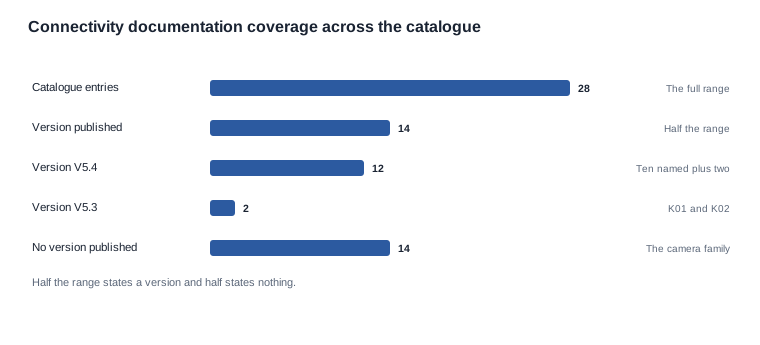
The connectivity rows on a smart glasses specification sheet are the easiest to copy and the hardest to use, because a version number is a protocol generation and almost nothing a buying decision turns on is determined by it. What a spec sheet actually gives you is a map of the supplier's documentation: which rows they are willing to commit to, which rows they have chosen to leave open, and therefore how much of the product you will have to establish yourself. That map is worth more than the rows themselves. In our own catalogue the version is published for 14 of 28 entries and left open for 14, and the 11 camera models a buyer most often wants — the L2 Utral and the MT5, the V03 Pro and the MT6, the KY06 and the S7, the L1 Pro and the CY05, the CY03 and the V06, and the V03 — publish no version at all, even though every one of them publishes a cell capacity and a rated runtime, and seven of the eleven also publish a charging interface. A comparison table built on the version row therefore compares the audio family against the camera family on one row and on nothing else. The way to use a spec sheet properly is to read each published row for what it can settle, to treat the open rows as the real shortlist criteria, and to write both into the purchase order so that a lot that fails them is a lot you can refuse.
The buyer reading a sheet row by row
The person doing this is normally a sourcing engineer or a product manager assembling the comparison table that an approval meeting will be run from. He has two, three or four supplier sheets in front of him, and the format of those sheets is doing more work than it should: every one of them has a version row, and the version row is the only row that reads like a comparable number.
Three situations produce this. The first is a brand opening a new line and needing a shortlist from scratch, where the temptation is to rank by the most legible row and move on. The second is a brand already shipping and adding a second supplier to a platform, where the real question is whether the two suppliers' products are equivalent at all. The third is a channel buyer auditing an incumbent, where the discovery is that half the catalogue states a version and half states nothing, and the question becomes whether that pattern is a documentation habit or a signal.
What he is afraid of is a table that reads rigorous and is not. A comparison table built from the published rows can produce a confident ranking that reverses when the open rows are filled in, and the reversal is discovered after the deposit rather than before it. The defence is a table that shows the open rows as open rows, with a plan attached to each one, rather than a table that quietly compares what is available on the day.
Why two suppliers' sheets read alike and cost differently
The reason two sheets can read alike and differ by a wide margin on total programme cost is that the sheet describes the product, and the programme cost is mostly not in the product. The sheet rows are the visible part of the cost structure. The invisible part is the fixed work that each of them implies: the radio approvals, the conformity assessment, the qualification, the number of artwork rounds, the number of destination markets, the number of configurations, and the tooling amortisation.
That is why a buyer comparing two quotations on unit price is comparing the one number both suppliers had the most incentive to make read similar. The comparison that actually separates the quotations is on the counts: how many markets, how many configurations, how many artwork rounds, how many documents have to be commissioned, and whether the radio file can be inherited. None of those counts appears on a spec sheet, which is why a spec sheet comparison settles so little.
The second structural point is about what the published rows are worth as procurement information. A published cell capacity is a commitment: the supplier is asserting a number that can be checked against the units at receipt. An unpublished row is not a defect; it is an absence of commitment. But absence of commitment has a cost, and that cost is the time and money needed to establish the row yourself. So the useful output of reading a sheet is not a ranking but an estimate: which rows are settled, which have to be requested in writing, and which have to be measured on a sample.
This is why our catalogue's pattern of published and open rows is informative rather than merely incomplete. The audio family publishes a version because the radio is the defining feature of the product. The camera family publishes battery and charging rows because the camera is the defining feature, and the radio is a supporting element. The pattern of what each family publishes tells you what each family is for, and a buyer who reads a sheet that way learns more from the empty cells than from the filled ones.
The seven connectivity rows, and the threshold to hold on each
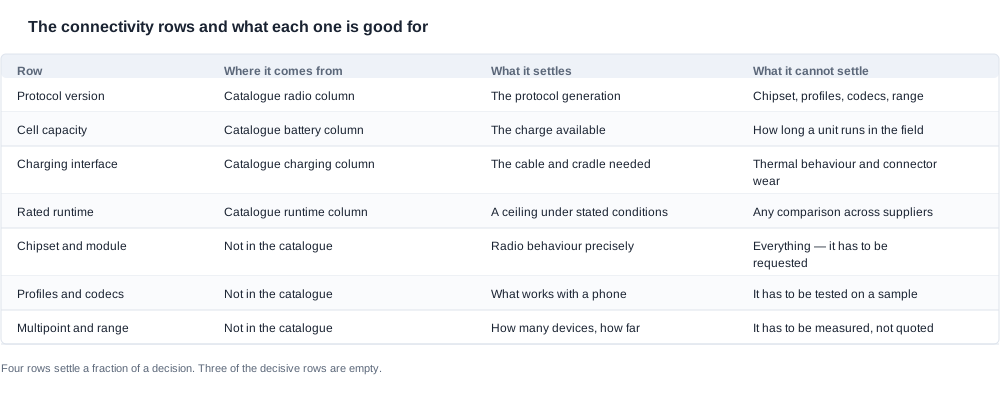
A useful spec sheet comparison needs a row discipline: for each row, what it is, what it settles, what it cannot settle, and the threshold to apply. These are the seven rows that matter in this category, and the thresholds are industry practice rather than anything specific to our own products.
The protocol version row. What it is: the core specification generation the radio module implements. What it settles: the protocol generation and, weakly, the encryption direction and the maturity of the surrounding chipset ecosystem. What it cannot settle: the module, the profiles, the codecs, the multipoint behaviour, the range, the update path or anything about whether the product may be sold. Threshold: a version with no module part number behind it is an incomplete row, and an incomplete row should be marked as such in the comparison table rather than carried forward as a number.
The module and chipset row. What it is: the part number of the radio. What it settles: the radio behaviour precisely — range, coexistence behaviour, current draw, supported profiles and the certified configurations. What it cannot settle: anything about the product's firmware behaviour. Threshold: the part number must appear in the comparison table as a required field. A supplier who will not supply it has told you that the whole radio row of the table will have to come from a sample instead.
The cell capacity row. What it is: the charge available, published in our range from 40 mAh in the A05 and the A06 up to 290 mAh in the L1 Pro and the CY03, and the L2 Utral and the CY05, with paired cells at 55 mAh, 70 mAh and 90 mAh in the audio families. What it settles: the power budget available. What it cannot settle: the runtime, because runtime is capacity divided by average load and the radio, the controller, the camera and the speakers all share it. Threshold: a cell capacity with no rated runtime beside it is half a row.
The rated runtime row. What it is: a ceiling under stated conditions, published in our range from roughly six hours on some audio platforms to roughly twenty on the children's entries. What it settles: an upper bound. What it cannot settle: any comparison between suppliers, because the conditions behind the figure are rarely the same. Threshold: a runtime figure without its conditions is not usable in a specification and should be removed from the table rather than propagated into it.
The charging interface row. What it is: magnetic or Type-C, and whether a case is included and at what capacity. What it settles: the cable, the cradle and the accessory geometry you have to stock. What it cannot settle: thermal behaviour, connector degradation or the charging time under a real load. Threshold: the charging interface has to appear on the purchase order as a named configuration, because it drives the accessory plan.
The profile and codec rows. What they are: the feature sets implemented and the compression formats negotiated. What they settle: whether the product's own features work with the phones in the customer's installed base. What they cannot settle: anything at all about the customer experience until a sample has been tested. Threshold: both must be requested in writing, and neither may be inferred from the version.
The multipoint and range rows. What they are: the number of simultaneous connections, and the distance the link survives. What they settle: the practical behaviour when a customer moves between a phone and a laptop, and the usable distance in a given environment. What they cannot settle: anything, since neither figure is published for any model in our range. Threshold: both must be established on a sample with a written protocol.
The thresholds that can be held as a shortlist criterion
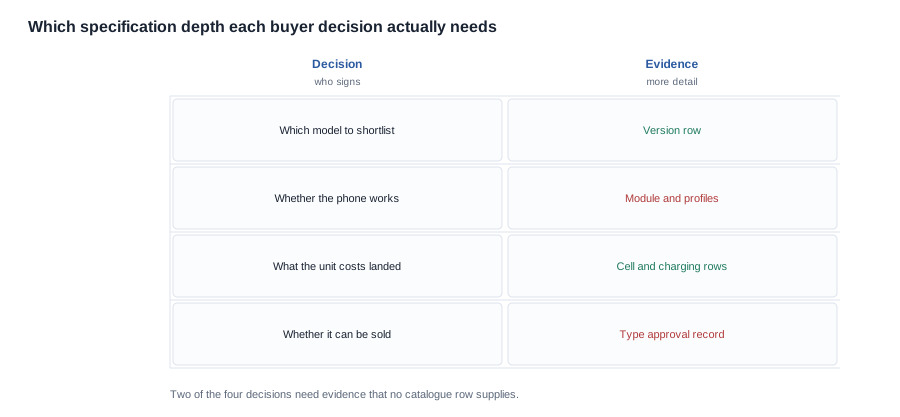
The shortlist criteria a procurement lead can apply to a set of spec sheets, in the order they should be evaluated:
- Does the sheet name the radio module? If not, every radio comparison downstream is provisional.
- Does the sheet list the profiles and the codecs? If not, the feature claims on the listing are untested.
- Does the sheet state a runtime with its conditions? If not, the runtime row cannot be compared and should be dropped from the table.
- Does the sheet state the charging interface and the case capacity? If not, the accessory and packaging plan is unknown.
- Does the sheet name the model designation on every row? If not, the document set will name a family rather than your unit.
- Does the sheet separate published rows from open rows? If not, ask for it before the comparison is built.
These six criteria are what to ask before you order, and each one tells you whether the comparison is worth building at all or whether you need a sample round first.

How to build a comparison table that does not mislead
The comparison table is where most category buying goes wrong, and the fault is almost always structural rather than arithmetic. Three construction rules fix most of it.
Rule one: give every row a status, not just a value. A cell in a comparison table should carry one of four states: published with a value, published without the conditions needed to compare it, requested and outstanding, or not published. A table that shows blanks as blanks tells the reader where the decision is actually being made, and a table that leaves blanks empty invites the reader to assume equivalence.
Rule two: never let a row be compared across different bases. Cell capacity of 40 mAh in a single cell and 90 mAh in a pair of cells are not two points on one scale, and neither are a runtime measured on a light workload and one measured on a camera workload. Where the basis differs, the row is either annotated or removed from the scoring. This is the same warning that applies to range figures and to any measured value that arrives without its method.
Rule three: keep the decision rows separate from the description rows. The rows that describe the product — the version, the cell, the runtime, the charging interface — are not the rows that decide the purchase. The decision rows are the ones a buyer has to go and establish: the module, the profiles, the codecs, the multipoint behaviour, the range and the update path. A table that mixes the two invites the reader to score the decision rows on the description rows.
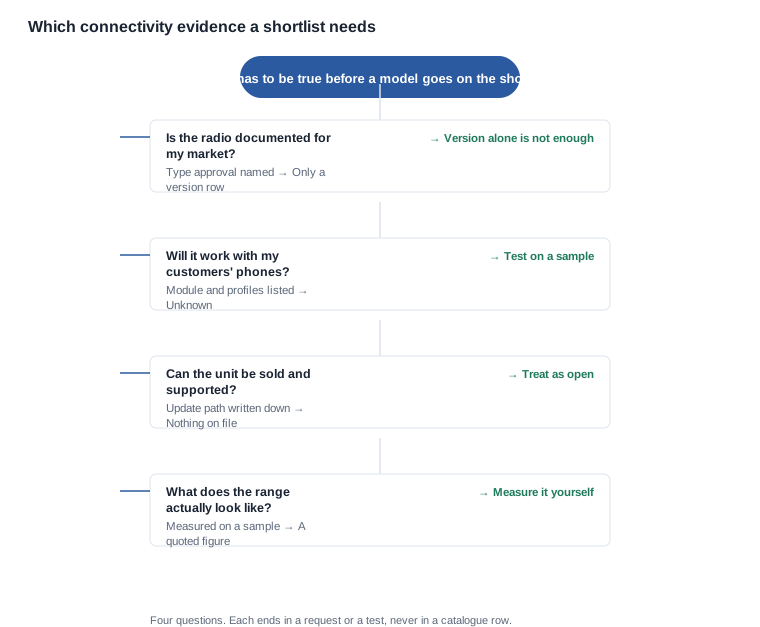
The order of work that follows from those three rules is short. Build the table from the published rows first, and leave the decision rows visibly empty. Send the outstanding row requests as a single list, per supplier, with the same wording so that the answers are comparable. Take the answers, and where an answer is still a behaviour rather than a document, move it to the sample plan. Run the sample tests on a protocol written down before the first reading. Then fill the decision rows and re-score. Only at that point is the ranking meaningful, and the point of the process is that the ranking will often differ from the version-based ranking the table started with.
A last practical point on the table itself: record where each number came from. A cell that reads "14 entries publish a version" is a fact about a catalogue on a date; a cell that reads "V5.4" is a claim about a module. When a supplier's document later says otherwise, the table is the thing that tells you which of the two was wrong, and it is worth being explicit about which column is which.
Where a spec-sheet comparison turns into a programme problem
The table was scored on published rows only. The symptom is a shortlist that reverses the moment the outstanding requests are answered. The root cause is that open rows were treated as equal to published ones. The prevention is the status column, and the rule that an outstanding row never scores.
A capability was inferred from the version. The symptom is a listing feature that does not work on a customer's phone. The root cause is that a protocol generation was read as a profile list. The prevention is to write the profile list into the specification and into the order.
The runtime was compared across different workloads. The symptom is a return rate that arrives in month two, once customers use the product for what they bought it for. The root cause is that a published ceiling was treated as a workload figure. The prevention is to compare runtimes only on the workload the product is sold for.
The document set names a family. The symptom is a customs query or a marketplace rejection. The root cause is that the table tracked product families and the paperwork tracks model designations. The prevention is to put the model designation on the purchase order as a named field.
The camera family was compared on the wrong rows. The symptom is a shortlist in which the audio platform appears to win on connectivity while the camera platform wins on everything the customer is buying it for. The root cause is that the comparison was built on the one row the camera family does not publish. The prevention is to decide the decisive rows first and to build the table around them.
The table was never re-scored after the sample round. The symptom is an order placed against a table that no longer reflects the evidence. The root cause is that the sample results were treated as a separate step rather than as table inputs. The prevention is to require a re-score before the purchase order is signed.
Where the negotiating room is, and where it is not
The published rows themselves are not negotiable, because they are the supplier's design choices rather than commercial terms. The version on a given model, the cell in it and the charging interface are fixed by the platform the supplier built. What a buyer can move is the number of configurations in the first order, the number of markets, the artwork round count, whether the supplier funds a second sample round for the radio behaviour work, and whether the outstanding documentation is commissioned at the buyer's cost or at the supplier's. That last one is the negotiation with the most leverage in this category, because the radio file is a fixed cost per family and per market, and a supplier who is willing to absorb it is giving away a real amount. It is also the one most often left unasked.
A shortlist walk-through, and what our catalogue can settle
This is a worked case rather than a customer case. The reason for it is the order.
Assume a brand-side sourcing engineer building a shortlist of three smart glasses platforms for an entry-level audio product aimed at call-centre training programmes. The channel is indoor, the usage is long, and the customer population is large enough that a percentage point of returns matters. Three supplier sheets arrive; two state Bluetooth 5.4 and one states 5.3, and the engineering lead's first instinct is to rank on that.
Step one: build the table with status columns. The engineer separates published rows from open rows and finds that all three sheets publish a version, a cell capacity, a runtime and a charging interface, and none of them publishes a module, a profile list, a codec list, a multipoint figure, a range or an update path. The table now shows that the decisive rows are empty for all three candidates, which is a much more useful finding than a ranking.
Step two: send the outstanding requests with identical wording. The three suppliers receive the same six questions. One answers all six, one answers three, one answers none and replies with the version again. The engineer's shortlist now has a fact in it that the version could not have produced.
Step three: move the behaviour rows to the sample plan. The two responsive suppliers' units arrive and the engineer runs a fixed protocol: link and re-link on the four host models the channel actually uses, a multipoint test with a call on each device, a range test at a stated distance in a training room with the desks where they are, and an overnight standby measurement. The results separate the two candidates on the standby drain, which is the row that matters for a long indoor use case, and they do not separate them on the radio generation.
Step four: re-score and set the criteria. The engineer's criteria are now a measured standby figure, a host list, a stated range at a stated distance and a written update path. The version row survives as a description in the table and drops out of the scoring. The order goes to the candidate that passes all four criteria, and the criteria are written into the purchase order so that the receiving inspection can repeat them.
Step five: write the listing from the evidence. The product page states the protocol version because it is a meaningful consumer specification, describes the codec behaviour because it was measured, and makes no claim about range beyond what was observed in a specific room. The narrower copy is easier to defend than the wider copy would have been.
The decisive step was step one. Two questions of reading cost an afternoon and saved the programme from being decided on the one row that carries no procurement information.
What we publish, and what we will not fill in
Here, we publish the rows we hold and mark the rest as open, and we would rather show you eight empty fields than eight plausible values.
Bluetooth V5.3 is published on the K01 and the K02 in the Bluetooth audio family. Bluetooth V5.4 is published on the D11 and the G07, the D12 and the LC-105-1, and the YK12 and the LC-105-2 in that same family, on the YKC02, the D17 and the ZH12 in the sport family, on the A07 in the children's family, and on the electrochromic and AR models. No version is published for the whole AI camera glasses family, nor for the bone conduction model, nor for the A05 and the A06.
We do not publish the chipset, the module part number, the profile list, the codec list, the multipoint figure, the measured range, the update method or the qualification reference for any model, and we will not estimate any of them from the version. Nor do we publish a frame weight for most models in the range; the only weight published anywhere in the catalogue is 158 g for the MT6 glasses unit, excluding its foldable charging case, and the case capacity there is 1200 mAh. Nothing we publish asserts a vision or health efficacy claim of any kind.
What we will do is take a connectivity row from a supplier sheet and tell you which of the four questions it leaves unanswered, and which model in our range carries the closest published equivalent. The connectivity rows across the range are at Bluetooth connectivity, what the version is worth commercially is covered in cost against performance, and how to read the row on a supplier sheet is set out in reading a Bluetooth datasheet. The document set a shipped product needs is collected in the certification checklist.
Send us a connectivity row from a supplier sheet and we will tell you which of the four questions it leaves unanswered.


