

Smart glasses Bluetooth version: the hardest to control
A radio either works, it does not, and when it is wrong the failure is often intermittent — a device that links on the bench and drops in a customer's pocket, or a unit that works in one market and not another because the band or the transmit power differs. That combination is what makes the radio the component in this category that is hardest to control and hardest to notice when it has gone wrong, and it is why a protocol version number is a poor proxy for whether a factory's radio is under control. The version tells you the supplier can read a column on a sheet. It tells you nothing about whether the factory measures against a physical reference, whether the assessment was performed on the production geometry, or whether a substituted component triggers a re-check. In our own catalogue we publish the version for 14 of 28 entries and publish no chipset, no module part number, no profile list, no codec list, no multipoint figure, no range, no update method, no qualification position, no reference unit practice, no sampling regime and no test report for any model. So the practical instruction for a buyer is to judge the supplier on the control points rather than on the number: eight of them, across three disciplines, and the questions that reveal whether they exist.
The buyer doing the audit, and what an audit is for
The reader is a supplier quality engineer, a sourcing lead running an audit, or a brand's incoming inspection lead who has been given a return rate and wants to know where it comes from. He is not after a certification. He is after evidence that the factory knows which parameters it controls and how it detects them when they move.
Three reasons an audit of this kind happens. The first is a return rate that has risen since launch with no product change, which usually means either an uncontrolled parameter or a configuration that changed without notice. The second is a second source being qualified for an existing platform, where the whole question is whether the same control points exist at the second factory. The third is a customs or market-surveillance query about the radio, where the answer has to be reconstructed from whatever the factory can produce.
What he wants in each case is the same: a small set of documents and artefacts that demonstrate a measurement practice, rather than a set of assurances. A factory with a retained reference unit, a stated sampling regime and a written change rule can be shown to be in control of the radio. A factory without them cannot be shown anything, regardless of what its spec sheet claims.
What makes a radio defect expensive
A radio defect is not expensive because the radio is a valuable component. It is expensive because of when it appears, how rarely it appears, and who finds it.
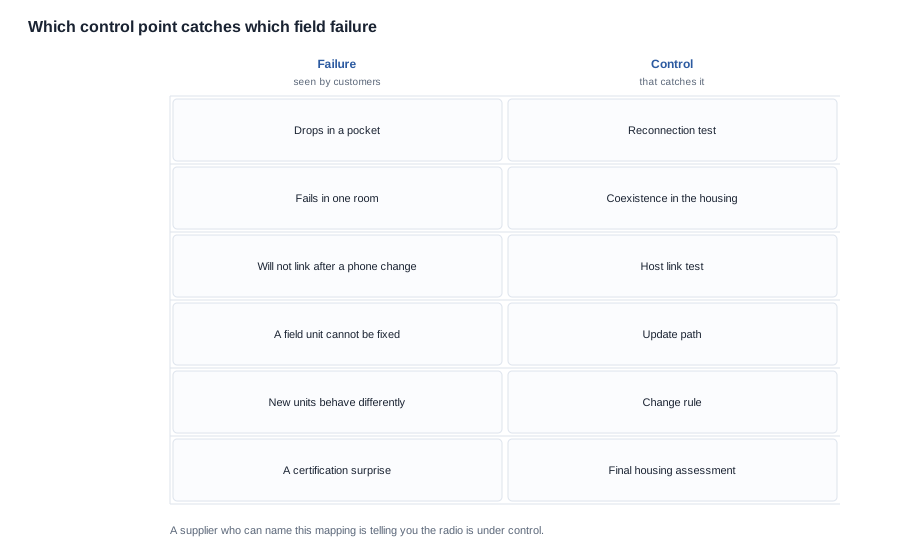
It appears late. A unit that links on the bench has passed every test the production line is capable of running. The failure mode that matters — a link that holds in the factory and drops in a pocket, or one that holds in one building and not another — needs a body, an environment and a duration to reproduce. A production line has none of those. So the detection point is not the line; it is the customer.
It appears intermittently. A deterministic defect is a contained problem, because the population with the defect can be isolated by testing. An intermittent one cannot, and the consequence is that the whole population is suspected. A supplier facing an intermittent radio issue has a choice between replacing a lot that may be mostly good and defending a lot that is partly bad, and either choice is expensive.
It appears as somebody else's fault. The customer reports it. The unit comes back. It is tested in the workshop, where it links reliably, and it is concluded that the unit was fine. The unit is returned, the customer is disappointed, and the second wave of the same complaint arrives with a different tone. By the time the pattern is visible — a room, a duration, a specific host model — the return rate has already done its commercial work.
It appears after the documentation has been signed off. The radio assessment is made on a representative sample of the product as it is built. If the frame, the hinge, the battery position or the antenna routing changes after that assessment, the assessment no longer describes what is being shipped, and nothing in the product itself signals the difference. This is the single most common way a radio escapes a controlled process, and it is why the geometry question belongs in every audit.
The commercial arithmetic follows directly. A unit that drops out in a customer's pocket becomes a return, a support call, a review, and possibly a lot that cannot be sold in a channel that reads reviews. A factory that treats the radio as a controlled parameter rather than as a purchased part is making a decision about where that cost sits, and it is usually the right one — because the cost of controlling it is line time and paperwork, while the cost of not controlling it is the customer.
The eight control points, and the threshold to hold on each
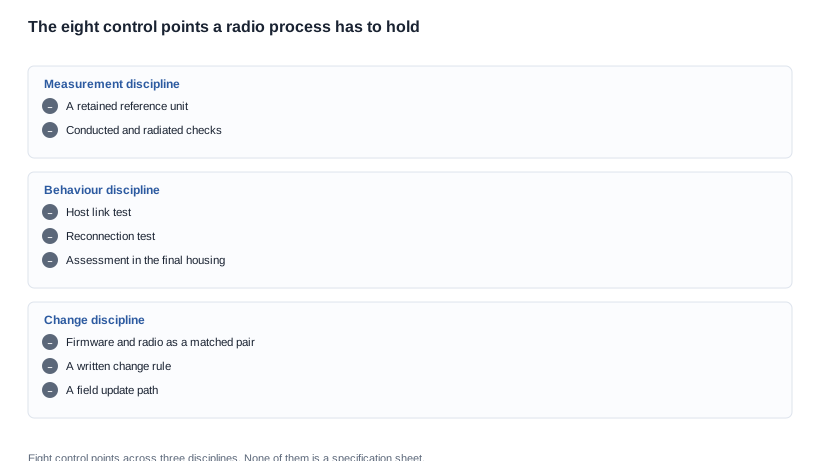
Eight control points, across three disciplines. The threshold for each is the same shape: an artefact a buyer can be shown, not an assurance a buyer is given.
Measurement discipline.
A reference unit. Every radio measurement is a comparison, and a comparison against a specification rather than against a physical unit is a subjective call. A retained reference unit, held in a controlled state, is what turns a judgement into a measurement. Threshold: the reference exists, it is retained rather than borrowed, and it is re-checked against a baseline on a stated cycle — because a reference that has drifted hides the drift. Evidence to ask for: the retention procedure and the re-check record.
The conducted and the radiated checks. These are two different tests of the same thing, and a product has to pass both. A factory that runs only one of them is running the cheaper one. Threshold: both are run, at stated frequencies, on a stated sample. Evidence to ask for: the test plan and the last two results.
Behaviour discipline.
The host link test. Which phones, which operating system versions, and how many attempts. Threshold: a written list of host models and versions with a stated attempt count and a stated pass line. A radio that links with one reference handset and has never been tried on three others is a radio whose customer experience is unknown. Evidence to ask for: the qualified host list and the test records against it.
The reconnection test. A device loses its connection constantly, because a body goes between a pocket and a hand and the body absorbs the signal. The behaviour that matters is what happens next: how quickly it reconnects, and how many attempts before it gives up and requires the user to do something. Threshold: a stated number of attempts before a manual reconnection is needed, and a stated method for measuring it. Evidence to ask for: the test record with the attempt count, not a pass mark.
The antenna in the final housing. This is the control point that catches the most problems, because the radio is affected by the frame. The frame is part of the antenna environment, and a development unit and a production unit with the same electronics can behave differently if the housing, the hinge or the battery position changed. Threshold: the assessment was performed on the production geometry, and the drawing revision it was performed on is recorded. Evidence to ask for: the assessment report with the revision reference.
Change discipline.
The firmware and the radio as a matched pair. A chipset has a supported firmware range, and a product that pairs a newer radio with an older firmware has a problem that appears in the field and nowhere else. Threshold: the supported range is documented, a mismatch is impossible by construction, and if it is possible it is detected. Evidence to ask for: the version matrix and the detection mechanism.
The update path. Whether a field unit can be updated, how the update is delivered, and how long the builds are kept. Threshold: a stated support window and a stated delivery method. This is also a compliance question, because the cybersecurity requirements of the Radio Equipment Directive became a mandatory component of CE marking on 1 August 2025 and they include a process for handling identified vulnerabilities. A radio with no update path has an open question against that requirement.
The change control. A component substituted because the original went out of stock can change the radio behaviour, and the change is usually invisible because the model code has not changed. Threshold: the rule names which changes trigger a re-assessment, and the version scheme distinguishes a change to the bill of materials from a change to the product. Evidence to ask for: the rule itself, and the last change record.
The eight control points as an audit checklist
For a buyer running a short supplier assessment, these are the eight items and the question that closes each one. They are the questions to ask, in the order that produces the cheapest disqualification first:
- Reference unit — is there one retained, and on what re-check cycle? A "no" here ends the conversation about measurement.
- Conducted and radiated checks — are both run, and on what sample size? A "one only" answer identifies the cheaper test.
- Host link test — which phone models and operating system versions, and how many attempts? A single reference handset is a red flag.
- Reconnection test — how many attempts before a manual reconnection is needed, and how was that measured?
- Assessment in the final housing — which drawing revision was assessed, and is it the revision being shipped?
- Firmware and radio as a matched pair — what is the supported range, and can a mismatch occur?
- Update path — what is the delivery method, and how long are builds kept?
- Change control — which changes trigger a re-assessment, and where is the change recorded?
Eight questions, and the criteria behind them are the same in every case: an artefact rather than an assurance. The due diligence value of the checklist is that it separates the suppliers who measure the radio from the suppliers who merely buy it, and it does so before a purchase order rather than after a return rate.
The sampling regime, which is where the judgement sits
The eight control points above describe what is measured. The sampling regime describes how much. Testing every unit catches the outliers and costs line time; sampling catches the systematic faults, which are the ones that affect thousands of units. The threshold is a stated regime with a stated rationale: for example, every unit for the conducted check and a stated frequency for the radiated check, or a stated sample size per lot with the lot identified.
A stated regime, a retained reference and a written change rule together make the rating defensible. A buyer who sees those three things knows the radio is under control, and can stop asking the question. A supplier who has none of them has not failed a standard — they have simply made the radio the buyer's problem.
The three questions that find the weak spots
If an audit has to be short, these three questions find more than a long walk-through:
- What is the reconnection behaviour? Ask for a number, such as the attempts before a manual reconnection is needed, and ask how it was measured.
- Was the radio assessed in the final housing, or in an engineering sample? The distinction is the one that most often exposes a surprise at certification.
- What happens if the radio component is substituted? The answer should be a process, not a reassurance.

How to test whether a supplier's radio is actually under control
Step one: ask for the artefacts, not for the conclusions. The reference unit retention record, the test plan, the host list, the reconnection records, the assessment report, the version matrix and the change rule. A factory that produces these can be audited; a factory that produces assurances cannot.
Step two: check the revisions. This is the step that catches the most problems. Take the drawing revision named in the radio assessment, the revision on the units at receiving, and the revision in the bill of materials for the current lot. If they differ, the assessment does not describe what is shipping.
Step three: run one behaviour test on a sample from a current lot, not a pre-production unit. Reconnection after a power cycle, and a link to one host model from the qualified list, on a unit drawn from stock. A factory that keeps a reference unit can show you the difference between the unit on your desk and the unit in the box.
Step four: ask what happens when a part goes out of stock, and watch the answer. The good answer names the trigger, the re-assessment and the notification. The bad answer is a statement about the supplier's relationships with its suppliers.
Step five: ask to see a change record, any change record. A factory that has never made a change has either been extraordinarily stable or has not been recording them. The record itself is the evidence, and it is usually short.
Step six: write the outcome into the purchase order. The control points a supplier agrees to are worth nothing as a conversation and worth something as a condition. An incoming inspection criterion that reproduces the reconnection test, an update-path commitment in the documentation pack, and a notice obligation on radio substitution are the three that earn their place.


Where a radio escapes the process
The assessment was done on an engineering sample. The symptom is a surprise at certification or at a market surveillance check, and it arrives late. The root cause is that the geometry was not treated as part of the assessment scope. The prevention is to make the drawing revision a field on the assessment report and to check it at receiving.
A part was substituted without a re-check. The symptom is a lot that behaves differently from the lots before it, with no paperwork recording a change. The root cause is a change rule that does not name the radio module. The prevention is a written rule with a trigger and a notification obligation.
The firmware baseline was moved. The symptom is units that link unreliably with a particular host model, and a firmware version on the units that does not match the version in the test records. The root cause is that the firmware and the radio are not treated as a matched pair. The prevention is a version matrix and a change record.
The host list was never written down. The symptom is a support team giving different answers to the same question. The root cause is that the testing was done against whatever handsets were available rather than against a defined list. The prevention is a written list, updated as the market changes.
The reference unit drifted and nothing was detected. The symptom is a slow shift in the measured population with no change in the product. The root cause is that the reference is re-checked only when somebody remembers. The prevention is a re-check on a stated cycle with a recorded result.
The update path was promised and not built. The symptom is a field population that cannot be brought into line with a strengthened requirement, and a compliance file with an open question in it. The root cause is that the update path was treated as a future engineering task rather than as a release condition. The prevention is to attach the build retention window and the delivery method to the documentation pack.
Where the commercial room is, once the control points are known
The interesting consequence of a control-point audit is that it moves the negotiating space. A supplier with a documented radio process has already absorbed the cost of testing, so the conversation about who funds a second sample round for coexistence and range work, or who carries the cost of a re-assessment after a substitution, becomes a conversation about scope rather than about capability.
The items that remain fixed in character are the certification cost and the laboratory time behind it, which are fixed per family and per market, and the tooling, which is a one-off cost usually amortised across the first order with the useful questions being over what volume it is amortised and what happens to it if the programme is discontinued. The version itself has no room: it is a property of the platform the supplier built.
What moves is the number of configurations, the number of markets, the artwork round count, the share of units taken at a pilot tier rather than the run tier, and — most usefully for a buyer who has just run a control-point audit — whether the supplier will fund the incoming inspection criteria you have written, including the ones that reproduce their own control points on every lot.
A supplier audit, and the limits of our own published position
What follows is a constructed scenario rather than a client project, and it is written to make the order of the checks visible rather than to report a result.
Assume a brand's incoming inspection lead qualifying a second source for an existing Bluetooth audio platform. The incumbent has a return rate of three per cent; the candidate's sample has linked reliably in the workshop, and the candidate's sheet states the same Bluetooth version as the incumbent's.
Step one: the artefacts request. The lead asks for the reference unit retention record, the test plan, the host list, the reconnection records, the radio assessment report, the firmware and radio version matrix, the update path and the change rule. The candidate returns six of the eight and says the reconnection records are internal and the change rule is being written.
Step two: the revision check. The lead compares the drawing revision named in the assessment report against the revision on the units at receiving. They differ by two revisions. The assessment describes a housing that is not the housing being shipped, which is exactly the failure mode the control point exists to catch, and the candidate had not noticed it because nothing in the product signals the difference.
Step three: the behaviour test. On a unit drawn from current stock rather than from a pre-production batch, the reconnection behaviour after a power cycle is materially worse than the assessment report records. The candidate's radio is assessed in a housing that the current one does not match, and the field behaviour follows the housing rather than the report.
Step four: the conditions. The lead does not walk away. The revision reference is made a field on the inspection record, the assessment is repeated on production geometry as a condition precedent, the reconnection test is written into the incoming criteria with its pass line, and the change rule is made a delivery obligation with a notice period attached.
Step five: the commercial outcome. The candidate's first order is smaller than planned and the assessment is carried as a condition, with the balance released on delivery of the repeated assessment. The lead has bought time rather than risk, and the inspection criteria now reproduce the supplier's own control points on every lot.
The decisive step was step two. The version was identical on both sheets and told the lead nothing; the drawing revision told her everything.
What our own documentation stands at, and what it does not
The boundary we hold: we publish the rows we have and mark the rest as open, and in this case the published row is the least informative one. We publish Bluetooth 5.3 on the K01 and the K02, and Bluetooth 5.4 on the D11, the D12, the LC-105-1, the LC-105-2, the G07, the YK12, the YKC02, the D17, the ZH12, the A07, the electrochromic entry and the AR entry. We publish no version for the AI camera glasses family, the bone conduction entry, the A05 or the A06.
We publish no chipset, no module part number, no profile list, no codec list, no multipoint figure, no range, no update method, no qualification position, no reference unit practice, no sampling regime and no test report for any model. We do not publish our line-side radio controls, because the company has not confirmed them, and we will not describe a quality control regime we cannot evidence. A supplier that cannot evidence its own regime should not be described in one.
Weight is the clearest illustration of the discipline this article describes. Our catalogue publishes a weight for one entry only — 158 g for the MT6 glasses unit, excluding its foldable charging case, whose capacity is 1200 mAh — and publishes none for the rest of the range. A published figure is a commitment the factory can be held to at receiving; an absent one is not a defect but an absence of commitment, and the buyer has to decide which way to read it before it becomes a dispute. We do not make any claim about eye protection, vision or health for anything we sell.
What we will do with a model and a market
Take a specific model and walk through the eight control points, saying which of them we can document today and which would have to be established before a buyer could rely on them. The connectivity rows across the range are at Bluetooth connectivity, the key rows in more detail are in the connectivity key rows, and the general pattern of production control is set out under quality gates.
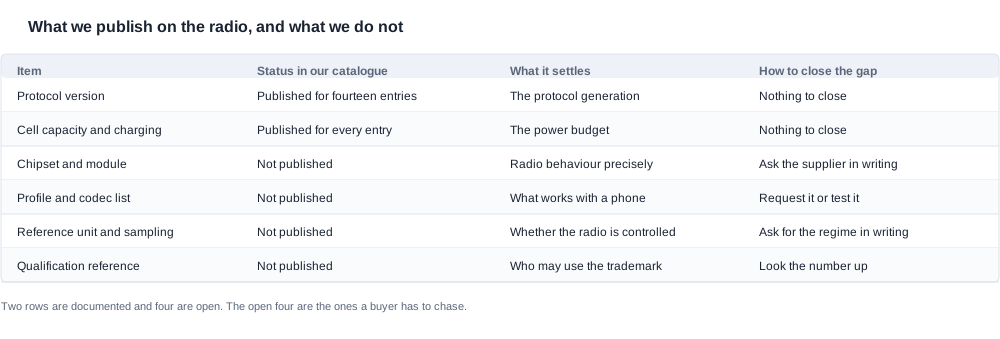
Tell us the model and the market, and we will say which of the eight control points we can document today.


