
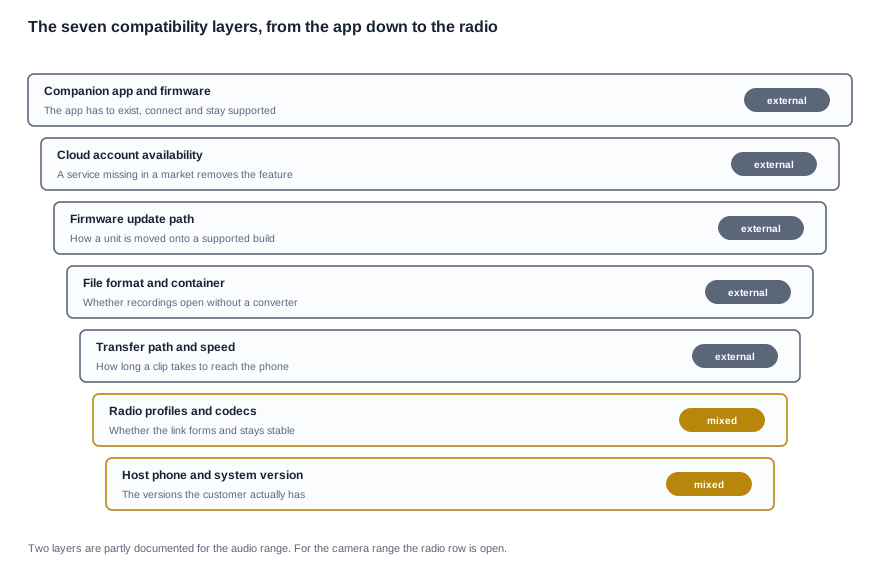
Compatibility is treated as a single question, and it is not. It is at least seven questions, each with a different owner and a different failure mode, and a product that connects perfectly in a demonstration can fail on a customer's phone for reasons that sit entirely inside this list. A camera product is more exposed than an audio one, because the file has to arrive, open and be editable, and every step of that journey is a compatibility question. This article sets out the layers, identifies who owns each one, and states where our own published rows stop.
The consequence for a procurement team is that "it is compatible" is not a specification and cannot be signed. It is the output of a matrix that has to be tested across combinations, and the number of combinations in this category is large enough that a buyer has to decide which of them matter before the sample order rather than after.
Smart glasses camera technology: the chain of handoffs
Who owns each layer
The radio. The product and the host device have to share the profiles they both support. This is the layer a buyer checks first, because pairing is the visible part, and it is the layer where a version number is most often mistaken for a guarantee. A protocol generation does not determine the profile list, and the profile list does not determine whether a phone will actually use them.
The host operating system. The application has to exist for it and to work on it. This is a question about versions rather than about platforms, and the versions matter: a product released with an application tested against one release of an operating system behaves differently on the next one, and the customer who updates first is the one who finds the problem.
The application and the firmware. The application has to connect to the hardware it ships with, and this is where the version lock lives. If the application requires a particular firmware and the path to that firmware is unclear, the customer has a device that the current application cannot use. The question is which firmware versions the current application supports, and how a unit is moved onto a supported one.
The file format. The recordings have to open in whatever the customer edits with. A format that requires a converter is a converter that somebody has to install, and a conversion step in a content workflow is a step that gets skipped.
The transfer path. How the files get from the device to the phone, and how long that takes. This is the layer that decides whether a product is usable, and it is the one most often assumed rather than tested. A one-minute clip that takes four minutes to arrive changes what a customer does with the product.
The service account. If the product uses a hosted service, the account has to work in the destination market, and a service that is unavailable in a market makes the feature unavailable in that market regardless of what the hardware can do. For a product sold into six markets, this is a real launch dependency rather than a technical footnote.
The update path. Whether the firmware can be updated on the customer's own phone, and for how long the builds are kept. This is also a compliance question, because the cybersecurity requirements of the radio equipment framework became a mandatory part of CE marking on 1 August 2025, and they cover the process for handling identified vulnerabilities. A product with no update path is a product with an open question against that requirement.
Why a camera product is more exposed than an audio one
An audio product's whole output is sound, and sound does not have a format problem, a transfer problem or a codec compatibility problem. A camera product's output is a file, and a file has to survive a chain of steps, each of which is a possible failure.
The practical consequence is that compatibility testing for a camera product is longer, and the questions above are better asked as a matrix than as a list: the product, the phone, the operating system version and the application version, tested together, with the file transferred and opened. Testing on one phone with one application version proves very little, and the customer who owns the phone nobody tested on is the customer who finds the gap.
There is a commercial dimension as well. A brand that has specified compatibility loosely will discover the gaps in the form of returns, each of which carries a support contact, a channel credit and a listing that has to be revised. A brand that has specified it as a matrix has a defensible answer to the customer whose phone is not on the list, which is a stated minimum specification rather than an apology.
The radio layer, where the version number gets mistaken for a guarantee
What a published Bluetooth version settles, and what it does not
A Bluetooth version number is a protocol generation. It tells you that the module implements a particular core specification, and from that you can infer a set of features existing at the time the specification was written. It does not tell you which of those features the product implements, which profiles are compiled into the host firmware, which codecs are offered, or how the link behaves in a congested 2.4 GHz environment — which is exactly the environment a glasses product lives in, sitting on a person's head next to a phone that may be simultaneously connected to a headset, a keyboard and a vehicle.
Our catalogue publishes the Bluetooth version for a substantial part of the audio range. The D12 and the LC-105-1, the G07 and the YK12, and the LC-105-2 and the D11 are published, and the sport models publish V5.4 on the YKC02, the D17 and the ZH12. The A07, the AR entry and the electrochromic entry are published as well, with the K01 and the K02 on an earlier generation than the rest. The camera family is different, and the difference matters: no Bluetooth version is published for any of the eleven camera models, including the CY05 and the KY06, the MT5 and the L2 Utral, the V03 and the V03 Pro, the MT6 and the CY03, the V06 and the S7, and the L1 Pro.
So the radio layer of the compatibility question is open across the largest single group in the catalogue, and we are telling you that in an article about compatibility because a buyer who assumes compatibility from a specification sheet is exactly the buyer who finds out later.
What to ask instead of assuming
Ask for the radio module part number rather than the version. The module part number implies the chipset, the antenna design, the coexistence behaviour and a large part of the current draw, which in turn affects the published runtime band. Ask for the implemented profile list, and ask which of the profiles are actually exercised in the shipping application. Ask for the codec list, because the codec negotiation is where a call with a particular phone model fails.
None of these is a substitute for a test matrix. They are the preconditions for building one sensibly, because a matrix of a hundred combinations is only worth running if the part numbers make the failures interpretable.

The file journey, where a camera product breaks and an audio product does not
One clip, five handoffs
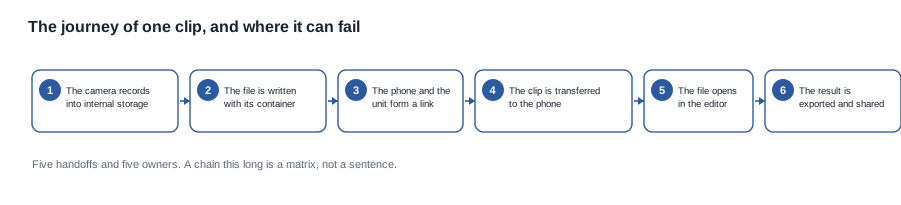
The path of a single recording is short enough to describe in one sentence and long enough to fail in five places. The camera writes into internal storage in a container with a codec. The phone and the unit form a link. The clip is transferred. The file opens in the editing application. The result is exported and shared. Each handoff has a different owner: the firmware, the radio stack, the transport, the application on the phone, and the customer's editing software.
The first handoff is the one that surprises buyers, because it is inside the product and therefore invisible to a compatibility test. A device can pair, transfer and open files perfectly while writing them in a container that the editing application will not handle without a converter. The failure then appears at the fifth handoff, in the customer's workflow, and it is reported as a compatibility problem even though every layer tested passed.
The second and third handoffs are the ones that vary most by phone. The transfer path is affected by the radio environment, by the phone's power management behaviour, and by how much other traffic the radio is carrying. A clip that arrives in under a minute in a laboratory may take several minutes in a live venue, and the customer experience difference is large.
The fourth handoff, and the one a brand controls
The application on the phone is the layer where the brand has influence rather than mere influence. The compatibility question is not "does the application install" but "which operating system versions does the current application support, and how is a customer on an unsupported version told". A product that releases an application for a new operating system version and breaks an old one converts a compatible product into an incompatible one without changing any hardware.
The update path closes the loop. If the firmware can be updated on the customer's own phone, a version mismatch is recoverable. If it cannot, the version lock is permanent for the units already in the field, which converts a temporary problem into a write-off of the installed base.
Testing compatibility as a matrix instead of a demonstration
Reading the matrix by rows
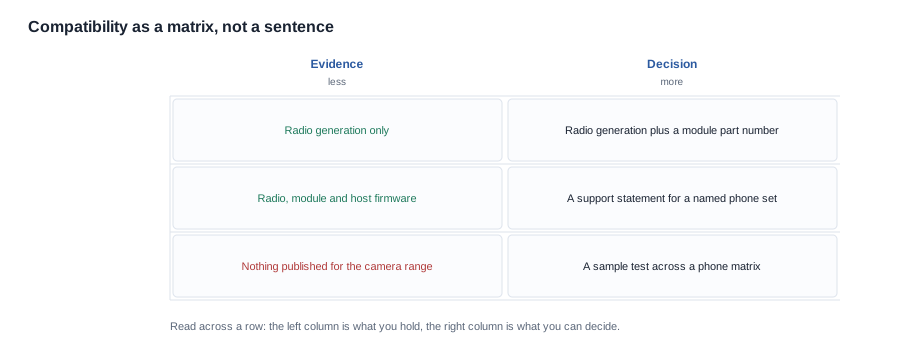
A demonstration proves one combination. A matrix is a set of combinations, each with a result, and the results are what a buyer can put in front of a channel. The three rows above are the states a camera programme typically reaches: a protocol generation alone, which is enough to publish but not enough to decide; a protocol generation plus a module part number, which is enough to build a meaningful test set; and a radio row, module row and host firmware row together, which is enough to publish a support statement for a named set of phones.
For a camera product, the first row is where our catalogue sits for all eleven camera models, which is why the second row of the matrix is a sample test rather than a document request.
Building the test set you actually need
The test set should be derived from the channel rather than from the supplier's laboratory list. Ask which phone models and operating system versions the supplier has tested, then compare that list against the models that actually move in the customer's market, and keep the intersection plus the two or three models at the edge of the range. Test the full chain on each one: connect, record, transfer, open, export.
State the sample size and the pass condition before the test rather than after. A compatibility test with no pass condition produces a list of observations, and observations do not settle a warranty claim. The pass condition for this category is simple and worth writing down: the recorded file arrives intact, opens in the customer's named editing application without a conversion step, and the audio and video stay in sync.
The row a brand has to write itself
The one row nobody supplies is the minimum specification for the customer's own device. A product with no stated minimum host specification will be returned by customers who never had the hardware to run it, and the return reason will be recorded against the product rather than against the customer. Stating a minimum specification moves that row from the returns queue to the product page, and it is a page a brand can write without any evidence it does not already hold.
The evidence to request before the sample order, and where our rows stop
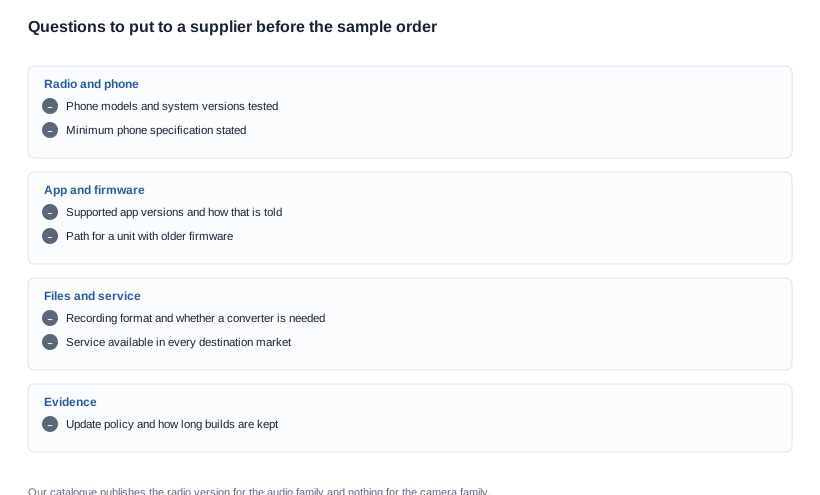
Eight questions, grouped by owner. The radio and host questions ask which phone models and operating system versions have been tested, and whether a minimum host specification is stated. The application and firmware questions ask which application versions are supported, how that is communicated, and what happens to a unit whose firmware is too old for the current application. The file and service questions ask what format is recorded and whether a converter is needed, and whether any hosted service is involved and whether it is available in every market the buyer sells into. The evidence question asks how firmware updates are delivered and how long the builds are kept.
Our own position on these rows is worth stating with the same clarity we would ask of a supplier. Our catalogue publishes the camera tiers and the electrical rows, and it publishes the Bluetooth version for the audio family, the sport models, the A07, the colour-change entry and the AR entry. It publishes no application, no operating system support statement, no file format, no transfer time, no service description and no update policy for any model, and we will not infer any of them.
That position is deliberately uncomfortable, and it is more useful than the alternative. A supplier who gives you a compatibility statement with no underlying rows is asking you to take their word for the one thing you cannot test on a sample without a device in every customer's pocket. A supplier who gives you the module part number, the implemented profiles, the recording container and the support statement lets you build the matrix yourself.
Where the sample evaluation fits
A sample order is the cheapest way to close the rows that cannot be closed on paper, and the sample evaluation protocol is where the close happens. The parts of it that matter for compatibility are narrow: connect to the customer's own test phones rather than the supplier's, record in the customer's environment rather than on a desk, transfer and time the transfer, and open the file in the customer's editing application rather than the supplier's. The sample evaluation route covers the wider protocol, and the connectivity rows and their gaps are set out under Bluetooth connectivity.
The eight questions to ask, in the order that reduces risk fastest
The checklist image above is grouped by owner, which is the right way to organise the request to a supplier. The order in which to send it is a different matter, and it is worth getting right, because a supplier who answers the first four has almost certainly answered the rest.
- Which phone models and operating system versions have been tested, and on which application version?
- What is the radio module part number, and which profiles are implemented in the shipping firmware?
- What is the recording container and codec, and does the file open in the common editing applications without a converter?
- What is the measured transfer time for a typical clip, and how much does it vary by host device?
- Is any hosted service involved, and is the account available in every destination market?
- Which application versions are supported, how is an unsupported customer told, and what happens to a unit whose firmware is too old for the current application?
- How are firmware updates delivered, and for how long are the builds kept?
- Is a minimum host specification stated in the product documentation, and what is it?
Question one is first because it is the cheapest to answer and it tells you whether the rest of the list will be answered in the same spirit. A supplier that has tested on named phone models has a test laboratory and a regression process behind it, and that is a better signal than any statement of intent. Questions two to four are asked together because they are the camera-specific rows, and a supplier who answers the camera rows specifically has answered them for a camera product rather than by copying an audio product's sheet.
Questions five to eight are the commercial rows. They do not stop a shipment, but they determine the total cost of the programme: a hosted service carries a recurring cost and a per-market availability question, an update policy determines whether a version problem is recoverable or permanent, and a minimum host specification is what keeps an unsupported customer out of the returns queue.
How to shortlist on compatibility when the data is thin
Compatibility data in this category is thin enough that a buyer should shortlist on the published rows and close the compatibility question on a sample, rather than trying to shortlist on compatibility itself. The published rows that narrow a camera shortlist are the resolution tier, the charging interface, the cell capacity, the case configuration and the runtime band. Two models that differ on those rows will behave differently enough in the field that testing one does not stand in for the other.
The trade-off a buyer is making is between test breadth and test depth. Testing one model across ten phone combinations proves the model and says nothing about the second model. Testing four models across three phone combinations proves the family and leaves the fourth combination open. For a programme with a single camera model, depth is the right answer. For a programme with a range, breadth is, and the remaining combinations have to be closed by the supplier's own regression evidence rather than by the buyer's budget.
The due diligence question underneath all of this is whether the supplier can describe a defect that has occurred in the field and how it was traced to a layer. A supplier who can name a past transfer failure, or a past application-version failure, has a process. A supplier who has never had either is either very new or is not testing, and in both cases the buyer should assume the buyer is the test laboratory.
The limit of what we can evidence on compatibility
Stated plainly: compatibility is a matrix rather than a claim, and it has to be tested across the combinations rather than asserted. We will publish the rows we hold and mark the rest as open, and we will not state an operating system support policy, an update commitment or a transfer time that the company has not confirmed for a given model.
What we will do is take a specific model and the list of phone and software combinations your customers actually use, and tell you which of the seven layers we can currently evidence for that model and which have to be established before launch. The imaging rows are under camera and imaging, and the measurements that settle quality are covered there as well.
Send the phone and software combinations your customers actually use, and we will tell you which compatibility layers we can evidence today.


