
The camera in a pair of smart glasses is described in a vocabulary that assumes you already know the photography. This article is for the buyer who has been handed a specification sheet with a number in it and needs to know what to ask next. It is not a photography lesson. It is a map of the terms you will meet, what each one actually tells you, what each one leaves out, and the five questions that separate two products that look identical on paper.
One point about the reader worth making at the start. Everything below is written for someone whose job is to decide whether to buy, from whom, at what price and against what evidence — not for someone who wants to know how to use the product. That is why the emphasis is on what a term settles, what it omits, and what to put in a request to a supplier. A vocabulary is only useful to a buyer when it comes attached to a decision.
Smart glasses camera technology: how a first-time buyer reads a datasheet
The first thing to understand about these sheets
A camera datasheet is written in an order that makes sense to the person who built the product and is close to meaningless to the person deciding whether to buy it. The sheet moves from the sensor to the lens to the processor to the battery, because that is the order of the signal chain. A buyer needs a different order, and the reordering is the skill this article teaches.
Start from the workload. Decide what the product has to do in the customer's hands, write that down as a workload rather than as a feature, and then read the sheet asking one question of every row: does this row settle anything about my workload? Rows that do not are noise, however impressive they look. Rows that do not exist are the ones that decide the order.
The ten rows you will meet, and what each one leaves out
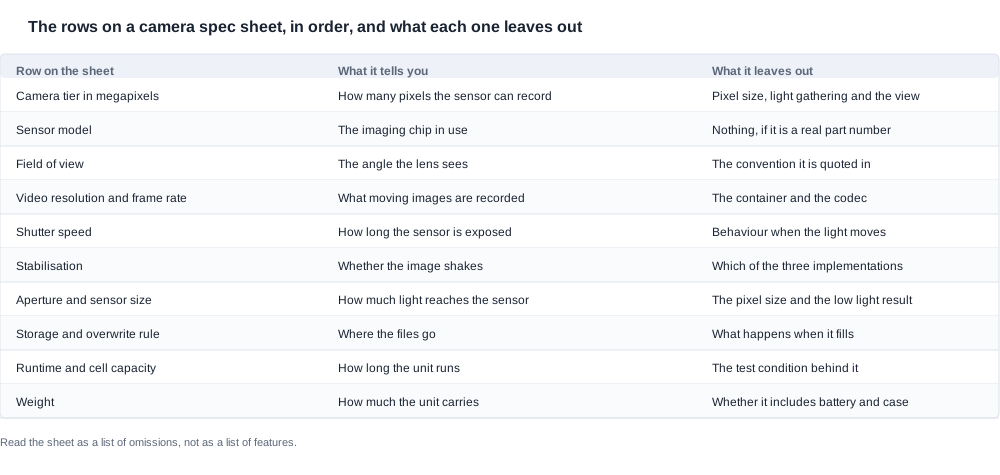
| Row on the sheet | What it tells you | What it leaves out |
|---|---|---|
| Camera tier in megapixels | How many pixels the sensor can record | Pixel size, light gathering and the view |
| Sensor model | The imaging chip in use | Nothing, if it is a real part number |
| Field of view | The angle the lens sees | The convention it is quoted in |
| Video resolution and frame rate | What moving images are recorded | The container and the codec |
| Shutter speed | How long the sensor is exposed | Behaviour when the light moves |
| Stabilisation | Whether the image shakes | Which of the three implementations |
| Aperture and sensor size | How much light reaches the sensor | The pixel size and the low light result |
| Storage and overwrite rule | Where the files go | What happens when it fills |
| Runtime and cell capacity | How long the unit runs | The test condition behind it |
| Weight | How much the unit carries | Whether it includes battery and case |
Megapixels are a count, not a quality
A megapixel is a million pixels, so 8 MP is eight million points of colour information in a single image and 13 MP is thirteen million. That is genuinely all it means. It does not say how large the individual pixels are, and the size of the pixel is what determines how much light it collects, which is what governs how an image behaves indoors or at dusk. A smaller-pixel sensor with a higher count can produce a worse picture than a lower-count sensor with larger pixels.
It also does not say what the lens sees, how the image stabilises, or whether the product records video at all. It is a starting filter rather than a comparison.
In our catalogue the camera models are published at 8 MP and 13 MP, and that resolution figure is the only imaging row we state for them. The 8 MP group is the MT5 and the CY05, the V03 and the V03 Pro, and the CY03 and the KY06, and the V06 and the MT6, and the 13 MP group is the L2 Utral and the S7, and the L1 Pro.
The order to read the sheet in, and why the order matters
Five passes, and what each one is for
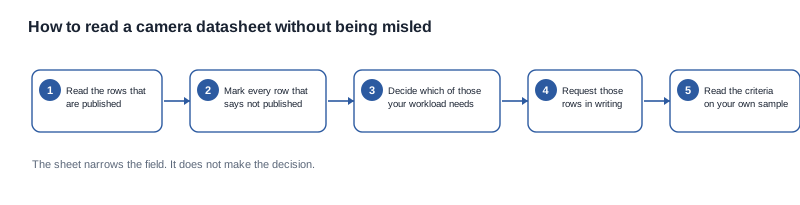
The first pass is to read the rows that are actually published and write them down, because those are the only rows that can be compared against another supplier's sheet. The second pass is to mark every row that says the figure is not published, and that list is the real content of the sheet for a buyer: it is a list of the questions you now have to ask. The third pass is to decide which of the missing rows your workload actually depends on, because most of them do not matter to your workload and asking about all of them produces six partial answers instead of one complete one.
The fourth pass is the request: those rows, asked for in writing, before quotations are compared, so that two suppliers are answering the same question rather than each answering the question they prefer. The fifth pass is the sample, read against criteria you wrote before the sample arrived. A sheet cannot complete any of these five passes on its own, which is why a sheet that looks complete is often the least useful document in the pack.
The rows that decide the order of work
The sensor model decides the pixel size, the light-gathering behaviour and therefore whether the low-light result is plausible. It is the most informative single string on any sheet in this category, and the one most often absent. Ask for it first.
The field of view decides whether first-person video works at all, and it is meaningless without the convention, because the same lens quoted on a diagonal basis and on a horizontal basis produces two different numbers. A sheet that gives a figure without a convention has not given a figure.
The video resolution and frame rate decide whether the product is a video camera at all, and the frame rate is what decides whether walking footage is usable rather than merely recorded.
The storage row decides the length of a session, and the overwrite rule decides whether that session ends badly.
The runtime row decides the working day, but only if a test condition is attached, and in our catalogue none is.
The five questions that separate two products that look identical
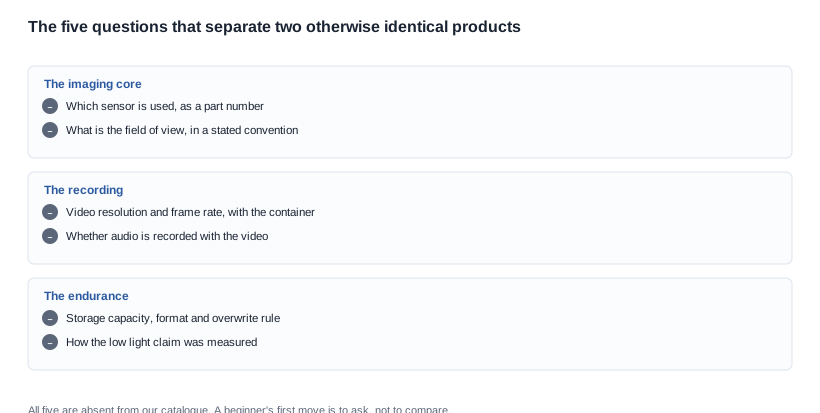
Two suppliers will send you two sheets with the same tier and the same runtime and the same case capacity, and the products behind them can be completely different. Five questions find the difference, and all five are answerable by a supplier who has the data.
- Which sensor is used? A part number is enough, and it is the most informative single answer a supplier can give. It also tells you the generation of the design, which tells you whether the vendor is working with a current part or an ageing one.
- What is the field of view, and in which convention? It determines whether the product works for first-person video or only for stills, and the convention determines whether you can compare it with the other sheet.
- What video resolution and frame rate does it record, and is audio recorded with the video? Our catalogue does not state this for any camera model, and a product that records stills only and a product that records video are sold with the same word.
- What is the storage capacity, the file format, and does it overwrite? Storage exhaustion in the middle of a session is one of the most common avoidable return reasons in this category, and it is entirely preventable if the behaviour is known before the order.
- How does it perform in poor light, and how was that measured? If the answer is a comparison against another product with no method, treat it as a marketing line rather than a specification.
The two questions worth asking twice
The sensor model question is worth asking a second time, phrased differently, because a supplier that answers it inconsistently is working from a datasheet rather than from a build. Ask which sensor is fitted to the model you are ordering, and then ask whether it will remain fitted for the duration of the programme. A tier change without a model change would be a revalidation event, and a buyer who does not know about it discovers it when the sample stops matching the quotation.
The field of view question is worth asking a second time with a different form of words. Ask for the angle the lens sees, and then ask how much of that angle the frame itself occupies. The usable view is a product property rather than an optical one, and a lens quoted at a generous diagonal figure can still deliver a narrow practical view once the frame geometry is accounted for.
Where a beginner's first enquiry should go, and what it should not
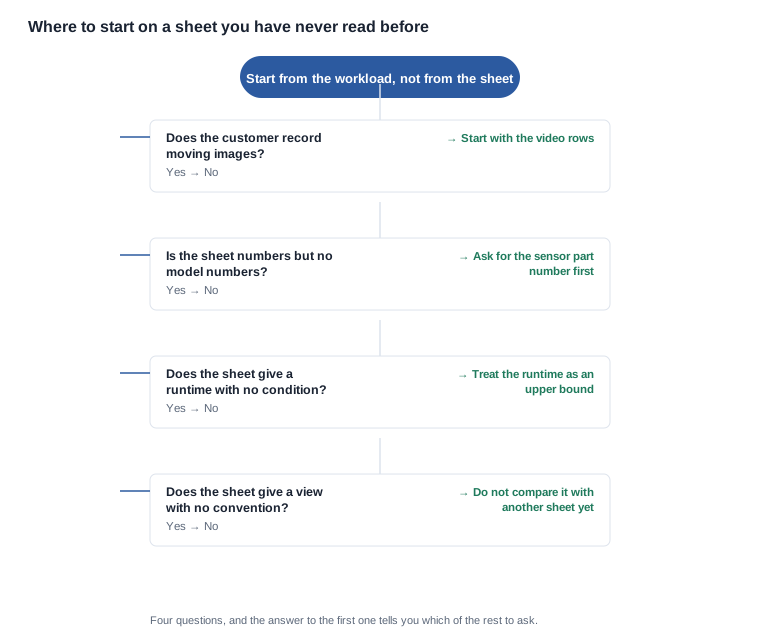
The four branching questions
If the customer records moving images, start with the video rows and leave the stills-oriented questions until later. If the sheet is full of numbers but contains no model part numbers at all, ask for the sensor part number first, because everything else on the sheet is unusable until you know what is behind it. If the sheet gives a runtime with no test condition, treat that runtime as an upper bound and price the product on the assumption that the customer is in the worst case. And if the sheet gives a field of view with no convention, do not compare it with another sheet yet, because the comparison is meaningless until both are on the same basis.
What not to lead with
Do not lead with a request for a quotation, because a quotation is a response to a specification and you do not have one yet. Do not lead with a request for the sample, because a sample answers questions you have not written down. And do not lead with a request for an image quality comparison, because without a protocol it produces an opinion dressed as a measurement.
Lead with the workload, in one sentence, and with the five questions. A supplier who answers all five has a documentation habit and a test process. A supplier who answers two is telling you something you need to know before the deposit, and that something is not about the product.
The questions that sound technical and are actually commercial
Two of the five questions are really about cost and schedule rather than about imaging, and they are worth separating out for a buyer meeting a supplier for the first time. The storage question determines whether the product can be the primary capture device or only a secondary one, which changes the volume the customer buys and therefore the price tier you are quoted. The runtime question determines whether the case is an accessory or the working day, and in our range seven of the eleven camera models ship with a case while four ship without one, which is a decision about packaging, freight and per-configuration minimums as much as it is about endurance.
The vocabulary trap: a term from a phone camera does not mean what it says here
The terms that mislead
Stabilisation. On a phone, stabilisation is handled by a fixed body and a computational pipeline that knows the scene. A camera in glasses moves with the person's head in ways the frame's own motion does not predict, so the problem is fundamentally different. Optical, electronic and software stabilisation are three different implementations with three different artefacts, and the word on its own tells you nothing.
Auto exposure and auto white balance. These assume a subject at a known distance in a known light. In this form factor the subject is whatever the person turns towards and the light is whatever they walk into. A camera that behaves well on a test bench and badly in a street is doing exactly what its algorithm was built to do.
Depth of field and portrait mode. A phone uses several cameras or a depth sensor to separate a subject. A glasses camera has one sensor and no published depth reference, so background separation is a processing effect rather than a measurement.
Frames per second against shutter speed. A camera in glasses is frequently moving, and a fast shutter is what stops motion from smearing. Shutter speed is not published in this range, and it is often the difference between usable footage and unusable footage.
The terms that mislead quietly
AI features. Our catalogue names an AI voice assistant in the camera tier's technology list. The term is a category label rather than a specification, and the details that would let a buyer distinguish one implementation from another — which models are supported, whether the processing runs on the device or in a service, what the processing actually does — are Not published.
Weight. The only published weight in the catalogue is the MT6 at 158 g, and it is the glasses unit including the battery and the camera, excluding the foldable charging case. No bare frame weight is published anywhere, and the case weight is not published either. A sheet that says "158 g" without saying what it includes is making a claim the buyer cannot use.
IP rating. Our catalogue publishes IP54 on two camera models, the V06 and the S7, and on no other camera model and no audio model. An ingress claim is a product-level statement about a sealed assembly, and it is not transferable from one model to another.
Turning the sheet into a purchase order that survives a dispute
What belongs in the order and what belongs in the email
The rows you gather from the sheet are only useful once they are attached to something. A criterion that exists only in an email is not binding; a criterion written into the purchase order, with the measurement condition and the sample size stated, is the acceptance standard, and a lot that fails it is a lot the buyer can refuse.
Before you order, three things should exist in writing. The first is the list of imaging rows the supplier has answered, with the method attached to each one, so that a later measurement can be compared with the earlier claim rather than with nothing. The second is the acceptance criteria, stated as minimums and measured on the received units. The third is the model designation attached to the order, because a family-level document is not coverage for a specific configuration and a substitution is otherwise undetectable until a customs query.
The five criteria worth carrying into the contract
- A field-of-view minimum, in a named convention, measured on the received units.
- A minimum usable frame rate while the person is walking.
- A maximum capture latency, stated in milliseconds from the control press to the written file.
- A storage exhaustion behaviour observed on the unit rather than described in a document.
- A recording and transfer pass condition on the customer's own host devices, with the device list named.
These five are the whole of the acceptance standard a camera programme needs. Each one corresponds to a row on the sheet that suppliers routinely leave unpublished, and each one can be settled by a measurement that the buyer's own engineer can run. That is what makes them worth writing: they convert the absent rows into enforceable decisions rather than leaving them as open questions that surface in the channel.
The trade-off a first-time buyer should be told about
The trade-off is between the breadth of the specification and the depth of the test. A supplier can answer every row on the sheet and still be wrong about the combination that matters in your channel, or it can answer three rows perfectly and have the measurement infrastructure to back them. Which is better depends entirely on how much of the total cost of the programme is the specification and how much is the volume of units that do not behave.
The practical answer is to pick the criteria that your workload depends on, require them by name, and accept the rest as open. A first-time buyer who tries to close every row will either pay for a bespoke measurement programme that the order does not justify, or will wait for a supplier to close rows that will never be published, and will end up with a product nobody has actually tested.
The rows we can answer, and the rows we will not fill
The boundary we hold: we will publish the imaging rows we have and mark the rest as open, and we will not fill them with typical values from the industry. We publish the 8 MP and 13 MP tiers and the electrical rows that go with them, and we publish no sensor model, no field of view, no video specification, no aperture, no stabilisation figure, no storage behaviour and no low light data for any camera model in our range. We will also not tell you that 13 MP is a better picture than 8 MP, because on the evidence we hold, that is not a statement we can make.
We will also point out where the surrounding obligations sit, because a first-time buyer is often surprised by them. The general product safety regime has applied since 13 December 2024 and covers consumer products regardless of where they were made. Our published certification position is that the catalogue's export-certification page carries ten patent certificates — eight appearance-design patents and two utility-model patents — and names no CE, FCC or RoHS marking, so the model-specific certificate numbers are a document to request rather than a published row. A device that records continuously brings questions about storage, about privacy and about what the retailer has to display, and those questions belong in the product page rather than in a support script.
What we will do is take a specific model, walk you through the five questions, and tell you which of them our documentation can answer and which have to come from a test on a sample before you commit to a volume. The full set of imaging rows is under camera and imaging, the models the guide refers to are on the AI camera glasses range, whether a camera belongs in your product at all is covered under do you need a camera, and the way to check a delivered unit is set out in sample evaluation.
Tell us the model and the use you have in mind, and we will say which of the five questions our documentation can answer and which need a test on a sample.


