
Smart glasses camera technology: the questions that decide an imaging programme
Camera specifications are the most published and the least sufficient part of a smart glasses product description. Resolution appears on every listing, it is easy to compare, and it tells you the least about whether the camera is any good. That makes the camera question a question about which rows are missing rather than about which are present, and it is a question that a procurement manager can close with a questionnaire.
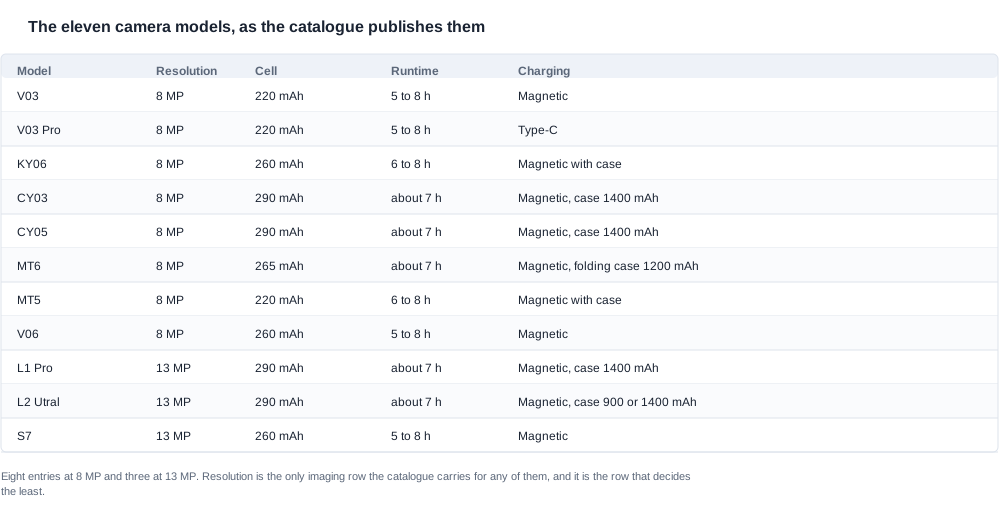
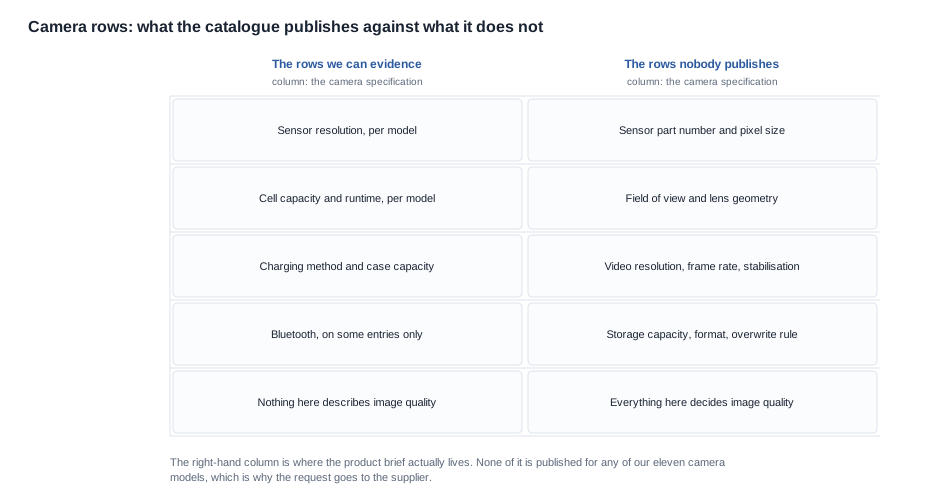
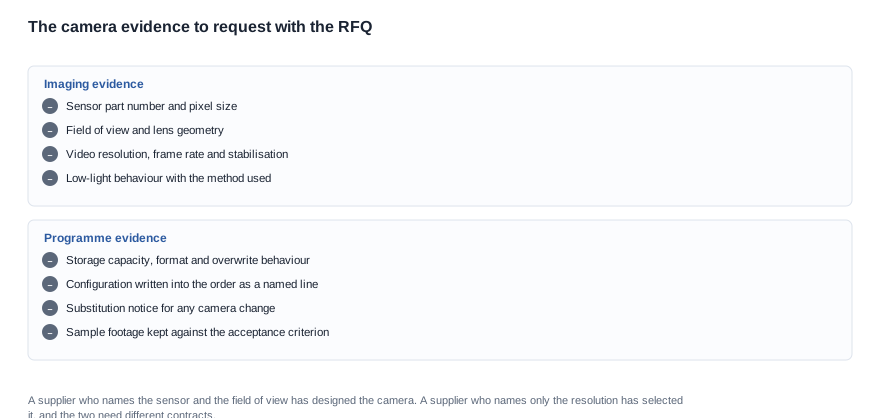
The conclusion for a buyer is short. Eleven of the twenty-eight entries in our catalogue carry a camera. The published row is resolution: eight entries publish 8 MP and three publish 13 MP. Everything that actually determines image quality is absent from our catalogue and, we would expect, from most others. The rows a buyer needs are the sensor part number and its pixel size, the field of view, the video resolution and frame rate, the stabilisation status, the storage behaviour and the low-light performance. None of those is published for any of our eleven camera models, so the only way to obtain them is to ask the supplier and then to verify them on a sample.
There is a second conclusion that matters commercially, and it is about what a supplier answer tells you about the supplier. A supplier that names the sensor and the field of view has designed the camera. A supplier that names only the resolution has selected a platform, and the two need different contracts. The first can be asked for a specification, an acceptance criterion and a substitution clause. The second can only be asked for a catalogue line, and the buyer is left with the risk that the production units behave differently from the evaluation units.
The eight rows that decide the purchase, in the order that eliminates fastest
Which sensor is used? A model number is enough, and it is the single most informative answer in the whole list. It gives the pixel size, the design era and whether plausible low-light performance is possible at all. A supplier that cannot name the sensor has either not chosen it deliberately or is reselling somebody else's platform without knowing the part.
What is the field of view? This decides whether the product works for first-person video at all. A narrow field of view is unusable for content work, because the person filming cannot see their own hands or the edges of the scene; a very wide one distorts. Our catalogue publishes no field of view for any model.
What video resolution and frame rate does it record? A device that records stills only is a different product from one that records 1080p video, and our catalogue does not say which is which for any model. This question disqualifies more suppliers than any other, because it separates manufacturers from resellers.
Is there stabilisation? Walking and cycling produce shake, and without stabilisation the footage is often unusable for the purpose it was made for. Whether the answer is yes or no, it needs to be a decision rather than an accident.
How is footage stored, and does it overwrite? Capacity, format and overwrite behaviour. Storage exhaustion part-way through a session is a common and entirely avoidable source of returns, and it is rarely documented anywhere.
What is the low-light performance? Ask how it was measured and under what conditions. This is the row that determines whether the product works indoors, and it is the row every supplier handles most loosely.
What is the resolution, and is it the same figure in every mode? A sensor's headline resolution and its output resolution are not always the same figure, and a camera that reduces output resolution to save storage is a camera whose recording behaviour differs from its published number. Ask whether the published figure applies to stills, to video, or to both.
Which firmware and which configuration does the figure apply to? Image processing is part of the camera. The same sensor in a different firmware build can produce a visibly different result, which is why an evaluation unit on a demonstration build is not evidence about production units.
Who owns the camera claim once the listing is written
The reader here is a brand-side product owner working with a procurement manager, a channel buyer building a private-label camera line, or a merchandiser who inherited a listing with a resolution number on it and no evidence behind it. The situation is one of three: comparing quotations that all quote a resolution, opening a new material number for a channel with a defined use, or fixing a listing claim that a reviewer has questioned.
The claim is where the camera programme actually lives, and the reason is structural. A resolution figure is the easiest number in the category to publish and the easiest number to copy. It therefore ends up on the listing whether or not anyone has established that it means anything for the customer's use. The buyer ends up owning a claim it cannot evidence, and the evidence gap is invisible because the figure is technically present.
The right way to close it is to replace the number with a statement the buyer can stand behind. If the camera records 1080p video with a stated frame rate, and the low-light behaviour has been checked in the environment the product is sold into, then the listing can say what the product does in the terms the customer will understand. If those rows are not available, the listing says what the product does and stops there. A narrower claim is cheaper to document, cheaper to support and considerably easier to defend.
There is a second claim holder that is easy to overlook, and that is the customer whose footage is the point. A buyer of a camera product is buying the result, and the result is not the resolution figure — it is a photograph or a clip that meets a purpose. A business buyer recording site inspections needs documentation-grade frames; a retailer making product content needs a frame that can be published; a sports channel needs a frame that survives motion. Those are three different requirements and one resolution number does not answer any of them, so the buyer has to translate its requirement into a testable condition before it asks a supplier anything.
The third claim holder is the channel partner. Where a retailer or a distributor sells the product on the manufacturer's listing, the claim is repeated without anyone re-testing it, and the first customer complaint arrives to a party that has no evaluation units and no protocol. Where the buyer can provide the channel with a short evaluation protocol and a set of reference frames, the channel can answer a customer question without escalating it. That document is one of the cheapest risk reductions available in this category.
Where the cost of a camera configuration sits
The camera is the most expensive configuration in the range and the one where the price comparison is most often misleading, because a camera changes the bill of materials, the case, the packaging and the documentation scope simultaneously.
The first cost is the sensor and the optics. An 8 MP sensor and a 13 MP sensor are different components at different prices, and the optics in front of them are a separate line. This is the visible part of the quotation and it is the part that moves with volume. It is also the part that tells you the least, because the cost of the whole imaging chain is not only in the sensor.
The second cost is the processing. The sensor and the lens are only half of what determines image quality; the other half is the image signal processor and the firmware that drives it. Our catalogue publishes no processor, accelerator or memory figure for any model in the range, which means a buyer comparing an 8 MP model with a 13 MP model is comparing two numbers and missing the component that actually distinguishes them. A 13 MP sensor with small pixels can produce a worse image than an 8 MP sensor with large pixels, particularly indoors or at dusk, and the only way to know which is which is to ask for the pixel size.
The third cost is the storage. Storage is a bill-of-materials item that does not appear on a product page, and it is the item that produces the most avoidable returns in this category. A product that records until the storage fills and then overwrites the oldest files has a recording behaviour the customer has to understand, and one that silently stops recording has a worse one.
The fourth cost is the power. The camera is the heaviest load in the whole product, and the published runtime figures across our camera tier run from five to eight hours on the 220 mAh models, six to eight on the MT5, roughly seven on the 265 and 290 mAh models, and five to eight on the 260 mAh sport models. Those are rated figures under stated conditions, and a camera configuration that changes the load profile changes what the runtime figure means. A buyer who compares a camera model with an audio model on runtime is comparing two different products.
The fifth cost never appears on a quotation: the substitution risk. The camera is the component most likely to be quietly substituted during a supply shortage, and it is the hardest to detect in a warehouse, because a substituted sensor is invisible in the box. The defence is a clause tying the sensor part number to the approved sample, plus a retained reference photograph.
So the buyer's negotiating space sits in the configuration definition, the evaluation unit quantity, the storage specification and the substitution clause. It is not in the sensor price.
Running a camera evaluation that settles the resolution question
Verification here is a short physical protocol, and the value of it depends entirely on whether the protocol was written before the recording was made.
Step one: ask for the sensor part number and the field of view in writing. If the answer is a datasheet rather than a number, the product was selected rather than designed, and the evaluation below is the only protection available.
Step two: ask for the video resolution, frame rate and stabilisation status. Three rows, one answer. A supplier who answers the stills resolution and declines the video row has told you the product may not record video at all, which in most programmes is a disqualification.
Step three: ask how storage works. Whether it fills, whether it overwrites, in which order, and what happens when it is full. Ask also whether the published resolution applies in every recording mode, because a camera that reduces output to save storage is a camera whose behaviour differs from its published figure.
Step four: run a fixed recording protocol on a sample unit from the production configuration. Two locations: indoors at low light, and outdoors in daylight. Two durations: a short clip and a session-length recording. Include movement, because the difference between stabilised and unstabilised output only appears in motion. Use the same script every time and record the conditions.
Step five: keep the recordings and the reference frames. They become the acceptance criterion and the support reference, and they are what a channel partner can be given instead of a second unit. A recording made to illustrate a product is not evidence; a recording made against a written protocol is.
Step six: write the criterion into the purchase order. The sensor part number, the field of view, the video resolution and frame rate, the stabilisation status, the storage behaviour and the low-light result. Plus the substitution clause, and plus the remedy for a unit that does not meet the criterion.

How camera programmes fail
The resolution treated as a quality claim. A listing published a resolution number and the customer expected an image quality that the number does not describe. The root cause is that the number was copied and the condition was never established. The control is to publish what the product does rather than what the sensor is, and to verify the claim on a sample before it ships.
The quiet demonstration. The evaluation was done in good light and the product performs poorly indoors. The root cause is that the protocol did not include a low-light condition. The control is to fix the two locations and the two durations in advance and to run them on a production-configuration unit.
The storage that filled. A customer recorded until storage ran out and the session stopped. The root cause is that the overwrite behaviour was never documented. The control is to require the storage behaviour in the request and to publish it in the quick-start material.
The platform substituted under a good quotation. The production units carried a different sensor and the image quality changed. The root cause is that the sensor was not a configuration attribute. The control is a substitution clause and a retained reference photograph from the first article.
The evaluation unit on demonstration firmware. The sample produced better results than the production units. The root cause is that the image processing differs between builds. The control is to require the sample to carry the production firmware and to state the firmware version in the evaluation record.
The specification applied to the wrong model. A camera claim written for one model was applied to another in the same range. The root cause is that the model designation was not attached to the feature. The control is to require the model designation against every camera claim, in the same way as every other claim in the range.
All of these are ordinary items, and not one of them is grounds for moving to a different supplier. They are reasons to write the protocol and to put it in the order.
The commercial terms a camera programme can move, and the ones it cannot
The camera is a specification dependency rather than a feature, and the cost of it should be visible in the quotation rather than absorbed into a feature list. Knowing which lines move is worth more than pushing hard on all of them.
The configuration set and the per-configuration minimum are the live numbers. Where several camera configurations sit in one programme, ask whether they are separate orderable configurations with their own part numbers and their own minimum order quantities. A camera model with a case, without a case, and with a different lens option is three bill of materials, three artwork lines and three documentation scopes, and the multiplicity cost is usually the largest hidden item in the quotation.
The evaluation unit quantity is negotiable and worth more than it looks. A camera programme needs more evaluation units than an audio programme, because image quality varies with the individual sensor and because the buyer needs units for more than one location. Suppliers under pressure on a first order will often concede extra evaluation units, and this is one of the places where the concession is cheap for them and valuable to the buyer.
Sample cost, first-article inspection allowances and a rework allowance are negotiable and frequently given away. The rework allowance is the one worth asking for specifically in this category, because a camera evaluation produces rework when the storage or overwrite behaviour does not match the specification.
The acceptance criteria are negotiable in wording and fixed in substance. A supplier will argue about the location, the duration and the light level. The criterion itself, and the consequence of missing it, are the parts that should not move.
Certification cost and certification time are fixed. They are a per-family cost and a queue at the test laboratory. A camera configuration that changes the housing, the lens or the case can invalidate part of the conformity position, and the re-validation is charged per configuration, which makes it the line that compounds across a range.
The sensor and the field of view are not commercial variables. If the requirement needs a particular field of view for first-person video, no negotiation changes the lens. What negotiation can do is change the number of configurations, the evaluation unit quantity, the artwork rounds, the documentation obligations and the acceptance criteria that bind them.
The clauses worth having in the agreement are these. The sensor part number and the field of view, written as configuration attributes. The video resolution, frame rate and stabilisation status. The storage capacity, format and overwrite behaviour. The firmware version the figures were taken on. The acceptance criterion and the recording protocol that produces it. A substitution clause covering the sensor, the lens and the case. And the model designation attached to every camera claim.
A worked example: a distributor selling a camera line into a documentation workflow
What follows is a constructed scenario rather than a client project, and it is written to make the order of the checks visible rather than to report a result.
Assume a distributor serving facilities-management companies, with a line of AI camera glasses that its customers use to record site inspections as evidence for a maintenance report. The constraint that matters is not the factory. It is that the recording is the deliverable, and a recording that does not show a corrosion mark or a cracked seal does not serve the purpose, regardless of what its resolution figure says.
The first move is to write the requirement in the customer's language. The requirement is not "eight megapixels". It is: a frame that shows a hairline crack in a pipe joint at two metres under fluorescent light, and a clip that shows a mechanic pointing at a component. The distributor sends that paragraph with the request for quotation, and it is a paragraph a factory can price and a buyer can test. Two of the three suppliers answer with the sensor part number, the field of view and a frame rate; one answers with a resolution number. The distributor now knows which quotation it can test.
The second move is the protocol. The distributor writes a recording script with the customer's own inspection checklist, fixed indoor and outdoor locations, and a fixed lighting condition, and it runs it on evaluation units from each supplier. It keeps the recordings. The first supplier's units produce frames that resolve the crack at the stated distance under the stated light; the second supplier's units do not, even though the resolution figure on the second product is the higher one. That result is the whole argument of the programme in one afternoon of work.
The third move is the storage question, which turns out to matter more than expected. The customers record an entire inspection session and then need the material to still be on the device at the end of a shift. The distributor asks how the storage behaves and learns that one configuration overwrites oldest-first without any warning to the person recording, which would have produced a support call from a customer whose first half-hour of evidence had vanished. The overwrite behaviour is written into the order and into the quick-start material.
The fourth move is the substitution risk, which the distributor takes seriously because the units travel. It asks for the sensor part number as a contractual attribute with a retained reference photograph from the first article, and it asks for the evaluation units to be credited against the first order.
The fifth move is commercial. The distributor asks for the camera configurations to be quoted separately with their own minimum order quantities, discovers that the case configuration carries a second bill of materials and a second documentation scope, and decides to launch with one configuration rather than two. It also negotiates the evaluation unit quantity upward, on the basis that a camera programme with one evaluation unit cannot test anything.
The result is a line whose claims are demonstrated rather than asserted, a customer workflow that works with the device as supplied, and a returns exposure that was measured in an afternoon rather than discovered in a quarter.
What our catalogue publishes about camera technology, and what it leaves open
The published material on camera technology is the part of the specification we can stand behind, and everything else is a question for the supplier's own file. We publish the rows our catalogue states, we mark the open rows as open, and we will not fill an open row with a typical value from a general data sheet. We publish resolution because the catalogue states it, and we would rather publish one true row than eight plausible ones.
These are the rows we do not publish, for any of the eleven camera models:
- The sensor part number and the pixel size are not published.
- The field of view and the lens geometry are not published.
- The video resolution and frame rate are not published.
- The stabilisation status is not published.
- The storage capacity, format and overwrite behaviour are not published.
- The low-light performance and the method used to measure it are not published.
- The Bluetooth version is not published for any camera model, even though it is published for fourteen of the other entries in the range.
These are the rows our published data does settle:
- Eleven catalogue entries carry a camera, and eight of them publish 8 MP: the V03, the V03 Pro, the KY06, the CY03, the CY05, the MT6, the MT5 and the V06.
- Three of them publish 13 MP: the L1 Pro, the L2 Utral and the S7.
- Across the camera tier the published cell configurations run from 220 mAh on the V03, the V03 Pro and the MT5, through 260 mAh on the KY06, the V06 and the S7, and 265 mAh on the MT6, up to 290 mAh on the CY03, the CY05, the L1 Pro and the L2 Utral.
- The published runtimes run from five to eight hours on the V03, the V03 Pro, the V06 and the S7, to six to eight hours on the KY06 and the MT5, and roughly seven hours on the CY03, the CY05, the L1 Pro, the L2 Utral and the MT6.
- Charging case capacities are published where the catalogue states them: 1400 mAh on the CY03, the CY05 and the L1 Pro, 900 or 1400 mAh on the L2 Utral, and 1200 mAh in the folding case on the MT6. The V03 Pro has no charging case.
- The 158 g whole-unit weight of the MT6 is the only weight published anywhere in the range. It is the weight of the glasses themselves, including the battery and the camera, and it excludes the folding charging case. No frame weight is published for any model.
What we will not do is estimate a field of view, infer a sensor from a resolution, or present a resolution figure as though it were a quality claim. What we will do is take a use case, a configuration and a target market, and tell you which rows are settled, which are open, and which have to come from a sub-supplier.
For the wider treatment, AI camera glasses imaging covers the technology and the camera buying checklist covers the same rows in list form. The sample arrival checks page covers what to do with the units when they turn up.
Writing the requirement as a result, not as a number
Write the requirement as a result, not as a number. Say what the recording has to show, at what distance, under what light, in what length of clip, and on which production model. That paragraph is what a factory can quote and what a buyer can test, and it is the only way to get a comparison that means anything.
Then put seven rows in the request for quotation: the sensor part number, the field of view, the video resolution and frame rate, the stabilisation status, the storage capacity, format and overwrite behaviour, the low-light behaviour with its method, and the firmware version the figures were taken on.
Finally, buy evaluation units and run one fixed recording protocol — two locations, two durations, some movement — and keep the recordings. That single afternoon of work separates the quotations that can be compared from the ones that cannot, and it produces the acceptance criterion you will put in the order. Send us the model, the quantity and the target market and we will tell you which of the published rows apply and which questions are the ones we would put to the factory ourselves.
Related reading
Ask us for the camera rows and we will say which we hold and which we do not.


