

A smart glasses certification checklist becomes useful when it stops being a list of certificate names and starts being a list of evidence. The problem with certification in this category is that the most commonly quoted answer is the least verifiable. "CE, FCC and RoHS" covers most of the conversation, and each of those three marks can mean a document, a declaration, a self assessment, or a file that belongs to a different product than the one in the carton. A comparison table of what exists in the published material, and what it does not cover, is a more useful instrument than a list of acronyms, because it is the only version of the question that produces an answer you can act on.
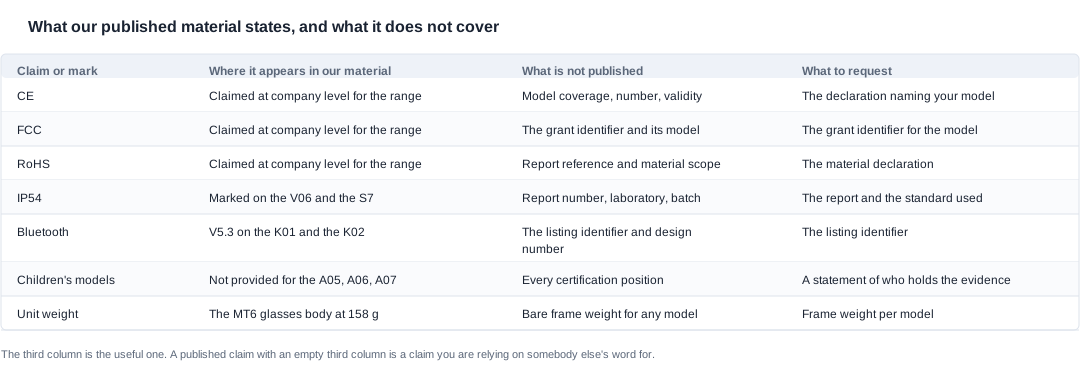
Smart glasses certification checklist: what we publish and what we do not
Why a comparison of published material beats a list of marks
Every supplier in this category publishes something, and the something is usually a set of marks. A mark is a compressed claim, and compression is efficient for brochures and useless for due diligence, because the thing that has been compressed away is the part that varies between models, configurations, markets and dates.
Publishing the gaps is a different exercise, and a more useful one. The table below sets out what our own material states, where it states it, what it does not state, and what a buyer should request in order to close the gap. The third column is the one that matters commercially, because a published claim with an empty third column is a claim a buyer is relying on somebody else's word for.
There is a second reason to do this publicly rather than privately. A supplier who publishes its gaps is telling a buyer that the verification work sits on the buyer's side of the table until documents are supplied, and a buyer who knows that can plan the cost. A supplier who publishes only marks is telling the buyer the opposite, and the buyer has to find out which is true at the point where it is most expensive to find out.
The distinction between a published claim and a published document
The distinction is easy to state and hard to hold in a conversation with a supplier, because both arrive in the same form. A published claim and a published document are both text in a catalogue, both are quotable, and both are signed off by somebody internally.
A published document is one that a third party can be shown. It has an identifier, a scope, a holder and a date, and if the scope does not cover the model in question, the answer to the question is no. A published claim has none of those, and the only way to resolve it is to ask, which means the buyer's programme depends on the quality of the response rather than on the quality of the evidence.
The practical test is simple. If a reader could take the published text, hand it to a customs broker, and the broker could act on it without contacting anyone, it is in the second category. If the broker has to come back with a question, it is in the first. Every row in the table above is written to make that distinction visible, because the entire cost difference between a good supplier and a difficult one in this category is hidden inside it.
The comparison table, and how to read the empty column
| Claim or mark | Where it appears in our material | What is not published | What to request |
|---|---|---|---|
| CE | Claimed at company level for the range | Model coverage, certificate number, validity | The declaration naming your model |
| FCC | Claimed at company level for the range | The grant identifier and its listed model | The grant identifier for the model |
| RoHS | Claimed at company level for the range | Report reference and material scope | The material declaration |
| IP54 | Marked on the V06 and the S7 | Report number, laboratory, sample batch | The report and the standard used |
| Bluetooth version | Published per model where a line exists | The listing identifier and design number | The listing identifier |
| Children's models | Not provided for the A05, A06, A07 | Every certification position | A statement of who holds the evidence |
| Unit weight | The MT6 glasses body at 158 g | Bare frame weight for any model | Frame weight per model |
| Camera resolution | Published per camera model | The sensor part numbers | The sensor part number |
| Charge method | Magnetic or Type C per model | The method for MT6 and CY05, and L1 Pro and the CY03 | The interface used on your configuration |
Read the table by column, not by row. Column two is mostly complete, and it describes what we publish about our own range with a precision that is unusual in this industry. Column three is where the commercial work is, and it is not small: it contains the model level coverage for every conformity claim, the identifiers behind the radio marks, the report behind the ingress marking, the sensor behind the resolution, the interface behind four camera models and the weight of every frame in the range.
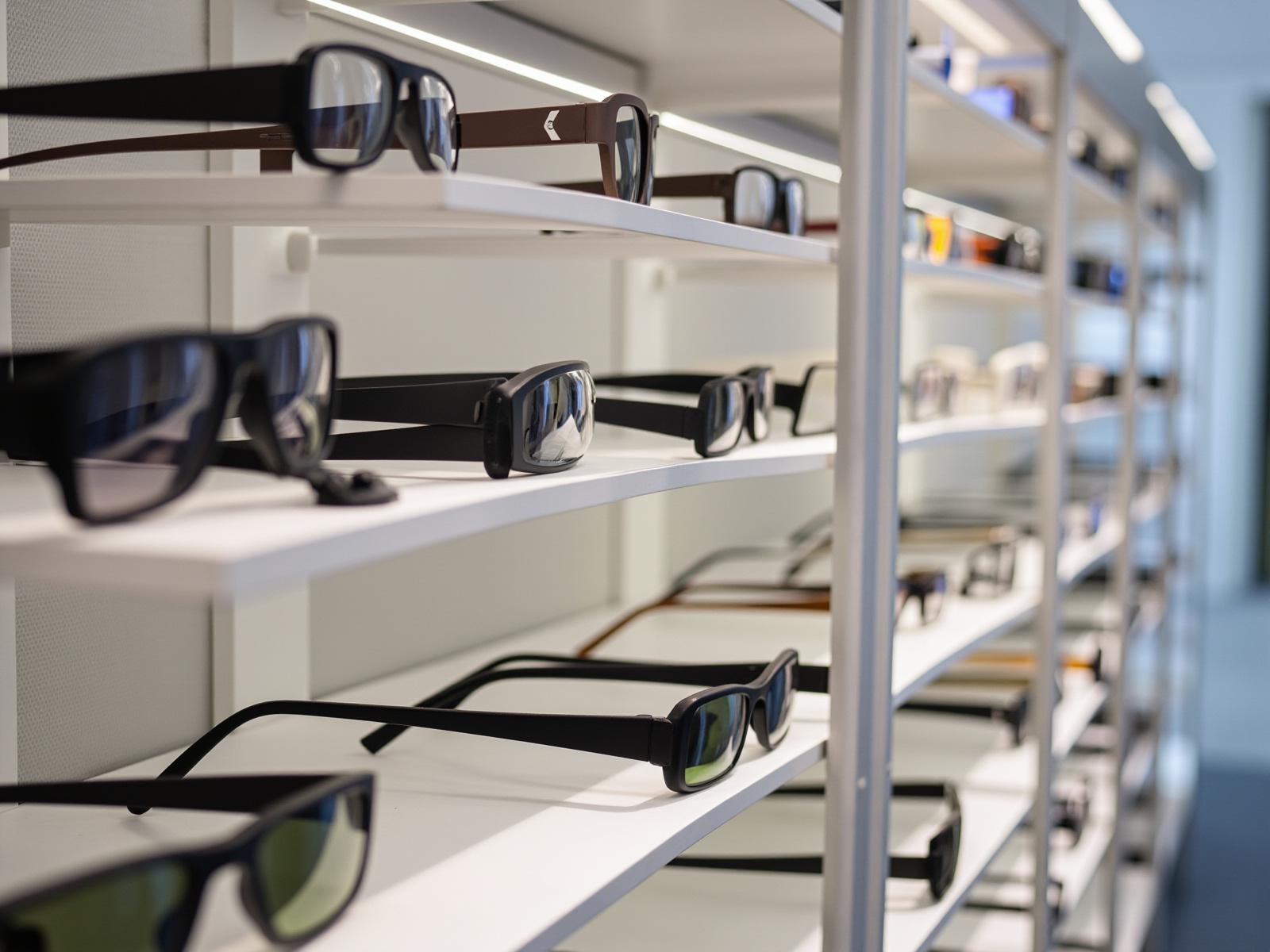
The two regulatory routes that cut across every model in the range
The radio route and the safety route
Most buyers in this category underestimate that there are two separate routes, and they run on different clocks and through different people.
The radio route applies to a product with a radio, and in Europe it sits inside the radio equipment directive framework, with the safety and electromagnetic compatibility requirements carried by the harmonised standards. The relevant point for a buyer is that the conformity assessment route depends on whether the product falls into a category requiring third party involvement, and that determination is made on the product rather than on the brand. A Bluetooth product also carries a cybersecurity file, and the EN 18031 series has formed a mandatory part of the CE mark for radio equipment since 1 August 2025, with three specifications published on 30 January 2025.
The product safety route is separate. Under the general product safety regulation, applicable in the European Union since 13 December 2024, a product placed on the market needs a manufacturer, an importer where the manufacturer is outside the region, a technical file and a risk assessment. A camera product with a radio carries the obligations that sit alongside it, and the children and battery lines add further ones.
Where the routes divide, and what that divides for a buyer
The division is not academic, because the two routes have different owners in a factory and different evidence. A supplier with a strong radio file can still have no transport summary for the case cell, and the transport summary is the one that stops the goods rather than the sale.
The fourth row in the route comparison is the one that needs a legal opinion rather than a document. A bone conduction platform in our range carries a published amplification figure of 35 dB, and that is a fact about the hardware and a regulatory question about the category the product sits in. No conformity file answers it, and a buyer who treats a certificate as a route map will be surprised by this one.
Both routes need the same underlying discipline underneath, which is a technical file per model rather than per company. When a supplier shows you one file for the company, the useful question is which models it covers, and the second useful question is what happens when the answer is not all of them.
Comparing two suppliers on certification rather than on claims
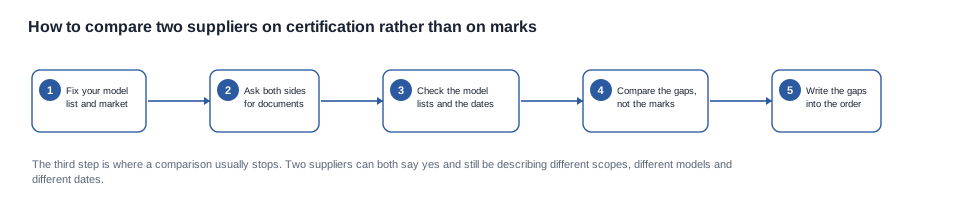
The comparison procedure, in five steps
The procedure is short, and every step is a document request rather than a judgement.
- Fix your own scope. Write down the model list, the configuration for each model, the destination market and the launch window. A comparison run without a fixed scope produces two answers that cannot be set against each other.
- Send the same request to both sides. Identical wording, identical attachments, same day. A comparison built on two different requests measures the difference between the requests.
- Check the model lists and the dates on what comes back. The model list against your own scope, and the dates against your launch window rather than against today.
- Compare the gaps, not the marks. Rank the outstanding items by what they cost if they are not closed, and check whether the two suppliers closed the same ones.
- Write the surviving gaps into the order. As conditions, with an owner and a date, so that the comparison does not have to be repeated at shipment.
What a like for like comparison actually requires
Three conditions, and if any of them fails the comparison produces a number that is wrong rather than a number that is uncertain.
The first is that both sides are answering for the same model. It is entirely normal for one side to answer for a model family and the other for a specific configuration, and the answer is not a comparison of their capabilities. The second is that both sides are answering for the same market. A supplier with an established file in your market has a structural advantage over one that does not, and that advantage is real and worth paying for, but it is not a documentation advantage.
The third condition is the one that is easiest to overlook: both sides have to be answering the same question about scope. A supplier who quotes one price for the whole range and a supplier who quotes per model are not quoting two prices for the same work. The first has scoped something, and the second has not.
When the two suppliers are answering about different products
The comparison fails in a specific and common way, and it is worth naming it because the failure looks like a capability difference from the outside.
One supplier has a file that covers the model the buyer wants. The other has a file that covers a neighbouring model, and its representative has answered on the basis of the range because the range is what they know. The two answers are both true, they are both confident, and the gap between them is a documentation gap rather than a performance gap.
The way to detect it is to require the model list to travel with every answer, and to compare that list against your own scope rather than against the prose around it. When a supplier returns a document whose scope is a product family, the entry in the comparison is a range, and a range is not a match for a specific model and configuration.
This is also the moment to separate what can be closed from what cannot. A scope extension for an existing model is usually a commercial conversation. A model that has never been assessed is a different order of problem, and treating the two as the same gap is how a buyer ends up with a launch date that no one can meet.
The five line comparison to put into your own request
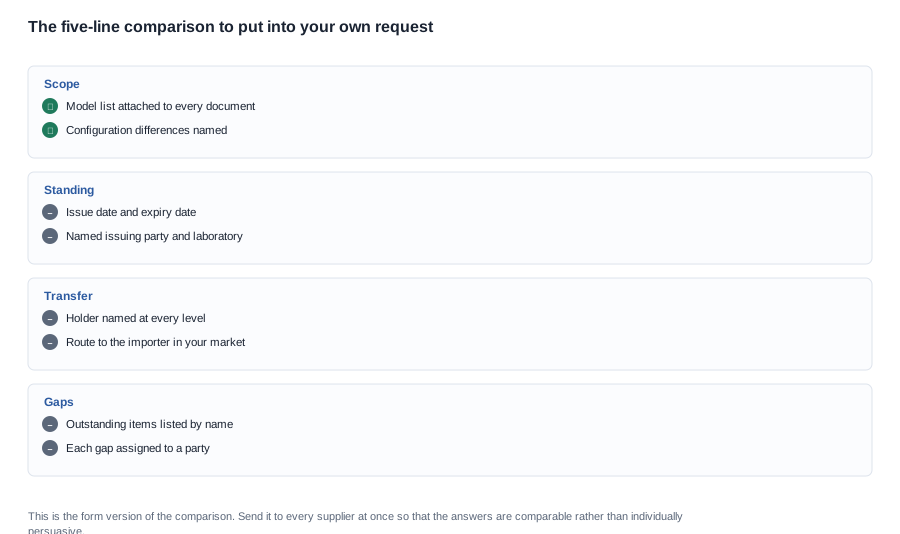
The five lines and what each one returns
- The exact model and configuration list covered by each document. Returns: the boundary of the file. A document that covers a range returns a range, and the range is the answer.
- The issue date and the expiry date of each document, and the market it is valid in. Returns: whether the file is usable in the window you are buying into.
- The named holder of each piece of evidence. Returns: whether the file can reach your importer in your market.
- The list of outstanding items, with an owner against each. Returns: the real state of the documentation, which no certificate can convey.
- The date the document was signed, and the person who signed it. Returns: whether the file has a person behind it or only a company.
The fifth line is the one most suppliers will not have been asked, and it is the line that most reliably distinguishes a maintained file from an archived one.
Sending the same request to every supplier
Send the five lines to every supplier in the round at the same time, with the same wording, and give the same deadline. The purpose is not to make the comparison fair in a contest sense. It is to remove the difference between a supplier who was asked precisely and a supplier who was asked vaguely, because that difference is otherwise indistinguishable from a difference in capability.
Keep the replies. A year later, when a claim is questioned or a market changes, the reply is the evidence of what was represented at the time, and it is the only record that is contemporaneous rather than reconstructed.

What the comparison says about our own evidence base
The rows where our published material is silent
The table above is a fair description of our position, and the third column is where a buyer will spend the verification effort.
The catalogue publishes no CE, FCC or RoHS text and no per-model certification row, and a range-level claim recorded outside the catalogue comes with no certificate numbers. Certificate numbers, issuing bodies, validity dates and covered model lists are not published for any model in the range. No third party test report number is published for the ingress marking on the V06 and the S7, the only two models that carry it, and no ingress, drop or ageing report is published at all. Camera sensor part numbers, field of view and video specification are published for none of the camera models, even though the resolution class is published for each of them: eight of the eleven camera models are published at 8 MP and three at 13 MP.
Certification status is not published at all for the three children's models, and our own source material flags that determining the applicable requirements is a question for the company's legal function rather than for the export team.
The comparison question that the table cannot settle
One row in the table is worth a further note, because it is the row where a buyer is most likely to be misled by the precision of the catalogue.
The resolution class is published for every camera model, and the split is factual: eight of the eleven camera models are published at 8 MP and three at 13 MP. What is not published is the sensor behind either class, the field of view, and the video specification. A comparison between two suppliers on resolution therefore produces a result that looks like a comparison and is not, because a resolution class is a marketing tier rather than a sensor designation, and two products in the same tier can behave very differently in low light, in motion and in the field of view of a camera that a buyer is going to point at work.
The fix is not a better comparison method. It is a different question: ask each supplier for the sensor part number and the video specification, and treat a refusal or a gap as a comparable answer in its own right. A supplier who publishes the sensor part number has a documentation habit that will show up again in the certification file, and a supplier who does not will make the same decision in a place where it is more expensive.
That is a fair description of the gaps rather than a set of complaints. Each unpublished row is a place where a buyer's marketing claim is unsupported, and an unsupported claim is a listing that can be withdrawn or a shipment that can be held.
The two catalogue entries that need a decision rather than a document
Two entries in the range are not documentary questions and should not be chased as if they were.
The first is the children's line, comprising the A05, the A06 and the A07, where no certification position is recorded. The requirements for children's eyewear in Europe and the United States are additional to the radio and chemistry requirements, and they are determined by the destination market and by the claims made. That determination belongs before the purchase order.
The second is the bone conduction platform and its published 35 dB amplification figure. This is a product category question rather than a documentation question, and it is the kind of question that a compliance file is sometimes mistaken for answering.
What we will state in writing
We will confirm in writing which frameworks apply to a given model in a given market, and we will tell you plainly which documents we hold and which we do not. Where a claim on your listing or artwork is not supported by anything in our documentation, we will say so rather than leave it to be discovered later.
We will not issue a compliance statement for a figure we have not measured, and we will not treat a catalogue marking as a certified rating. We will also say when the answer to a question sits with your own legal function rather than with us, and the children's models are the clearest case of that.
The certification checklist pillar collects the market by market requirements, and the AI camera glasses range shows which models the claims in the table apply to.
Running the same comparison on your own programme
A comparison is only worth running when the scope is written down first, so the first thing to send us is the scope. Give us the model list with the configurations, the destination market, the quantity band and the launch window, and we will return the same five line comparison applied to the models you have asked about, including the rows where our published material is silent and what has to be obtained to close them.
Send the model list and the market, and we will show you the comparison including the gaps.


