Most buyers plan a smart glasses certification budget as a single line called "certification", and then discover at invoicing that it was six lines. The cost breakdown is not complicated, but it is only predictable if you know which line moves when you change something, and on smart glasses, model naming and firmware revisions move more of them than anyone expects.
This is a cost structure breakdown, not a price list. Individual laboratory fee schedules differ by country, laboratory and standard, and our own quotation figures are not published. What we can do is tell you which lines exist, what drives each one, and which ones are most often missed at the budgeting stage. The lines that are missed are consistently the ones that are not billed by the laboratory, which is why a budget built from a quotation alone is always short.
Smart glasses certification checklist: the seven lines inside a cost breakdown
Why one line called certification always comes in under budget
A single line in a budget behaves like a single line in a quotation: it absorbs whatever is charged to it, and the person who set it never sees the composition. The consequence is that a programme discovers its cost structure after the money is committed, at which point the only remaining lever is the schedule.
The structure below is not a price list and it does not claim to be the only possible one. It is the set of lines that recur on smart glasses programmes, and it is useful because each line is driven by something a buyer can name before it happens. A line driven by a decision you can make is a line you can budget. A line driven by an event you cannot see coming is a line you can only cover with contingency.
There is a second reason the structure matters. When two suppliers quote a similar total for certification, they are almost never quoting the same scope, because the totals are usually compared at the line level where the fees are, and the line levels are where the difference is. Establishing the lines on both sides before comparing the totals converts an unfair comparison into a fair one.
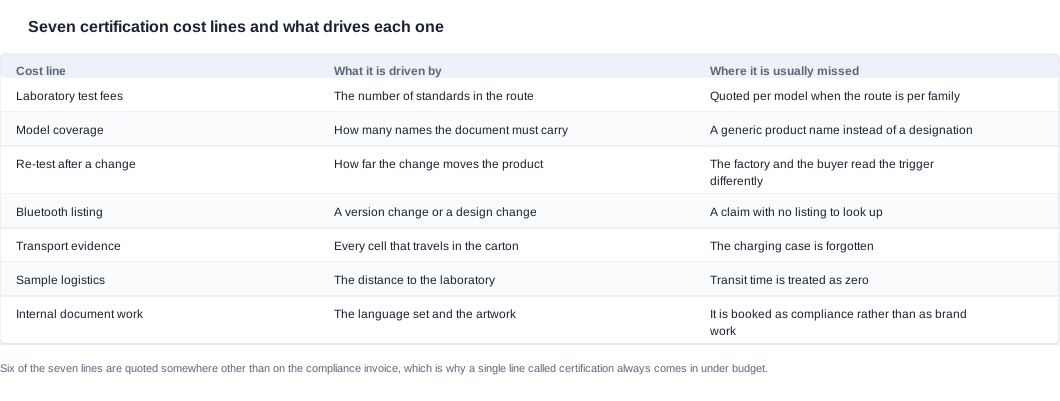
The seven lines and what drives each of them
| Cost line | What it is driven by | Where it is usually missed |
|---|---|---|
| Laboratory test fees | The number of standards in the route | Quoted per model when the route is per family |
| Model coverage | How many names the document must carry | A generic product name instead of a designation |
| Re-test after a change | How far the change moves the product | Factory and buyer read the trigger differently |
| Bluetooth listing | A version change or a design change | A claim with no listing to look up |
| Transport evidence | Every cell that travels in the carton | The charging case is forgotten |
| Sample logistics | The distance to the laboratory | Transit time is treated as zero |
| Internal document work | The language set and the artwork | Booked as compliance rather than as brand work |
Seven lines, and six of them are quoted somewhere other than on the compliance invoice. That is the single most useful observation in this article, and it is the reason a buyer comparing two quotations should ask for the breakdown rather than the total.

Which cost lines move when the model name changes and which move when the market changes
Model naming, the line that quietly doubles a budget
This is the line that buyers estimate best and buyers still get wrong, because they estimate per model when the commercial reality is per model family. The distinction is worth being precise about, since a supplier who is honest about it will usually quote a lower number for a second model in the same family, and a supplier who is not will quote a lower number and deliver a higher one.
The doubling comes from a different mechanism. A report that lists "smart glasses" as the product name does not cover "MT6" as a shipping SKU. If the certificate names a model designation that differs from what appears on your box, your importer, your distributor or your marketplace account can challenge it. Getting the designation aligned before the sample goes to the laboratory is free. Getting it changed afterwards is a re-issue, and sometimes a full re-test.
This is why the first question in any certification quotation should be about which names appear on the resulting document, and why the answer belongs in writing rather than in a catalogue extract. A buyer who asks this question before the deposit and not after it has saved a line item that is otherwise invisible until the first shipment.
Market scope, the line that buys coverage nobody uses
The second movable line is market coverage, and it moves for a different reason: the cost of a market file is largely fixed per market rather than per unit, so the question is never whether it is expensive but whether it is needed.
A buyer who adds a market to the first order because it is on the roadmap is buying a fixed cost against a launch that has not happened. If the second launch slips, the certification spend does not come back. The better sequence is to quote the current market, and to price the additional market separately as a decision with its own cost, its own lead time and its own owner, so that the decision is taken when the launch is real rather than when the roadmap is written.
The re-test trigger, where the factory and the buyer read the same rule differently
Battery capacity, firmware, the antenna layout, the enclosure material and the charging interface can each be a trigger for re-evaluation, depending on how far the change moves the product. Sellers and factories often disagree here, because the factory sees a minor component swap and the compliance route sees a changed product.
The disagreement is not about facts. It is about the threshold, and the threshold is a commercial question that is usually left undefined. The only fix is contractual: state in the order what counts as a re-test trigger and who pays when it fires. Where that clause is absent, every change becomes a negotiation conducted at the moment the programme is least able to absorb it.
A workable trigger is a named list rather than a general clause. If the order names the five changes above and says that each triggers a scope review, then the review happens in advance and costs a scoping conversation. If the order says that material changes may trigger re-evaluation, then the review happens after the fact, and it happens in the week the goods were supposed to ship.
The two cost lines buyers estimate worst: case cells and sample logistics
The charging case is a second cell and a second classification
Devices with lithium batteries, and charging cases with their own cells, need test evidence referenced by the carrier before air freight moves. The case is not an accessory in the regulatory sense, and treating it as one is the most common transport costing error on this category.
In our own published range the case configuration varies across the camera models, and the variation is not obvious from a product list. The CY05 and the L1 Pro, and the CY03 are published with a 1400 mAh case. The L2 Utral is published with a 900 or 1400 mAh case, which means two configurations of the same model and two different transport positions. The MT6 is published with a 1200 mAh folding case, and the catalogue's own weight figure for that model is the glasses body at 158 g, which excludes that case entirely.
The KY06 and the MT5 are published with a case whose capacity is not disclosed, and the V03 Pro is published with no case. Every one of those is a line that has to be settled before the transport evidence is priced, because each one changes either the number of cells in the consignment or the classification of the shipment.
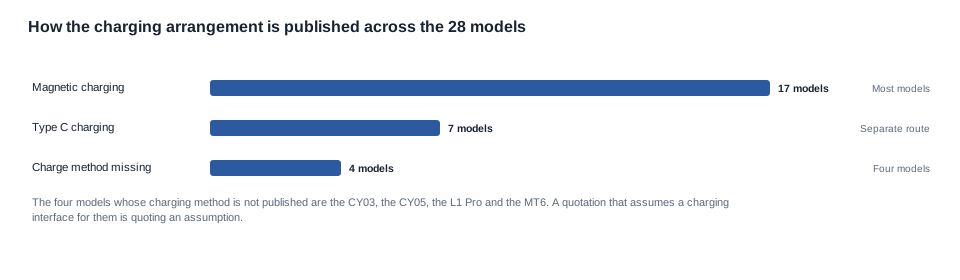
The charging interface interacts with this in a way that is easy to miss. The charging method is magnetic on seventeen of the twenty-eight models in the catalogue, Type C on seven, and it is not published at all for the CY03 and the MT6, and the CY05 and the L1 Pro. A quotation that assumes an interface for those four is quoting an assumption, and the assumption will surface as a chargeable question from whichever laboratory or carrier handles the file.
Sample transit time, the term nobody negotiates
A sample has to travel to the laboratory and come back. The courier cost is small; the elapsed time is not. If the laboratory is overseas and the programme is on a fixed launch date, the transit is usually the term nobody negotiated, because it is invisible in a quotation and visible only in a schedule.
Two practical questions reduce the surprise. The first is whether the sample being sent for testing can be the same unit that is retained from the production batch, which removes one leg of the logistics and one argument about what a sample proves. The second is whether the laboratory accepts a unit that has already been built and packed, or requires a specific configuration, because the second answer determines whether a finished carton can be used at all.
The line that never appears on any invoice
The seventh line is internal document work: instructions for use, labelling, packaging artwork, importer details, and the language set for the destination market. This is brand side labour, and it is almost never in the certification line of the budget, which is why launches slip by two weeks and the slip is attributed to the laboratory.
The way to handle it is to name it as a line with an owner rather than to absorb it. The artwork, the translations and the importer details are decisions that have to be made by somebody, and the moment they are somebody else's problem is the moment they start moving the schedule.
The line that the buyer can move and the factory cannot
Of the seven lines, one is unusual in that the buyer has more control over it than the supplier does, and that is the model coverage line.
The number of names a document has to carry is decided by the buyer's own scope. A programme with two model designations in one family, a shared charging configuration and a shared radio configuration is a materially cheaper compliance scope than a programme with the same unit volume spread across four configurations, and the difference is not in the testing but in the paperwork, the artwork and the number of model specific rows that have to be maintained and eventually re-issued.
This is a decision with a long tail, because every additional designation is a configuration that has to be kept aligned across the carton artwork, the declaration, the transport file and the technical file. Suppliers are right to ask a buyer to consolidate designations before quoting, and buyers are right to do it anyway, because the consolidation is a simplification of the product rather than of the paperwork.
The other side of the same point is that a buyer's willingness to consolidate is one of the clearest signals of how the programme will run. A buyer who arrives with four designations where one would do will arrive with four prices to reconcile after the first shipment.

How to make two certification cost breakdowns comparable
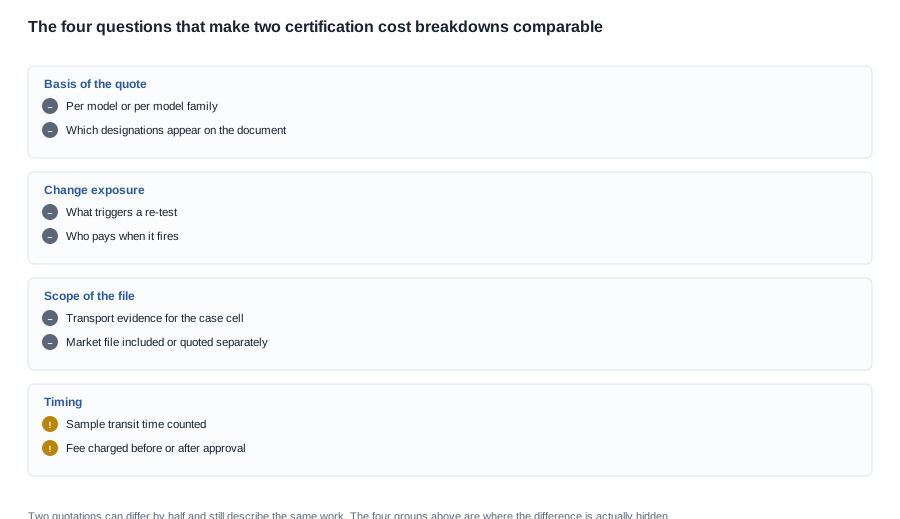
The four questions to put in the quotation request
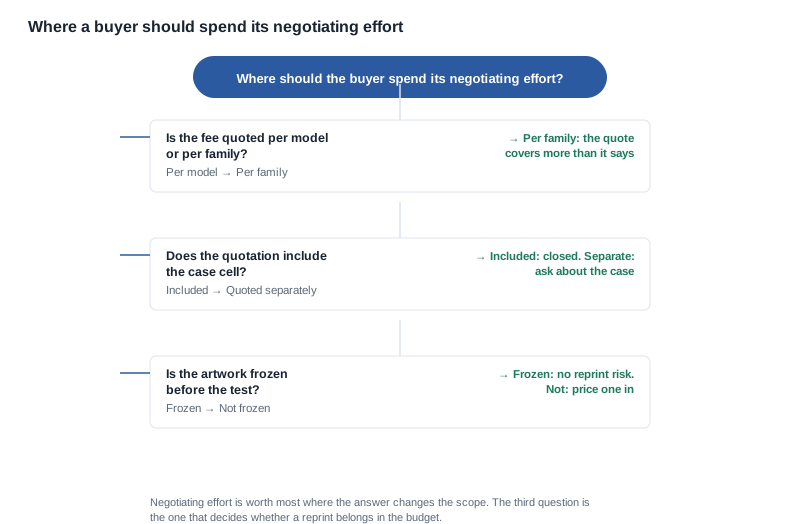
- Is this price per model or per model family? If the supplier quotes one number for a range, ask which SKU names appear on the resulting document.
- What happens to this cost if I change the model name? If the answer is vague, that is the expensive branch.
- Which changes trigger a re-test, and who pays? Get it as a line in the purchase order rather than as a conversation.
- Is the transport evidence included, and does it cover the charging case? Ask about the case separately every time.
Each of the four returns something comparable between two suppliers, which the total on the quotation does not.
Reading the answers, and what a vague answer means
A precise answer names the basis. A per model price comes with the list of names that will appear on the document. A scope question comes with the list of triggers. A transport question comes with the cell and the case configuration. Where the answer is precise, two quotations can be set against each other and the comparison is worth making.
A vague answer is not automatically a bad sign, and it is worth separating vagueness from evasion. A supplier who says "it depends on the configuration" has answered the question, because they have identified the variable, and the next question is which configuration yours is. A supplier who says "the certification cost depends on the market" has not answered the question, because you told them the market in the request.
The practical rule is that a vague answer must be converted into a named variable before the comparison is allowed to continue. Otherwise the lower total is simply the quotation that has been less specific, and the difference will be paid at the first shipment.

What the current catalogue can and cannot support
The four questions our own position forces us to answer
We should be clear about our own side. This factory's catalogue shows an export-certification page of ten patent certificates — eight appearance-design patents and two utility-model patents — and names no CE, FCC or RoHS marking, describes the charging interface and Bluetooth version per model where the published material carries a line for it, but publishes no certificate numbers, no issuing bodies and no validity dates.
The child models carry an explicit note that certification information has not been provided at all, and the bone conduction platform carries a published amplification figure of 35 dB that raises a regulatory question that a compliance line in a budget cannot absorb.
That is not a gap we can paper over, and it is also not unusual for a factory at this stage. What it means practically is that the verification work sits on your side of the table until we supply documents. The full document by document check is on our certification verification checklist, and it is designed to be run against any supplier, ours included.
The two rows in the published range that change the transport line
Two rows of the published range change the transport line of a quotation in ways that are worth checking before a budget is signed.
The first is the L2 Utral, because a model published with two case capacities is two transport positions, and a quotation that covers "the L2 Utral" covers neither unless it says which. The second is the four camera models whose charging method is not published, because the interface is an input to the file and an unstated interface is an unquoted line.
For anyone comparing product classes on the same budget line, the range overview for AI camera glasses shows which models carry a charging case, because that changes the transport line of this breakdown more than any other single attribute in the range.
What a quote from us includes and what it does not
A quotation from us will state the compliance route that applies to a given model in a given market, the scope of testing that route implies, and the assumptions it rests on. It will not state a number for work that has not been scoped, and it will not present a compliance claim as though it were a verified certificate.
Where we have not published certificate numbers, we will say so rather than describe the certification as complete. That makes our quotations slightly more conservative than some, and it means the budget you build from them should hold up when your own compliance person asks questions.
Where the money in a certification budget actually goes
The three buckets a budget should be split into
A workable budget divides into three buckets, and the division matters more than the total.
The first bucket is the assessment itself: the testing, the declaration and the market file. This bucket is close to fixed per model family and per market, and the useful question about it is not whether the number can come down but whether the scope is right.
The second bucket is the variable work: re-issues, re-tests, re-labeling and the transport evidence for whichever cells actually travel. This bucket is driven by decisions, and it is the bucket that a written trigger clause controls.
The third bucket is internal: the artwork, the translations, the importer details and the sample logistics. This bucket is brand side labour, it is rarely quoted, and it is the bucket that is most often discovered to be on the critical path.
The first bucket is what the buyer argues about, the second is what the buyer controls, and the third is what the buyer forgets. A budget that treats all three as one line will be wrong in a way that only shows up late.
The number we will not put on an invoice
We will not quote you a number for something that has not been done, and we will not present a compliance claim as though it were a verified certificate. Where a scope is not yet fixed, we will tell you what has to be fixed before a number means anything.
Send us your target destination markets and the model shortlist, and we will map which routes each one needs before anyone talks about price.