
The documentation requirements for smart glasses quality consistency are what turn a good run into a repeatable one, and they are almost entirely about records rather than about tests. A buyer who understands the distinction can stop paying for inspection and start buying evidence, and the change in cost is immediate.
The distinction is worth stating precisely, because it is where most of the money in this category is misallocated. A test tells you that a unit passed. A record tells you that the unit you received is the unit that was tested, in the configuration you ordered, on the firmware build you expected, from the production window you think it came from. A buyer who holds the first and not the second can defend a quality conversation badly, because a claim about a specific unit needs a chain back to the production date.
Our published material makes this concrete in an uncomfortable way. The catalogue publishes the cell capacity, the charge time, the rated use, the charging interface, the case option and the resolution tier per model, and it publishes a unit weight for exactly one model — the MT6 glasses body at 158 g, including its 265 mAh cell and its camera, and excluding the 1200 mAh folding charging case, whose own weight is not published. It publishes no sensor part numbers, no ingress test report numbers and no certificate numbers for any model. So the documentation a buyer holds is, in many cases, the only objective record that exists, which is a reason to specify it carefully rather than to assume the factory keeps it.
Smart glasses quality consistency is a documentation problem, not a test problem
The reader is a buyer working for the brand, a channel buyer or an importer who is about to put a quality programme in place, or who has one and is not sure what it is missing. The question in front of them is rarely "how do I test this". It is "what do I need to be holding when something goes wrong", which is a different question with a different answer.
Three arguments establish that the documentation is the specification rather than the commentary on it.
The first is that there is very little published to check against. In this category a large part of what a product does is not published and therefore cannot be the basis of a claim. No sensor model, no acoustic measurement, no ingress report number, no certificate number, no tolerance around any published figure, no defect rate. A buyer who wants to assert that a delivered unit matches an expectation has to point at a document, because there is no catalogue row that settles it.
The second is that a finding is only as strong as its chain. When a channel partner says a unit is not right, the buyer's ability to act depends on a chain: this unit, from this production window, built to this configuration, with this firmware build, tested against this criterion, by this method, and the result was this. Every link in that chain is a record. If one link is missing, the chain breaks at a point chosen by whoever is arguing, which in a dispute is not usually the buyer's side of the table.
The third is that the records are cheaper than the alternative. The eight records below are all produced during work that is happening anyway. Asking for them costs a buyer a paragraph in the purchase order and a supplier a habit. The alternative — the inspection regime that substitutes for missing records — repeats its cost on every unit for the life of the programme and still cannot answer a question about a unit produced two years ago.
How to decide which documentation to buy
The buyer's question is not "how much documentation do I want". It is "which decisions will this documentation support", and the way to answer that is to list the decisions the programme will actually have to make and work backwards from each one to the record it needs.
There are five such decisions in most buying programmes, and they are worth naming because each one names its own evidence.
-
What do I accept into the warehouse? The decision is made at the receiving dock, on a sample, and it needs the acceptance criterion, the sample size and the record of the result. The criteria decision here is a limit question: what is the worst unit that still passes, and who decides.
-
What do I tell the channel partner? The decision is made when a claim arrives, and it needs the chain: unit, production window, configuration, firmware build, criterion, result. Without the chain the only available answer is a general concession, and a general concession teaches the channel the wrong lesson.
-
Did the product change, or did the process change? The decision is made after a drift is suspected, and it needs the golden sample, the retained units and the change log. The criteria here are temporal: does the current unit match the approved one, and when did it stop matching.
-
Can this shipment go into the destination market? The decision is made at the border or in the warehouse, and it needs the artwork approval, the configuration sheet and the transport documentation. The red flags in this decision are usually a carton that does not match the approval and a battery document that does not match the cell lot.
-
What should the next order cost? The decision is made at the next quotation, and it needs the inspection records across runs, because the only way to price consistency is to show what the drift cost and what the programme costs.
A buyer who lists those five decisions has, without any further work, produced the documentation requirement. And a supplier who is asked for the records those five decisions need has been asked for a coherent set rather than a wish list, which is the difference between a request that gets answered and one that gets a policy document back.
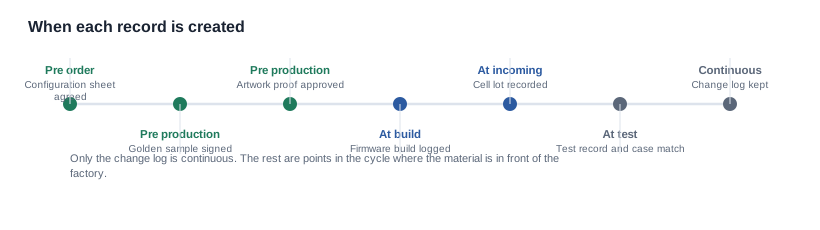

The eight records, and what each one proves
| Record | What it proves | When it is created | What happens without it |
|---|---|---|---|
| Approved golden sample | What "correct" means, physically | Before the production run | Assembly and finish disputes with no reference point |
| Frozen configuration sheet | The exact model, colour, case, interface and packaging | Before the run starts | Every unit is compared against a description instead of a thing |
| Firmware build record | Which build shipped in which batch | At build time | A support query cannot be checked against a version |
| Cell batch record | Which cell lot went into which batch | At incoming | An endurance complaint cannot be investigated |
| Unit-to-case test record | That the case in the box charges the unit in the box | At test | A charging fault is indistinguishable from a dead battery |
| Test record with a pass criterion | That a defined test was run and passed | At test | "Tested" means nothing without the criterion |
| Packaging artwork approval | Which print revision shipped | Before the run | Wrong artwork in a market, or a wrong box |
| Non-conformance and change log | What went wrong and what changed | Continuously | The same fault recurs across three shipments |
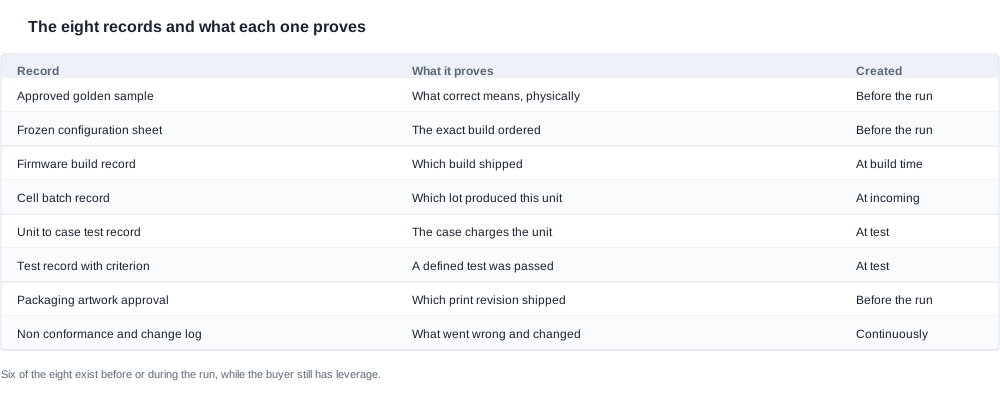
The column that matters most is the third one, because it decides who has to create the record and at what point in the cycle. Six of the eight exist before or during the run, which means they are created while the buyer still has leverage and while the factory still has the material in front of it. Only the non-conformance log is continuous, and it is the one that is most often empty — a log with entries in it is evidence of a process running, while an empty log is usually written after the fact or not at all.
The fourth column is what a buyer should read twice, because it describes the actual commercial consequence rather than a technical gap. "The same fault recurs across three shipments" is the most expensive line in the table, and it is expensive because it is the only one that repeats.
The unit-to-case record, which is the one most often missing
The unit-to-case test record is the record most frequently absent, and it is the one that protects the customer. A unit that will not charge on the case in the box is a fault that presents to the customer as a flat battery, and the customer will describe it as a battery problem, and the battery is the part nobody disputes because the cell capacity is published.
The published case options in this range are 1400 mAh on the CY05 and the CY03, and the L1 Pro, 900 mAh or 1400 mAh on the L2 Utral, and a 1200 mAh folding case on the MT6. So a case and a frame are a matched pair, and a matched pair is something a test bench can confirm and a warehouse cannot. The V03 Pro has no charging case at all, which is a configuration statement rather than a gap, and the KY06 and the MT5 have a case whose capacity is not published, which is a documentation gap and should be treated as one.
A related point applies to the four camera models whose charging method is not published — the CY03 and the L1 Pro, and the CY05 and the MT6. Their case capacity is published, so the case-to-unit match can be planned, but the interface itself is not, which means the record cannot be written from the catalogue and has to be supplied as a document.
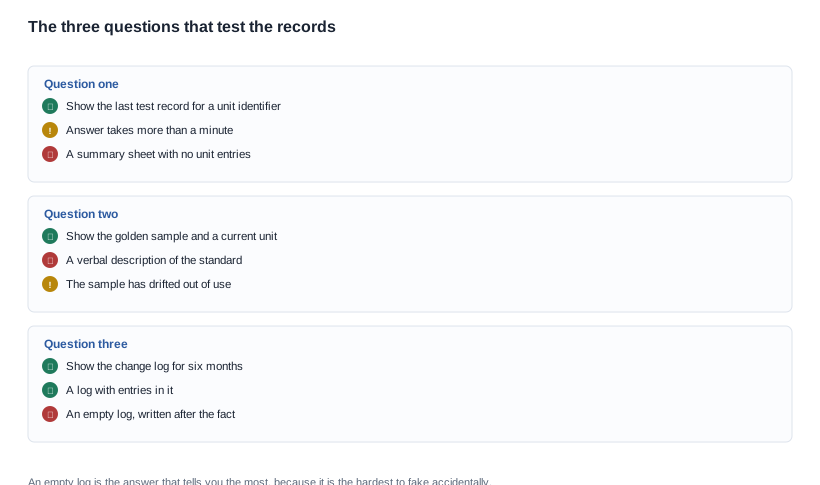
The three questions that reveal whether the records exist
The eight requests are the specification. The three questions below are the diagnostic, and they are the ones a buyer asks when the answers to the specification have been slow.
-
Show me the last batch's test record for a specific unit identifier. If the answer takes more than a minute, or the record turns out to be a summary sheet with no unit-level entries, the record does not exist in the form a claim needs. The identifier should be one the buyer supplies from units already in the warehouse, because a supplier that holds unit-level records can match one immediately.
-
Show me the approved golden sample and a current production unit side by side. A verbal description of the standard is not a standard. This comparison is also the fastest way to find out whether the golden sample has drifted out of use, because a sample that has been in a drawer for two years is a sample of a product that no longer exists.
-
Show me the change log for the last six months. A log with entries in it is evidence of a process. A log with no entries usually means the log is written after the fact, or not at all, and the question to ask in that case is what happens today when a component changes, rather than whether it happened last spring.
The quality consistency common mistakes article covers what the second of these comparisons usually reveals, and it is worth reading the two together.
What the records are worth at the other end of the chain
The value of a record is not in the file. It is in the three conversations the file makes possible, and each of them is a conversation a buyer will have eventually.
The customer claim. When a channel partner reports a problem, the buyer's position depends entirely on the chain. With the records, the buyer can say which units, from which window, against which criterion, with which result, and can propose a remedy for a specific population. Without them, the buyer can only offer a general concession, which is the most expensive way to buy silence, because it concedes on units that were never faulty and teaches the channel that complaints are answered with money.
The customs and market-access question. A shipment that is held or re-labelled on entry is not primarily a quality event, but the same records answer it. The configuration sheet says what was ordered; the artwork approval says what was printed; the cell batch record supports the transport documentation that a lithium-containing device requires. A buyer with those records answers the question; a buyer without them starts again from the beginning, at the port, with a demurrage clock running.
The next price negotiation. This is the least obvious of the three and the most valuable. A buyer who can show a supplier that run three differed from run one has a factual basis for the price discussion, because the question stops being whether the supplier is good and becomes whether the programme carries a cost that the current price does not. A supplier that has seen this once tends to quote the second order differently, because the evidence is now on the buyer's side of the table.


Which records a first order will actually produce
Not every record exists for every order, and a buyer who asks for eight records on a small first order will be told, correctly, that several of them do not exist. That answer is useful, provided the buyer can tell which ones matter for the size of the order.
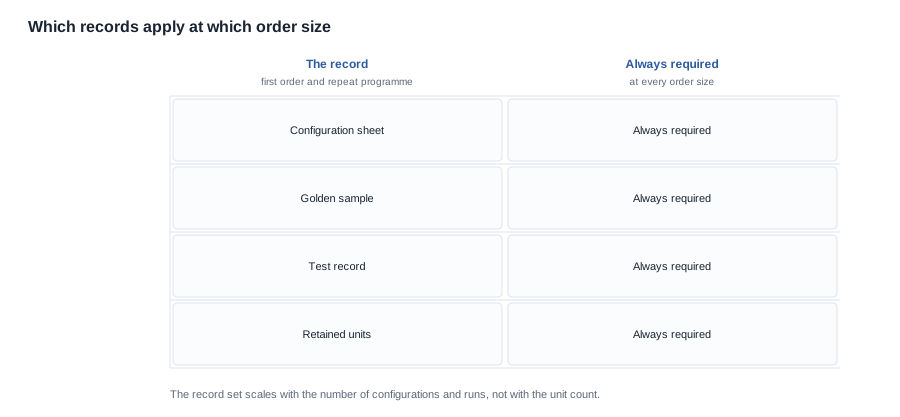
The rule is that the records scale with the number of configurations and the number of runs, not with the unit count. A first order of one configuration on a single run justifies four records: the frozen configuration sheet, the approved golden sample, the test record with its pass criterion, and the retained units. Everything else becomes valuable when there is a second run to compare against, or a second colourway or case option that could have been confused with the first.
The two records that are never optional are the frozen configuration sheet and the golden sample, because without them nothing else can be compared with anything. A programme that has those two and nothing else can still answer the question that matters most in a first order — was the unit we received the unit we approved — and every other record on the list is a refinement of that.
The third record that should never be dropped is the test record with its pass criterion, even on a small order, because the criterion is what a buyer reuses and the record is what a supplier reuses. A criterion that is written once and never tested against a real batch is a piece of paperwork, and a piece of paperwork is what the six common mistakes in this category are made of.
A checklist for reviewing the records before you order
The eight records are what to ask for. The five questions below are how to review what comes back, and they are worth applying before the order is released rather than after the first claim.
- Does the record name a unit, a lot or a run? A record that names only a run cannot support a claim about a specific unit, and a claim about a specific unit is the only kind that reaches a customer.
- Does the record carry a criterion, or only a result? "Passed" without the criterion it passed against is not a finding; it is a summary of a test that could have been anything.
- Is the method written down? Two results are only comparable if the method is the same, and a method that exists only in the head of an inspector is not a method.
- Was the record created before or after the fact? A log that is written at the end of a run is a summary; a log written during the run is a record. The difference is visible in whether entries have dates and intermediate detail.
- Does the record link the unit to its components and its configuration? A lot record with no link to a unit cannot be used to investigate a complaint, which is the one thing a buyer asks it for.
These five questions are the red-flag test for any supplier's documentation. A supplier whose records answer all five has a documentation system; a supplier whose records answer two has a paperwork habit; a supplier whose records answer none has nothing, and the diligence has to be done by inspection instead, at a cost that repeats on every unit.
What Cynrin will produce for a run, and the action to take
The short answer: in this category the documentation is the specification, because so much of what the hardware does is not published and therefore cannot be the basis of a claim. We publish the model-level data and we will supply the records for a production run against an agreed configuration sheet, an agreed test plan and an agreed sample, and we will also say that a supplier who cannot produce a golden sample and a test record has not got a consistency process, whatever the paperwork says.
We will not publish a defect rate, a consistency figure or a cycle life rating, because none of them appears in our source material. We will not fill a documentation row with a typical value from a supplier's general data, and we will not sign a clause that depends on a specification our published material does not contain, because the first time that clause is invoked is the worst possible moment to discover the gap.
The quality consistency advanced guide covers how to make the specification, the quality consistency glossary fixes the vocabulary so that a requirement in a purchase order is unambiguous, the wider framework is at smart glasses quality consistency and at the quality consistency section, and the AI camera glasses range lists the model data these records are measured against.
The action to take now. Tell us the models, the configurations, the run size and the number of runs you expect, and we will say which of the eight records apply to that programme, what each one has to contain, and which ones will not exist for a first order so that you can build a different route to the same assurance. Documentation is the cheapest quality instrument in this category, and the only one that still works in month eighteen.
Related reading
- Building the specification — quality consistency advanced guide
- The vocabulary the records are written in — quality consistency glossary
- The published baseline the records are measured against — AI camera glasses


