

Certification claims are unusually easy to make and unusually hard to check, because the document that proves them usually belongs to someone the supplier controls and you do not. That is what makes the eight red flags below worth memorising: each is a thing a supplier can say or a defect you can see in a document that sounds like compliance and is not, and each comes with the single question that tests it. None of them is an accusation and none of them is a reason to end a relationship. They are lines that have to be closed before the money moves, and a buyer who can name the line has something to put in the order.
Apply all eight to us as well. Several of them apply to our own file today, and we would rather name that here than have a buyer find it at a border. The ingress protection ratings page explains the digit that two of these flags turn on.
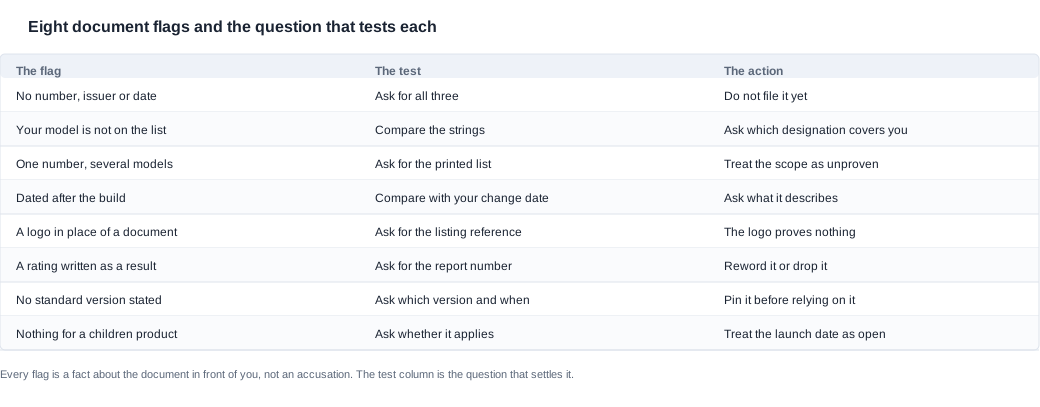
Smart glasses certification checklist: four flags aimed at the document itself
Flag one: a PDF with no number, no issuer and no date. A certificate missing those three cannot be verified by anyone, including the person who issued it. The test is to ask for all three in one sentence and to read the speed of the answer. A supplier with a document produces the number, the issuer and the date. A supplier without one produces a paragraph about its quality management system, which is a different subject and usually a sign that the document was never in the file.
Flag two: a model list that omits your SKU. "We are certified for the range" is a sentence, not a document. The test is to compare the strings character by character against the designation on your purchase order, because the difference is very often a suffix or a spelling rather than a version. Our own catalogue prints one model as the L2 Utral, which appears to be a rendering of Ultra, and that is exactly the kind of difference that is invisible to a supplier and fatal at a border.
The two minutes that catch the string mismatch
The string comparison is worth a procedure rather than a glance, because the eye normalises differences that the file will not. Take the designation from your purchase order and write it on one line. Take the designation from the document and write it on the line below. Then compare them in this order: the prefix, the numeric or alphabetic core, and the suffix. In practice almost every mismatch is in the suffix, because a suffix is the part people add casually — a Pro, a Max, a Pro Max, a year — and because the core is what both parties are actually looking at.
Do the same comparison in the other direction, from the document's list to your order rather than from your order to the document's list. The asymmetry matters: a document that lists three models and you are buying one of them is a scope question, and a document that lists one model and you are buying three is a scope question too, and they need different answers. The first needs the other two models confirmed as in scope; the second needs two more assessments or an explicit extension.
The last part of the procedure is to check the designations in the documentation against the designations in the artwork, because that is where a mismatch survives longest. Artwork is usually finalised from the product page rather than from the purchase order, and a product page carries a marketing name. A supplier who has confirmed a designation against the purchase order has not necessarily confirmed it against the box, and the box is the last artefact to be sealed. Flag three: the same number appearing against several model names. Either the document genuinely covers them and is being described carelessly, or it covers one and is being stretched. The test is to ask for the model list as printed on the document, and then to check whether the printed list is what the scope actually says. A document that names a family in its title and a single model in its scope is a single-model document with a family title, and a lot of this category's paperwork is exactly that.
Flag four: documentation dated after the product revision. A certificate issued after a firmware or hardware change may describe a product that no longer exists. The test is to compare the document date against your own change date before relying on it, and the two dates live in different places: the document has a date, the revision has a number, and the link between them is the change register that most suppliers keep and few buyers ask to see.

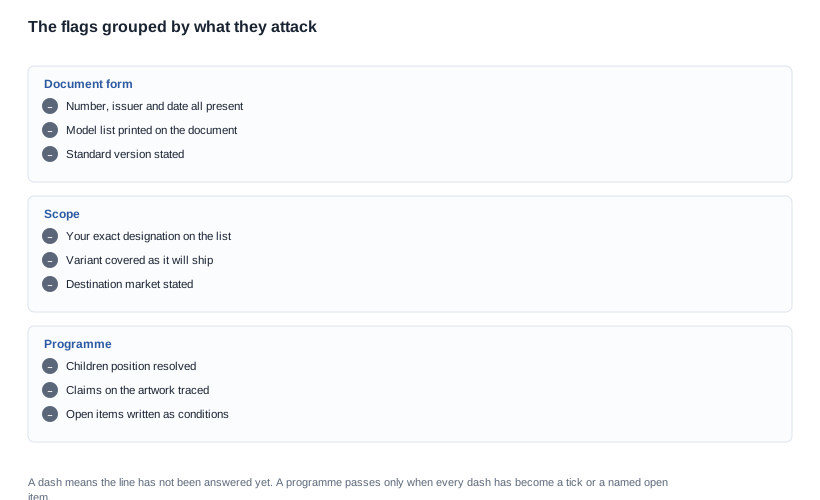
Two flags that concern the scope of the claim
Flag five: a logo in place of a document. "Bluetooth certified" with a logo and no listing reference proves nothing, because qualification is verified in a public registry rather than on a datasheet. The test is to ask for the listing identifier and to search for it. This range spans Bluetooth V5.3 on the two-cell 90 mAh audio models and V5.4 across most of the rest of the audio and sports line, and the qualification listing is a separate instrument per model — so a logo in a brochure says nothing about whether the listing for your model exists.
The distinction between a listing and an authorisation is worth holding separately, because suppliers use the two words interchangeably. The radio authorisation is the market's own record, and the qualification listing is the industry's. A product can hold one and not the other, a product can hold the listing and have had the authorisation issued for a different product code, and a product can have held both at a point in time and let the authorisation lapse while the listing stayed current. None of those four states is visible on a logo.
There is a sharper version of this flag in this particular catalogue, and it is worth stating because it catches buyers who are reading our own published rows as evidence. Our catalogue publishes a Bluetooth version for fourteen of the twenty-eight designations and publishes none for the eleven camera models, for the two children's models where no version is shown, and for the bone-conduction platform. A buyer who reads "no version published" as "no radio evidence exists" is drawing a conclusion the catalogue does not support in either direction. The correct reading is narrower: the radio evidence for those models has to be requested rather than inferred.
Flag six: an ingress rating stated as a result rather than as a marking. "Our product passed IP54 testing" is a claim about a test report that has not been shown. An ingress marking printed on a device means the marking; it does not mean you have seen the report behind it. In our own catalogue the IP54 marking appears on the V06 and on the S7 and on no other model, and no report behind it has been published. The test is to ask for the report number, and to treat the answer — either way — as the answer that decides whether the marking goes on your artwork.
The wording tells you what kind of document you are holding
There is a quick read on any document set that saves a week: read the verbs. "Passes", "approved", "tested" and "certified" describe a result. "Marked", "designed", "rated" and "declared" describe a manufacturer's statement or a framework. "Approved by" describes a process. A document set that uses result verbs without a report reference behind them is making a claim, and the claim has to be evidenced before it is printed on anything you sell.
The distinction matters commercially because the two are priced differently. Substantiating a result costs a laboratory and a lead time. Removing a claim costs an edit to a product page. A buyer who identifies which of the two they are about to request is able to ask for the right thing, and that is the difference between a two-week delay and a two-month one.
One flag that concerns the version of a standard
Flag seven: nobody can name the standard version that was tested. Standards are revised, and a document that cites a standard without a version describes a document that may not exist any more. The test is to ask which version was used and when, and to expect both parts of the answer. A supplier who has done this properly answers both without hesitating, because the version is on the report. A supplier who cannot answer is telling you the file was assembled without reading the documents inside it, and that inference is worth drawing because it changes how much you trust the rest of the set.
This flag has become more common rather than less, because the framework itself has grown. A Bluetooth product now has to deal with a radio file and, since the EN 18031 series of harmonised standards became a mandatory part of the CE mark on 1 August 2025, a cybersecurity file as well, with three specifications in that series published on 30 January 2025. A supplier who quotes a single standard number and cannot name its version has probably not read the second file either.

One flag that blocks a whole product category
Flag eight: no certification information at all for a child product. Children's products carry requirements that general consumer electronics do not, and they differ by market, with the European and the United States frameworks adding requirements rather than substituting them. The test is not a document request; it is an applicability decision, and it has to be made before a listing exists.
Our own catalogue records that no certification information has been provided for the child range — the A05, the A06 and the A07 — and we publish it that way rather than filling the gap. That makes it a blocker and not a detail. A child product launch with an unresolved certification position is a launch with a date that will move, and the date moving is the expensive part, because it moves the packaging, the artwork, the marketplace listing and the campaign together.
The three questions that decide the children's applicability
The applicability decision is harder than it looks, because the trigger is not the electronics but the positioning and the marketing. Three questions in order resolve it, and they are worth asking before the first sample is ordered rather than after the artwork is signed.
- How is the product positioned, and where is that positioning published? A model described in a catalogue as a children's protection or children's audio product attracts the children's requirements regardless of what the hardware shares with an adult model. The positioning is the trigger, and the positioning is usually in the marketing copy rather than in the engineering documentation.
- What is the intended age range, and who set it? The age grading drives which parts of the requirements apply, and an age range that nobody set explicitly is an age range that was set implicitly by the marketing.
- Which additional test reports does that answer require, and who orders them? This is the part that affects the launch date, because the additional reports are additional laboratory work with their own scheduling, and they are usually not in the supplier's existing file for an adult model.
The reason this flag deserves its own section rather than a line in a list is that it is the only one of the eight where the answer cannot be closed by asking the supplier for a document. The other seven are all document questions. This one is a decision, and the decision belongs to the buyer, which is precisely why it has to be scheduled rather than discovered.
How to escalate a flag without ending the relationship
A flag is a line to close, not a verdict on the supplier. The escalation that works is short, and it keeps the relationship intact because it is aimed at the document rather than at the supplier.
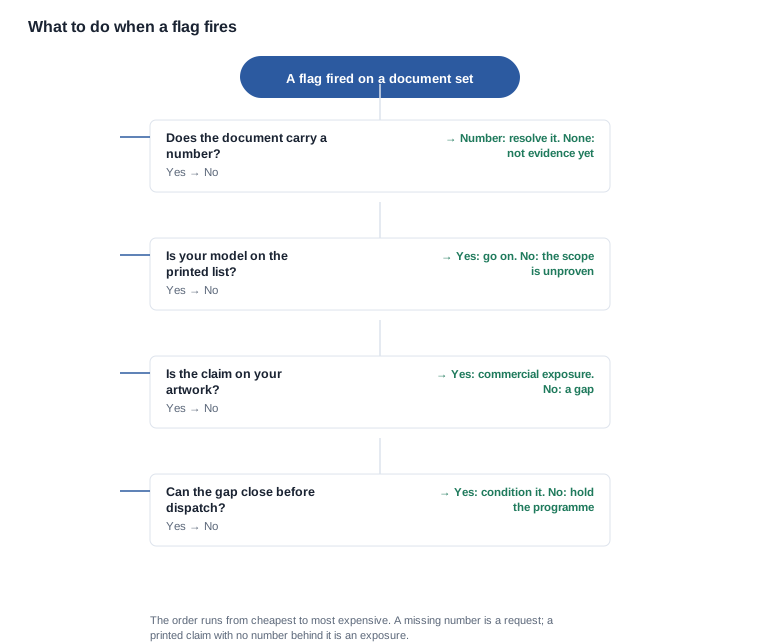
The mechanics are: write the flag down with the document reference next to it, ask the one question that tests it, and classify the answer into three buckets — covered, missing, or not applicable. Not applicable is a legitimate and valuable answer, because it tells you the document was never supposed to cover that ground. Covered closes the line. Missing is a request with a named owner.
The reason this framing matters commercially is that most suppliers in this category are not withholding anything. They are holding a file that was assembled for a different scope, and they have never been asked to check it against a scope. A buyer who sends a specific, answerable question about one line gets an answer within a day; a buyer who sends a general request for "your certification documentation" gets a folder and a delay. The escalation is not about pressure. It is about making the question small enough to answer.
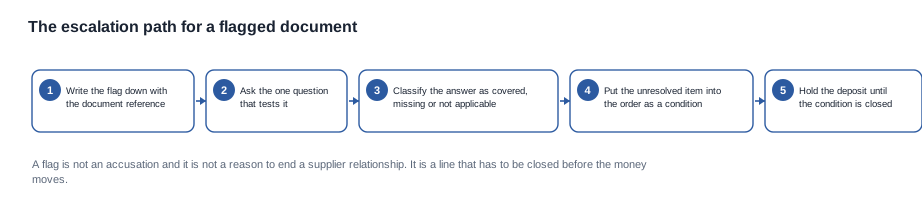
Once the flags are classified, the unresolved ones go into the purchase order as conditions rather than into an email as complaints. That is the difference between a flag and a dispute: a condition has a trigger, an owner and a consequence, and it is signed. The contract terms page covers how those clauses are usually drafted, and the AI camera glasses range is where the model coverage behind them comes from.
Keeping the flags in a register rather than in an inbox
The escalation is only worth building if the results survive the person who ran it, and the cheapest way to achieve that is a register with one line per flagged item. The line has five fields, and it is deliberately small: the model designation, the document reference, the flag that fired, the question that was asked, and the answer with its date. Five fields is enough to re-run the check at the next order without re-reading the correspondence.
The register earns its keep at the reorder rather than at the first order. A supplier who answered a scope question precisely in year one can be asked the identical question in year two, and the answer can be compared line against line. What changed on the supplier's side, what changed on your side, and what the evidence looks like now are three separate columns in the same register, and the diff between them is the single most informative document in a recurring compliance programme.
The five fields are:
- The model designation, exactly as it appears on the purchase order
- The document reference, so that the flag points at something rather than at a supplier
- The flag that fired, named the same way every time so that the counts are meaningful
- The question that was asked, kept verbatim because the wording of the question shapes the answer
- The answer, with the date it was given, because a document position moves
The second reason to keep it is that it changes the negotiation. A buyer with a register can ask a supplier to close a specific line rather than re-opening the whole subject, and a supplier who has seen the same line three times will close it faster than one who is asked to restate a position. The register also makes the programme transferable, because the person who inherits the file in month four can see which lines are closed, which are open and who owns each one — which is more than the folder of PDFs ever managed to communicate.
There is one test worth keeping for the whole set of flags, and it settles more conversations than any document review. Ask which parameter is not published for the product and watch what happens. A supplier who says "that one is not published, and here is what we can measure" is telling you something real. A supplier who produces a confident figure immediately has either tested it or borrowed it, and the follow-up — which, and from where — resolves it.
Where our own document set fails these tests today
The boundary we hold: we will state what our compliance position is and we will not describe it as verified where it is not. Concretely: the export-certification page in our catalogue carries ten patent certificates — eight appearance-design patents and two utility-model patents — and names no CE, FCC or RoHS marking, and we publish no certificate numbers, no issuing bodies and no validity dates. That means the flag list above, applied to us today, returns several flags — flag one in particular, because a company-level claim with no identifier behind it cannot be independently verified by anyone.
The honest response is that the verification work sits on the buyer's side until we supply documents for a specific configuration and destination, and that where we cannot supply them we will say so rather than describe the position as complete. We also publish no ingress test report number behind the IP54 marking on the V06 and the S7, we publish no Bluetooth version for the eleven camera models, and we publish no charging interface for the L1 Pro and the CY05, and the MT6 and the CY03.
It is worth being clear that this is a statement about our published documentation rather than an admission that the evidence does not exist. A document can exist in a factory file and not be released on a public catalogue, and for a specific configuration and destination we can often supply exactly the thing the flag asks for. The point of listing our own flags is that a buyer who applies the list to us gets the same information as a buyer who applies it to anyone else: what can be evidenced, what cannot, and which questions are still open. A supplier who publishes its own gaps is giving the buyer the information it would otherwise have to spend a month extracting.
The full check is at certification verification, and the product coverage is on the AI camera glasses page. Send us your destination markets and your model shortlist, and we will tell you which routes apply, which documents we can produce today, and which of the eight flags our own set currently raises.


